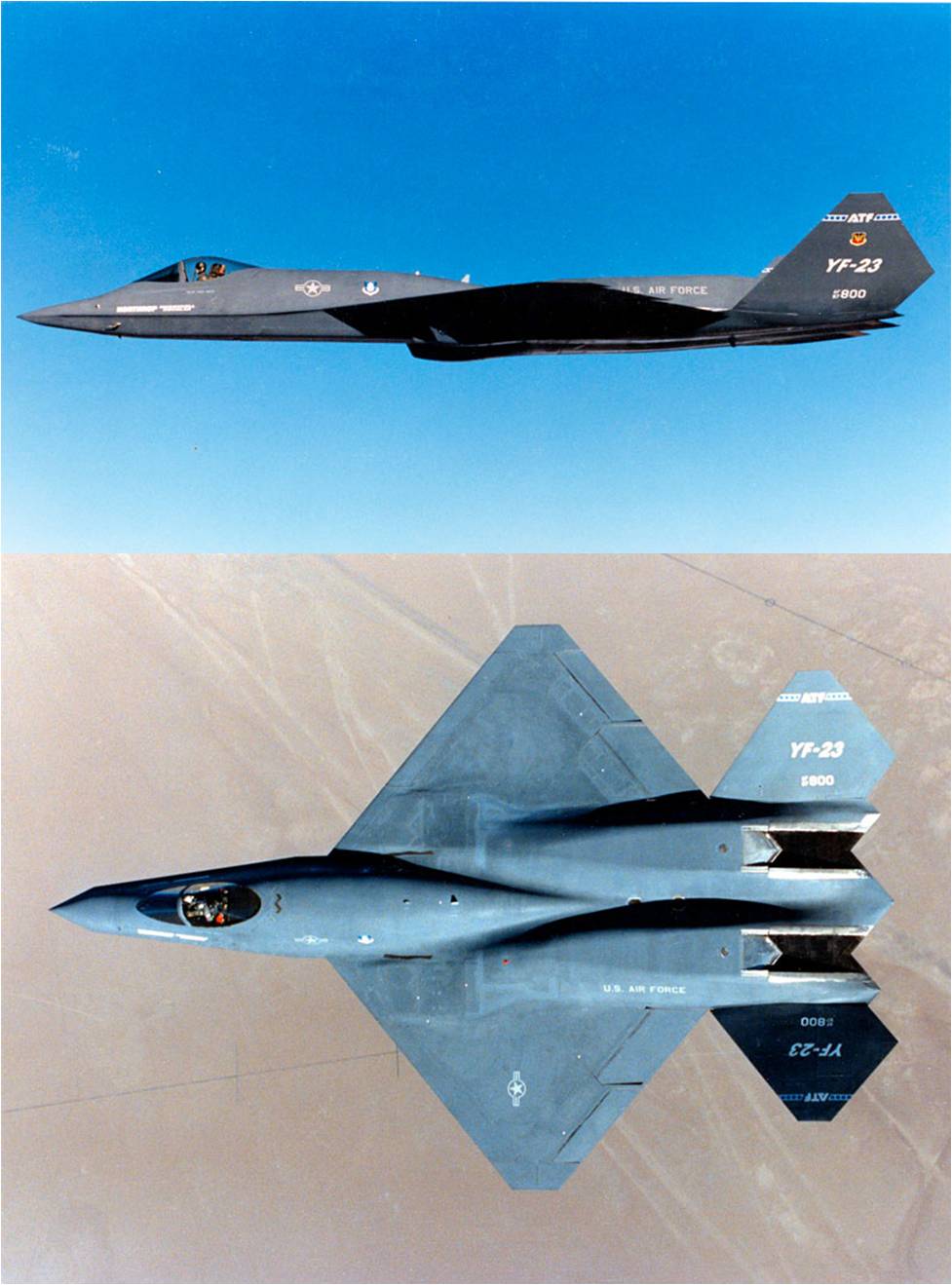
Twenty-three years ago this week, the Northrop YF-23 Advanced Tactical Fighter took to the air for the first time. Veteran test pilot Paul Metz was at the controls of the revolutionary single seat, twin engine air superiority fighter aircraft.
The Advanced Tactical Fighter (ATF) was intended as a next-generation replacement for the USAF F-15 Eagle. The mission was air superiority; complete control and dominance of an adversary’s airspace under wartime conditions. Key capabilties in this role would be survivability, supercruise, stealth, and ease of maintenance.
The ATF program began in mid-1981 when USAF released a Request For Information (RFI) to the American aerospace industry. Study contracts were subsequently awarded to Boeing, General Dynamics, Grumman, Lockheed, McDonnell Douglas, Northrop, and Rockwell in September 1983. This was followed twenty-four months later with a formal Request For Proposal (RFP).
With the exception of Grumman and Rockwell, USAF received RFP responses from the awardees of the ATF study contracts in July of 1986. Just three months later, Lockheed and Northrop got the nod to go head-to-head in a competition to build and demonstrate an ATF prototype aircraft. Lockheed’s version of the ATF became known as the YF-22 while Northrop’s received the designation YF-23.
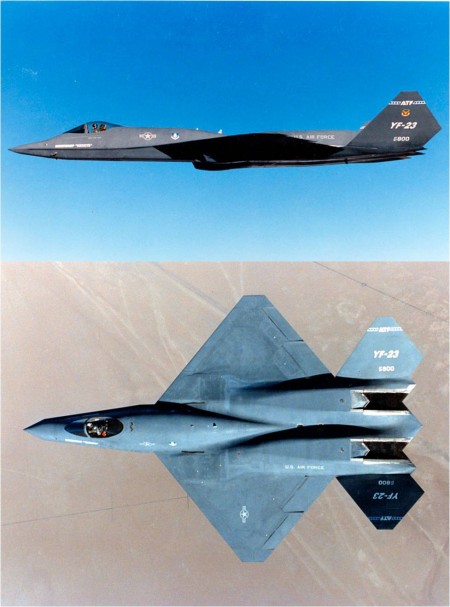
Northrop’s ATF prototype was a impressive looking aircraft where form followed function. From its diamond planform wings and area-ruled external shape to its upper surface engine exhaust troughs and all-moving V-tail assembly, the YF-23’s gifted designers created a next-generation air superiority fighter with outstanding performance and stunning visual appeal.
The YF-23 ATF measured 67.5 feet in length and had a wing span of 43.5 feet. The type’s loaded and empty weights were 51,320 lbs and 29,000 lbs, respectively. Power was provided by twin turbofan engines rated at 35,000 lbs of sea level thrust each. Performance was quite impressive with a maximum speed of 1,650 mph (Mach 2.2) and service ceiling of 65,000 feet.
Northrop built and flight-tested a pair of ATF prototype aircraft. YF-23 Prototype Air Vehicle 1 (PAV-1) carried tail number 87-0800 and was powered by Pratt and Whitney YF-119 turbofans. Called “Black Widow II, it was painted a charcoal gray. YF-23 Prototype Air Vehicle 2 (PAV-2) received tail number 87-0801 and was powered by General Electric YF-120 turbofans. PAV-2’s nickname of “Gray Ghost” derived from it having been painted in several shades of gray.
The maiden YF-23 flight took place on Monday, 27 August 1990 at Edwards Air Force Base, California. Chief Test Pilot Paul Metz put YF-23 PAV-1 through its paces during the 50-minute flight. YF-23 PAV-2 went to make its first flight on Friday, 26 October 1990 with Jim Sandberg at the controls. The pair of YF-23 aircraft went on to make 50 test sorties for a total of 65.2 hours through December 1990.
While the YF-23 was faster and had more favorable stealth characteristics, the Lockheed YF-22 was the more agile aircraft. This and other factors led to the Air Force selecting the YF-22 in April of 1991 as the winner of the ATF competition. This decision stunned many in the aerospace industry, most especially Northrop. To this day, many die-hard YF-23 adherents remain adamant that the Air Force selected the second-best ATF candidate.
YF-23 PAV-1 is currently on display in the Research and Development wing of the National Museum of the United States Air Force in Dayton, Ohio. YF-23 PAV-2 can be seen at the Western Museum of Flight at Torrance Airport in California.
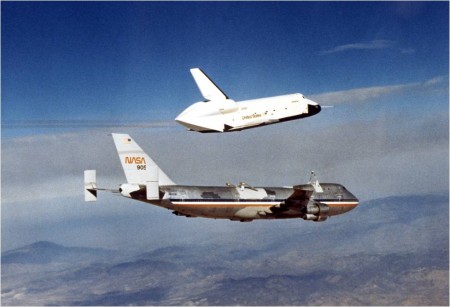
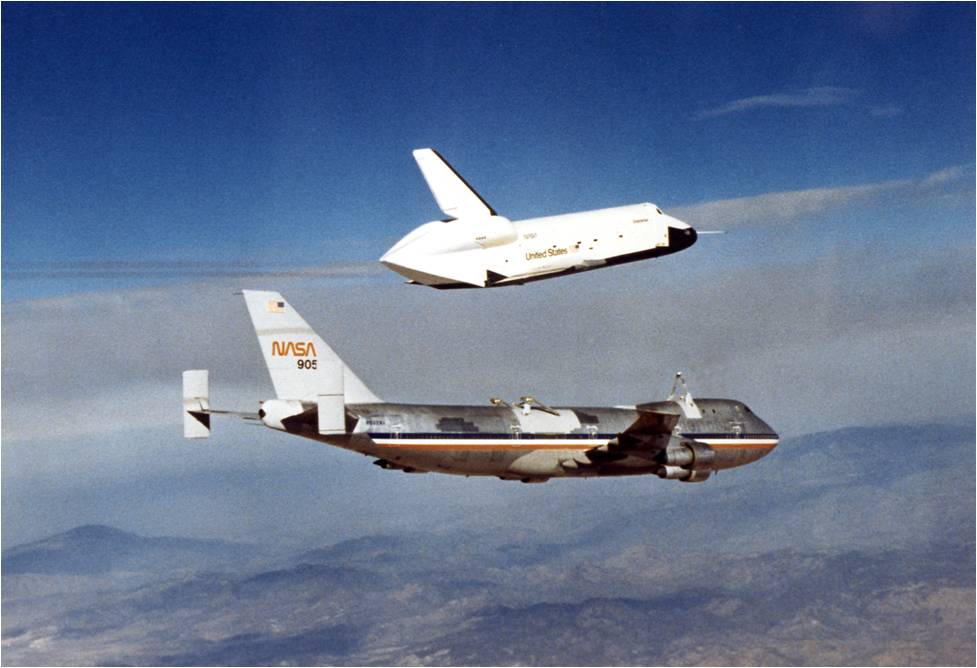
Thirty-six years ago this month, the Space Shuttle Orbiter Enterprise successfully completed the first free flight of the Approach and Landing Tests (ALT) Program. NASA Astronauts Fred W. Haise, Jr. and Charles G. “Gordon” Fullerton were at the controls of the pathfinder orbiter vehicle (OV-101).
Developers of the Space Shuttle Orbiter faced the challenge of designing a vehicle capable of flight from 17,500 mph (Mach 28) at entry interface (400,000 ft) to 220 mph (Mach 0.3) at landing. Complicating this task was the fact that the Orbiter flew an unpowered, lifting entry that covered a distance of more than 4,400 nm. Once at the landing site, Shuttle pilots had a single opportunity to land the winged ship.
An Orbiter’s approach to the landing field is quite steep compared to that of a commercial airliner. Whereas the glide slope of the latter is around 2-3 degrees, the Orbiter’s flight path during approach is about 22 degrees below the horizon. Falling like a rock is an apt description of its flight state.
The Space Shuttle Approach and Landing Tests (ALT) involved a series of flight tests intended to verify the subsonic airworthiness and handling qualities of the Orbiter. Conducted at Edwards Air Force Base between February and October 1977, the ALT employed a modified Boeing 747 known as the Shuttle Carrier Aircraft (SCA). The Orbiter Enterprise was attached atop the SCA to hitch a ride to altitude.
The Shuttle ALT consisted of a total of thirteen (13) flight tests; five (5) Captive-Inactive (CI) tests, five (5) Captive-Active (CA) tests and three (3) Free Flight (FF) tests. CI testing was aimed at verifying the handling qualities of the SCA-Orbiter combination in flight. There was no crew was onboard the Orbiter for these tests. CA testing focused on preparing for the upcoming free flight series. A crew flew onboard the Orbiter which remained mated to the SCA.
The ALT Free Flights were where the rubber met the road so to speak. The Enterprise and her crew separated from the SCA at altitudes ranging from 19,000 and 26,000 ft to test the Orbiter in free flight. Landings were made initially on Rogers Dry Lake (Runway 17) and ultimately on Edwards’ 15,000-ft concrete runway (22).
The Enterprise was flown in two (2) different configurations. The first involved the use of a tailcone fairing which streamlined the base region of the Orbiter. This increased the Orbiter’s lift-to-drag ratio which decreased the vehicle’s rate of descent. It also reduced the level of buffeting experienced by the SCA’s empennage while the Orbiter rode atop the carrier aircraft.
The second Enterprise configuration flown involved removal of the tailcone. This really reduced the Orbiter’s lift-to-drag ratio and correspondingly increased the rate of sink. Indeed, the Orbiter’s descent rate without the tailcone was roughly twice as high as that with the tailcone. Removal of the tailcone also markedly increased the buffet loads sustained by the SCA’s empennage.
ALT Free Flight No. 1 took place on Friday, 12 August 1977. With Fitzhugh L. Fulton, Jr. and Thomas C. McMurtry flying the SCA (N905NA), the Enterprise and her crew of Haise and Fullerton was carried to an altitude of 24,100 ft. At a speed of 310 mph in a slight dive, the big glider cleanly separated from the SCA. Just 321 seconds later, the Orbiter touched-down on Rogers Dry Lake at 213 mph.
ALT Free Flights No. 2-5 were successfully conducted over the next several months. Astronauts Joseph H. Engle and Richard H. Truly flew Enterprise on the second and fourth free flights while Haise and Fullerton manned the Orbiter’s cockpit on the third and fifth missions.
Enterprise flew without the tailcone during the last two ALT flights. As expected, the trip downstairs was rapid. Time of descent from 22,400 ft for Free Flight No. 4 was 154 seconds with a landing speed of 230 mph. Free Flight No. 5 took only 121 seconds to descend 19,000 ft and landed at 219 mph.
ALT Free Flight No. 5 was notable in that (1) the Enterprise made its first landing on concrete and (2) a Pilot-Induced Oscillation (PIO) occurred at initial touchdown. For a few tense moments Command Pilot Haise struggled to keep his skittish steed on the ground. Following several disturbing skips and bounces, the Enterprise finally settled down and rolled to a stop.
The Space Shuttle Approach and Landing Tests (ALT) were a necessary prelude to space for the Orbiter. Indeed, the ALT flights represent the first time that NASA’s new winged reentry vehicle took to the air. Having successfully demonstrated the ability to safely land an Orbiter, the next flight in the Space Shuttle Program would be STS-1 in April 1981. Interestingly, that 2-day mission would come to a successful conclusion when the Columbia landed on Rogers Dry Lake back at Edwards Air Force Base, California.
Aerosciences instructor and CEO J. Terry White just taught two back-to-back classes to the brilliant men and women of the Air Force Test Center (AFTC) at Edwards Air Force Base, CA. This marks the tenth course Mr. White has had the pleasure of teaching at Edwards AFB, where he once worked as an Aerodynamics Engineer at NASA Dryden Flight Research Center. Regarding the opportunity to teach at Edwards AFB, he said, “I love being there because of the history, the people and the connection that it has with all things aerospace over the last 70 years. To me, Edwards is synonymous with flight test.”
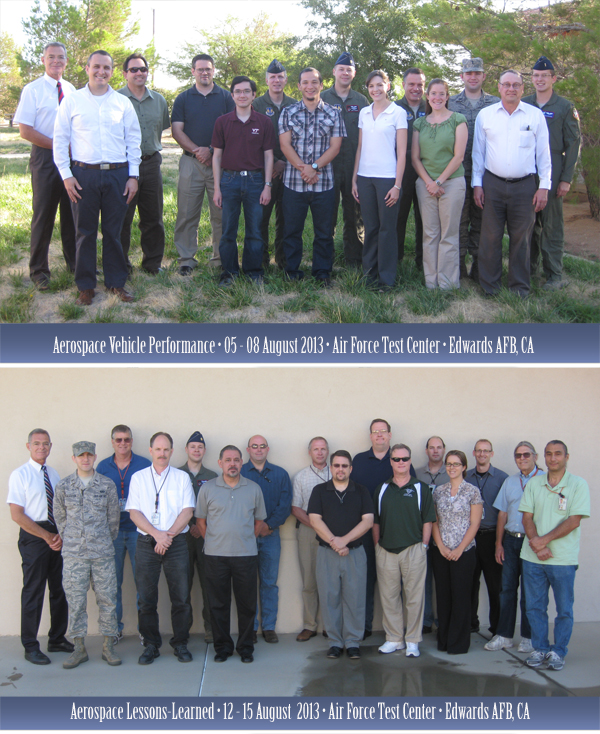
From 05-08 August, Mr. White held his Aerospace Vehicle Performance (AVP) course, which provides a thorough training experience in the rudiments of propeller-driven and jet-propelled aircraft flight performance. Many of the students commented on the benefit of Mr. White’s instruction on specific excess power. One student said, “I needed a refresher on specific excess power and estimating tools – I haven’t used these concepts in years.” Another student commented, “Specific excess power seems to be glossed over in most texts, but it is used regularly in my job – nice to have it explained again.”
From 12-15 August, Aerospace Lessons-Learned (ALL) was taught to the AFTC community. The course is designed to help aerospace professionals avoid making the same mistakes as those who have gone before. One student emphasized this point, saying “I plan on sending my less-experienced and new lead engineers to this course. We have significant experience loss occurring and this course may help communicate knowledge to them that we cannot give due to lack of experience.” This, of course, is one of Mr. White’s great passions – to help preserve the legacy of lessons-learned in years gone past and pass the baton on to the new generation of aerospace professionals.
The WEA team extends sincere gratitude to the wonderfully helpful Ms. Kathy Finley and the exceptionally resourceful Ms. Cathy Clum, as well as each student in attendance. We hope to see you all again soon!
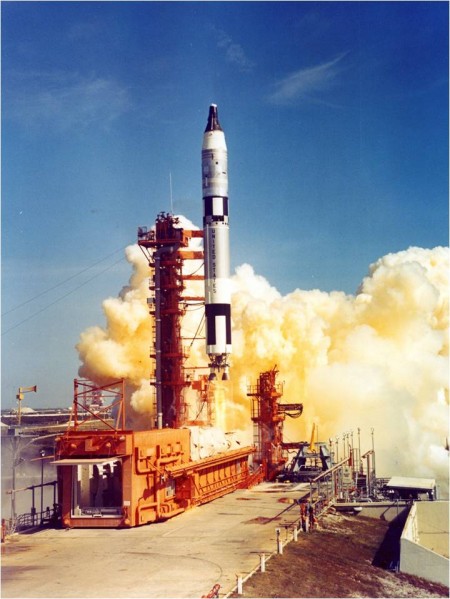
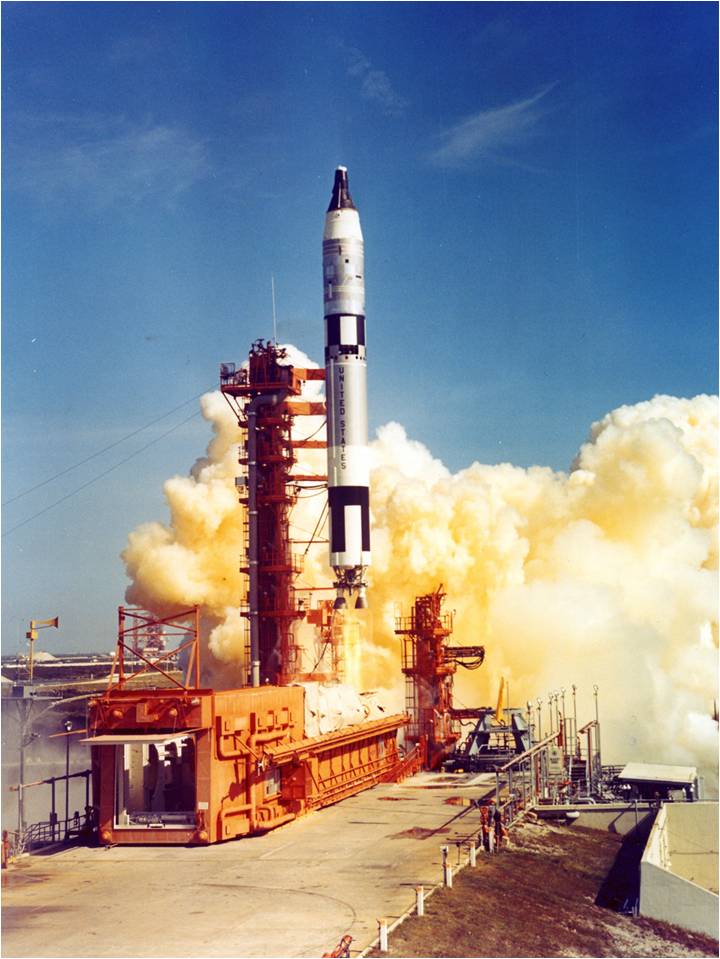
Forty-eight years ago this month, NASA astronauts Leroy Gordon Cooper and Charles M. “Pete” Conrad set a new spaceflight endurance record during the flight of Gemini 5. It was the third of ten (10) missions in the historic Gemini spaceflight series. The motto for the mission was “Eight Days or Bust”.
The purpose of Project Gemini was to develop and flight-prove a myriad of technologies required to get to the Moon. Those technologies included spacecraft power systems, rendezvous and docking, orbital maneuvering, long duration spaceflight and extravehicular activity.
The Gemini spacecraft weighed 8,500 pounds at lift-off and measured 18.6 feet in length. Gemini consisted of a reentry module (RM), an adapter module (AM) and an equipment module (EM).
The crew occupied the RM which also contained navigation, communication, telemetry, electrical and reentry reaction control systems. The AM contained maneuver thrusters and the deboost rocket system. The EM included the spacecraft orbit attitude control thrusters and the fuel cell system. Both the AM and EM were used in orbit only and discarded prior to entry.
Gemini-Titan V (GT-5) lifted-off at 13:59:59 UTC from LC-19 at Cape Canaveral, Florida on Saturday, 21 August 1965. The two-stage Titan II launch vehicle placed Gemini 5 into a 189 nautical mile x 87 nautical mile elliptical orbit.
A primary purpose of the Gemini 5 mission was to remain in orbit at least eight (8) days. This was the minimum time it would take to fly to the Moon, land and return to the Earth. Other goals of the Gemini 5 mission were to test the first fuel cells, deploy and rendezvous with a special rendezvous pod and conduct a variety of medical experiments.
Despite fuel cell problems, electrical system anomalies, reaction control system issues and the cancellation of various experiments, Gemini 5 was able to meet the goal of an 8-day flight. But it wasn’t easy. The last days of the mission were especially demanding since the crew didn’t have much to do. Pete Conrad called his Gemini 5 experience “8 days in a garbage can.”
On Sunday, 29 August 1965, Gemini 5 splashed-down in the Atlantic Ocean at 12:55:13 UTC. Mission elapsed time was 7 days, 22 hours, 55 minutes and 13 seconds. A new spaceflight endurance record.
Gemini 5 was Gordon Cooper’s last spaceflight. Cooper left NASA due to a deteriorating relationship with management. Pete Conrad flew three (3) more times in space. In particular, he commanded the Gemini 11, Apollo 12 and Skylab I missions. Indeed, Conrad’s Apollo 12 experience made him the third man to walk on the Moon.
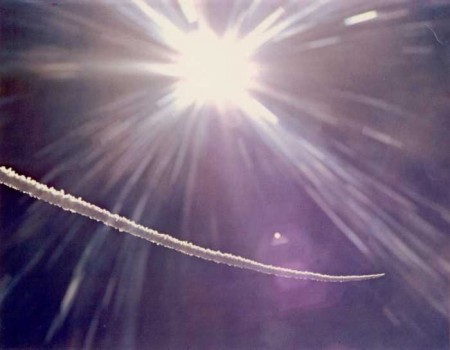
Fifty years ago this month, NASA chief research pilot Joseph A. Walker flew X-15 Ship No. 3 (S/N 56-6672) to an altitude of 354,200 feet. This flight would mark the highest altitude ever achieved by the famed hypersonic research vehicle. The date was Thursday, 22 August 1963.
Carried aloft by NASA’s NB-52A (S/N 52-0003) mothership, Walker’s X-15 was launched over Smith Ranch Dry Lake, Nevada at 17:05:42 UTC. Following drop at around 45,000 feet and Mach 0.82, Walker ignited the X-15′s small, but mighty XLR-99 rocket engine and pulled into a steep vertical climb.
The XLR-99 was run at 100 percent power for 85.8 seconds with burnout occurring around 176,000 feet on the way uphill. Maximum velocity achieved was 3,794 miles per hour which tranlates to Mach 5.58 at the burnout altitude. Following burnout, Walker’s X-15 gained an additional 178,200 feet in altitude as it coasted to apogee.
Joe Walker went over the top at 354,200 feet (67 miles). Although he didn’t have much time for sight-seeing, the Earth’s curvature was strikingly obvious to the pilot as he started downhill from his lofty perch. Walker subsequently endured a hefty 5-g’s of eyeballs-in normal acceleration during the backside dive pull-out. The aircraft was brought to a wings-level attitude at 70,000 feet. Shortly after, Walker greased the landing on Rogers Dry Lake at Edwards Air Force Base, California.
The X-15 maximum altitude flight lasted 11 minutes and 8 seconds from drop to nose wheel stop. In that time, Walker and X-15 Ship 3 covered 305 miles in ground range. The mission was Ship No. 3′s 22nd flight and the 91st of the X-15 Program.
For Joseph Albert Walker, the 22nd of August 1963 marked his 25th and last flight in an X-15 cockpit. The mission qualified him for Astronaut Wings since he had exceeded the 328,000 foot (100 km) FAI/NASA standard set for such a distinction. Strangely, the historic record indicates that Joe Walker never officially received Astronaut Wings for this flight in which the X-15 design altitude was exceeded by more than 100,000 feet.
J. Terry White just returned to Arnold Air Force Base, TN to teach the fine professionals at Arnold Engineering Development Complex (AEDC). The flight simulation test facilities at AEDC operate 58 aerodynamic and propulsion wind tunnels, rocket and turbine engine test cells, space environmental chambers, arc heaters, ballistic ranges and other specialized units.

From 22-25 July, Mr. White taught his Advanced Missile Aerodynamics (AMA) course. The course is designed for aerospace professionals seeking an advanced knowledge and understanding of classic missile aero force and moment prediction methodologies, with an emphasis placed on techniques pertinent to the preliminary design environment. As one student noted, “This course is very useful to those here at AEDC who work in wind tunnels, as well as others interested in aerodynamics.” Another student said “The course was excellent. I would recommend it to any engineer practicing in missile aerodynamics or testing fields.”
From 29 July – 01 August, Mr. White taught his increasingly popular Aerospace Lessons-Learned (ALL) short course . One student said the course “provided an excellent presentation of past accidents and failures. It made me more aware of influences that must be addressed correctly to prevent failure and loss of life.” Another student emphasized this point, saying “Those who don’t learn from the past are doomed to repeat it.” This, of course, is the driving message behind the ALL short course. From design to implementation, the course has been a labor of love for Mr. White, who is a time-wizened veteran of the aerospace industry.
The WEA team would like to thank Ms. Dee Wolfe and Dr. Don Malloy for their enthusiastic assistance and support, as well as each of the wonderful students in attendance. It is a distinct pleasure working with the fine professionals at AEDC!
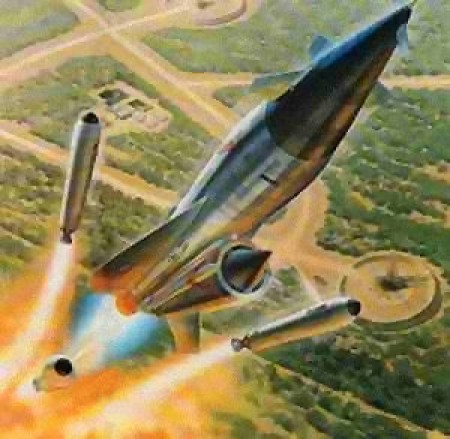
Forty-nine years ago this month, the United States abandoned a 7-year effort to develop a nuclear-armed, supersonic cruise missile. The joint USAF-AEC program was known as Project Pluto. The centerpiece of this program was the nuclear-fueled, ramjet-powered Supersonic Low-Altitude Missile (SLAM).
The 1950′s saw the development of myriad aircraft, missile and submarine concepts designed for delivery of nuclear weaponry over strategic distances. This developmental activity was driven by the escalating Cold War between the United States and the Soviet Union. In addition to weapons, the power of the atom was also considered for propulsion applications during this era.
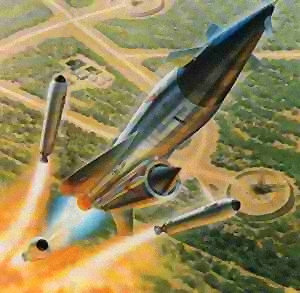
SLAM was perhaps the most fearsome weapon ever conceived. The missile was designed to deliver as many as 26 nuclear bombs over the Soviet Union in a single mission. It would do this while flying at Mach 3 and less than 1,000 feet above ground level. SLAM’s shock wave overpressure alone (162 dB) would devastate structures and people along its flight path. And, as if that were not enough, the type’s nuclear-fueled ramjet would continuously spew radiation-contaminated exhaust all over the countryside.
The SLAM airframe was huge. It measured 88 feet in length, nearly 6 feet in diameter and weighed 61,000 pounds at launch. The vehicle would be fired from a ground-based launch site and accelerated to ramjet takeover speed by a trio of jettisionable rocket boosters. The nuclear-fueled ramjet was rated at 35,000 pounds of thrust.
To find its way to the target area(s), the Ling-Temco-Vought (LTV) SLAM would use a guidance system known today as TERCOM – Terrain Contour Matching. At a target, SLAM would eject an atomic warhead upwards from its payload bay. The resulting lofted trajectory gave SLAM time to depart the hot target area prior to weapon detonation. Following completion of its mission, the missile would then ditch itself by diving into a deep ocean graveyard.
The heart of the Project Pluto missile was the nuclear-fueled ramjet. An unshielded nuclear reactor, code named TORY, was devised, built and successfully tested. Testing was conducted at a special-purpose test site in Nevada. In its Tory II-C configuration, the SLAM ramjet produced over 500 megawatts of power in 5 minutes of continuous operation during a test conducted in May of 1964.
SLAM’s nap-of-the-earth, supersonic flight profile would subject the airframe to terrific airloads, vibrations and temperatures. The Project Pluto team successfully devised structural and thermal material solutions to handle the daunting flight environment. In addition, nuclear-hardened electronics and flight controls were successfully developed.
From a technological standpoint, Project Pluto proved to be entirely viable. However, doubts about its implementation started to arise as flight testing of the nuclear-powered missile was seriously considered. Where do you flight-test a radiation-spewing missile? What happens if you can’t turn-off the reactor? What do you do if the guidance system fails? Where do you dispose of the missile after a flight test? These and other disturbing questions began to trouble program officials.
Coupled with the above practical concerns of SLAM flight testing were growing political and mission obsolesence issues. Pentagon officials ultimately deemed Project Pluto as being highly provocative to the Soviet Union in the sense that the communist super power might feel compelled to develop their own SLAM. Further, American missilery was quickly developing to the point where ICBM-delivered warheads would do the job and at a lower per-unit cost.
So it was that on Wedneday, 01 July 1964, Project Pluto was canceled after 7 years of fruitful development. While no airframe was ever built and tested, SLAM technology was applied to a host of subsequent aerospace vehicle developments.
SLAM would truly have been “The Missile From Hades” had it matured to the point of flight. Indeed, the ethical issues concerning the missile’s use were quite sobering. And, owing to Murphy’s Law and its many corollaries, the chances for unintended catastrophe were high as well. Despite the allure of this ”technically sweet” solution to a national defense problem, the decision to cancel Project Pluto was ultimately the only correct course to follow.

Forty-four years ago this month, the United States of America landed two men on the surface of the Moon.
The Apollo 11 Lunar Module Eagle landed in Sea of Tranquility region of the Moon on Sunday, 20 July 1969 at 20:17:40 UTC. Less than seven hours later, astronauts Neil A. Armstrong and Edwin E. Aldrin, Jr. became the first human beings to walk upon Earth’s closest neighbor. Fellow crew member Michael Collins orbited high overhead in the Command Module Columbia.
As Apollo 11 commander, Neil A. Armstrong was accorded the privilege of being the first man to step foot upon the Moon. As he did so, Armstrong spoke these words: “That’s one small step for Man; one giant leap for Mankind”. He had intended to say: “That’s one small step for ’a’ man; one giant leap for Mankind”.
Armstrong and Aldrin explored their Sea of Tranquility landing site for about two and a half hours. Total lunar surface stay time was 22 hours and 37 minutes. The Apollo 11 crew left a plaque affixed to one of the legs of the Lunar Module’s descent stage which read: “Here Men From the Planet Earth First Set Foot Upon the Moon; July 1969, A.D. We Came in Peace for All Mankind”.
Following a successful lunar lift-off, Armstrong and Aldrin rejoined Collins in lunar orbit. Approximately seven hours later, the Apollo 11 crew rocketed out of lunar orbit to begin the quarter million mile journey back to Earth. Columbia splashed-down in the Pacific Ocean at 16:50:35 UTC on Thursday, 24 July 1969. Total mission time was 195 hours, 18 minutes, and 35 seconds.
With completion of the flight of Apollo 11, the United States of America fulfilled President John F. Kennedy’s 25 May 1961 call to land a man on the Moon and return him safely to the Earth before the decade of the 1960′s was out. It had taken 2,982 demanding days and much national treasure to do so.
Mission Accomplished, Mr. President.
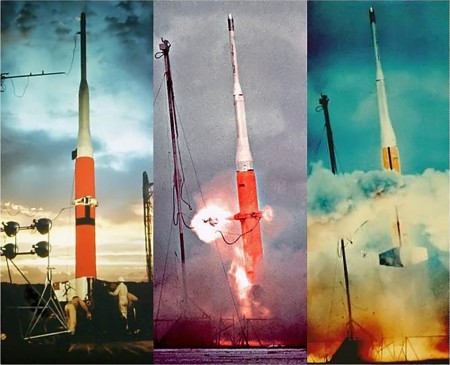
Fifty-seven years ago this week, the triple-staged USAF/Lockheed X-17 successfully flew its first aerodynamic heating research mission. The hemispheric reentry test article achieved a peak Mach number of 12.84 during the high temperature flight experiment.
In the early 1950’s, the United States began developing its first stable of Intercontinental Ballistic Missiles (ICBM’s). Among the many technical issues facing engineers at that time, perhaps the most vexing was that of reentry vehicle survivability owing to the extreme temperatures encountered in hypersonic flight. These high temperatures resulted from the flow deceleration which occurred within the reentry vehicle bow shock wave as kinetic energy was transformed to thermal energy.
The temperatures within the shock layer of a hypersonic reentry vehicle can exceed 10,000 degrees Fahrenheit. Indeed, there is enough kinetic energy in the flow that should it all be converted to thermal energy, the reentry vehicle material would be vaporized. The pressing challenge in the 1950’s was to determine how to shape the vehicle such that the kinetic-to-thermal energy conversion process transferred most of the energy to the air rather than the vehicle.
H. Julian Allen and Alfred Eggers of the National Advisory Committee for Aeronautics (NACA) discovered that a blunted forebody would significantly reduce the magnitude of aerodynamic heating relative to that of a sharp or pointed body. However, the concept needed to be tested to confirm its validity. Wind tunnels that could provide full-scale flight Mach number, Reynolds number, and temperature similitude did not exist at the time. Thus, the only recourse was flight test.
The X-17 Program was established to provide the first hypersonic, high-altitude flight data relative to entry vehicle aerodynamic heating. The United States Air Force contracted with Lockheed for development of a vehicle capable of boosting reentry vehicle test articles to hypersonic flight conditions. The idea was to acquire aerodynamic heating data for various reentry vehicle shapes. The fast-paced program was driven by the urgency of national defense interests.
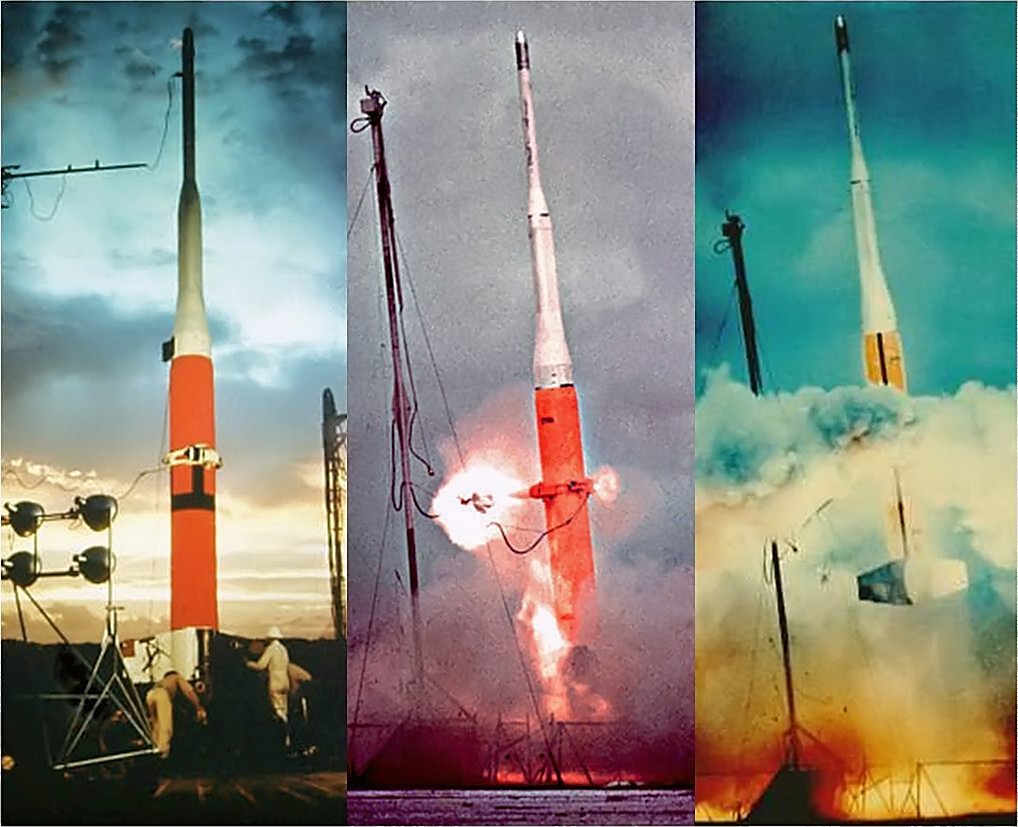
The Lockheed-developed X-17 was a three-stage vehicle. It measured 40.5 feet in length and had a maximum diameter of 31 inches. The first stage rocket motor did the heavy lifting. The Thiokol XM-20 solid rocket motor produced an average thrust of 48,000 lbs for 28 seconds. Burnout occurred at Mach 5 and 90,000 feet.
Following first stage burnout, the entire X-17 launch stack coasted to an apogee of about 500,000 feet. The vehicle went over the top at around Mach 0.8. The gravitationally-aided fall back toward the earth caused the vehicle’s velocity to build-up rapidly. Indeed, as the X-17 passed through 120,000 feet on the way downstairs, the Mach meter reading was back up to 5.
Second stage propulsion consisted of a trio of Thiokol XM-19 rocket motors which produced a combined thrust of 101,700 lbs for 1.5 seconds. These motors were ignited shortly after the empty first stage was jettisoned. The resulting high acceleration drove the vehicle to a Mach number approaching 10 as the X-17 passed through 72,000 feet. The second stage was jettisoned just after burnout.
A single XM-19 rocket motor comprised third stage propulsion. Peak acceleration was better than 90 g’s resulting in the X-17 payload reaching a burnout Mach number of about 14 at 55,000 feet. The temperature measurement period between maximum Mach number and Mach 2 was brief; on the order of 10 seconds. These temperature data were telemetered to the ground since the test article was completely destroyed at impact.
The first X-17 aerodynamic heating research mission was launched on Wednesday, 17 July 1956 from the Air Force Missile Test Center (AFMTC) near Cape, Canaveral Florida. The X-17 system worked well as the hemispheric reentry vehicle test article reached a maximum velocity of 8,184 mph or Mach 12.84. Apogee for this first X-17 research mission occurred at an altitude of 465,000 feet.
A total of twenty-five (25) aerodynamic heating research missions would ultimately be flown during the X-17 Program. The last of which occurred in March of 1957. This very successful test effort produced a wealth of first-ever heat transfer data that helped write the book on reentry vehicle design. Key findings included the effects of boundary layer transition, external shape, and high temperature material thermal response.
The X-17 Program was among the most important of the 1950’s. Indeed, both the Atlas and Titan Programs conducted initial tests of their respective reentry vehicle designs using the X-17 as a testbed. The upshot of this is that the United States was able to develop survivable reentry vehicles in a timely fashion during the height of the Cold War.
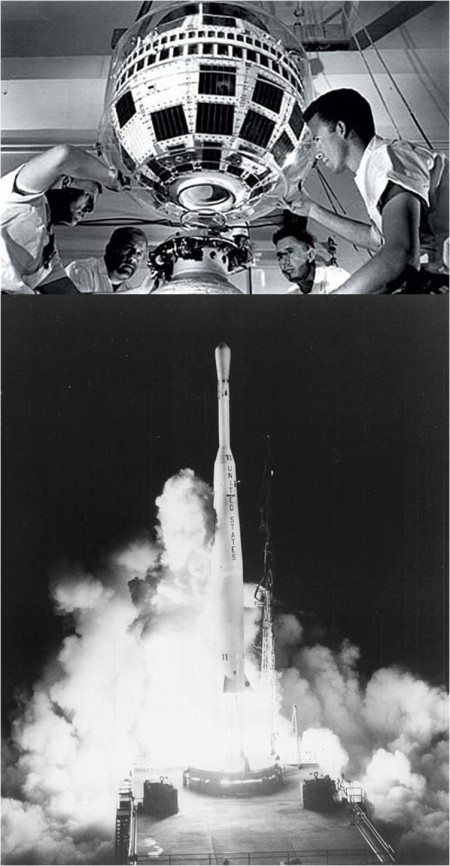
Fifty-one years ago this week, the United States successfully orbited the world’s first active-repeater communications satellite. Known as Telstar 1, the satellite successfully relayed through space the first television pictures, telephone calls, fax images and provided the first live transatlantic television transmission.
Telstar was a development of the Bell Telephone Laboratories for the American Telephone and Telegraph (AT&T) Company. The concept involved orbiting of a satellite that could receive, amplify and retransmit electromagnetic signals around the globe.
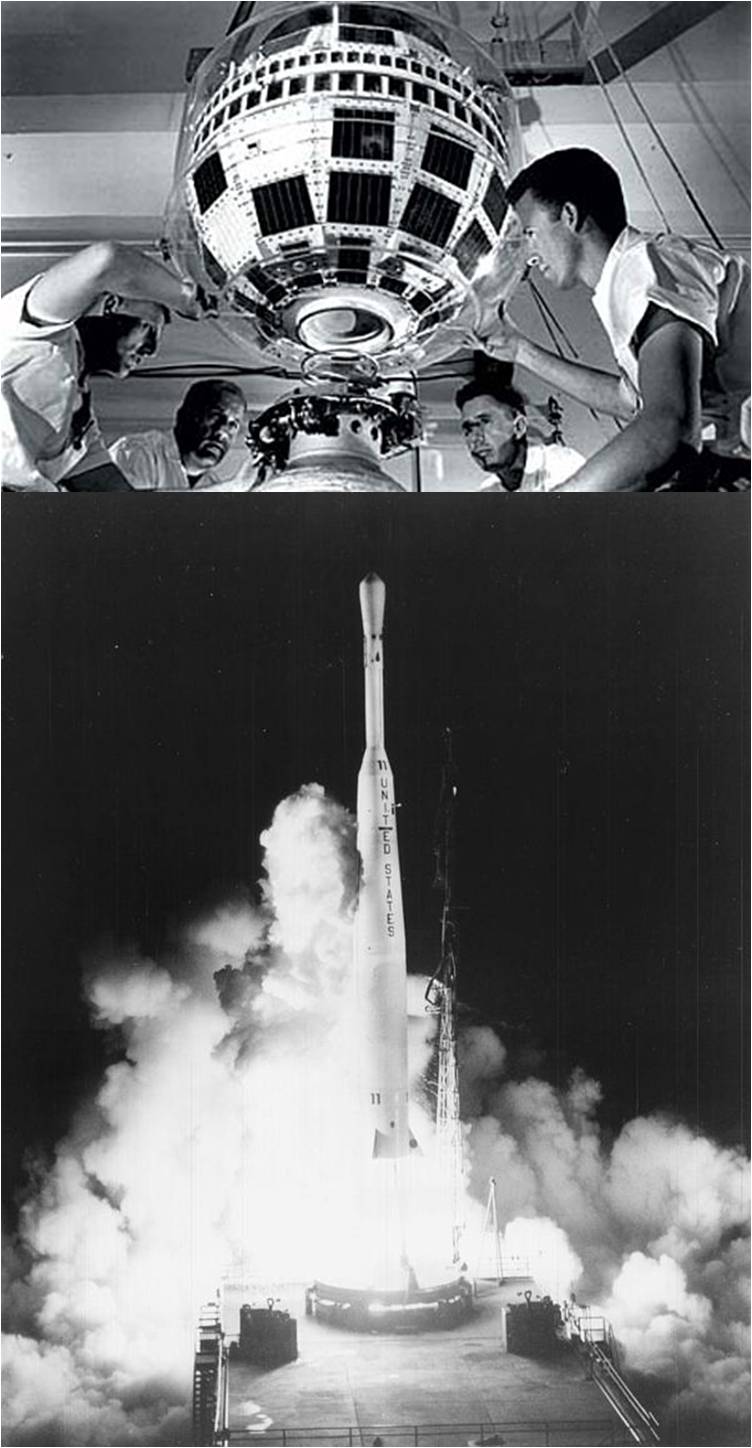
The Telstar satellite was spherical in shape, had a diameter of 34.5 inches, and weighed about 170 lbs. Its external surface was covered with solar cells for electrical power generation. Telstar 1 was equipped with a single transponder and an externally located antenna array.
On Tuesday, 10 July 1962, Telstar 1 was launched into space aboard a Thor Delta launch vehicle. Lift-off from Cape Canaveral’s LC-17B came at 08:35 UTC. The satellite was successfully placed into a highly elliptical 3,046 nm x 510 nm orbit with an inclination of 45 degrees and a period of 157.8 minutes.
Telstar 1’s non-geosynchronous orbit limited its availability for transatlantic signals to about 20 minutes during each orbital pass. The power of the satellite’s transponder was quite low. To compensate, ground station antennas had to be very large. These units measured 177 feet in length and weighed around 750,000 lbs.
Once in orbit, Telstar 1 went right to work. On Wednesday, 11 July 1962, the satellite successfully relayed its first television signals in a transmission that originated in the United States. Specifically, images of the American flag were relayed to a ground station in France. While image quality was crude by today’s standards, Old Glory still looked pretty good in this first broadcast.
Telstar 1 made its inaugural public transatlantic broadcast on Monday, 23 July 1962. This historic broadcast featured the Statue of Liberty, the Eiffel Tower, remarks by President John F. Kennedy, excerpts from a baseball game between the Philadelphia Phillies and the Chicago Cubs, images of the American flag waving in the breeze, and pictures of Yves Montand, a then-popular French singer.
Telstar 1 transmitted more than 400 telephone, telegraph, fax and television transmissions during a rather abbreviated operational career. In November 1962, Telstar 1’s onboard electronics malfunctioned due to the harsh radiation environment encountered during repeated passage through the Van Allen Radiation Belts. Residual space-borne radiation from recent U.S. and Soviet nuclear weapons testing in space also contributed to the satellite’s demise.
Telstar 1 ushered in a new era in global communications. Its revolutionary technology profoundly changed life on earth in that global connectivity became more immediate and intimate. Telstar also spawned a new industry that has evolved into today’s massive global telecommunications market. Not too bad for a little ball filled with transistors, broadcasting with a weak transponder and orbiting high in the radiation-drenched heavens.