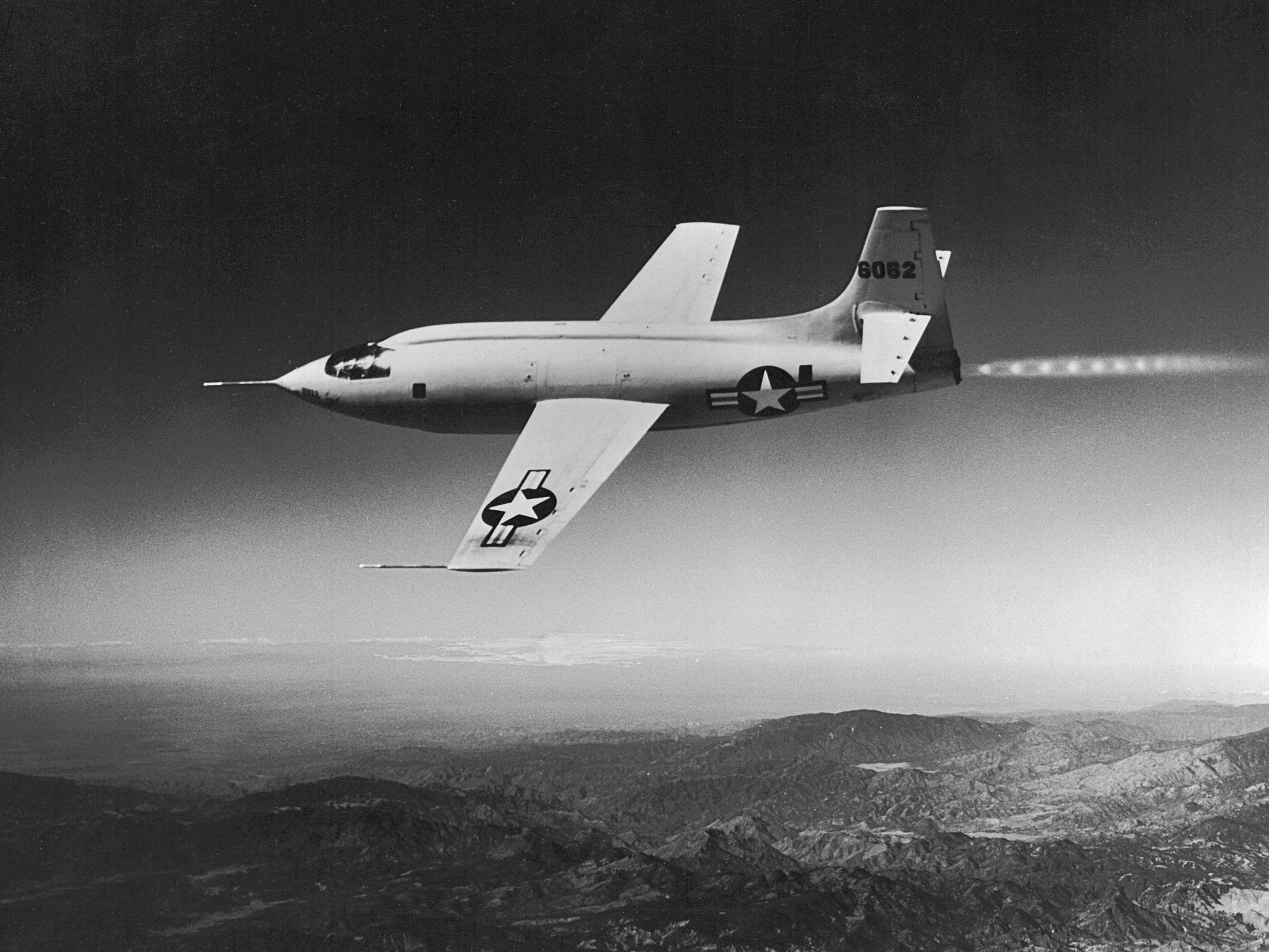
Sixty-three years ago this month, a United States Air Force aircraft broke the storied sound barrier for the first time. While the rocket-powered Bell XS-1 is credited in the history books for this achievement, there is ample and compelling evidence that the North American XF-86 Sabre was in fact the first aircraft to exceed Mach One.
October 1947 was a pivotal time in the history of aviation. For it was in that very month and year that a piloted aircraft first safely exceeded the speed of sound. This feat was accomplished by a United States Air Force aircraft, flown by a World War II combat ace, in the skies over a remote desert air base in California.
The common understanding is that (1) the aircraft involved was the Bell XS-1, Ship No. 1 (S/N 46-062), (2) piloted by Captain Charles E. “Chuck” Yeager at (3) Muroc Army Airfield, California. It is a verifiable fact that said aircraft and pilot indeed flew supersonically on Tuesday, 14 October 1947 at the aforementioned location. However, this occasion did not necessarily mark the first time that the sonic wall was successfully penetrated.
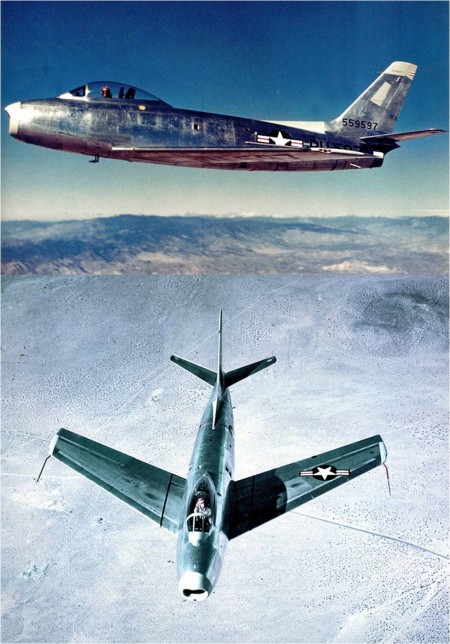
While anathema to some, it is averred here that the aircraft that first safely achieved supersonic flight was the North American XF-86 Sabre, Ship No. 1 (S/N 45-59597). This was accomplished with the aircraft in a dive. The pilot of that aircraft was North American test pilot and former Air Force fighter pilot George Schwartz “Wheaties” Welch. Welch exceeded Mach 1 on at least two dates in October of 1947. In particular, the 1st and the 14th of that month.
If you are looking for the official flight records that substantiate the assertions above, you will be disappointed. However, if you are willing to ponder the available anecdotal and circumstantial accounts submitted by numerous eye and earwitnesses, you may want to consider reading the 1998 book entitled “Aces Wild: The Race to Mach 1” by engineering test pilot Albert W. “Al” Blackburn.
I won’t spoil your fun here in delving into Blackburn’s writings. However, suffice it to say that the author’s case is persuasive. And Blackburn, who passed away in 2011, knew whereof he spoke. As an accomplished and respected aviation veteran, he graduated from MIT with a masters degree in Aeronautical Engineering and defended freedom from the air in both World War II and the Korean War.
Al Blackburn flew as a test pilot for the United States Navy at the Naval Air Test Center in Patuxent River, Maryland. Later, he became an engineering test pilot for North American Aviation in Los Angeles, California. Among many distinctions, Al Blackburn made the first flight in the F-100 Zero Length Launch (ZEL) Program. He also served as the third president of the Society of Experimental Test Pilots (SETP).
If you get the feeling that I’m trying to validate Al Blackburn and thus his story about the first to achieve Mach 1, you would be right! That’s because you will hear other voices, some of high aeronautical repute, who vehemently disagree with Blackburn. However, at least in this writer’s view, the collective contentions of the anti’s are easily challenged and ultimately fail to persuade.
While Chuck Yeager is still with us, George Welch is not. He sadly and needlessly perished at the ripe old age of 36 in an infamous F-100A Super Sabre mishap in 1954. However, to the end of his life, Welch steadfastly (and with absolutely no notoriety) maintained that he was indeed the first to Mach 1. For his part, Chuck Yeager is understandably among the naysayers when the topic of Welch being the first to achieve Mach 1 is raised.
After you consider the case presented by Al Blackburn in “Aces Wild”, perhaps you will agree with me that the historical record should be amended to read: Chuck Yeager and the Bell XS-1 were the first to exceed Mach 1 in level flight. George Welch and the North American XF-86 was the first to exceed Mach 1; which exceedance was accomplished in a dive.
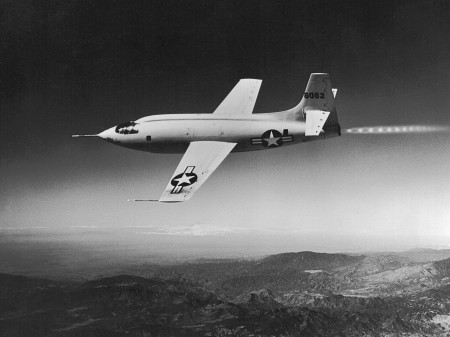
Sixty-six years ago this week, the USAF/Bell XS-1 rocket-powered experimental aircraft exceeded the speed of sound when it reached a maximum speed of 700 mph (Mach 1.06) at 45,000 feet.
Bell Aircraft Corporation of Buffalo, New York built three (3) copies of the XS-1 under contract to the United States Army Air Forces (USAAF). These aircraft were designed to approach and then fly beyond the speed of sound.
The Bell XS-1 measured 31-feet in length and had a wing span of 28 feet. Gross take-off weight tipped the scales at around 12,500 lbs. The XS-1 had an empty weight of about 7,000 lbs. Propulsion was provided by a Reaction Motors XLR-11 rocket motor capable of generating a maximum thrust of 6,000 lbs at sea level.
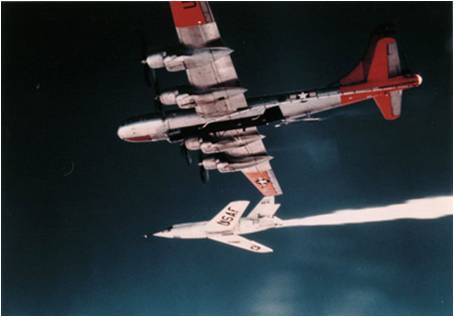
On the morning of Tuesday, 14 October 1947, the XS-1 (S/N 46-062) dropped away from its B-29 mothership (S/N 45-21800 ) as the pair flew at 220 mph and 20,000 feet. In the XS-1 cockpit was USAAF Captain and World War II ace Charles E. Yeager. The young test pilot had named the aircraft Glamorous Glennis in honor of his wife.
Following drop, Yeager sequentially-lit all four XLR-11 rocket chambers during a climb and push-over that ultimately brought him to level flight around 45,000 feet. The resulting acceleration profile propelled the XS-1 slightly beyond Mach 1 for about 20 seconds. Yeager then shutdown the rocket, decelerated to subsonic speeds, and landed the XS-1 on Muroc Dry Lake at Muroc Army Airfield, California.
The world would not find out about the historically-significant events of 14 October 1947 until December of the same year. As it was, the announcement came from a trade magazine that even today is sometimes referred to as “Aviation Leak”.
Today, Glamorous Glennis is prominently displayed in the Milestones of Flight hall of the National Air and Space Museum located in Washington, DC. For his efforts in breaking the sound barrier, Chuck Yeager was a co-recipient of the 1948 Collier Trophy.
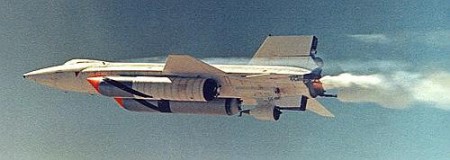
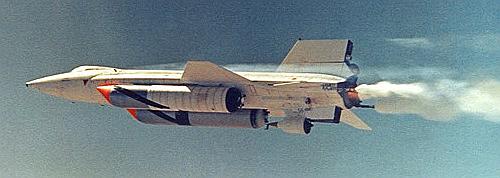
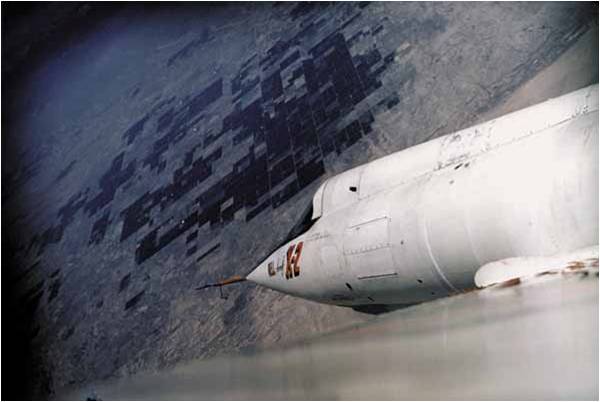
Forty-six years ago this month, USAF Major William “Pete” Knight piloted the fabled USAF/North American X-15A-2 hypersonic research aircraft to a record speed of 4,520 mph – about a mile and a quarter per second.
North American’s original X-15 production run consisted of three (3) aircraft. The X-15A-2 was a rebuild of the 2nd airframe (S/N 56-6671) which had been severely damaged during an emergency landing at Mud Lake, Nevada in November of 1962.
The rebuilt aircraft was configured with a pair of droppable propellant tanks that allowed the type’s XLR-99 rocket engine to operate 60 seconds beyond the stock X-15′s 80-second burn time. Among other modifications, the aircraft also carried a pylon-mounted dummy ramjet in the ventral region of the aft fuselage.
With the addition of the external propellant tanks, the X-15A-2 was really a three-stage vehicle. The first stage was the NASA NB-52B mothership which launched the X-15 at Mach 0.82 and 45,000 feet. The second stage consisted of the propellant-laden external tanks which were jettisoned at Mach 2.0 and 70,000 feet. The third stage was the X-15A-2 with its entire internal propellant load.
Due to the increased speed of the X-15A-2, the aircraft was covered with Martin MA-25S ablator to protect it from the higher aerodynamic heating loads. The baseline ablator was pink in color and gave the X-15A-2 a rather odd appearance. Fortunately, application of a white wear/sealer over the ablator gave the aircraft a more dignified look.
On Tuesday, 03 October 1967, Pete Knight and the X-15A-2 dropped away from the NB-52B (S/N 52-008) at the start of the X-15 Program’s 188th mission. Knight ignited the XLR-99 rocket engine and executed a pull-up followed by a pushover to level flight at a little over 102,000 feet. Aircraft speed at XLR-99 burnout was 4,520 mph (Mach 6.7).
As the aircraft decelerated following burnout, Knight executed a series of pre-planned flight maneuvers to acquire vital aerodynamics data. However, passing through Mach 5.5, he received an indication in the cockpit that a high temperature condition existed in the XLR-99 engine bay.
Knight attempted to jettison the aircraft’s remaining propellants, but to no avail. The jettison tubes were welded shut by whatever was going on back in the engine bay. This meant he would land heavier and faster than usual. Fortunately, Knight’s piloting skills allowed him to get the X-15A-2 on to Rogers Dry Lake in one piece.
As flight support personnel inspected the X-15A-2 airframe following Knight’s emergency landing, they were alarmed at what they found. The aft ventral region of the aircraft had incurred significant thermal damage. Further, the dummy ramjet was gone.
As reported in the classic technical report, NASA TM-X-1669, much higher-than-expected aerodynamic heating levels were responsible for the damage to the X-15A-2 airframe.
First, shock wave/boundary layer interaction heating on the lower fuselage just ahead of the pylon (1) completely destroyed the ablator in that region and (2) penetrated the Inconel-X airframe structure. This introduced very high temperature air into the X-15 engine bay.
Second, impingement of the dummy ramjet nose shock on the detached bow shock coming off of the pylon produced a shear layer that focused on the pylon leading edge. The resulting heating rates were of sufficient magnitude and duration to both burn away the pylon ablator and burn through the pylon structure. The weakened pylon attachment eventually failed and the dummy ramjet departed the main airframe.
Pete Knight will forever hold the record for the fastest X-15 flight. However, the X-15A-2 never flew again. Only 11 more flights remained in the X-15 Program at the time. A lack of time and funding meant that little was to be gained by repairing the thermally-damaged aircraft.
As for the final disposition of the X-15A-2 (S/N 56-6671), the aircraft’s remaining ablator was removed with its external surface cleaned-up and original markings restored. The aircraft now resides in the Research and Development Wing of the National Museum of the United States Air Force located at Wright-Patterson AFB in Dayton, Ohio.
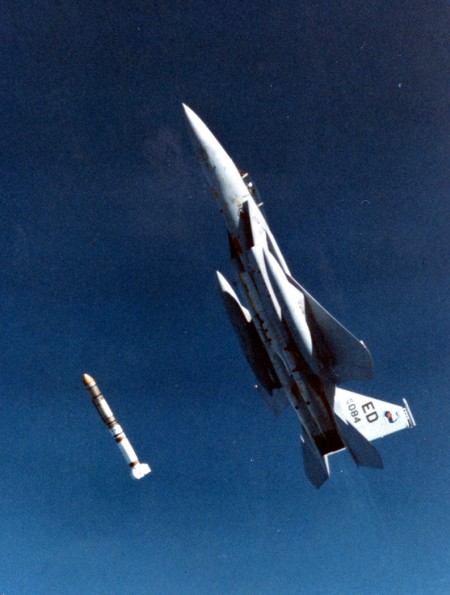
Twenty-eight years ago this month (September), the USAF/LTV ASM-135 anti-satellite missile successfully intercepted a target satellite orbiting 300 nautical miles above the Earth. The test was the first and only time that an aircraft-launched missile successfully engaged and destroyed an orbiting spacecraft.
The United States began testing anti-satellite missiles in the late 1950′s. These and subsequent vehicles used nuclear warheads to destroy orbiting satellites. A serious disadvantage of this approach was that a nuclear detonation intended to destroy an adversary satellite will likely damage nearby friendly satellites as well.
By the mid 1970′s, the favored anti-satellite (ASAT) approach had changed from nuclear detonation to kinetic kill. This latter approach required the interceptor to directly hit the target. The 15,000-mph closing velocity provided enough kinetic energy to totally destroy the target. Thus, no warhead was required.
The decision to proceed with development and deployment of a US kinetic kill weapon was made by President Jimmy Carter in 1978. Carter’s decision came in the aftermath of the Soviet Union’s successful demonstration of an orbital anti-satellite system.
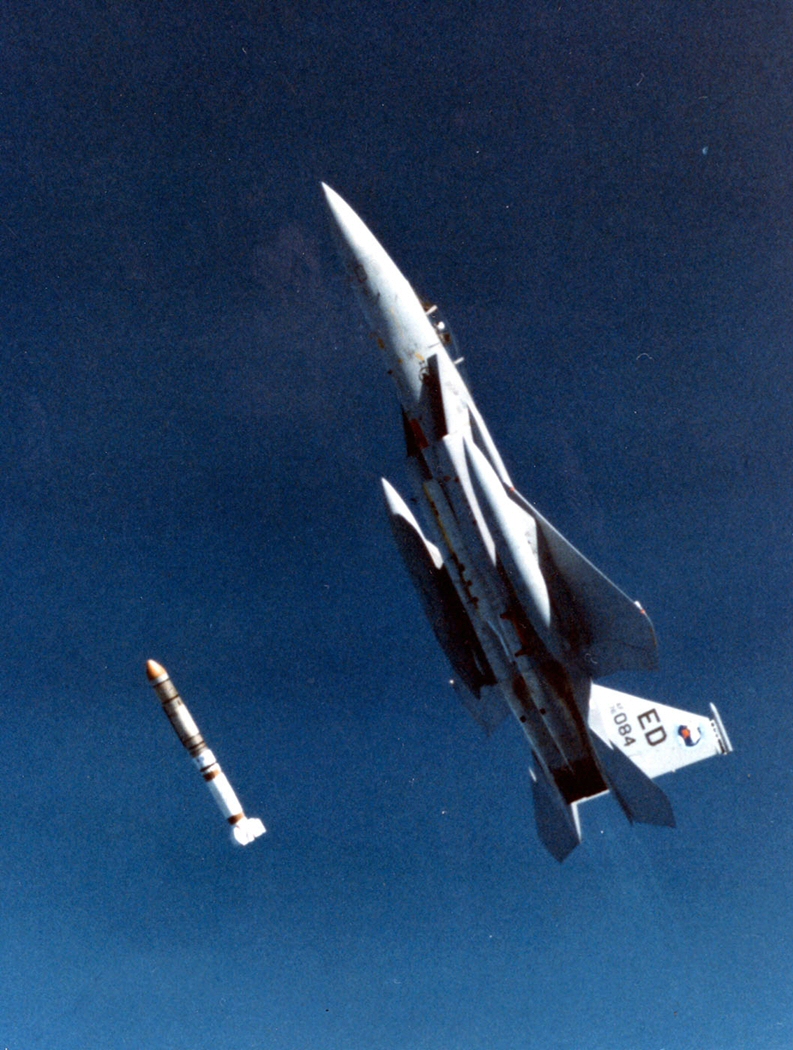
LTV Aerospace was awarded a contract in 1979 to develop the Air-Launched Miniature Vehicle (ALMV) for the USAF. The resulting anti-satellite missile (ASM) system was designated the ASM-135. The two-stage missile was to be air-launched by a USAF F-15A Eagle executing a zoom climb. In essence, the aircraft acted as the first stage of what was effectively a 3-stage vehicle.
The ASM-135 was 18-feet in length and 20-inches diameter. The 2,600-lb vehicle was launched from the centerline station of the host aircraft. The ASM consisted of a Boeing SRAM first stage and an LTV Altair 3 second stage. The vehicle’s payload was a 30-lb kinetic kill weapon known as the Miniature Homing Vehicle (MHV).
The ASM-135 was first tested in flight on Saturday, 21 January 1984. While successful, the missile did not carry a MHV. On Tuesday, 13 November 1984, a second ASM-135 test took place. Unfortunately, the missile failed when the MHV that it was carrying was aimed at a star that served as a virtual target. Engineers went to work to make the needed fixes.
In August of 1985, a decision was made by President Ronald Reagan to launch the next ASM-135 missile against an orbiting US satellite. The Solwind P78-1 satellite would serve as the target. Congress was subsequently notified by the Executive Branch regarding the intended mission.
The historic satellite takedown mission occurred on Friday, 13 September 1985. USAF F-15A (S/N 77-0084), stationed at Edwards Air Force Base, California and code-named Celestial Eagle, departed nearby Vandenberg Air Force Base carrying the ASM-135 test package. Major Wilbert D. Pearson was at the controls of the Celestial Eagle.
Flying over the Pacific Ocean at Mach 1.22, Pearson executed a 3.8-g pull to achieve a 65-degree inertial pitch angle in a zoom climb. As the aircraft passed through 38,000-feet at Mach 0.93, the ASM-135 was launched at a point 200 miles west of Vandenberg. Both stages fired properly and the MHV intercepted the Solwind P78-1 satellite within 6-inches of the aim point. The 2,000-lb satellite was obliterated.
In the aftermath of the stunningly successful takedown of the Solwind P78-1 satellite, USAF was primed to continue testing the ASM-135 and then introduce it into the inventory. Plans called for upwards of 112 ASM-135 rounds to be flown on F-15A aircraft stationed at McChord AFB in Washington state and Langley AFB in Virginia. However, such was not to be.
Even before the vehicle flew, the United States Congress acted to increasingly restrict the ASM-135 effort. A ban on using the ASM-135 against a space target was put into effect in December 1985. Although USAF actually conducted successful additional ASM-135 flight tests against celestial virtual targets in 1986, the death knell for the program had been sounded.
In the final analysis, a combination of US-Soviet treaty concerns, tepid USAF support and escalating costs killed the ASM-135 anti-satellite effort. The Reagan Administration formally cancelled the program in 1988.
While the ASM-135 effort was relatively short-lived, the technology that it spawned has propagated to similar applications. Indeed, today’s premier exoatmospheric hit-to-kill interceptor, the United States Navy SM-3 Block IA anti-ballistic missile, is a beneficiary of ASM-135 homing guidance, intercept trajectory and kinetic kill technologies.
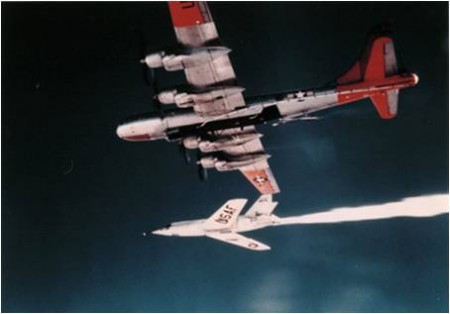
Fifty-seven years ago this month, the USAF/Bell X-2 Starbuster rocket-powered research aircraft reached a record speed of 2,094 mph with USAF Captain Milburn G. “Mel” Apt at the controls. This corresponded to a Mach number of 3.2 at 65,000 feet.
Mel Apt’s historic achievement came about because of the Air Force’s desire to have the X-2 reach Mach 3 before turning it over to the National Advisory Committee For Aeronautics (NACA) for further flight research testing. Just 20 days prior to Apt’s flight in the X-2, USAF Captain Iven C. Kincheloe, Jr. had flown the aircraft to a record altitude of 126,200 feet.
On Thursday, 27 September 1956, Apt and the last X-2 aircraft (S/N 46-674) dropped away from the USAF B-50 motherhip at 30,000 feet and 225 mph. Despite the fact that Apt had never flown an X-aircraft, he executed the flight profile exactly as briefed. In addition, the X-2′s twin-chamber XLR-25 rocket motor burned propellant 12.5 seconds longer than planned. Both of these factors contributed to the aircraft attaining a speed in excess of 2,000 mph.
Based on previous flight tests as well as flight simulator sessions, Apt knew that the X-2 had to slow to roughly Mach 2.4 before turning the aircraft back to Edwards. This was due to degraded directional stability, control reversal, and aerodynamic coupling issues that adversely affected the X-2 at higher Mach numbers.
However, Mel Apt now found himself in a predicament from which there was no real chance of escape. If he waited for the X-2 to slow to Mach 2.4 before initiating a turn back to Edwards Air Force Base, he quite likely would not have enough energy and therefore range to reach Rogers Dry Lake. On the other hand, if he decided to initiate the turn back to Edwards at high Mach number, he risked having the X-2 depart controlled flight. Apt opted for the latter.
As Apt increased the aircraft’s angle-of-attack, the X-2 careened out of control and subjected him to a brutal pounding. Aircraft lateral acceleration varied between +6 and -6 g’s. The battered pilot ultimately found himself in a subsonic, inverted spin at 40,000 feet. At this point, Apt effected pyrotechnic separation of the X-2′s forebody which contained the cockpit and a drogue parachute.
X-2 forebody separation was clean and the drogue parachute deployed properly. However, Apt still needed to bail out of the X-2′s forebody and deploy his personal parachute to complete the emergency egress process. But, it was not to be. Mel Apt ran out of time, altitude, and luck. He lost his life when the X-2 forebody that he was trying to escape from impacted the ground at several hundred miles an hour.
Mel Apt’s flight to Mach 3.2 established a record that stood until the X-15 exceeded it in August 1960. However, the price for doing so was very high. The USAF lost a brave test pilot and the lone remaining X-2 on that fateful day in September 1956. The mishap also ended the USAF X-2 Program. NACA never did conduct flight research with the X-2.
However, for a few terrifying moments, Mel Apt was the fastest man alive.
From 16-19 September, Aerosciences instructor J. Terry White taught his Aerospace Vehicle Performace (AVP) course to the fine aerospace professionals at Arnold Engineering Development Complex (AEDC). This is the fourth course Mr. White has taught to AEDC community in the past 13 months, having previously taught his Fundamentals of Hypersonics (FOH) and Basic Missile Aerodynamics (BMA) courses to the organization, which is based at Arnold Air Force Base, TN.

The AVP course has been a popular course of late, which seems to be linked with ongoing industry efforts to design more advanced aerospace vehicles. The course provides participants with the knowledge and skills needed to accurately estimate aircraft take-off and landing performance and understand the essentials of proper aircraft design. With these and other simple tools, students are able to estimate the performance of a wide variety of general aviation, commercial, military and special purpose aircraft missions.
One student in attendance noted that the course appeals to professionals from diverse fields, saying “The course would be great for engineers who come from other backgrounds but need aero knowledge.” Another student commented on the course’s relevancy to AEDC in particular, saying “Mr. White provided an outstanding presentation of basic performance methodology and analysis approach. The course helps establish a fundamental understanding of aircraft aerodynamic performance and other core competencies for the AEDC test mission.”
Mr. White is honored by the opportunity to serve the innovative men and women at AEDC. He and the entire WEA team would like to thank Mr. Don Malloy and Ms. Dee Wolfe, as well as each student in attendance this week.
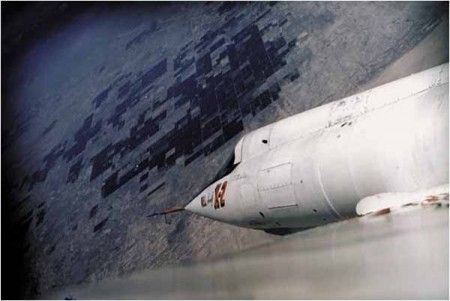
Fifty-seven years ago this month, the USAF/Bell X-2 research aircraft flew to an altitude of 126,200 feet. This accomplishment took place on the penultimate mission of the type’s 20-flight aeronautical research program. The date was Friday, 07 September 1956.
The X-2 was the successor to Bell’s X-1A rocket-powered aircraft which had recorded maximum speed and altitude marks of 1,650 mph (Mach 2.44) and 90,440 feet, respectively. The X-2 was designed to fly beyond Mach 3 and above 100,000 feet. The X-2’s primary mission was to investigate aircraft flight control and aerodynamic heating in the triple-sonic flight regime.
The X-2 had a gross take-off weight of 24,910 lbs and was powered by a Curtis-Wright XLR-25 rocket motor which generated 15,000-lbs of thrust. Aircraft empty weight was 12,375 lbs. Like the majority of X-aircraft, the X-2 was air-launched from a mothership. In the X-2’s case, an USAF EB-50D served as the drop aircraft. The X-2 was released from the launch aircraft at 225 mph and 30,000 feet.
The pilot for the X-2 maximum altitude mission was USAF Captain Iven Carl Kincheloe, Jr. Kincheloe was a Korean War veteran and highly accomplished test pilot. He wore a partial pressure suit for survival at extreme altitude.
While the dynamic pressure at the apex of his trajectory was only 19 psf, Kincheloe successfully piloted the X-2 with aerodynamic controls only. The X-2 did not have reaction controls. Mach number over the top was supersonic (approximately Mach 1.7).
Kincheloe’s maximum altitude flight in the X-2 (S/N 46-674) would remain the highest altitude achieved by a manned aircraft until August of 1960 when the fabled X-15 would fly just beyond 136,000 feet. However, for his achievement on this late summer day in 1956, the popular press would refer to Iven Kincheloe as the “First of the Space Men”.
Sensors & Systems instructor John L. Minor just held his Fundamentals of Unmanned Aerial Vehicles, Missions and Systems (UAV) course at Edwards Air Force Base, CA. The training was held 09-13 September at the Air Force Test Center(AFTC), which conducts developmental test and evaluation of air, space and cyber systems to provide timely, objective and accurate information to decision makers.

The UAV course is designed for technical specialists, engineers, managers and operational professionals with responsibility for the selection, design, integration, test and operation of UAVs, UAV links and UAV payloads for any military or civil application. One student in attendance said, “This is a much-needed course for flight test engineers. The instructor was a great communicator – one of the best teachers I have ever had!” Another student commented on the essential element Mr. Minor brings to his courses, saying “He is an excellent teacher with great war stories and tales that brought real life into the academics.”
Mr. Minor and the entire WEA staff would like to thank Ms. Patricia Jones, Ms. Kathy Finley, Ms. Cathy Clum and each of the wonderful students in attendance.
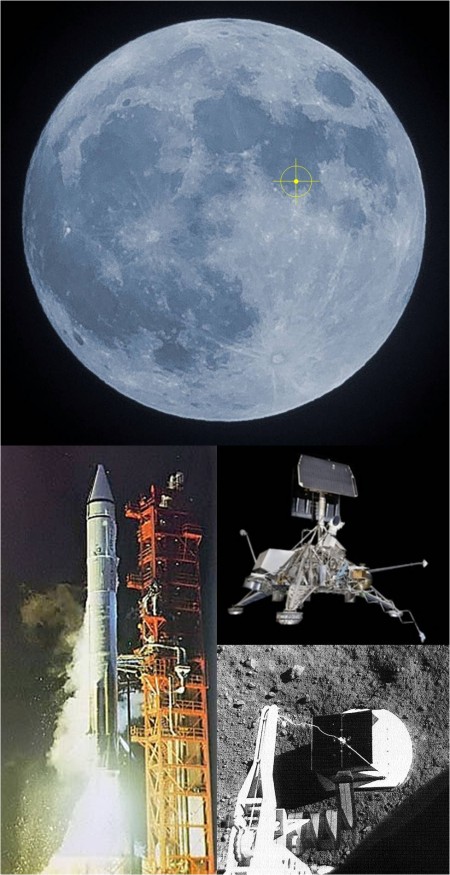
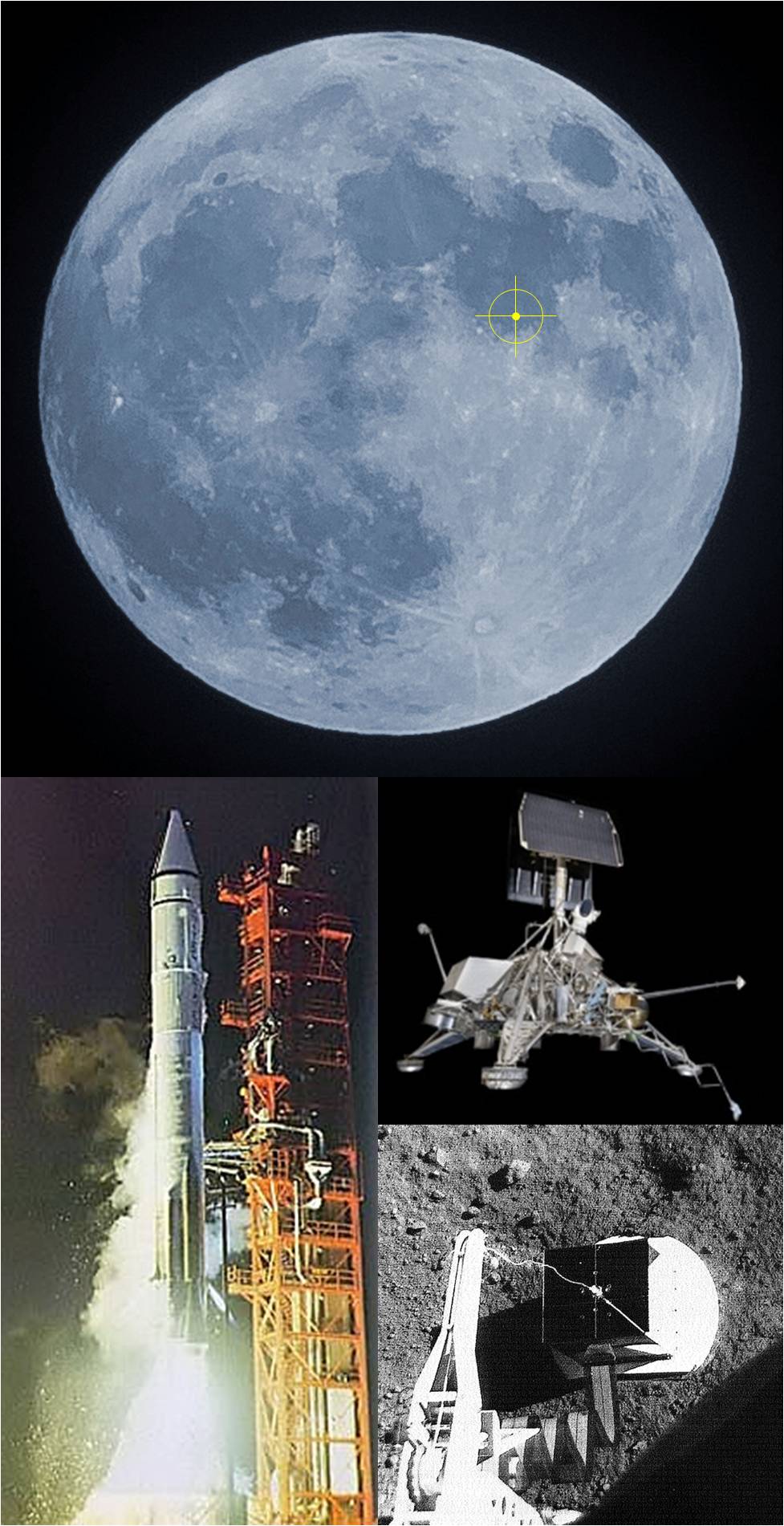
Forty-six years ago this month, the Surveyor 5 robotic spacecraft made a successful soft-landing on the Moon’s Mare Tranquilitatis. Touchdown of the 3-legged lander occurred approximately 15 nautical miles northwest of the future Apollo 11 manned lunar landing site.
In preparation for the first manned lunar landing, the United States conducted an extensive investigation of the Moon using Ranger, Lunar Orbiter and Surveyor robotic spacecraft.
Ranger provided close-up photographs of the Moon starting at a distance of roughly 1,100 nautical miles above the lunar surface all the way to impact. Nine (9) Ranger missions were flown between 1961 and 1965. Only the last three (3) missions were successful.
Lunar Orbiter spacecraft mapped 99% of the lunar surface with a resolution of 200 feet or better. Five (5) Lunar Orbiter missions were flown between 1967 and 1968. All were successful.
Surveyor spacecraft were tasked with landing on the Moon and providing detailed photographic, geologic and environmental information about the lunar surface. Seven (7) Surveyor missions were flown between 1966 and 1968. Five (5) spacecraft successfully landed.
The Surveyor spacecraft weighed 2,300 lbs at lift-off and 674 lbs at landing. The 3-legged vehicle stood within a diameter of 15 feet and measured almost 11 feet in height. Surveyor was configured with a television camera, a surface sampler and an alpha-scattering instrument to determine the chemical composition of the lunar soil.
Surveyor 5 lifted-off from Kennedy Space Center’s Launch Complex 36B at 07:57:00 UTC on Friday, 08 September 1967. The trip to the Moon was provided courtesy of a General Dynamics Atlas-Centaur launch vehicle. The Earth-to-Moon transit time was approximately 65 hours.
Immediately after the mid-course correction burn on the second day of flight, a helium tank leak occurred in the spacecraft’s vernier rocket fuel system. This forced engineers to hastily develop a revised retro-braking and landing strategy on the fly to save the mission. Happily, the new descent trajectory worked like a charm as Surveyor 5 successfully landed near the southwestern extremity of Mare Tranquilitatis (i.e., Sea of Tranquility). Vehicle touchdown occurred at 00:46:44 UTC on Monday, 11 September 1967.
During Surveyor 5’s first lunar day, a total of 18,006 photographs were taken and 83 hours of alpha-scattering measurements were acquired. The latter accomplishment marked the first in-situ testing of lunar soil. (For that matter, the first in-situ testing of the soil of any extraterrestrial orb.) By Sunday, 24 September 1967, Surveyor 5 was put into sleep mode for its first lunar night.
On Sunday, 15 October 1967, Surveyor 5 immediately powered-up upon radio command from Earth to begin its second lunar day of surface operations. The spacecraft took an additional 1,048 photographs and accumulated 22 hours of alpha-scattering data during this period. Following two more lunar day/night cycles, Surveyor 5 operations permanently ceased at 00:04:30 UTC on Sunday, 17 December 1967.
The historical record indicates that 19,118 photographs were transmitted during the first, second, and fourth lunar days of the Surveyor 5 mission. Further, the soil composition at the landing site was determined to be quite similar to that of basaltic rock on Earth. In summary, all mission objectives were accomplished.
Although seldom remembered today, the Surveyor Program provided America with a wealth of lunar surface information critical to the Apollo Program. Surveyor’s success provided an added measure of confidence in the attainability of a manned lunar landing. Interestingly, Apollo 11, the first manned lunar landing, took place on Mare Tranquilitatis at a point about 15 nm southeast of the Surveyor 5 landing site.
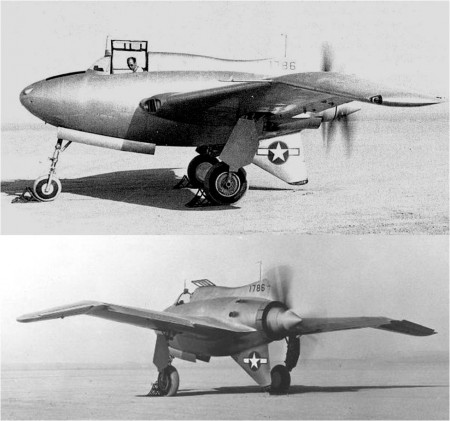
Seventy-years ago this week, flight testing of the USAAF/Northrop XP-56 Black Bullet commenced at Army Air Base, Muroc in California. Northrop Chief Test Pilot John W. Myers was at the controls of the experimental pursuit aircraft.
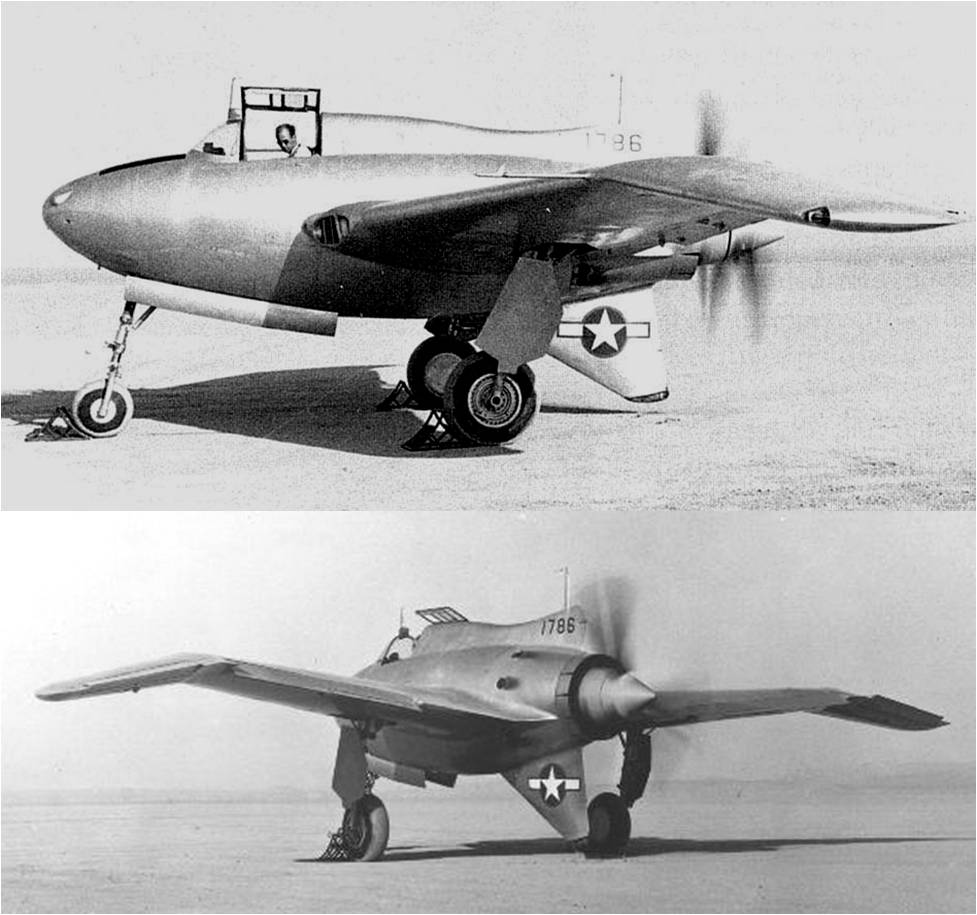
The XP-56 (X for Experimental, P for Pursuit) was an attempt at producing a combat aircraft that had superior speed performance relative to conventional fighter-like airframes of the early 1940’s. Towards this end, designers sought to maximize thrust and minimize weight and aerodynamic drag. The product of their labors was a truly strange aircraft configuration.
The XP-56 was essentially a hybrid flying wing to which was added a stubby fuselage to house the pilot and engine. Power was provided by a single Pratt and Whitney R-2800 radial piston engine driving contra-rotating propellers. A pusher power plant installation was selected in the interest of reducing forebody drag. Gross Take-Off Weight (GTOW) came in at 11,350 lbs.
The XP-56’s wing featured a leading edge sweep of 32 degrees and a span of 42.5 feet. The tiny fuselage length of 27.5 feet necessitated the use of elevons for pitch and roll control. Aft-mounted dorsal and ventral tails contributed to directional stability while yaw control was provided by a rudder mounted in the ventral tail.
Under contract to the United States Army Air Force (USAAF), Northrop built a pair of XP-56 airframes; Ship No. 1 (S/N 41-786) and Ship No. 2 (S/N 42-38353). Top speed was advertised as 465 mph at 25,000 feet while the design service ceiling was estimated to be around 33,000 feet. The XP-56 was a short-legged aircraft, having a predicted range of only 445 miles at 396 mph.
XP-56 Ship No. 1 took to the air for the first time on Monday, 06 September 1943. The scene was Rogers Dry Lake at Army Air Field, Muroc (today’s Edwards Air Force Base) in California. Northrop Chief Test Pilot John W. Myers had the distinction of piloting the XP-56. As described below, this distinction was dubious at best.
Myers actually flew XP-56 Ship No. 1 twice on the type’s inaugural day of flight testing. The first flight was really just a hop in the air. Using caution as a guide, Myers flew only 5 feet off the deck in a 30 second flight that covered a distance on the order of 1 mile. The aircraft registered a top speed 130 mph. While the XP-56 exhibited a nose-down pitch tendency as well as lateral-directional sensitivities, Myers was able to complete the flight.
The XP-56’s second foray into the air nearly ended in disaster. Shortly after lift-off at 130 mph, the XP-56 presented pilot Myers with a multi-axis control problem about 50 feet above the surface of Rogers Dry Lake. The strange-looking ship simultaneously yawed to the left, rolled to the right, and pitched down. Holding the control stick with both hands, it was all the Northrop Chief Test Pilot could do keep the nose up and prevent the XP-56 from diving into the ground.
Myers attempted to throttle-back as his errant steed passed through 170 mph. The anomalous yawing-rolling-pitching motions reappeared at this point, once again testing Myers’ piloting skills to the max. The intrepid pilot was finally able to get the XP-56 back on the ground. Albeit, the landing was more of a controlled crash. All of this excitement took place in about 60 seconds over a two mile stretch of Rogers Dry Lake. John Myers had certainly earned his flight pay (and then some) for the day.
XP-56 Ship No. 1 was demolished during a take-off accident on Friday, 08 October 1943. Although he sustained minor injuries, Myers survived the incident thanks largely to wearing an old polo helmet to protect his valuable cranium. Following the mishap , Myers said that “the airplane wanted to fly upside down and backwards, and finally did.”
XP-56 Ship No. 2 flew a total of ten (10) flights between March and August of 1944. Northrop test pilot Harry Crosby did the piloting honors this time around. Like Myers, Crosby had his hands full trying to fly the XP56. However, Crosby was able to coax the XP-56 up to 250 mph.
Despite valiant attempts to rectify the XP-56’s curious and dangerous handling qualities, Northrop engineers were never able to satisfactorily correct the little beast’s ills. This, coupled with the facts that the XP-56 (1) did not deliver the promised speed performance and (2) was being eclipsed by rapid developments in aircraft technology, the strange aerial concoction became a faded memory by 1945.
A final thought. Just why the XP-56 was given the nickname of Black Bullet is not clear. Ship No. 1 was bare metal and thus silver in appearance. Ship No. 2 sported a dark grey and green camouflage paint scheme. The Bullet moniker could be in deference to the bullet-like nose of the fuselage. In the final analysis, the name Black Bullet probably just sounded cool and evoked a stirring image of a bullet speeding to the target!