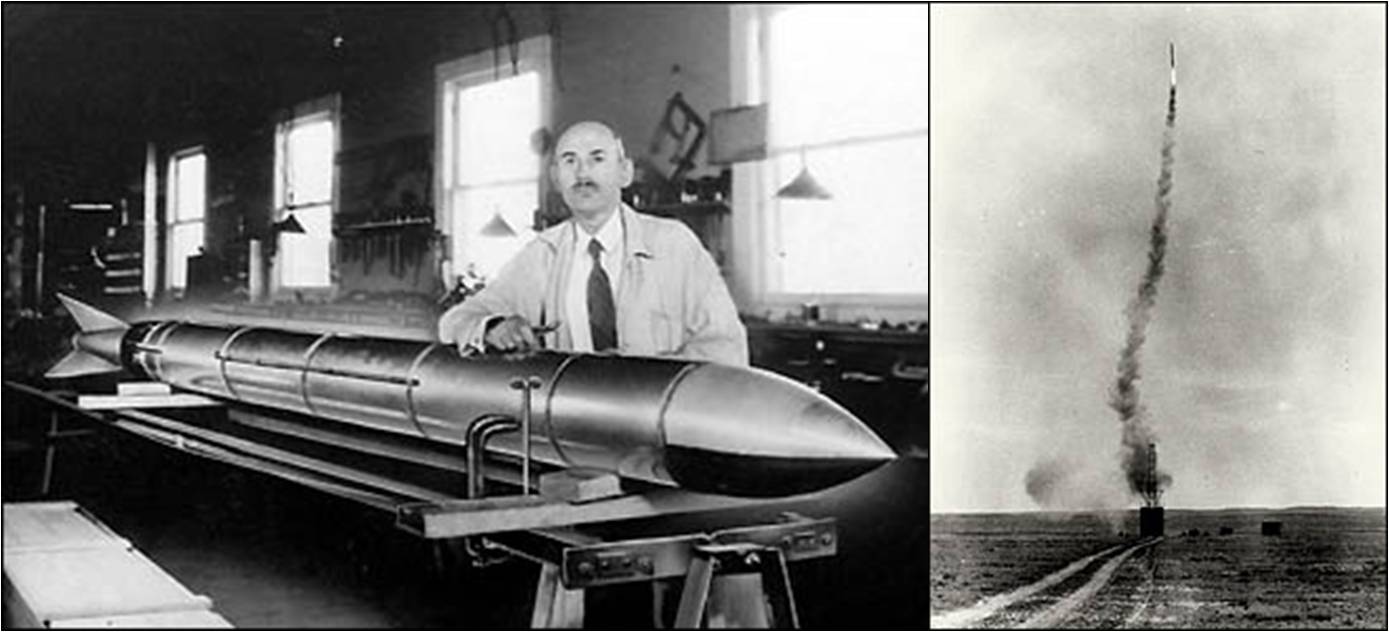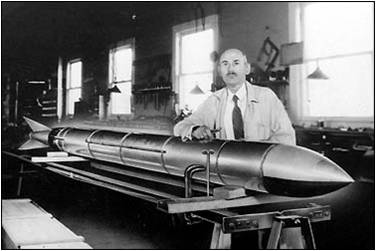
Seventy-five years ago today, pioneering rocket scientist Robert H. Goddard and staff fired a liquid-fueled rocket to a record altitude of 7,500 feet above ground level. The record-setting flight took place at Roswell, New Mexico.
Robert Hutchings Goddard was born in Worcester, Massachusetts on Thursday, 05 October 1882. He was enamored with flight, pyrotechnics, rockets and science fiction from an early age. By the time he was 17, Goddard knew that his life’s work would combine all of these interests.
Goddard was a sickly youth, but spent his well moments as a voracious reader of all manner of science-oriented literature. He graduated in 1904 from South High School in Worcester as the valedictorian of his class. He matriculated at Worcester Polytechnic and graduated with a Bachelor of Science degree in physics in 1908. A Master of Science degree and Ph.D. from Worcester’s Clark University followed in 1910 and 1911, respectively.
Goddard spent the next eight years of his life working on numerous propulsion and rocket-related projects. Then, in 1919, he published his now-famous scientific treatise entitled A Method of Reaching Extreme Altitudes. In that paper, the press glommed on to Goddard’s passing mention that a multi-staged rocket could conceivably fly all the way to the Moon.
Goddard was roundly ridiculed for his fanciful prognostications about Moon flight. The New York Times was especially derogatory in its estimation of Goddard’s ideas and accused him of junk science. A Times editorial even criticized Goddard for his “misconception” that a rocket could produce thrust in the vacuum of space.
Even the U.S. government largely ignored Goddard. This scornful treatment to which Goddard was subject hurt him profoundly. So much so that he spent the remainder of his life alienated from the denizens of the press as well as the dolts of governmental employ.
Despite the blow to his professional reputation, Goddard resolutely pressed on with his rocket research. Indeed, after more that five years of intense development effort, Goddard and his staff launched the first liquid-fueled rocket on Tuesday, 16 March 1926 in Auburn, Massachusetts. The flight duration was short (2.5 seconds) and the peak altitude tiny (41 feet), but Goddard proved that liquid rocket propulsion was feasible.
Goddard’s liquid-fueled rocket testing would ultimately lead him from the countryside of New England to the desert of the Great South West. With financial support from Harry Guggenheim and the public backing of Charles Lindbergh, Goddard transfered his testing activities to Roswell, New Mexico in 1930. He would continue liquid-fueled rocket testing there until May 1941.
On Friday, 31 May 1935, experimental rocket flight A-8 took to the air from Goddard’s Roswell, New Mexico test site at 1430 UTC. Roughly 15 feet in length and weighing approximately 90 pounds at lift-off, the 9-inch diameter A-8 achieved a maximum altitude of 7,500 feet (1.23 nautical miles) above the desert floor. Only a flight in March of 1937 would go higher (9,000 feet).
Robert Goddard was ultimately credited with 214 U.S. patents for his rocket development work. Only 83 were awarded in his life time. His far-reaching inventions included rocket nozzle design, regenerativley cooled rocket engines, turbopumps, thrust vector controls, gyroscopic control systems and more.
Goddard died at the age of 62 from throat cancer in Baltimore, Maryland on Friday, 10 August 1945. Many years would pass before the full import of his accomplishments was comprehended. Then, the posthumously-bestowed recognition came in torrents. In 1959, Congress issued a special gold medal in Goddard’s honor. The Goddard Spaceflight Center was so named by NASA in 1959 as well. Many more such bestowals followed.
Perhaps the most meaningful of the recognitions ever accorded Robert Hutchings Goddard occurred 24 years after his passing. It was in connection with the first manned lunar landing in July of 1969. And it was poetic not only in terms of its substance and timing, but more particularly in light of the source from whence the recognition came.
A terse statement in the New York Times corrected a long-standing injustice. It read: “Further investigation and experimentation have confirmed the findings of Issac Newton in the 17th century, and it is now definitely established that a rocket can function in a vaccum as well as in an atmosphere. The Times regrets the error.”
Thirty-seven years ago this week, astronauts Pete Conrad, Joe Kerwin and Paul Weitz became the first NASA crew to fly aboard the recently-orbited Skylab space station. Not only would the crew establish a new record for time in orbit, they would effect critical repairs to the space station which had been seriously damaged during launch.
Skylab was America’s first space station. The program followed closely on the heels of the historic Apollo lunar landing effort. Skylab provided the United States with a unique space platform for obtaining vast quantities of scientific data about the Earth and the Sun. It also served as a means for ascertaining the effects of long-duration spaceflight on human beings.
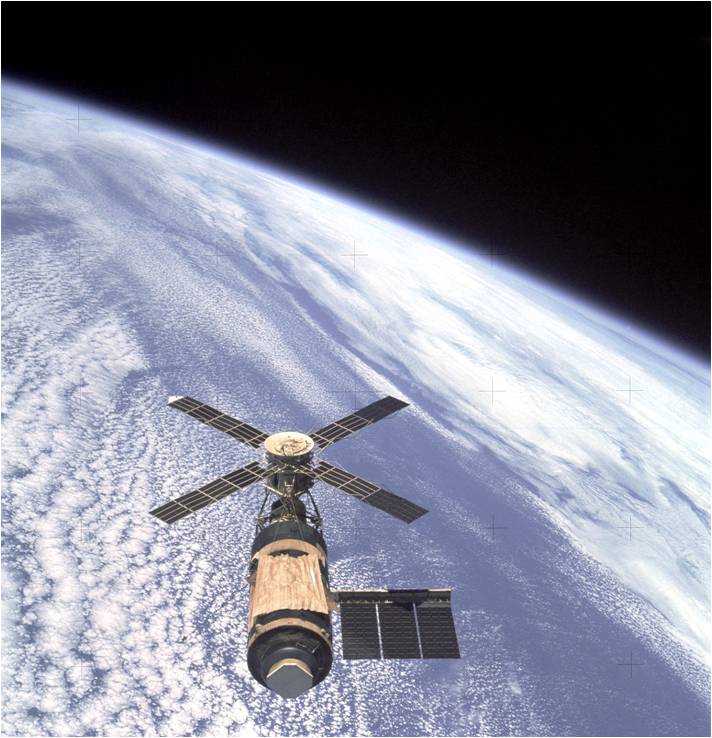
A Saturn IVB third stage served as Skylab’s core. This huge cylinder, which measured 48-feet in length and 22-feet diameter, was modified for human occupancy and was known as the Orbital Workshop (OWS). With the addition of a Multiple Docking Adapter (MDA) and Airlock Module (AM), Skylab had a total length of 83-feet.
Skylab was also outfitted with a powerful space observatory known as the Apollo Telescope Mount (ATM). This unit sat astride the MDA and was configured with a quartet of electricity-producing solar panels. The OWS had a pair of solar panels as well. The entire Skylab stack weighed 85 tons.
The Skylab space station (Skylab 1) was placed into a 270-mile orbit using a Saturn V launch vehicle on Monday, 14 May 1973. Upon reaching orbit, it quickly became apparent that all was far from well aboard the space station. The micro-meteoroid shield and solar panel on one side of the OWS had been lost during ascent. The other OWS solar panel was stuck and did not deploy as planned.
With the loss of an OWS solar panel, Skylab would not have enough electrical energy to conduct its mission. The station was also heating up rapidly (temperatures approached 190 F at one point). The lost micro-meteoroid shield also provided protection from solar heating. Sans this protection, internal temperatures could rise high enough to destroy food, medical supplies, film and other perishables and render the OWS uninhabitable.
NASA engineers quickly went to work developing fixes for Skylab’s problems. A mechanism was invented to free the stuck solar panel. A parasol of gold-plated flexible material, deployed from an OWS scientific airlock, was then fashioned and tested on the ground. This material would cover the exposed portion of the OWS and provide the needed thermal shielding.
The onus was now on the Skylab 2 crew of Conrad, Kerwin and Weitz to implement the requisite fixes in orbit. On Friday, 25 May 1973, the Skylab 2 crew and their Apollo Command and Service Module (CSM) were rocketed into orbit by a Saturn IB launch vehicle. They quickly rendezvoused with Skylab and verified its sad condition. It was time to get to work.
The first order of business was to try to free the stuck solar panel. As Conrad flew the CSM in close proximity to Skylab, Kerwin held Weitz by the feet as the latter leaned out of the open CSM hatch and attempted to release the stuck solar panel with a pair of special cutters. No joy in spaceville. The solar panel refused to deploy.
The Skylab 2 crew next attempted to dock with Skylab. They tried six times and failed. The CSM drogue and probe was not functioning properly. The crew had to fix it or go home. With great difficulty, they did so and were finally able to dock with Skylab. The objective now was to enter Skylab and deploy the parasol thermal shield.
With Conrad remaining in the CSM, Kerwin and Weitz sported gas masks and cautiously entered Skylab. The temperature inside of the OWS was 130 F. Fortunately, the air was found to be of good quality and the pair went to work deploying the thermal shield through a scientific airlock. The deployment was successful and the temperature started to slowly fall.
It would not be until Thursday, 07 June 1973 that the stuck solar panel finally would be freed. On that occasion, Conrad and Kerwin donned EVA suits and spent 8 hours working outside of Skylab. Their initial efforts with the cutters were unsuccesful.
Undeterred, Conrad and Kerwin improvised and were able to cut the strap that restrained the solar panel. Then, heaving with all their might, the pair finally freed the solar panel. In obedience to Newton’s 3rd Law, as the solar panel deployed in one direction, the astronauts went flying in the other. Happily, they were able to collect themselves and safely reenter the now adequately-powered Skylab.
Skylab 2 went on to spend 28 days in orbits; a record for the time. This record was quickly eclipsed by the Skylab 3 and Skylab 4 crews which spent 59 and 84 days in space, respectively. Skylab was an unqualified success and provided a plethora of terrestrial, solar and human factors data of immense importance to space science. These data played a vital role in the design and development of the ISS.
Skylab was abandoned following the Skylab 4 mission in February of 1974. The plan was to reactivate it and raise its orbit using the Space Shuttle when the latter became operational. Unfortunately, a combination of a rapidly deteriorating orbit and delays in flying the Shuttle conspired against bringing this plan to fruition. Skylab reentered the Earth’s atmosphere and broke-up near Australia in July of 1979.
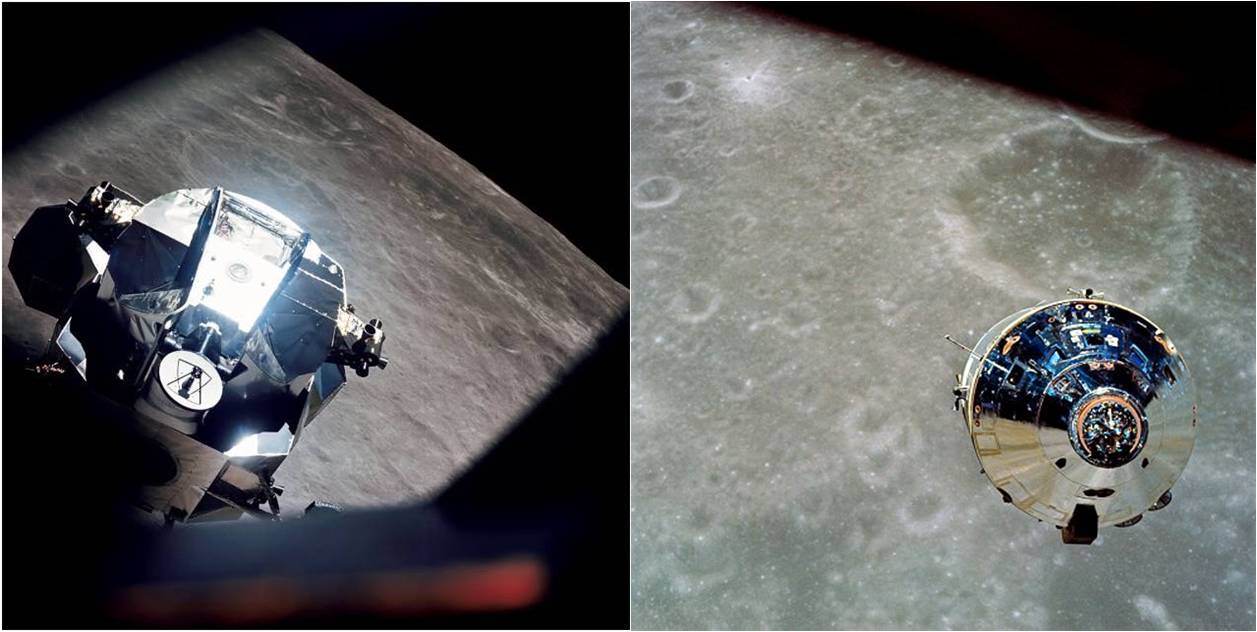
Forty-one years ago this week, Apollo 10 set sail for the Moon on a mission that would see American astronauts fly within a mere 8 nautical miles of the lunar surface. This historic flight cleared the way for the first manned lunar landing just 2 months later.
The infamous Apollo 1 fire in January 1967 resulted in a 21-month suspension of manned spaceflight operations for the United States. By the time the first post-Apollo 1 flight occurred in October 1968, a scant 14 months remained for fulfillment of the national goal to land men on the Moon and return them safely to the Earth by the end of the 1960’s.
Not a few held the position that the lunar landing goal could not be achieved by the end of the decade. Some went so far as to say a successful lunar landing would never occur. Space program opponents had a field day. As always, these ever-present naysayers averred that the US should be spending its money on more “socially-important” programs.
Despite the undercurrents of pessimism and vacillation, NASA resolutely pressed forward. In October of 1968, the Apollo Command Module was thoroughly tested in Earth orbit during Apollo 7. Then, in December of 1968, the mighty Saturn V launch vehicle placed the crew of Apollo 8 in lunar orbit. Finally, the Lunar Module was successfully flight-tested by the Apollo 9 astronauts in March of 1969.
Incredibly, each of the key Apollo flight hardware had been individually tested during 3 missions that were flown over the course of 5 months. Now it was time to test them together. Enter Apollo 10. The purpose of Apollo 10 was to fly to the Moon and do everything short of an actual landing. Apollo 10 was thus a complete dress rehearsal for Apollo 11 sans the landing.
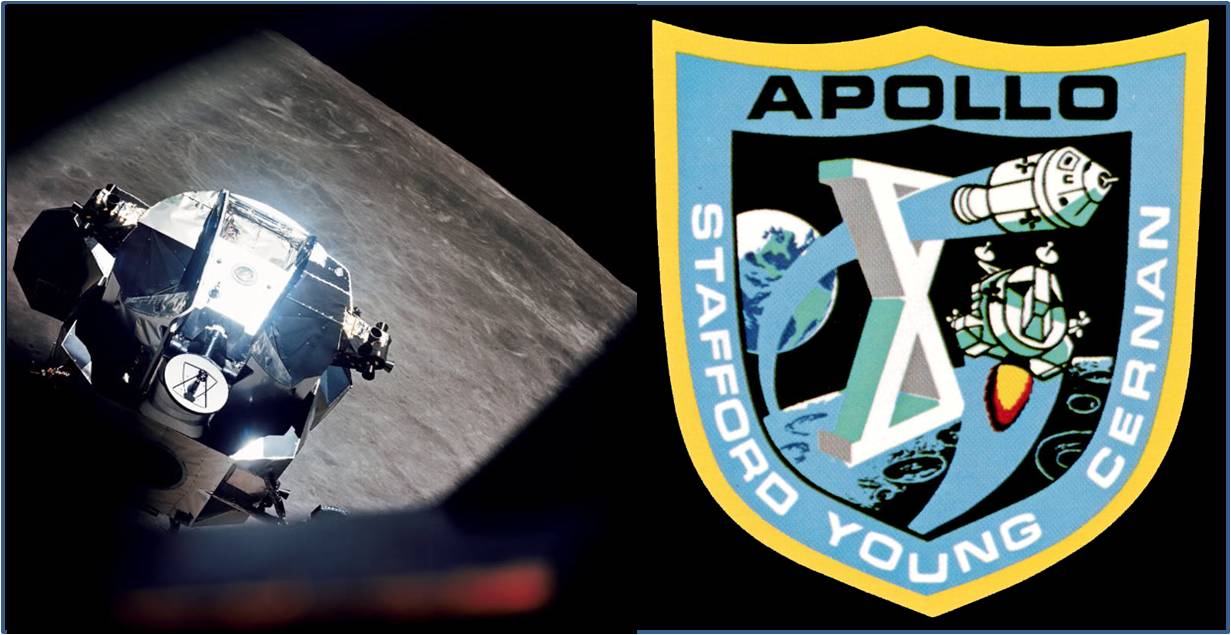
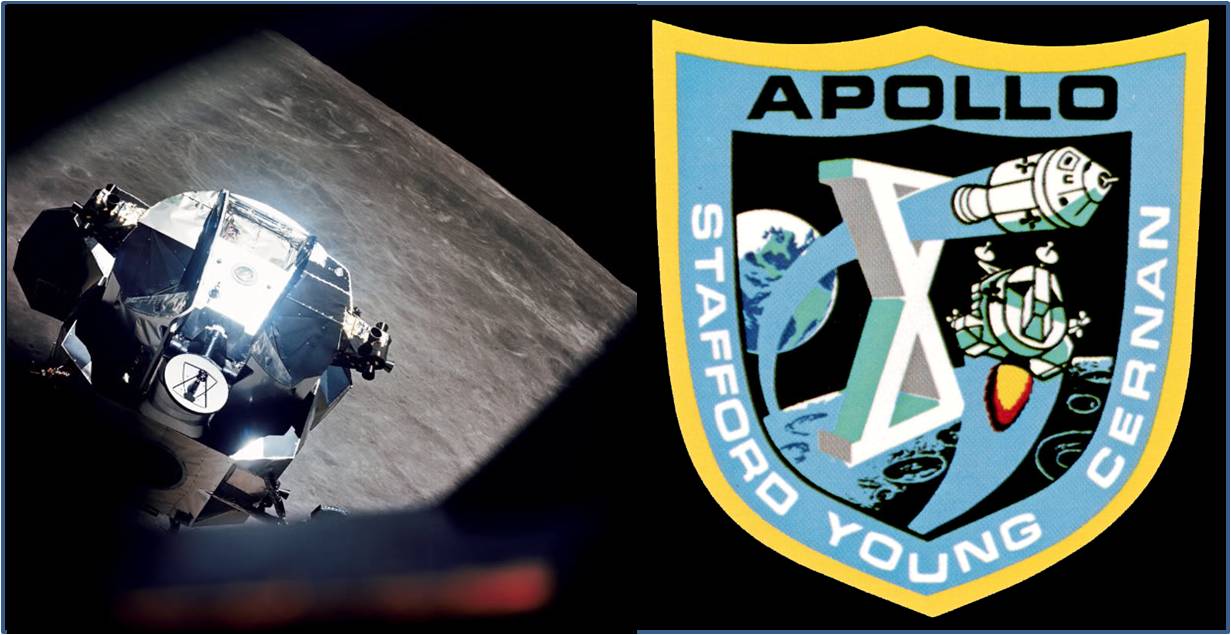
On Sunday, 18 May 1969, Apollo 10 lifted-off from Cape Canaveral’s LC 39B at 16:49 UTC. The crew consisted of Mission Commander Thomas P. Stafford, Command Module Pilot John W. Young and Lunar Module Pilot Eugene A. Cernan. Riding on 7.5 million pounds of first stage thrust, the Saturn V accelerated, went through 2 staging events and arrived in Earth orbit 12 minutes after lift-off.
Following systems checkout, the Saturn IVB third was re-ignited to start the translunar injection (TLI). Apollo 10 entered lunar orbit almost 76 hours after launch. The astronauts later circularized their orbit at 60 nautical miles and then rested in preparation for the next day’s lunar landing rehearsal.
At a mission elapsed time of 98 hours, the Apollo 10 Command and Lunar Modules undocked and separated from one another. Stafford and Cernan crewed the Lunar Module and while John Young flew alone in the Command Module. Over the next 18 hours the Lunar Module crew flew all the flight maneuvers and executed all the procedures associated with a lunar landing.
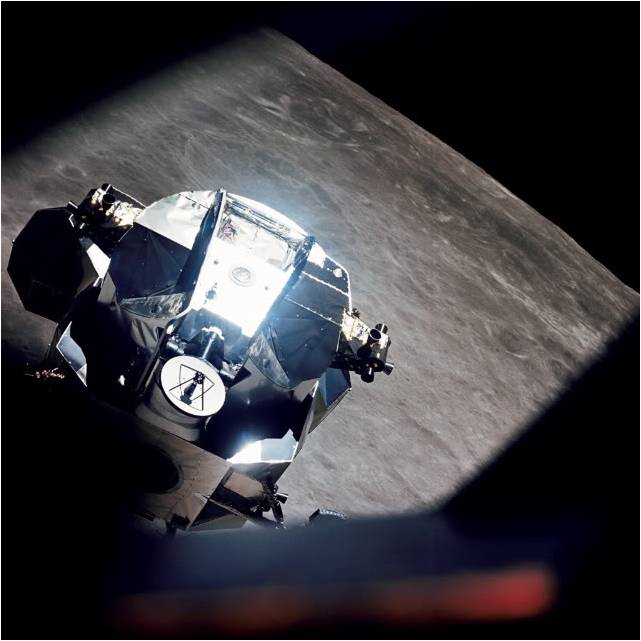
As planned, Stafford and Cernan did not land on the Moon. The closest approach to the lunar surface was approximately 8 nautical miles. The view was great and thoughts about landing were in the crew’s minds. In actuality, the Apollo 10 Lunar Module was not configured for a lunar landing. Had the crew attempted such, they would have been doomed.
The Lunar Module’s return to rendezvous and dock with the Command Module was unremarkable with the exception of staging. The crew mistakenly left the Abort Guidance System (AGS) in AUTOMATIC rather than ATTITUDE HOLD. At separation of the Ascent and Descent Stages, the Ascent Stage wildly gyrated and flirted with gimbal lock.
The crew quickly discovered the AGS switch position problem and brought the vehicle back into control. But it was pretty hairy there for a few moments. As Stafford and Cernan worked to steady their steed, both astronauts articulated their surprise and concern with the dire situation using colorful and interesting language not typically associated with refined behavior.
Happily, the trip back to Earth was nominal. Apollo 10 landed at 16:52 UTC in the Pacific Ocean on Monday, 26 May 1969. Their mission had been highly successful. The way was now clear for an actual lunar landing attempt. That opportunity came just 2 months later. History records that men landed on the Moon and safely returned to the Earth in July 1969.
John Young returned to and landed on the Moon as Commander of Apollo 16 in April of 1972. He went on to command the first Space Shuttle mission (STS-1) in April of 1981. Gene Cernan was Commander of Apollo 17 in December 1972 and was the last man to walk on the Moon. Tom Stafford never returned to the Moon. However, he served as Apollo Spacecraft Commander for the ASTP mission in July of 1975.
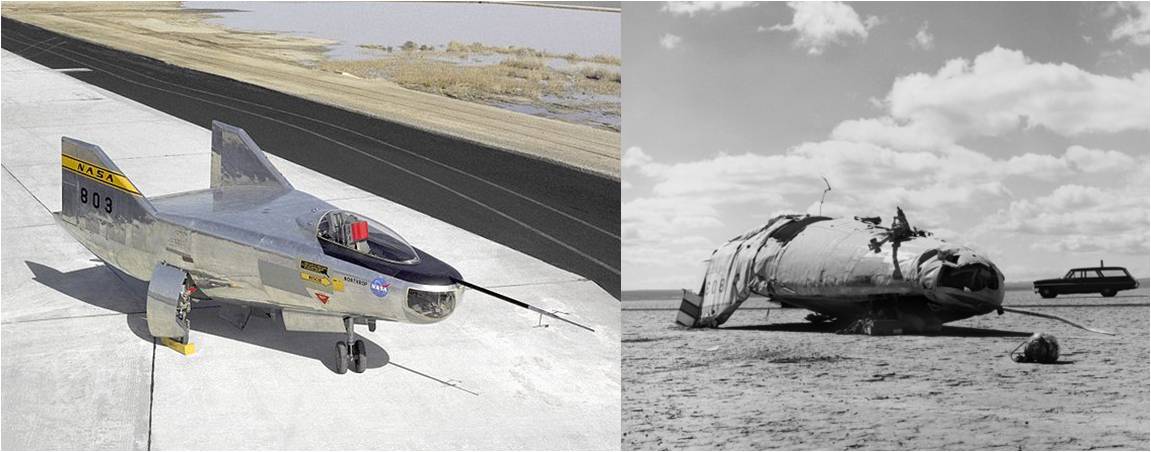
Forty-three years ago today, NASA’s experimental M2-F2 lifting body flight research aircraft was demolished in a horrific landing mishap on Rogers Dry Lake at Edwards Air Force Base. Although critically injured, NASA test pilot Bruce A. Peterson survived the mishap.
A lifting body is a wingless aircraft wherein the aerodynamic lift required for flight is derived solely from the fuselage. Interest in such a configuration stems from the type’s inherent suitability for lifting atmospheric entry from space. The primary attributes being favorable cross-range capability and aerodynamic heating performance.
Lifting body concepts date back to at least the 1950’s. From 1963 to 1975, both NASA and the United States Air Force conducted a number of manned lifting body flight research programs. The aircraft involved were the M2-F1, M2-F2, M2-F3, HL-10, X-24A and X-24B. All were flown out of Edwards Air Force Base between 1963 and 1975.
The favorable hypersonic flight performance of lifting bodies comes at a price. Specifically, lifting bodies are not particularly good subsonic aircraft from the standpoint of lateral-directional handling qualities. The type also falls like a rock in the approach and landing phase. Due to characteristically-low values of subsonic lift-to-drag ratio, touchdown speeds can exceed 250 knots.
The M2-F2 was the first of the heavy weight lifting bodies. It measured 22 feet in length and 9.4 feet in span. The aircraft had an empty weight of 4,630 pounds. The M2-F2 had boosted hydraulic 3-axis flight controls and a stability augmentation system. The vehicle was also configured with a quartet of hydrogen peroxide rockets rated at 400 pounds of thrust each.
On Wednesday, 10 May 1967, the M2-F2 (NASA S/N 803) fell away from the fabled B-52B (S/N 52-0008) launch aircraft at an altitude of 44,000 feet. NASA test pilot Bruce A. Peterson was at the controls of the M2-F2. This was Peterson’s 3rd flight in the M2-F2 and the aircraft’s 16th overall. It would be the last research flight for both.
The early part of the mission was unremarkable. Then the flight test gremlins made their presence known. Passing through 7,000 feet in a steep glide, Peterson pushed forward on the control column and brought the M2-F2 to quasi-zero angle-of-attack. The aircraft quickly entered a Dutch Roll with extreme, rapid lateral excusions.
Peterson increased angle-of-attack to arrest the wild lateral-directional motions of the M2-F2. However, he was no longer pointed toward Runway 18 on Rogers Dry Lake as intended. The ground was coming up rapidly and he would have to land the M2-F2 on a part of the lakebed that did not have the typical visual aids required for correctly judging height above surface level.
Peterson might have gotten himself and the M2-F2 on the ground in one piece except for the helicopter that now loomed directly ahead in his landing path. Not that it was the helicopter pilot’s fault. It was just that the M2-F2 had strayed so far from its intended flight path that the helicopter was suddenly a navigational hazard.
Managing to somehow avoid a collision with the flight support helicopter, Peterson now fired his landing rockets in an attempt to stay in the air a little longer. He then hit the landing gear switch. In 1.5 seconds the gear would be down and locked. Unfortunately, there was only one second of flight time remaining before touchdown.
As the M2-F2 contacted the lakebed at 220 knots, its main landing gear was jammed back up into the fuselage. That was the end of the ball game. The M2-F2 tumbled end-over-end across Rogers Dry Lake shearing off the canopy, main gear and right vertical tail. The battered and twisted airframe finally came to rest inverted on the lakebed.
Incredibly, rescue crews found Bruce Peterson still alive as they came upon the crash scene. He was even conscious, However, the pilot was terribly hurt. Peterson’s oxygen mask had been torn off as the M2-F2 tumbled six (6) times. He received severe facial injuries due to repeated impact with the lakebed surface. In addition, Peterson suffered a fractured skull, severe damage to his right eye and a broken hand.
Bruce Peterson came back from his brush with eternity. He needed extensive reconstructive surgery on his face and lost the sight in his right eye. Peterson served as a project engineer for a number of NASA flight programs and even flew as a Marine reservist. He later served as a safety officer on the B-2 flight test effort. Bruce Peterson passed away at the age of 72 on 01 May 2006.
For those who remember, “The Six-Million-Dollar Man” was a television series about a fictional test pilot who had been badly injured in an aircraft accident. In the storyline, the fictional character was “rebuilt” by doctors using bionic technology. Trivia buffs may be interested to know that the basis for “The Six-Million-Dollar Man” was Bruce Peterson’s M2-F2 experience.
For those that remember, the “The Six-Million-Dollar Man” was a televison series about a fictional test pilot who had been badly injured in an aircraft accident. In the storyline, the fictional character was “rebuilt” by doctors using bionic technology. Trivia buffs may be interested to know that the basis for “The Six-Million-Dollar Man” was Bruce Peterson’s terrifying M2-F2 crash.
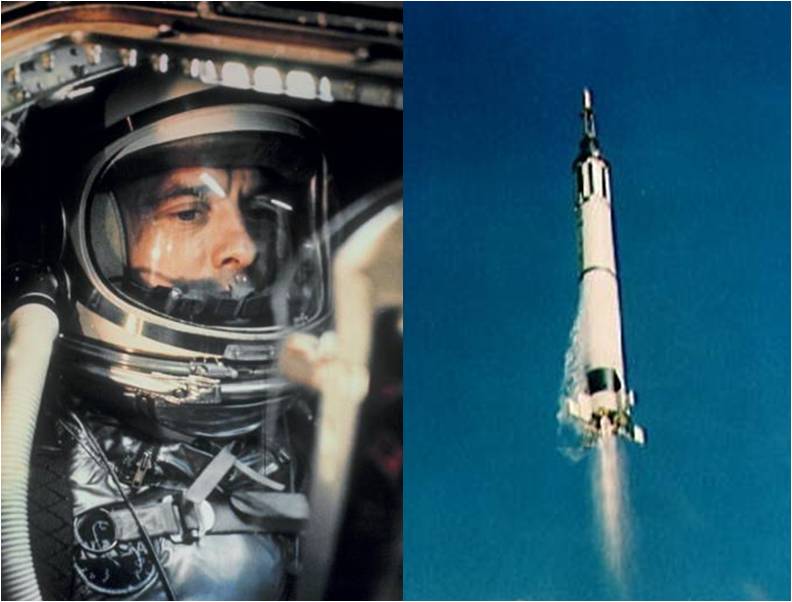
Forty-nine years ago this week, United States Navy Commander Alan Bartlett Shepard, Jr. became the first American to be launched into space. Shepard named his Mercury spacecraft “Freedom 7”.
Officially designated as Mercury-Redstone 3 (MR-3) by NASA, the mission was America’s first true attempt to put a man into space. MR-3 was a sub-orbital flight. This meant that the spacecraft would travel along an arcing parabolic flight path having a high point of about 115 nautical miles and a total range of roughly 300 nautical miles. Total flight time would be about 15 minutes.
The Mercury spacecraft was designed to accommodate a single crew member. With a length of 9.5 feet and a base diameter of 6.5 feet, the vehicle was less than commodious. The fit was so tight that it would not be inaccurate to say that the astronaut wore the vehicle. Suffice it to say that a claustrophobic would not enjoy a trip into space aboard the spacecraft.
Despite its diminutive size, the 2,500-pound Mercury spacecraft (or capsule as it came to be referred to) was a marvel of aerospace engineering. It had all the systems required of a space-faring craft. Key among these were flight attitude, electrical power, communications, environmental control, reaction control, retro-fire package, and recovery systems.
The Redstone booster was an Intermediate Range Ballistic Missile (IRBM) modified for the manned mission. The Redstone’s uprated A-7 rocket engine generated 78,000 pounds of thrust at sea level. Alcohol and liquid oxygen served as propellants. The Mercury-Redstone combination stood 83 feet in length and weighed 66,000 pounds at lift-off.
On Friday, 05 May 1961, MR-3 lifted-off from Cape Canaveral’s Launch Complex 5 at 14:34:13 UTC. Alan Shepard went to work quickly calling out various spacecraft parameters and mission events. The astronaut would experience a maximum acceleration of 6.5 g’s on the ride upstairs.
Nearing apogee, Shepard manually controlled Freedom 7 in all 3 axes. In doing so, he positioned the capsule in the required 34-degree nose-down attitude. Retro-fire occurred ontime and the retro package was jettisoned without incident. Shepard then pitched the spacecraft nose to 14 degrees above the horizon preparatory to reentry.
Reentry forces quickly built-up on the plunge back into the atmosphere with Shepard enduring a maximum deceleration of 11.6 g’s. He had trained for more than 12 g’s prior to flight. At 21,000 feet, a 6-foot droghue chute was deployed followed by the 63-foot main chute at 10,000 feet. Freedom 7 splashed-down in the Atlantic Ocean 15 minutes and 28 seconds after lift-off.
Following splashdown, Shepard egressed Freedom 7 and was retreived from the ocean’s surface by a recovery helicopter. Both he and Freedom 7 were safely onboard the carrier USS Lake Champlain within 11 minutes of landing. During his brief flight, Shepard had reached a maximum speed of 5,180 mph, flown as high as 116.5 nautical miles and traveled 302 nautical miles downrange.
The flight of Freedom 7 had much the same effect on the Nation as did Lindbergh’s solo crossing of the Atlantic in 1927. However, in light of the Cold War fight against the world-wide spread of Soviet communism, Shepard’s flight arguably was more important. Indeed, Alan Shepard became the first of what Tom Wolfe called in his classic book “The Right Stuff”, the American single combat warrior.
For his heroic MR-3 efforts, Alan Shepard was awarded the Distinguished Service Medal by an appreciative nation. In February 1971, Alan Shepard walked on the surface of the Moon as Commander of Apollo 14. He was the lone member of the original Mercury Seven astronauts to do so. Shepard was awarded the Congressional Space Medal of Freedom in 1978.
Alan Shepard succumbed to leukemia in July of 1998 at the age of 74. In tribute to this American space hero, naval aviator and US Naval Academy graduate, Alan Shepard’s Freedom 7 spacecraft now resides in a place of honor at the United States Naval Academy in Annapolis, Maryland.
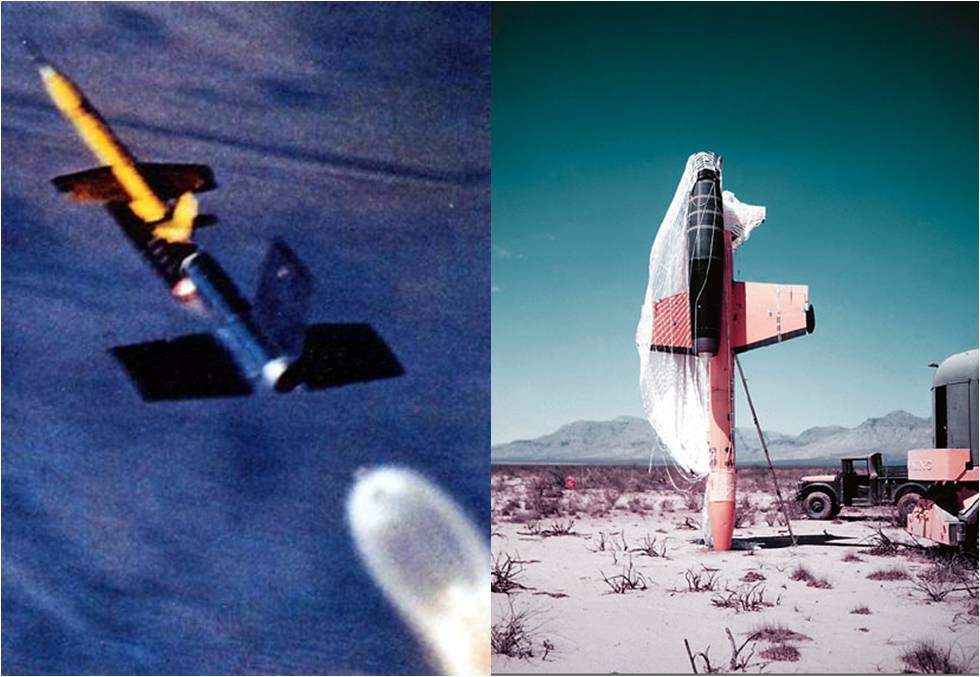
Fifty-nine years ago today, the first flight test of a full-scale Lockheed X-7A ramjet test vehicle took place near Alamogordo, New Mexico. However, the dreaded flight test gremlins prevailed on this occasion as the entire X-7 launch stack disintegrated shortly after drop from its USAF B-29 launch aircraft.
The inauspicious start to the X-7 flight test program on Thursday, 26 April 1951 was but a momentary bump in the road. Ultimately, that road would lead to significant technological progress in the development of ramjet propulsion systems. Approximately 130 flight tests involving the X-7 would be conducted between 1951 and 1960.
The beginning of the X-7 program dates back to December of 1946. At that time, the United States was on the cusp of an unprecedented period of frontiersmanship in the realm of high-speed flight. Among other needs, a flying testbed was required to perform ramjet propulsion flight research.
A ramjet is a form of airbreathing propulsion well suited for flight up to a Mach number of about 5. Unlike the turbojet, a ramjet contains no internal rotating machinery. Flow compression comes entirely from deceleration of the supersonic freestream. However, a ramjet cannot produce static thrust. Hence, it must be boosted to flight speed via another propulsion system such as a turbojet or rocket.
The X-7 was rocket-boosted to ramjet take-over conditions. Booster thrust was on the order of 100,000 pounds with a burn time of 5 seconds. Following booster separation, the type would fly on ramjet power until fuel exhaustion. The ramjet test article was slung under the belly of the X-7 airframe which made for an asymmetric vehicle configuration.
The entire X-7A-1 launch stack measured almost 33 feet in length and had a gross weight of about 8,000 pounds. Later variants such as the X-7A-3 and XQ-5 would be longer by 3 and 4 feet, respectively. However, their gross weight was about the same as that of the X-7A-1 configuration.
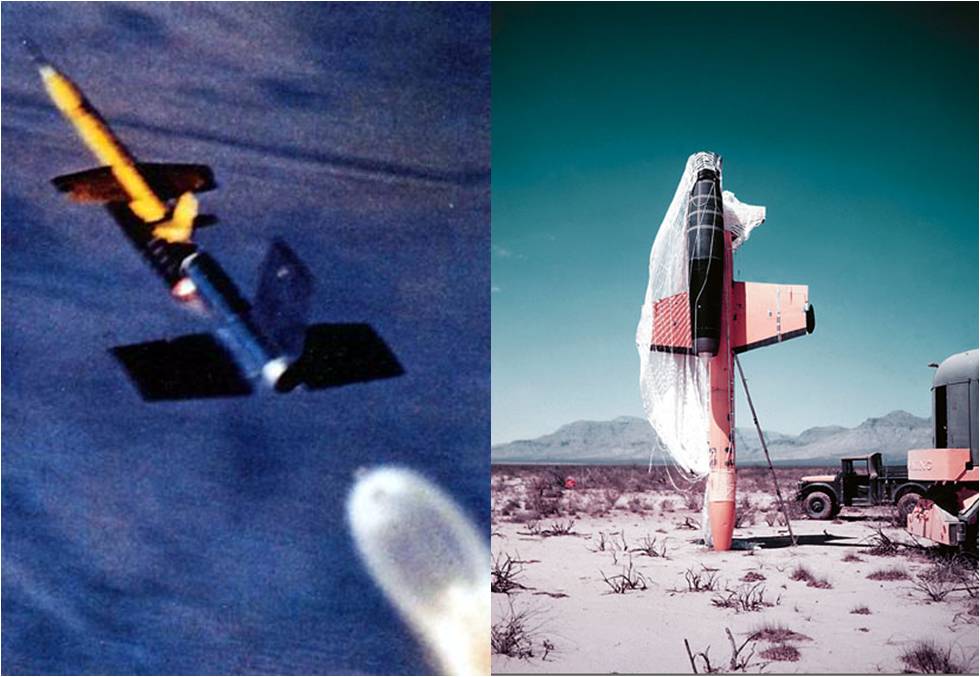
The X-7 was designed for reusability. Vehicle recovery was effected via a multi-segment parachute system. This feature afforded engineers the unique opportunity to make a post-flight inspection of each ramjet engine test article. These inspections of flight hardware made for a more reliable means of making needed propulsion system design improvements.
Typically, the X-7’s long conical nose penetrated several feet into the soil at landing. The result was that the X-7 airframe stuck out of the ground with the main parachute usually draped over the vehicle’s aft end. This somewhat comical operational feature made the X-7 much easier to locate on the floor of the vast desert test range.
The X-7 was utilized to flight test ramjet engines that ranged from 20 to 36 inches in diameter. Key propulsion performance data were telemetered to ground stations for post-flight analysis. The ability to test an assortment of ramjet engine configurations during many flights produced a wealth of ramjet propulsion data over the life of the X-7 program.
The X-7 established a variety of flight performance records during its heyday. The type’s airbreathing propulsion speed, altitude and range records included 2,880 mph (Mach 4.3), 106,000 feet and 134 miles, respectively. Note that these marks were all accomplished in the 1950’s.
The technological legacy of the X-7 program is impressive. Indeed, flight vehicles such as the Boeing BOMARC, Lockheed SR-71 and Lockheed D-21 were direct beneficiaries of X-7 propulsion flight research. Though difficult to assess the extent thereof, Lockheed’s legendary Advanced Development Program (i.e., Skunk Works) has undoubtably benefitted from the X-7’s rich propulsion legacy as well.
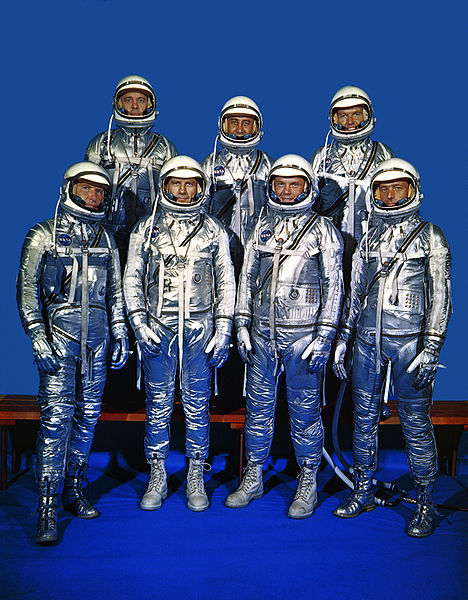
Fifty-one years ago this month, NASA held a press conference in Washington, D.C. to introduce the seven men selected to be Project Mercury Astronauts. They would become known as the Mercury Seven or Original Seven.
Project Mercury was America’s first manned spaceflight program. The overall objective of Project Mercury was to place a manned spacecraft in Earth orbit and bring both man and machine safely home. Project Mercury ran from 1959 to 1963.
The men who would ultimately become Mercury Astronauts were among a group of 508 military test pilots originally considered by NASA for the new role of astronaut. The group of 508 candidates was then successively pared to 110, then 69 and finally to 32. These 32 volunteers were then subjected to exhaustive medical and psychological testing.
A total of 18 men were still under consideration for the astronaut role at the conclusion of the demanding test period. Now came the hard part for NASA. Each of the 18 finalists was truly outstanding and would be a worthy finalist. But there were only 7 spots on the team.
On Thursday, 09 April 1959, NASA publicly introduced the Mercury Seven in a special press conference held for this purpose at the Dolley Madison House in Washington, D.C. The men introduced to the Nation that day will forever hold the distinction of being the first official group of American astronauts. In the order in which they flew, the Mercury Seven were:
Alan Bartlett Shepard Jr., United States Navy. Shepard flew the first Mercury sub-orbital mission (MR-3) on Friday, 05 May 1961. He was also the only Mercury astronaut to walk on the Moon. Shepherd did so as Commander of Apollo 14 (AS-509) in February 1971. Alan Shepard died from leukemia on 21 July 1998 at the age of 74.
Vigil Ivan Grissom, United States Air Force. Grissom flew the second Mercury sub-orbital mission (MR-4) on Friday, 21 July 1961. He was also Commander of the first Gemini mission (GT-3) in March 1965. Gus Grissom might very well have been the first man to walk on the Moon. But he died in the Apollo 1 Fire, along with Astronauts Edward H. White II and Roger Chaffee, on Friday, 27 January 1967. Gus Grissom was 40 at the time of his death.
John Herschel Glenn Jr., United States Marines. Glenn was the first American to orbit the Earth (MA-6) on Thursday, 22 February 1962. He was also the only Mercury Astronaut to fly a Space Shuttle mission. He did so as a member of the STS-95 crew in October of 1998. Glenn was 77 at the time and still holds the distinction of being the oldest person to fly in space. John Glenn will be 89 in July 2010.
Malcolm Scott Carpenter, United States Navy. Carpenter became the second American to orbit the Earth (MA-7) on Thursday, 24 May 1962. This was his only mission in space. Carpenter subsequently turned his attention to under-sea exploration and was an aquanaut on the United States Navy SEALAB II project. Scott Carpenter will be 85 in May 2010.
Walter Marty Schirra Jr., United States Navy. Schirra became the third American to orbit the Earth (MA-8) on Wednesday, 03 October 1962. He later served as Commander of Gemini 6A (GT-6) in December 1965 and Apollo 7 (AS-205) in October 1968. Schirra was the only Mercury Astronaut to fly Mercury, Gemini and Apollo space missions. Wally Schirra died from a heart attack in May 2007 at the age of 84.
Leroy Gordon Cooper Jr., United States Air Force. Cooper became the fourth American to orbit the Earth (MA-9) on Wednesday, 15 May 1963. In doing so, he flew the last and longest Mercury mission (22 orbits, 34 hours). Cooper was also Commander of Gemini 5 (GT-5), the first long-duration Gemini mission, in August 1965. Gordo Cooper died from heart failure in October 2004 at the age of 77.
Donald Kent Slayton, United States Air Force. Slayton was the only Mercury Astronaut to not fly a Mercury mission when he was grounded for heart arrythemia in 1962. He subsequently served many years on Gemini and Apollo as head of astronaut selection. He finally got his chance for spaceflight in July 1975 as a crew member of the Apollo-Soyuz mission (ASTP). Deke Slayton died from brain cancer in June of 1993 at the age of 69.
History records that the Mercury Seven was the only group of NASA astronauts that had a member that flew each of America’s manned spacecraft (i.e, Mercury, Gemini, Apollo and Shuttle). Though just men and imperfect mortals, we salute each of them for their genuinely heroic deeds and unique contributions made to the advancement of American manned spaceflight.
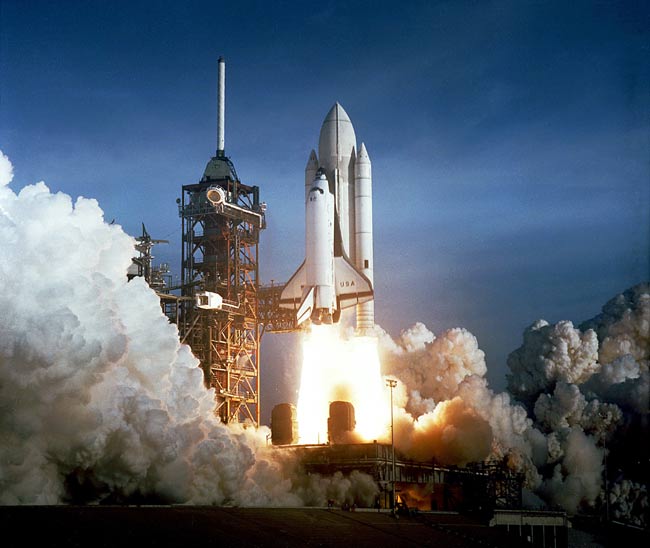
Twenty-nine years ago today, the United States successfully launched the Space Shuttle Columbia into orbit about the Earth. It was the maiden flight of the Nation’s Space Transportation System (STS).
The Space Shuttle was unlike any manned space vehicle ever flown. A giant aircraft known as the Orbiter was side-mounted on a huge liquid-propellant stage called the External Tank (ET). Flanking opposing sides of the ET was a pair of Solid Rocket Boosters (SRB). The Orbiter, SRB’s and ET measured 122 feet, 149 feet and 154 feet in length, respectively.
The Space Shuttle system was conceived with an emphasis on reusability. Each Orbiter (Columbia, Challenger, Atlantis, Discovery and Endeavor) was designed to fly 100 missions. Each SRB was intended for multiple mission use as well. The only single-use element was the ET since it was more cost effective to use a new one for each flight than to recover and refurbish a reusable version.
NASA called STS-1 the boldest test flight in history. Indeed, the STS-1 mission marked the first time that astronauts would fly a space vehicle on its inaugural flight! STS-1 was also the first time that a manned booster system incorporated solid rocket propulsion. Unlike liquid propellant rocket systems, once ignited, the Shuttle’s solid rockets burned until fuel exhaustion.
And then there was the Orbiter element which had its own new and flight-unproven propulsion systems. Namely, the Space Shuttle Main Engines (SSME) and Orbital Maneuvering System (OMS). Each of the three (3) SSME’s generated 375,000 pounds of thrust at sea level. Thrust would increase to 475,000 pounds in vacuum. Each OMS rocket engine produced 6,000 pounds of thrust in vacuum.
The Orbiter was also configured with a reusable thermal protection system (TPS) which consisted of silica tiles and reinforced carbon-carbon material. The TPS for all previous manned space vehicles utilized single-use ablators. Would the new TPS work? How robust would it be in flight? What post-flight care would be needed? Answers would come only through flight.
To add to the “excitement” of first flight, the Orbiter was a winged vehicle and would therefore perform a hypersonic lifting entry. The vehicle energy state would have to be managed perfectly over the 5,000 mile reentry flight path from entry interface to runway touchdown. Since the Orbiter flew an unpowered entry, it would land dead-stick. There would only be one chance to land.
On Sunday,12 April 1981, the Space Shuttle Columbia lifted-off from Pad 39A at Cape Canaveral, Florida. Official launch time was 12:00:03 UTC. The flight crew consisted of Commander John W. Young and Pilot Robert L. Crippen. Their Columbia launch stack tipped the scales at 4.5 million pounds and thundered away from the pad on over 7 million pounds of thrust.
Columbia went through maximum dynamic pressure (606 psf) at Mach 1.06 and 26.5 KFT. SRB separation occurred 120 seconds into flight at Mach 3.88 and 174,000 feet; 10,000 feet higher than predicted. This lofting of the ascent trajectory was later attributed to unmodeled plume-induced aerodynamic effects in the Orbiter and ET base region.
Following separation, Columbia rode the ET to burnout at Mach 21 and 389.7 KFT. Following ET separation, Columbia’s OMS engines were fired minutes later to achieve a velocity of 17,500 mph and a 166-nautical mile orbit.
Young and Crippen would orbit the Earth 37 times before coming home on Tuesday, 14 April 1981. In doing so, they successfully flew the first hypersonic lifting reentry from orbit. Though unaware of it at the time, the crew came very close to catastrophe as the Orbiter’s body flap had to be deflected 8 degrees more than predicted to maintain hypersonic pitch control.
The reason for this “hypersonic anomaly” was that ground test and aero modeling had failed to capture the effects of high temperature gas dynamics on Orbiter pitch aerodynamics. Specifically, the vehicle was more stable in hypersonic flight than had been predicted. This necessitated greater nose-down body flap deflections to trim the vehicle in pitch. It was a close-call. But Columbia and its crew lived to fly another day.
Columbia touched-down at 220 mph on Runway 23 at Edwards Air Force Base, California at 18:20:57 UTC. Young and Crippen were euphoric with the against-the-odds success of the Space Shuttle’s first mission.
NASA too reveled in the Shuttle’s accomplishment. And so did America. This was the country’s first manned space mission since 1975. The longest period of manned spaceflight inactivity ever in the Nation’s history.
Fittingly, a well-known national news magazine celebrated Columbia’s success with a headline which read: “America is Back!”
And while it flies no more, we remember that first Orbiter, its first flight and its many subsequent accomplishments. To which we say: Hail Columbia!
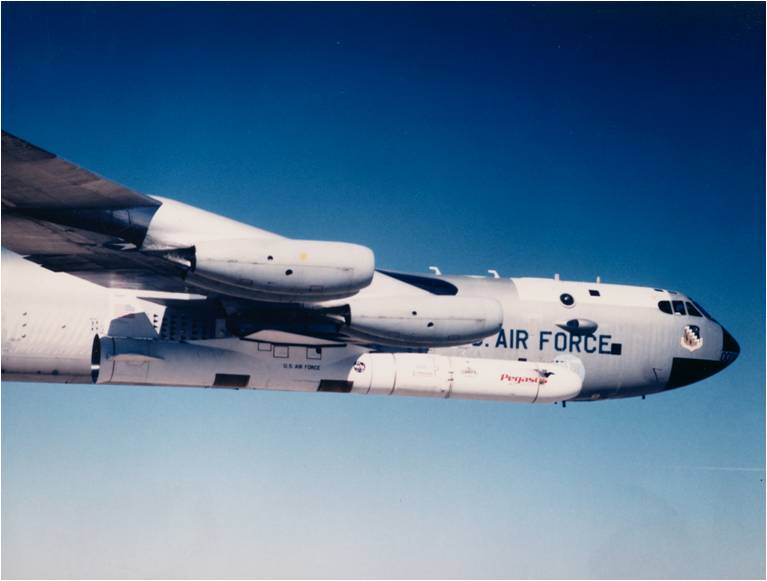
Twenty-years ago today, the Orbital Sciences Corporation (OSC) orbited a PegSat satellite using the then-new Pegasus 3-stage launch vehicle. This historic event marked the first successful implementation of the air-launched satellite launcher concept.
The concept of air-launch dates back to the 1940’s and the early days of United States X-plane flight research. A multi-engine aircraft known as the mothership was employed to transport a smaller test aircraft to altitude. The test aircraft was subsequently dropped from the mothership and went on to conduct the flight research mission.
A clear benefit of air-launch was that all of the fuel and propulsion required to get to the drop point was provided by the mothership. Thus, the test aircraft was allowed to use all of its own fuel for the flight research mission proper. In that sense, the mothership-test aircraft combination functioned as a two-stage launch vehicle.
The value and efficacy of the air-launch concept was demonstrated on numerous X-plane programs. Flight research aircraft such as the Bell XS-1, Bell X-1A, Bell X-1E, Bell X-2, Douglas D-558-II, and North American X-15 were all air-launched. More recently, the X-43A and X-51A scramjet-powered flight research vehicles also employed the air-launch concept.
An added benefit of the air-launch technique is that the launch site is highly portable! This provides enhanced mission flexibility compared to fixed position launch sites. The associated operating costs are much lower for the air-launched concept as well.
Orbital Science’s original Pegasus launch vehicle configuration was designed to fit within the dimensional envelope of the X-15. The standard Pegasus configuration measured 50 feet in length and had a wingspan of 22 feet. The same dimensions as the baseline X-15 rocket airplane. Pegasus body diameter and launch weight were 50 inches and 41,000 pounds, respectively.
A key design feature of the Pegasus 3-stage launch vehicle configuration was the vehicle’s trapezodal-planform wing which provided the aerodynamic lift required to shape the endoatmospheric portion of the ascent flight path. This made Pegasus even more X-15-like.
The real difference between Pegasus and the X-15 was propulsion. The X-15 performed a sub-orbital mission using an XLR-99 liquid rocket engine rated at 57,000 pounds of sea level thrust. Pegasus used a combination of three (3) Hercules solid rocket motors to perform an orbital mission. The 1st, 2nd and 3rd stage rocket motors were rated at 109,000, 26,600 and 7,800 pounds of vacuum thrust, respectively.
On Thursday, 05 April 1990, the first Pegasus launch took place over the Pacific Ocean within an area known as the Point Arguello Western Air Drop Zone (WADZ) . Pegasus 001 fell away from its NASA B-52B (S/N 52-0008) mothership at 19:10 UTC as the pair flew at Mach 0.8 and 43,000 feet. Pegasus first stage ignition took place 5 seconds after drop.
Following first stage ignition, the Pegasus executed a pull-up to begin the trip upstairs. The second and third stage rocket motors fired on time. The stage separation and payload fairing jettison events worked as planned. Roughly 10 minutes after drop, the 392-pound PegSat payload arrived in a 315 mile x 249 mile elliptical orbit.
Since that triumphant day in April 1990, both the Pegasus launch vehicle configuration and mission have grown and matured. Of a total of 40 official Pegasus missions to date, 37 have been flown successfully.
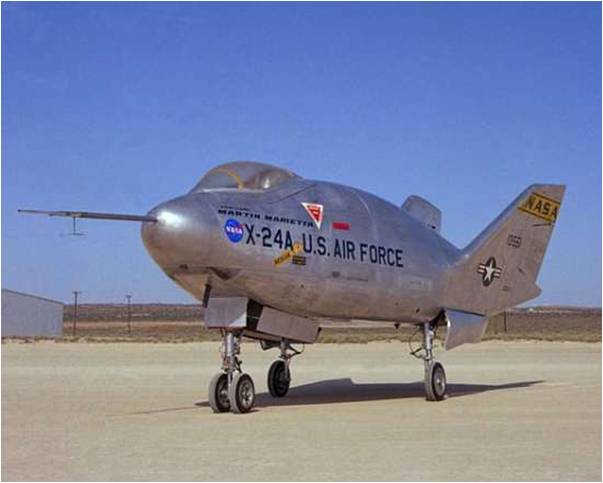
Thirty-nine years ago today, the USAF/NASA X-24A lifting body was flown to a speed of 1,036 mph (Mach 1.6) by NASA Research Pilot John Manke. It was the fastest flight of the rocket-powered lifting body.
A lifting body is an unconventional aircraft in that the vehicle generates lift without the benefit of a wing. Rather, the aircraft produces lift by the manner in which its fuselage is shaped.
In the early days of manned spaceflight, there were two schools of thought regarding the preferred mode of entry from orbital flight. One camp favored ballistic entry where the predominant flight force was aerodynamic drag. This was in contradistinction to lifting entry where both aerodynamic lift and drag forces were generated.
Ballistic entry is the more simple approach, but affords little control of the endoatmospheric flight path. This stems from the fact that the landing point for a ballistic entry is largely dictated by the entry vehicle’s velocity and flight path angle at entry interface.
While operationally more complicated, lifting entry provides a positive means for controlling the entry vehicle’s flight path and thus its landing point. At hypersonic speeds, even a small amount of lift markedly enhances entry vehicle downrange and crossrange capability.
Part of the complication of designing a lifting entry vehicle stems from the need to deal with high levels of heating during entry flight. The vehicle’s shape not only dictates its aerodynamic capabilities, but its aerodynamic heating characteristics as well. Thus, issues of flight path control and airframe survivability are interrelated.
The heyday of lifting body flight research spans the period from 1963 to 1975. For the record, the lifting bodies flown in that era include the following vehicles: M2-F1, M2-F2, M2-F3, HL-10, X-24A and X-24B. Each of these aircraft were piloted. All lifting body flight research was conducted at Edwards Air Force Base, California.
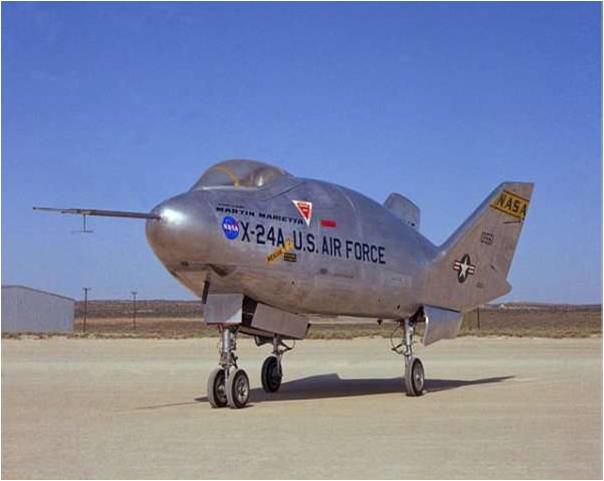
The X-24A was developed by the Martin Company under contract to the United States Air Force. A single X-24A was produced. It measured 24.5 feet in length and had a gross weight of 11,450 pounds. Airframe empty weight was 6,300 pounds.
Though unconventional in shape, the X-24A incorporated full 3-axis flight controls. The aircraft was powered by the venerable XLR-11 rocket motor. This four-chambered propulsion system was rated at 8,500 pounds of sea level thrust. Maximum burn time was on the order of 140 seconds. All landings were conducted deadstick.
The X-24A displayed generally good handling characteristics, but had to be flown precisely. Angle-of-attack had to be maintained between about 4 and 12 degrees. Flight at lower and higher angles-of-attack encountered undesirable aerodynamic control and cross-coupling characteristics.
On Monday, 29 March 1971, X-24A (S/N 66-13551) fell away from the B-52B mothership in an effort to fly a maximum speed mission. NASA research pilot John Manke was at the controls. Manke accelerated the aircraft in a climb and reached a record speed of 1,036 mph (Mach 1.6). Interestingly, it was John Manke who had previously flown the X-24A to its highest altitude of 71,407 feet on 27 October 1970.
The X-24A, like all of the lifting bodies, contributed significantly to the decision to land the Space Shuttle Orbiter deadstick. The lifting bodies, as well as X-aircraft such as the X-1, X-2, and X-15, proved conclusively that an aircraft could reliably (1) manage its energy state and (2) precisely control touchdown point in an unpowered state.
The X-24A flew a total of 28 flight research missions. Following its final flight, the X-24A was then converted to the radically different-appearing X-24B configuration which flew 36 times. Today, the X-24B is displayed in a place of honor in the United States Air Force Museum at Wright-Patterson Air Force Base in Dayton, Ohio.