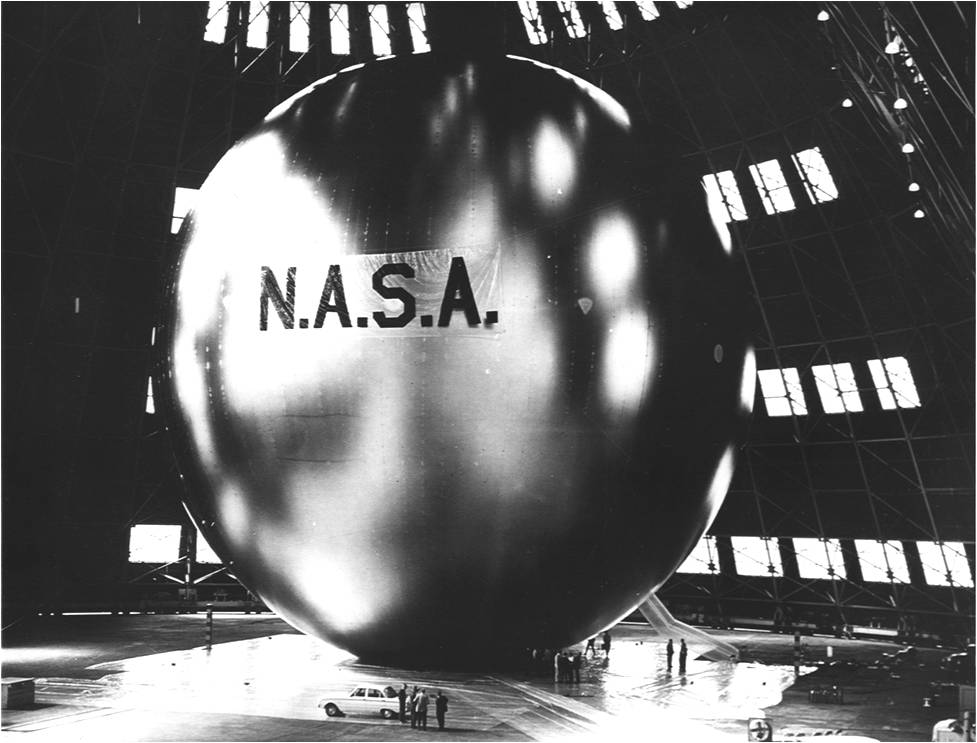
Fifty years ago this week, the United States successfully launched the Echo 1A passive communications satellite into Earth orbit. The 100-foot diameter balloon was among the largest objects ever to orbit the Earth.
A plethora of earth-orbiting communication satellites provide for a global connectivity that is commonplace today. Such was not always the case. Roll the clock back a half-century and we find that a global communications satellite system was just a concept. However, keen minds would soon go to work and provide mankind with yet another tangible spaceage benefit.
Communications satellites are basically of two types; passive and active. A passive communications satellite (PCS) simply reflects signals sent to it from a point on Earth to other points on the globe. An active communications satellite (ACS) can receive, store, modify and/or transmit Earth-based signals.
The earliest idea for a PCS involved the use of an orbiting spherical balloon. The balloon was fabricated from mylar polyester having a thickness of a mere 0.5 mil. The uninflated balloon was packed tightly into a small volume and inserted into a payload canister preparatory to launch. Once in orbit, the balloon was released and then inflated to a diameter of 100 feet.
The system described above materialized in the late 1950’s as Project Echo. The Project Echo satellite was essentially a huge spherical reflector for transcontinental and intercontinental telephone, radio and television signals. The satellite was configured with several transmitters for tracking and telemetry purposes. Power was provided by an array of nickel-cadmium batteries that were charged via solar cells.
Echo 1 was launched from Cape Canaveral, Florida on Friday, 13 May 1960. However, the launch vehicle failed and Echo 1 never achieved orbit. Echo 1A (sometimes referred to as Echo 1) lifted-off from Cape Canveral’s LC-17A at 0939 UTC on Friday, 12 August 1960. The Thor Delta launch vehicle successfully placed the 166-lb satellite into a 820-nm x 911-nm orbit.
An interesting characteristic of the Echo satellite was the large oscillation in the perigee of its orbit (485 nm to 811 nm) over several months. This was caused by the influences of solar radiation and variations in atmospheric density. While these factors are just part of the earth-orbital environment, their effects were much more noticeable for Echo due to the type’s large surface area-to-weight ratio.
Echo 1A orbited the Earth until it reentered the Earth’s atmosphere on Saturday, 25 May 1968. Echo 2 was a larger and improved version of Echo 1A. It measured 135-feet in diameter and weighed 547-lb. Echo 2 orbited the Earth between January of 1964 and June of 1969. Other than the Moon, both satellites were the brightest objects observable in the night sky due to their high reflectivity.
The Echo satellites served their function admirably. For a time, they were quite a novelty. However, progress on the ACS scene quickly relegated the PCS to obselescence. Today, virtually all communication satellites are of the ACS variety.
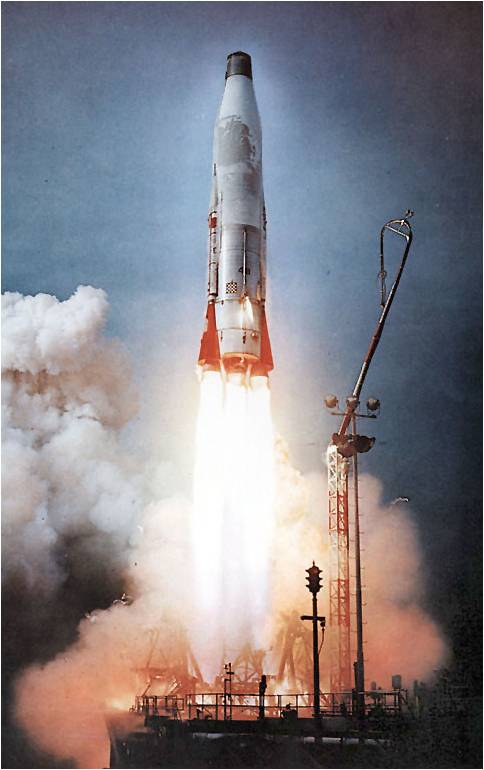
Fifty-two years ago today, an Atlas B flew 2,500 miles down the Eastern Test Range in a key developmental test of America’s first Intercontinental Ballistic Missile (ICBM). Among other historic achievements, the test marked the first successful flight of the innovative stage-and-a-half missile.
The infamous Cold War between the United States and the Soviet Union was marked by the specter of nuclear confrontation. Each side developed a family of launch vehicles that could deliver nuclear ordnance to the homeland of the other. The type of launch vehicle employed is known as an Intercontinental Ballistic Missile (ICBM).
An ICBM flies a long, arcing (sub-orbital) trajectory to the target. This flight path is parabolic in shape and thousands of miles in range. The maximum altitude point (apogee) is about mid-way to the target and is located hundreds of miles above the surface of the Earth. An ICBM can reach any point on the globe within 30 minutes of launch.
The first ICBM developed by the United States was the Atlas missile. The origins of this program date back to late 1945 when the United States Army requested proposals from the aerospace industry for novel long-range missile concepts. Consolidated-Vultee Aircraft (Convair) caught the Army’s eye with a missile design that ultimately became the Atlas.
The Atlas was innovative from a number of standpoints. Perhaps most novel was the use of very thin stainless steel tankage in an effort to provide the Atlas with an extremely lightweight structure. However, the tank was so thin that a screwdriver could easily puncture its walls. Moreover, the tank would collapse even under its own weight. Nitrogen pressurization was employed to obtain the necessary structural rigidity.
Another Atlas innovation involved the use of the so-called stage-and-a-half or parallel staging propulsion concept. This system was comprised of a pair of outboard boosters (Stage 0) and a single sustainer core (Stage 1). These engines burned a LOX/kerosene propellant mix and were ignited at launch. Stage 0 was jettisoned after 135 seconds of flight. The sustainer continued to fire an additional 95 seconds.
Atlas A was first flown in June of 1957. The type operated the booster engines only and carried a mass simulator warhead. Only three (3) of its eight (8) developmental flight tests were considered successful. The type achieved a maximum range of 600 nm during its third flight which occurred on Tuesday, 17 December 1957.
Atlas B was the first Atlas test vehicle to operate both the booster and sustainer rocket engines. The vehicle measured 85 feet in length and had a diameter of 10 feet. Lift-off weight was slightly over 244,000 pounds. Its XLR89-5 booster engines and XLR105-5 sustainer engine generated 341,130 and 81,655 pounds of vacuum thrust, respectively.
Atlas B test vehicles flew ten (10) times and enjoyed seven (7) successful flight tests. The first launch (Atlas B, Serial No. 3B) occurred on Friday, 19 July 1958 and was not successful. Atlas B, Serial No. 4B lifted-off from Cape Canaveral’s LC-13 at 22:16 UTC on Saturday, 02 August 1958. This test was entirely successful as the missile reached an apogee of 560 miles and traveled 2,500 miles downrange.
In the years that followed, other Atlas variants were developed including the Atlas C, D, E, F, G and H. Atlas C was the first pre-production version of the Atlas Program. Atlas D was the first operational version of the Atlas ICBM. Atlas E and Atlas F missiles were the first ICBM’s stored in underground silos and raised to ground level for launch. Atlas G and H launched numerous space exploration payloads.
Ironically, the Atlas did not serve long in its primary role as an ICBM. The type was quickly eclipsed by more capable launch vehicles such as the Titan II. However, the Atlas would be used to great effect as a launch vehicle for a wide variety of satellites and scientific spacecraft. The Atlas was ultimately man-rated as a booster. It was used to successfully orbit Mercury astronauts during four (4) Mercury missions flown in 1962 and 1963.
The Atlas has continued to evolve as a commercial launch platform to the current day. The Atlas I was introduced in July of 1990. It was followed by the Atlas II and Atlas III in 1991 and 2000, respectively. The Atlas V is the most recent Atlas variant and first flew in 2002. Significantly, the Atlas is the longest running launch vehicle program in the history of American spaceflight.
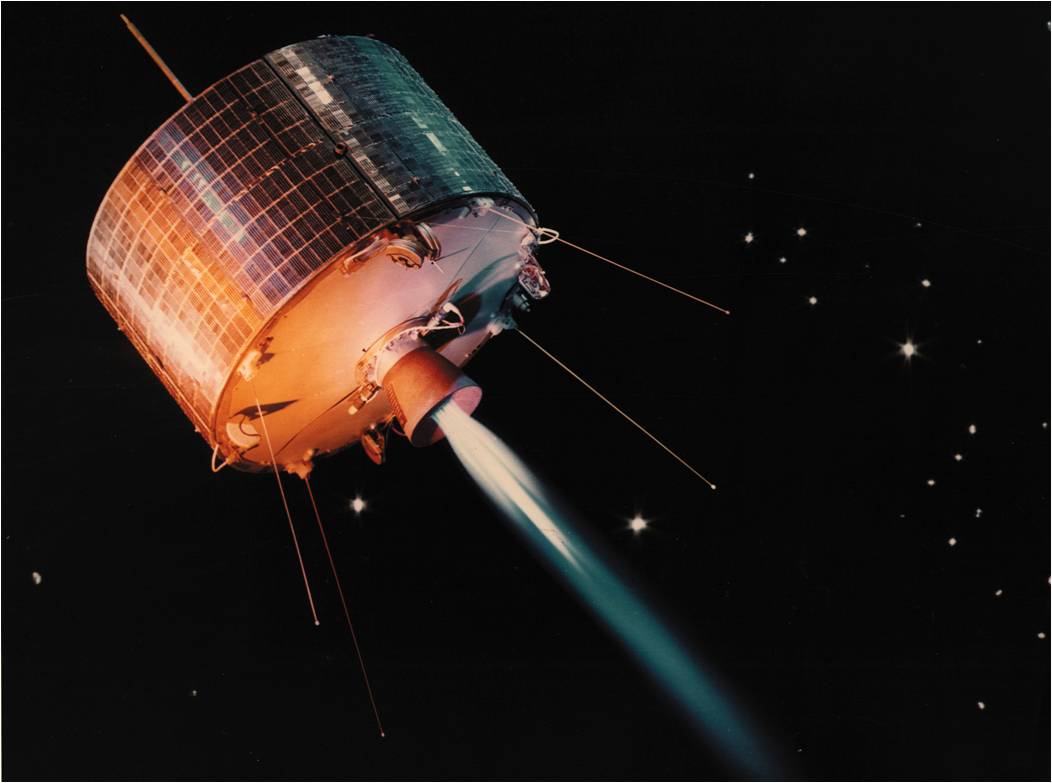
Forty-seven years ago today, the United States successfully orbited the world’s first geosynchronous communications satellite. This accomplishment marked the advent of today’s massive global communications market.
A geosynchronous orbit is one in which the orbital period of a satellite is equal to the time it takes the Earth to complete one revolution about its rotational axis. That is, the satellite completes one revolution around the Earth in slightly less than 24 hours. The altitude for such an orbit is 22,300 miles.
A geostationary orbit is a geosynchronous orbit that lies in the Earth’s equatorial plane. A peculiarity of a geostationary orbit is that the satellite’s position above the Earth remains fixed. Three (3) satellites equally spaced around the Earth in geostationary orbit are within direct line-of-sight of each other. Earth-based stations can use this arrangement to relay radio, television and other signals to any point on the globe.
The Hughes Aircraft Company in California began working on a concept for a geosynchronous satellite in early 1959. A trio of Hughes engineers (Harold Rosen, Thomas Hudspeth and Donald Williams) ultimately came up with a workable geosynchronous satellite design. It became known as Syncom – Synchronous Communications Satellite.
Syncom was cylindrical in shape. It measured 28 inches in diameter and had a height of 15.35 inches. The satellite weighed about 150 pounds fully fueled. Syncom’s external surface was covered with solar cells for power generation with nickel-cadmium batteries used for power storage. Syncom was spun about its symmetry axis for stabilization. Attitude control was provided by an array of nitrogen thrusters.
Syncom 1 was launched on Thursday, 14 February 1963 from Cape Canaveral, Florida. Unfortunately, the spacecraft’s signal was lost during the final boost to geosynchronous orbit. The loss of signal was attributed to an electrical failure. Later, ground-based telescope observations confirmed that the satellite had achieved a near-geosynchronous orbit.
Syncom 2 was launched from Cape Canaveral’s LC-17A at 14:38 UTC on Friday, 26 July 1963. A NASA Thor-Delta B provided the ride into orbit. Syncom’s 1,000-pound thrust apogee motor was used for the final ascent to a quasi-geosynchronous orbit. Over a period of several weeks, the satellite was nudged into a true geosynchronous orbit.
Syncom 2’s geosynchronous orbit was inclined 33 degrees with respect to the Earth’s equator. Thus, the resulting orbit was not geostationary. Coupled with the Earth’s rotation, the spacecraft actually moved in a figure-8 pattern over the globe that tracked 33 degrees north and south of the equator.
Syncom 2 went into active service on Friday, 16 August 1963. The satellite went on to perform brilliantly in its intended role as a communications link. A companion satellite, Syncom 3, was launched on Monday, 19 August 1964 and subsequently joined Syncom 2 in geosynchronous orbit. Significantly, Syncom 3 was used to broadcast the 1964 Tokyo Summer Olympics to America.
Syncom 2 and 3 continued to provide intercontinental communications across the Pacific Ocean until 1966. Increasingly more sophisticated and capable satellites followed. The communications revolution that Syncom started has grown to the point where there are now several hundred communications satellites operating in geosynchronous orbit about the Earth. While long silent, Syncom 2 and 3 continue to orbit the Earth today.
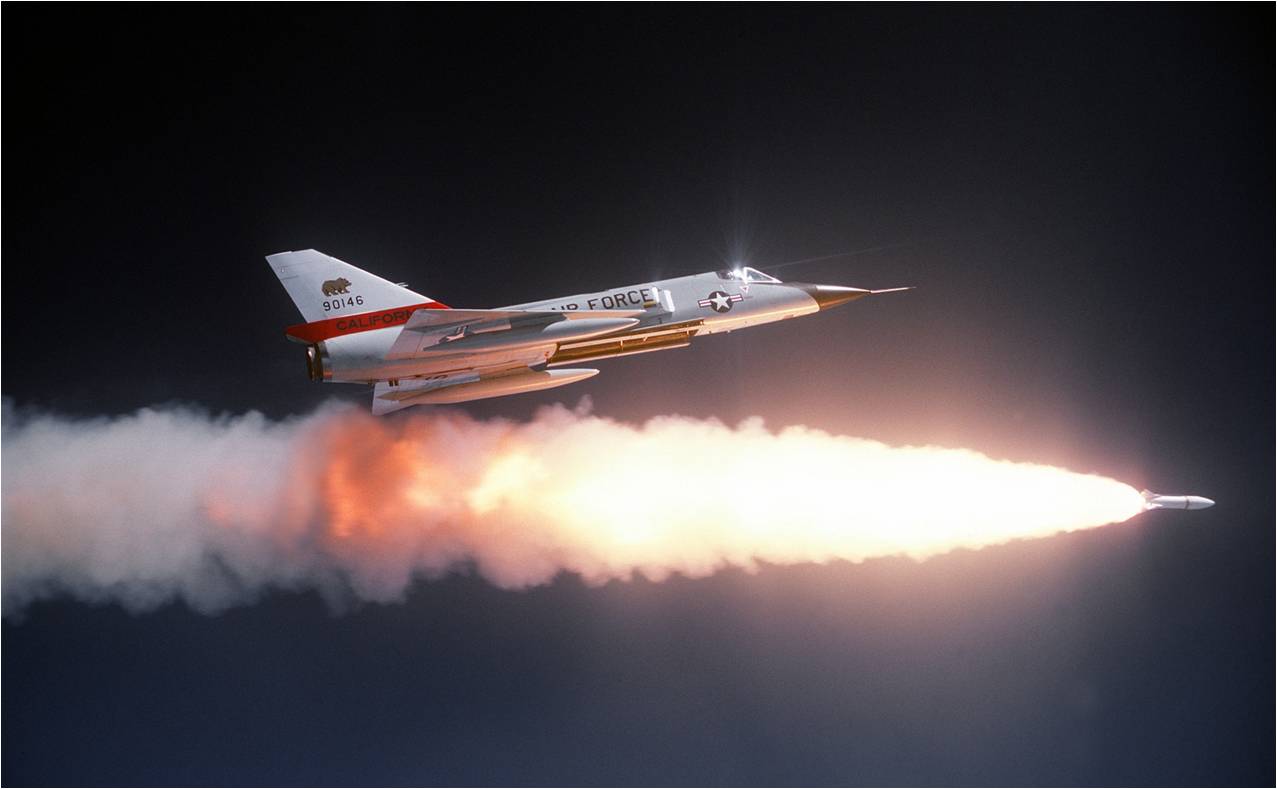
Fifty-three years ago today, the United States successfully conducted the only live-fire test of the only known nuclear-armed air-to-air missile ever developed by the West. The test took place over the Nuclear Test Site located at Yucca Flats, Nevada.
The Cold War between the Soviet Union and the United States gave rise to the development of myriad nuclear weapons. Both superpowers ultimately relied on a triad of platforms, consisting of bombers, missiles and submarines, to deliver nuclear ordnance. Each side used these same types of platforms in a defensive role as well.
The United States employed land-based interceptor aircraft for defending against the Soviet bomber threat. These aircraft would go out to engage and destroy Soviet bomber groups before the latter could penetrate US airspace. The weapon of choice for taking out the bombers was the air-to-air missile.
The most fearsome of air-to-air missiles was armed with a nuclear warhead. The idea was simple. A defending aircraft would fire the nuclear-armed missile into a bevy of Soviet bombers. Detonation of the warhead would in theory destroy an entire bomber group with a single atomic blast.
The Douglas Aircraft Company produced just such a missile for the United States Air Force in the mid-1950’s. The subject missile was originally known as the MB-1 Genie (aka Bird Dog, Ding-Dong, and High Card). The type’s 1.5 kiloton nuclear device had a blast radius on the order of 1,000 feet.
The Genie measured 9.67 feet in length and had a nominal diameter of 17.5 inches. Firing weight was 822 pounds. Genie’s Thiokol SR49-TC-1 solid rocket motor had a rated thrust of 36,500 pounds. The resulting high thrust-to-weight ratio allowed the missile to quickly accelerate to the target. Genie had a top Mach number of 3.3 and a range of slightly over 6 miles.
Genie was carried by the top USAF interceptor aircraft of its day; the Northrop F-89 Scorpion, McDonnell F-101B VooDoo and Convair F-106 Delta Dart. The missile was unguided. That is, Genie was simply a point and shoot weapon. The warhead would detonate only after rocket motor burnout. This delay permitted the carrier aircraft to quickly depart the area following launch.
The only in-flight detonation of a Genie warhead occurred during the summer of 1957 as part of Operation Plumbbob. This program was series of nuclear weapons tests conducted from May to October of the subject year at the Yucca Flats Nuclear Test Site in Nevada.
At 1400 UTC on Friday, 19 July 1957, USAF Captain Eric Hutchison fired a single Genie missile from his Northrop F-89J aircraft. The missile’s W25 warhead detonated at 15,000 feet above ground level shortly after rocket motor burnout. A group of USAF officers was positioned directly below the air burst to prove that the missile could be used over populated areas. The men were reported to be unharmed.
Genie was never used in anger. Approximately 3,150 missiles were produced by the time Thiokol closed down the production line in 1963. This production run included a number of improved variants known as the MB-1-T, ATR-2A, AIR-2A and AIR-2B. Genie ultimately served with both the USAF and the Canadian Air Force. It was withdrawn from service in 1985.
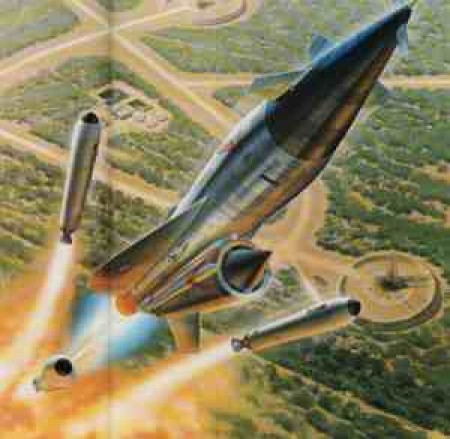
Forty-six years ago this month, the United States abandoned a 7-year effort to develop a nuclear-armed, supersonic cruise missile. The joint USAF-AEC program was known as Project Pluto. The centerpiece of this program was the nuclear-fueled, ramjet-powered Supersonic Low-Altitude Missile (SLAM).
The 1950’s saw the development of myriad aircraft, missile and submarine concepts designed for delivery of nuclear weaponry over strategic distances. This developmental activity was driven by the escalating Cold War between the United States and the Soviet Union. In addition to weapons, the power of the atom was also considered for propulsion applications during this era.
SLAM was perhaps the most fearsome weapon ever conceived. The missile was designed to deliver as many as 26 nuclear bombs over the Soviet Union in a single mission. It would do this while flying at Mach 3 and less than 1,000 feet above ground level. SLAM’s shock wave overpressure alone (162 dB) would devastate structures and people along its flight path. And, as if that were not enough, the type’s nuclear-fueled ramjet would continuously spew radiation-contaminated exhaust all over the countryside.
The SLAM airframe was huge. It measured 88 feet in length, nearly 6 feet in diameter and weighed 61,000 pounds at launch. The vehicle would be fired from a ground-based launch site and accelerated to ramjet takeover speed by a trio of jettisionable rocket boosters. The nuclear-fueled ramjet was rated at 35,000 pounds of thrust.
To find its way to the target area(s), the Ling-Temco-Vought (LTV) SLAM would use a guidance system known today as TERCOM – Terrain Contour Matching. At a target, SLAM would eject an atomic warhead upwards from its payload bay. The resulting lofted trajectory gave SLAM time to depart the hot target area prior to weapon detonation. Following completion of its mission, the missile would then ditch itself by diving into a deep ocean graveyard.
The heart of the Project Pluto missile was the nuclear-fueled ramjet. An unshielded nuclear reactor, code named TORY, was devised, built and successfully tested. Testing was conducted at a special-purpose test site in Nevada. In its Tory II-C configuration, the SLAM ramjet produced over 500 megawatts of power in 5 minutes of continuous operation during a test conducted in May of 1964.
SLAM’s nap-of-the-earth, supersonic flight profile would subject the airframe to terrific airloads, vibrations and temperatures. The Project Pluto team successfully devised structural and thermal material solutions to handle the daunting flight environment. In addition, nuclear-hardened electronics and flight controls were successfully developed.
From a technological standpoint, Project Pluto proved to be entirely viable. However, doubts about its implementation started to arise as flight testing of the nuclear-powered missile was seriously considered. Where do you flight-test a radiation-spewing missile? What happens if you can’t turn-off the reactor? What do you do if the guidance system fails? Where do you dispose of the missile after a flight test? These and other disturbing questions began to trouble program officials.
Coupled with the above practical concerns of SLAM flight testing were growing political and mission obsolesence issues. Pentagon officials ultimately deemed Project Pluto as being highly provocative to the Soviet Union in the sense that the communist super power might feel compelled to develop their own SLAM. Further, American missilery was quickly developing to the point where ICBM-delivered warheads would do the job and at a lower per-unit cost.
So it was that on Wedneday, 01 July 1964, Project Pluto was canceled after 7 years of fruitful development. While no airframe was ever built and tested, SLAM technology was applied to a host of subsequent aerospace vehicle developments.
SLAM would truly have been “The Missile From Hell” had it matured to the point of flight. Indeed, the ethical issues concerning the missile’s use were quite sobering. And, owing to Murphy’s Law and its many corollaries, the chances for unintended catastrophe were high as well. Despite the allure of this “technically sweet” solution to a national defense problem, the decision to cancel Project Pluto was ultimately the only correct course to follow.
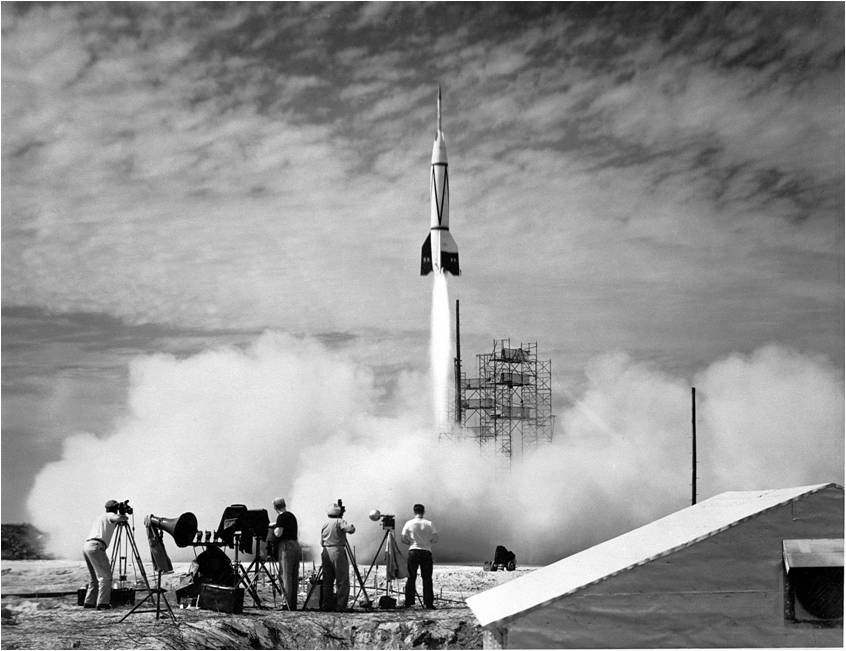
Sixty-years ago this month, the United States launched a primitive two-stage rocket from an obscure site situated on Florida’s eastern coast. The rocket was the Army’s Bumper-WAC No. 8. The then little-known launch location has since become synonymous with American aerospace achievement. We know it today as Cape Canaveral.
The Bumper Program was a United States Army effort to reach flight altitudes and velocities never before achieved by a rocket vehicle. The name “Bumper” was derived from the fact that the lower stage would act to “bump” the upper stage to higher altitude and velocity than it (i.e., the upper stage) was able to achieve on its own.
The Bumper two-stage configuration consisted of a V-2 booster and a WAC Corporal upper stage. The V-2′s had been captured from Germany following World War II while the WAC Corporal was a single stage American sounding rocket. The launch stack measured 62 feet in length and weighed around 28,000 pounds.
From a propulsion standpoint, the V-2 booster generated 60,000 pounds of thrust with a burn time of 70 seconds. The WAC Corporal rocket motor produced 1,500 pounds of thrust and had a burn time of 47 seconds.
The first Bumper-WAC shots took place at White Sands Proving Ground (WSPG) in New Mexico. The first six (6) flights were dedicated to achieving maximum altitude. Indeed, Bumper-WAC No. 5 flew to an altitude of 250 miles on Thursday, 24 February 1949.
WSPG could not be used for the last two (2) flights which required the Bumper-WAC vehicle to remain within the atmosphere. A larger range was required to handle these missions which involved a significant amount of essentially horizontal flight. Looking beyond Bumper, it was clear that future programs would also require a much larger test range as well.
After considering a number of geographical locations within the US, the new Long Range Proving Ground (LRPG) was ultimately established in the state of Florida. The LRPG locale was hot, bug-infested and covered with sand dunes and scrub palmetto. However, the LRPG was also immediately adjacent to the Atlantic Ocean which provided a vast region over which test rockets could be safely flown.
Bumper-WAC No. 7 was supposed to be the first rocket fired from the LRPG. However, Bumper-WAC No. 8 got that honor when No. 7 experienced a glitch on the pad. No. 8 was fired at 13:29 UTC on Monday, 24 July 1950. The mission failed when the rocket motor of the WAC upper stage did not ignite.
On Saturday, 29 July 1950, Bumper-WAC No. 7 was launched from the LRPG. The mission was entirely successful. The WAC upper stage burned-out at Mach 9 and flew 150 miles downrange. The maximum sustained velocity within the atmosphere was more than 3,200 mph – a record for the time.
While the Bumper Program would fade into history, the LRPG did not. History records that the fledging test facility would develop into America’s preeminent launch complex. The military services would grow both our Nation’s missile defense and space launch vehicle capabilites there. Later, NASA would come on the scene and send astronauts first into Earth orbit and then to the Moon.
Cape Canaveral now operates in a season of decline relative to our national space effort. The fabled Space Shuttle will soon be retired. The CEV Program is slated for cancelation, leaving our country without either a national manned launch vehicle or spacecraft. Very soon, we will not even be able to go to and from our own space station. The prevailing “wisdom” is that private industry will solely provide access to space in the future. And such is to be accomplished without any national system being available as a back-up.
That we as a nation find ourselves in the predicament outlined above, is at once ironic and obscene. However, this is America and we are Americans. And, despite determined and increasing assaults from without and from within, we are still a land of liberty and opportunity. We can chose a better path.
Whether Cape Canaveral has seen its best days or if those that lie ahead will be better still, it is up to the citizens of the United States to determine. The responsibility and obligation to do so can neither be evaded nor avoided. If we chose rightly, Cape Canaveral’s, and indeed our beloved country’s, best days await in the future.
To both we say with deepest sentiment: “Long may you run.”
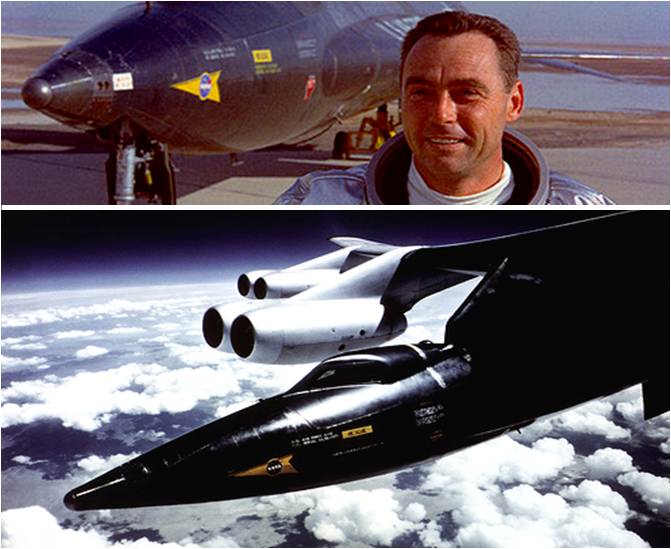
Forty-three years ago this month, USAF Major William F. “Pete” Knight made an emergency landing in X-15 No. 1 at Mud Lake, Nevada. Knight somehow managed to save the hypersonic aircraft following a complete loss of electrical power as it passed through 107,000 feet during climb.
The famed X-15 Program conducted 199 flights between June 1959 and October 1968. North American Aviation (NAA) built three (3) X-15 aircraft. Twelve (12) men from NAA, USAF and NASA flew the X-15. Eight (8) pilots received astronaut wings for flying the X-15 beyond 250,000 feet. One (1) aircraft and one (1) pilot were lost during flight test.
The X-15 flew as fast as 4,520 mph (Mach 6.7) and as high as 354,200 feet. The basic airframe measured 50 feet in length, featured a wing span of 22 feet and had a gross weight of 33,000 pounds. The type’s Reaction Motors XLR-99 rocket engine burned anhydrous ammonia and liquid oxygen to produce a sea level thrust of 57,000 pounds. The X-15 used both 3-axis aerodynamic and ballistic flight controls.
An X-15 mission was fast-paced. Flight time from B-52 drop to unpowered landing was typically 10 to 12 minutes in duration. The pilot wore a full pressure suit and experienced 6 to 7 G’s during pull-out from max altitude. There really was no such thing as a routine X-15 mission. However, all X-15 missions had one factor in common; danger.
On Thursday, 29 June 1967, X-15 No. 1 (S/N 56-6670) made its 73rd and the X-15 Program’s 184th free flight. Launch took place at 1828 UTC as the NASA B-52B launch aircraft (S/N 52-0008) flew at Mach 0.82 and 40,000 feet near Smith Ranch, Nevada. Knight, making his 10th X-15 flight, quickly ignited the XLR-99 and started his climb upstairs.
The X-15 was performing well and Knight was enjoying the flight until 67.6 seconds into a planned 87 second XLR-99 burn. That’s when the engine suddenly quit. A couple of heartbeats later, the Stability Augmentation System (SAS) failed, the Auxiliary Power Units (APU’s) ceased operating, the X-15’s generators stopped functioning and the cockpit lights went out. This was the total hit; a complete power failure.
Pete Knight was now just along for the ride. No thrust to power the aircraft. No electrical power to run onboard systems. No hydraulics to move flight controls. Even the reaction controls appeared inoperative. The X-15 continued upward, but it wallowed aimlessly in the low dynamic pressure of high altitude flight. At this point, Knight considered taking his chances and punching-out.
The X-15 went over the top at 173,000 feet. On the way downhill, Knight was able to get some electrical power from the emergency battery. This meant that he now had some hydraulic power and could utilize the X-15’s flight control surfaces. Knight next tried to fire-up the APU’s. The right APU would not respond. The left APU fired, but the its generator would not engage.
As the X-15 descended and the dynamic pressure built-up, Knight was able to maneuver his stricken X-15. He headed for Mud Lake in a sustained 6-G turn. As he leveled off at 45,000 feet, Knight instinctively knew he could now make the east shore of the Nevada dry lake. But it was tough work to fly the X-15. Knight ended-up using both hands to fly the airplane; one on the side stick and one on the center stick.
While Knight was trying to get his airplane down on the ground in one piece, only he and his Maker knew his whereabouts. The X-15 flight test team certainly didn’t, since Knight’s radio, telemetry and radar transponder were now inop. Further, the X-15 was not being skinned tracked at the time of the electrical anomaly. Just before he touched-down at Mud Lake, Knight’s X-15 was spotted by NASA’s Bill Dana who was flying a F-104N chase aircraft.
Pete Knight made a good landing at Mud Lake. The X-15 slid to a stop. After a struggle with the release mechanism, he managed to get the canopy open. Hot and soaked with perspiration, Knight somehow removed his own helmet. A ground crewman usually did that for him. But there were no flight support people at his X-15 landing site on this day.
As he attempted to get out of the X-15 cockpit, Knight pulled an emergency release. To his surprise, the headrest blew off, bounced off the canopy and smacked him square in the head. Undeterred, Knight got out of the cockpit and onto terra firma. In the meantime, a Lockheed C-130 Hercules had landed at Mud Lake. Wearily, Pete Knight got onboard and returned to Edwards Air Force Base.
Post-flight investigation revealed that the most probable source of the X-15’s electrical failure was arcing in a flight experiment system. This system had been connected to the X-15’s primary electrical bus. The solution was to connect flight experiments to the secondary electrical bus.
Reflecting on Knight’s amazing recovery from almost certain disaster, long-time NASA flight test manager Paul Bickle claimed the fete was among the most impressive of the X-15 Program. Indeed, it was Pete Knight’s clearly uncommon piloting skill and calmness under pressure that gave him the edge.
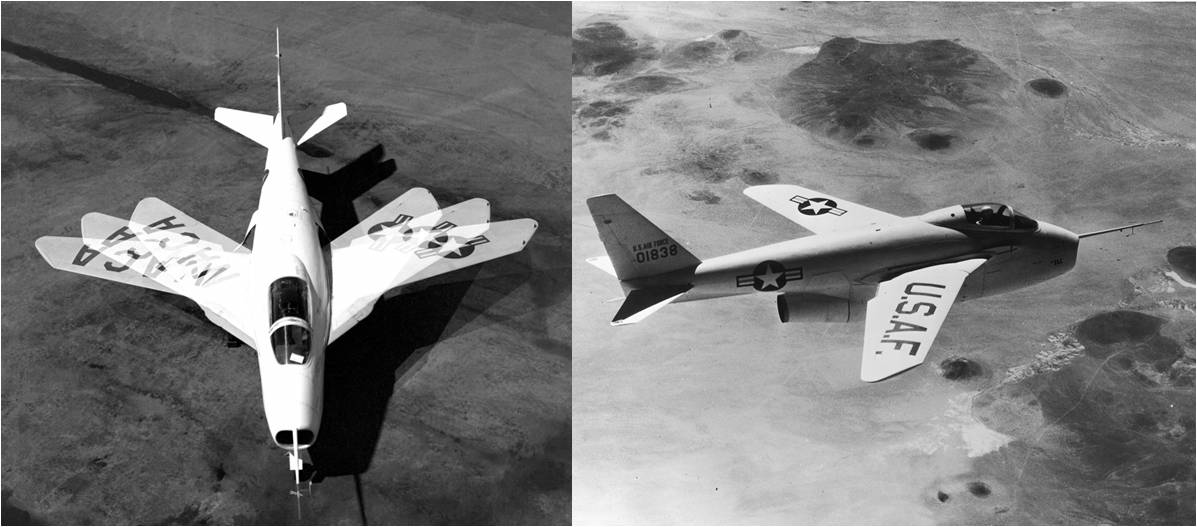
Fifty-nine years ago this month, the No. 1 USAF/Bell X-5 variable-sweep-wing aircraft testbed took to the air for the first time with Bell test pilot Jean “Skip” Ziegler at the controls. The X-5 holds the distinction of being the first aircraft capable of changing its wing sweep while in flight.
The ability to change wing sweep during flight allows an aircraft to be flown more optimally throughout its flight envelope. For instance, low wing sweep enhances low-speed lift characteristics while high wing sweep reduces wave drag at high speeds. Unfortunately, these aerodynamic gains come at the price of increased structural weight and mechanical complexity.
During World War II, the Third Reich developed the Messerschmitt P.1101 aircraft which was configured with a ground-adjustable variable-sweep wing. The P.1101 was captured in 1945 by the United States as part of the spoils of war. The aircraft was subsequently transported to Wright Field in Ohio for detailed examination by American aeronautical experts.
The Bell Aircraft Corporation ultimately came into possession of the P.1101 in August of 1948 after it had been examined by the Air Force and subsequently declared as surplus by the service. After an abortive attempt to re-engine the aircraft, Bell abandoned its effort to fly the P.1101. The company then made a decision to develop a completely new variable-sweep-wing aircraft.
Bell secured a contract from the Air Force in February of 1949 to build a pair of experimental variable-sweep-wing aircraft. The new airplane joined the young X-plane family as the X-5. The tail numbers assigned by the Air Force were 50-1838 and 50-1839.
The X-5 wing sweep could be varied between 20 and 60 degrees in flight. This resulted in a wing span that varied between 33.5 feet at 20 degrees of sweep and 20.75 feet at 60 degrees of sweep. The X-5 measured 33.5 feet in length and had a gross take-off weight of 9,875 pounds. The aircraft was powered by a single Allison J35-A-17A turbojet rated at 4,900 pounds of sea level thrust.
The X-5 was a nimble aircraft. It flew as fast as Mach 0.95 and as high as 45,000 feet. In fact, the X-5 was used at various times as a chase aircraft in support of other flight test programs at Edwards. On the other hand, the X-5 was less than docile in terms of handling qualities. It was particularly unruly in a spin.
On Wednesday, 20 June 1951, the No. 1 X-5 (50-1838) took-off from Edwards Air Force Base on its first contractor flight. This aircraft would eventually accumulate 153 flights, the last of which occurred on Tuesday, 25 October 1955. A dozen men from Bell, USAF and NACA flew the X-5 during that period. The last man to fly the X-5 was none other than Neil Armstrong.
While the No. 1 X-5 (50-1838) survived the flight test program, the No. 2 aircraft (50-1839) did not. The aircraft first flew on 10 December 1951 and was lost following an unrecoverable spin on Wednesday, 14 October 1953. USAF Major Raymond Popson lost his life when he was unable to eject from the stricken aircraft. The flight was Popson’s first and last in the X-5. It is not clear how many flights 50-1839 made during its service life.
The Bell X-5 provided a wealth of performance, stability and control and handling qualities data relative to variable-sweep-wing flight. The aircraft served as the progenitor to a number of famous operational aircraft including the General Dynamics F-111 Aardvark, Grumman F-14 Tomcat, and Rockwell B-1B Lancer.
The surviving X-5 (50-1838) is currently on display at the United States Air Force Museum at Wright-Patterson Air Force Base in Dayton,Ohio.
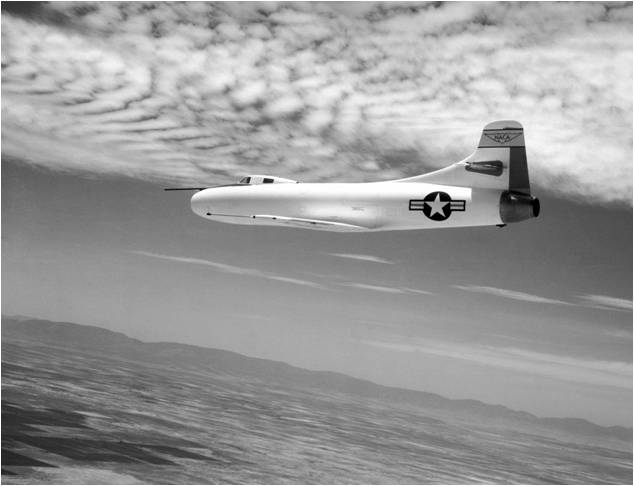
Fifty-seven years ago this month, NACA test pilot A. Scott Crossfield piloted the United States Navy/Douglas D-558-I transonic research aircraft on the last of the type’s 230 flights. The flight was conducted on Wednesday, 10 June 1953 at Edwards Air Force Base, California.
Flight near and beyond the speed of sound is characterized by large variations in flowfield density. Variable density flow is known as compressible flow. A key compressible flow phenomenon is the formation of shock waves. These fluid dynamic flow features are the result of locally supersonic flow being deflected or turned.
As every aircraft has a distinct shape, it also has its own distinct shock wave system. The topology and strength of this 3-dimensional shock wave system significantly affects aircraft flight performance, stability and control, handling qualities, airframe buffet characteristics and airloads.
Following World War II, the United States initiated a sustained flight research effort in the realm of transonic and supersonic flight. In league with the US military and the National Advisory Committee For Aeronautics (NACA), the American aeronautical industry designed and built a variety of aircraft used to conduct flight research during the 1940’s and 1950’s. These experimental aircraft were the first of the fabled X-planes.
In June of 1945, the Douglas Aircraft Company was awarded a contract by the United States Navy (USN) to build a total of six (6) flight research aircraft. These vehicles would be used in a two phase flight research program. Phase I was devoted to transonic flight testing while Phase II would investigate supersonic flight. The Phase I aircraft was known as the D-558-I Skystreak while the Phase II airplane was called the D-558-II Skyrocket.
The USN/Douglas D-558-I Skystreak measured 36-feet in length and had a wingspan of 25-feet. The straight-winged aircraft weighed a bit over 10,000 pounds and was powered by an Allison J35 turbojet rated at 5,000 pounds of sea level thrust. The aircraft was single place and employed ground take-off. Three (3) copies were made; BuAer tail numbers 37970, 37971 and 37972.
Later painted white to improve visibility, each Skystreak was originally painted a stunning red. This led to the type’s nickname of the “Crimson Test Tube”. Other nicknames included the “Flying Stove Pipe” and the “Supersonic Test Tube”. This last moniker is misleading in that the aircraft could only go slightly supersonic and only in a dive.
Along with its D-558-II companion, the D-558-I helped write the book on transonic aircraft aerodynamics. The D-558-I Skystreak acquired vital flight data relative to aircraft stability and control, handling qualities, airframe buffet and airloads. Those data are used to support aircraft design efforts down to the present day.
Pilots reported that the D-558-I exhibited generally favorable handling qualities. However, the Skystreak had its share of peculiar transonic aerodynamic attributes as well. Wing drop due to asymmetric shock-induced separation was one such phenomenon. Reduced control effectiveness and severe lateral-directional oscillations, both due to shock wave-induced flow separation at high Mach number, were exhibited as well.
Beyond 0.94 Mach number, the D-558-I experienced a phenomenon known as “Mach Tuck”. This condition is attributable to an aftward shift in the aircraft transonic center-of-pressure location as the pressure pattern over the aircraft changes with Mach number. This is equivalent to an increase in nose down pitching moment. Taken to extremes, the “Mach Tuck” flight condition is unrecoverable due to an exceedance of pitch control authority.
Approximately 15 men flew the D-558-I Skystreak 230 times between April of 1947 and June of 1953. One aircraft and one pilot was lost during the type’s flight research program. NACA test pilot Howard Lilly died and aircraft 37971 was destroyed when a J35 turbojet compressor blade failed during take-off on Tuesday, 25 November 1947.
Today the surviving aircraft are publically displayed in tribute to the Skystreak’s contributions to aeronautics. Tail No 37970 is displayed at the Naval Air Museum in Pensacola, Florida while Tail No. 37972 can be viewewd at the Carolinas Avaiation Museum in Charlotte, North Carolina.
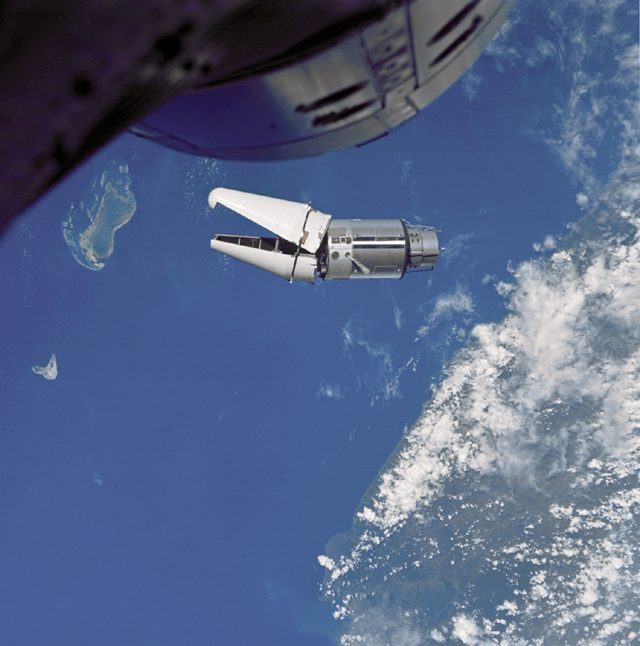
Forty-four years ago this month, NASA astronauts Thomas P. Stafford and Eugene A. Cernan became the 7th two-man Gemini crew to orbit the Earth. Known as Gemini 9A, the mission was the 13th manned spaceflight flown by the United States.
The Gemini Program was absolutely critical to the success of America’s lunar landing effort. A total of 10 Gemini missions was flown during a 20-month period between 1965 and 1966. Gemini demonstrated the key capabilities of rendezvous and docking, orbital maneuvering, long duration spaceflight and extra vehicular activity.
Each Gemini mission had its share of difficulties which arose and had to be overcome during flight. Gemini 9A was arguably the most ill-fortuned and technically frustrating of the series. Mission goals included rendezvous and docking with an Agena Target Vehicle (ATV), maneuvering the combined Gemini-Agena combination and demonstration of the first manned rocket pack; the United States Air Force Astronaut Maneuvering Unit (AMU).
The original Gemini 9 prime crew was Elliot M. See and Charles A. Bassett. However, both men died on Monday, 28 February 1966 as they attempted to land their T-38 aircraft during a rain storm in St. Louis, Missouri. The Gemini 9 back-up crew of Stafford and Cernan somehow managed to land their T-38 aircraft during that same storm. The men were appointed as the prime crew with the devastating loss of See and Bassett.
On Tuesday, 17 May 1966, an ATV was launched ahead of Gemini 9. The Agena vehicle never made it to orbit due to a problem with its Atlas booster. McDonnell engineers hurriedly conceived and built a substitute for the ATV known as the Augmented Target Docking Adapter (ATDA). While Stafford and Cernan could rendezvous and dock with the ATDA, they could not change their orbital path since the ATDA had no propulsion system.
With the loss of the ATV and the introduction of the ATDA, Gemini 9 now came to be known as the Gemini 9A mission. The ATDA was successfully fired into orbit on Wednesday, 01 June 1966. However, the ATDA’s nose shroud had failed to jettison. Thus, Gemini 9A would not be able to dock with the ATDA.
The launch window for Gemini 9A was only 40 seconds on the day that the ATDA was launched. That window came and went when computer problems arose at a most inopportune moment. Having been denied the opportunity to launch, Stafford and Cernan unstrapped and waited to fly another day.
On Friday, 03 June 1966, Gemini 9A lifted-off from LC-19 at Cape Canaveral, Florida. Lift-off time was 1339 UTC. Within 5 hours, the crew caught up with the ATDA. What they saw did not inspire hope. The ATDA’s shroud indeed had not jettisoned properly. Commander Stafford radioed to Mission Control: “It looks like an angry alligator out here rotating around.”
The Gemini 9A crew asked for permission to use the nose of their spacecraft to nudge the recalcitrant shroud from the ATDA. Permission denied. The Gemini spaceraft might be damaged. How about performing an EVA and having Cernan cut the shroud attachment lanyards? No way. Sharp-edged debris might pierce Cernan’s EVA suit.
Making the best of the situation, Stafford and Cernan moved away from the ATDA and then rendezvoused with it again. They did this a number of times to gain practice. They also performed stationkeeping with the ATDA to learn the nuances of that flight mode.
Cernan’s much anticipated EVA with the AMU took place on Sunday, 05 June 1966. That particular experience deserves an article all its own. Suffice it to say that things did not go well. Working outside the spacecraft was much more physically demanding and functionally non-intuitive than expected.
Cernan found that any movement of his limbs resulted in unwanted reactions on his body. It was exceedingly difficult to remain still and perform useful work. He had to continually fight to maintain body position. Further, the Gemini spacecraft did not have enough hand-holds. Cernan’s exertions were such that his heart rate peaked at 195 beats per minute. Perspiration fogged his visor. Now he was blind.
Cernan struggled to get to the AMU which was stored in the Gemini’s aft adapter. He prepared the unit for free-flight, but continued to labor. He ultimately came to the conclusion that free-flying the AMU was infeasible on this mission. Dishearted and still blinded by the perspiration-induced fog on his visor, Cernan managed to safely return to the spacecraft cabin and secured the hatch. Total EVA time was 128 minutes.
Stafford and Cernan completed their demanding mission with reentry and splashdown in the Atlantic Ocean on Monday, 06 June 1966. They excuted a computer-controlled entry and landed less than one-half mile from the prime recovery ship; the USS Wasp. Official mission elapsed time was 72 hours, 20 minutes and 50 seconds.
It is worth noting that Gemini 9A, like all Gemini missions, was a test flight. The ATDA and AMU experiences were certainly frustrating, but not without merit from a learning standpoint. That learning was put to good use as evidenced by the accomplishments of Gemini’s 10, 11 and 12.
Rendezvous, docking and orbital maneuvering with the ATV all went extremely well on the last trio of Gemini missions. And on Gemini 12, the most vexing of early manned spaceflight problems was solved; that of EVA. Indeed, with the aid of techniques and equipment developed from Gemini 9A lessons-learned, one Edward E. “Buzz” Aldrin convincingly demonstrated the feasibility of an astronaut performing meaningful work in space.