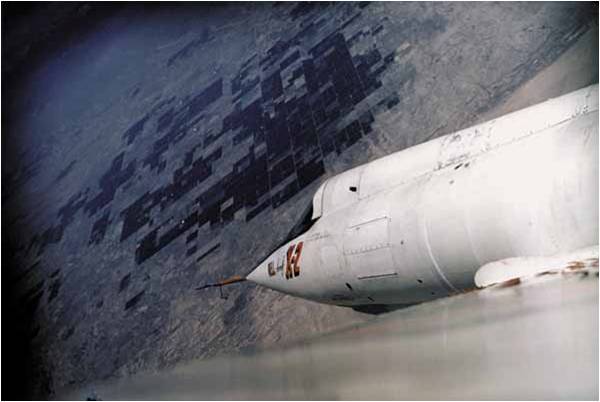
Fifty-three years ago today, the USAF/Bell X-2 research aircraft flew to an altitude of 126,200 feet. This accomplishment took place on the penultimate mission of the type’s 20-flight aeronautical research program. The date was Friday, 07 September 1956.
The X-2 was the successor to Bell’s X-1A rocket-powered aircraft which had recorded maximum speed and altitude marks of 1,650 mph (Mach 2.44) and 90,440 feet, respectively. The X-2 was designed to fly beyond Mach 3 and above 100,000 feet. The X-2’s primary mission was to investigate aircraft flight control and aerodynamic heating in the triple-sonic flight regime.
The X-2 had a gross take-off weight of 24,910 lbs and was powered by a Curtis-Wright XLR-25 rocket motor which generated 15,000-lbs of thrust. Aircraft empty weight was 12,375 lbs. Like the majority of X-aircraft, the X-2 was air-launched from a mothership. In the X-2’s case, an USAF EB-50D served as the drop aircraft. The X-2 was released from the launch aircraft at 225 mph and 30,000 feet.
The pilot for the X-2 maximum altitude mission was USAF Captain Iven Carl Kincheloe, Jr. Kicheloe was a Korean War veteran and highly accomplished test pilot. He wore a partial pressure suit for survival at extreme altitude.
While the dynamic pressure at the apex of his trajectory was only 19 psf, Kincheloe successfully piloted the X-2 with aerodynamic controls only. The X-2 did not have reaction controls. Mach number over the top was supersonic (approximately Mach 1.7).
Kicheloe’s maximum altitude flight in the X-2 (S/N 46-674) would remain the highest altitude achieved by a manned aircraft until August of 1960 when the fabled X-15 would fly just beyond 136,000 feet. However, for his achievement on this late summer day in 1956, the popular press would refer to Iven Kicheloe as the “First of the Space Men”.
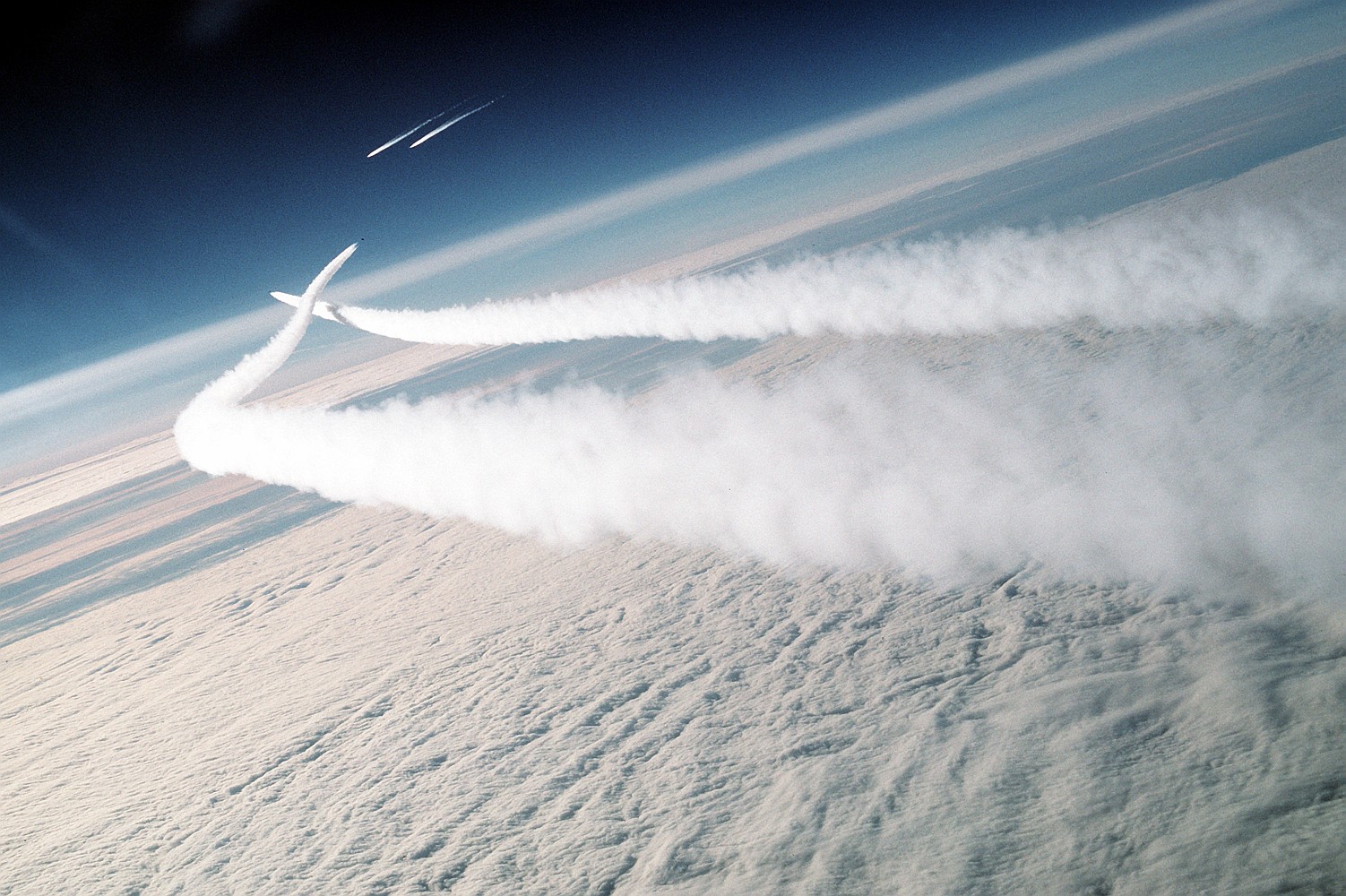
We take pause this week from our regular aerospace retrospective and consider a topic of a different nature. Such a change-of-pace seems quite natural as summer wanes and legions of new and returning education seekers troop through the portals of our country’s universities. However, rather than focus on the matriculating crowd, we will set our sights on those who have completed their formal education and are now members of the American aerospace workforce.
Education does not end with the granting of a diploma or even a collection of diplomas. This is especially the case in today’s aerospace industry which encompasses so many disciplines and technical specialties. And the list grows as new technology emerges. For the successful aerospace engineer, learning and gaining technical knowledge is truly a daunting career-long process.
The majority of one’s technical skills, critical knowledge, and lessons-learned are acquired on the job. However, professional short courses also serve a vital role in one’s career development. A well designed and capably taught aerospace professional short course provides the engineer with critical specialty knowledge and disciplinary technical context in a very short amount of time. And it does so at low cost.
Aerospace professional short courses are most typically taught by subject matter experts (SME’s) who have successfully plied their trade over a career that often spans decades. These SME’s know their specialty area intimately by virtue of this vast experience. Further, they are often passionate about and notable contributors to their technical discipline.
Somewhat fortuitously, the majority of SME’s who teach aerospace professional short courses are often very good technical instructors. They understand what the learner needs to know and how to convey that knowledge. A capable aerospace professional short course instructor also has an uncanny ability to inspire his or her audience to learn and grow. That kind of instruction is infectious and makes it a true pleasure to learn.
While there is certainly more to say concerning the merits of the aerospace professional short course, it seems appropriate to end this session with the following observation. Among the most valuable aspects of the aerospace professional short course are (1) the review and understanding of key aerospace historical events and (2) the transmittal of hard-won engineering lessons-learned.
In the fast-paced, competitive, high-stakes and cost-conscious aerospace market of the 21st century, the victory will most often go to those who learn from and clearly remember the experiences of the past.
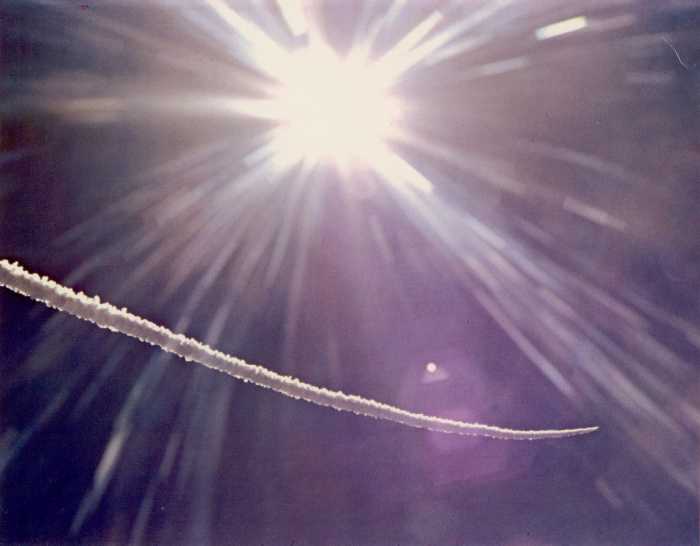
Forty-six years ago this month, NASA chief research pilot Joseph A. Walker flew X-15 Ship No. 3 (S/N 56-6672) to an altitude of 354,200 feet. This flight would mark the highest altitude ever achieved by the famed hypersonic research vehicle. The date was Thursday, 22 August 1963.
Carried aloft by NASA’s NB-52A (S/N 52-0003) mothership, Walker’s X-15 was launched over Smith Ranch Dry Lake, Nevada at 17:05:42 UTC. Following drop at around 45,000 feet and Mach 0.82, Walker ignited the X-15’s small, but mighty XLR-99 rocket engine and pulled into a steep vertical climb.
The XLR-99 was run at 100 percent power for 85.8 seconds with burnout occurring around 176,000 feet on the way uphill. Maximum velocity achieved was 3,794 miles per hour which tranlates to Mach 5.58 at the burnout altitude. Following burnout, Walker’s X-15 gained an additional 178,200 feet in altitude as it coasted to apogee.
Joe Walker went over the top at 354,200 feet (67 miles). Although he didn’t have much time for sight-seeing, the Earth’s curvature was strikingly obvious to the pilot as he started downhill from his lofty perch. Walker subsequently endured a hefty 5-g’s of eyeballs-in normal acceleration during the backside dive pull-out. The aircraft was brought to a wings-level attitude at 70,000 feet. Shortly after, Walker greased the landing on Rogers Dry Lake at Edwards Air Force Base, California.
The X-15 maximum altitude flight lasted 11 minutes and 8 seconds from drop to nose wheel stop. In that time, Walker and X-15 Ship 3 covered 305 miles in ground range. The mission was Ship No. 3’s 22nd flight and the 91st of the X-15 Program.
For Joseph Albert Walker, the 22nd of August 1963 marked his 25th and last flight in an X-15 cockpit. The mission qualified him for Astronaut Wings since he had exceeded the 328,000 foot (100 km) FAI/NASA standard set for such a distinction. Ironically, the historic record indicates that Joe Walker never officially received Astronaut Wings for this flight in which the X-15 design altitude was exceeded by over 100,000 feet.
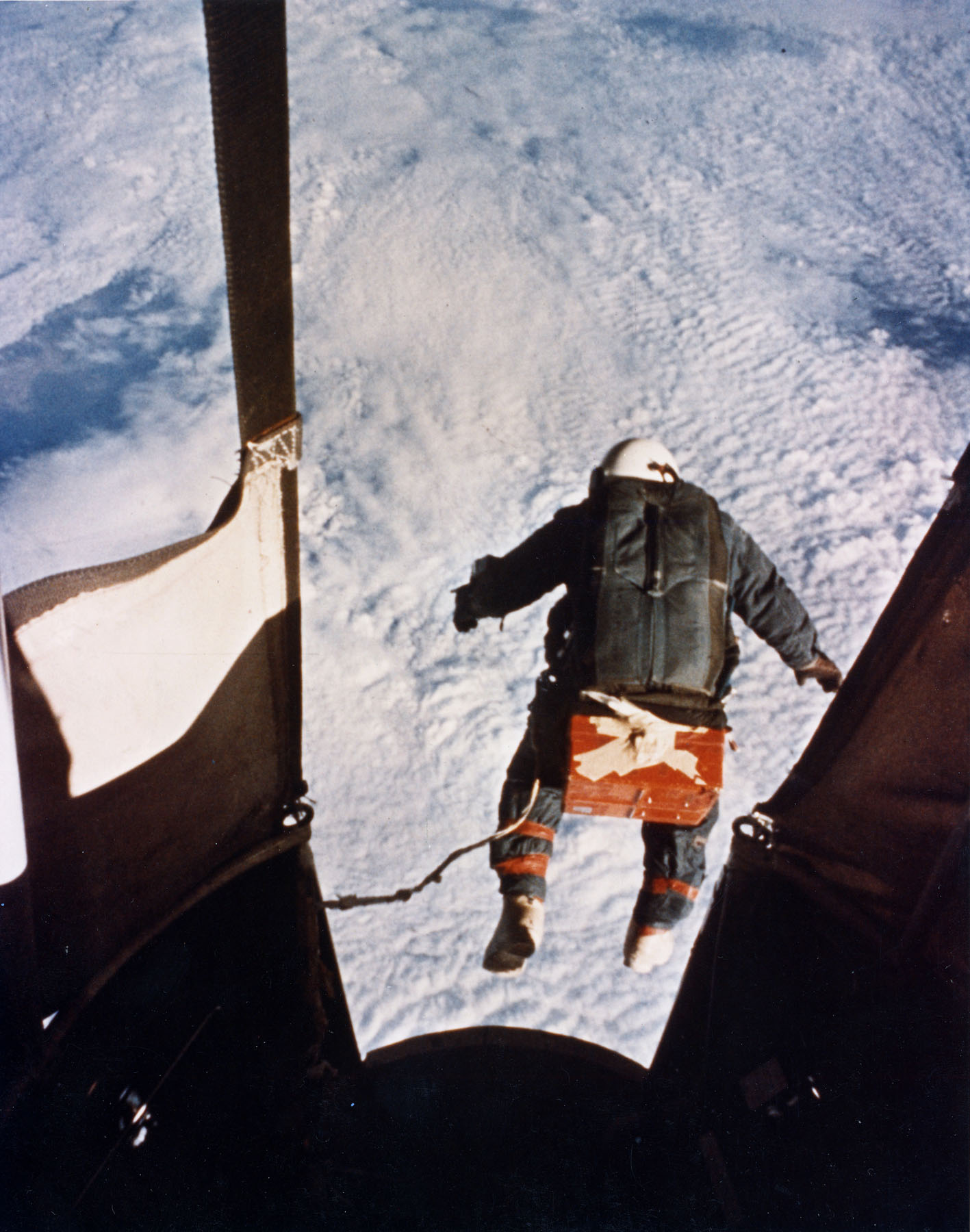
Forty-nine years ago this month, USAF Captain Joseph W. Kittinger, Jr. successfully completed a daring parachute jump from 102,800 feet (19.5 miles). The historic bailout took place on Tuesday, 16 August 1960 over the Tularosa Basin of New Mexico.
Kittinger’s jump was the final mission of the three-jump Project Excelsior flight research effort which focused on manned testing of the Beaupre Multi-Stage Parachute Parachute (BMSP). The system was being developed to provide USAF pilots with a means of survival from an extreme altitude ejection.
Transport to jump altitude was via a 3-million cubic foot helium balloon. Kittinger rode in an open gondola. He was protected from the harsh environment by an MC-3 partial pressure suit as well as an assortment of heavy cold-weather clothing. Kittinger and his jump wardrobe and flight gear weighed a total of 313 pounds
The Excelsior III mission was launched just north of Alamogordo, New Mexico at 11:29 UTC. Ninety-three minutes later, Kittinger’s fragile balloon reached float altitude. At 13:12 UTC, Kittinger stepped out of the gondola and into space. As he did so, he said: “Lord, take care of me now!”
The historic record shows that Joe Kittinger experienced a free-fall that lasted 4 minutes and 36 seconds. During this time, he fell 85,300 feet (16.2 miles). Incredibly, Kittinger reached a maximum free-fall velocity of 614 miles per hour (Mach 0.92) passing through 90,000 feet.
The BMSP worked as advertised. Kittinger entered the cloud deck obscuring his Tularosa Basin landing point at 21,000 feet. Main parachute deployment occurred at 17,500 feet. Total elapsed time from bailout to touchdown was 13 minutes and 45 seconds.
While Joe Kittinger and the Excelsior team focused on flight testing technology critical to the survival of fellow aviators, a byproduct of their efforts were aviation records that stand to this very day. Those achievements include: highest parachute jump (102,800 feet), longest free-fall duration (4 minutes 36 seconds), and longest free-fall distance (85,300 feet).
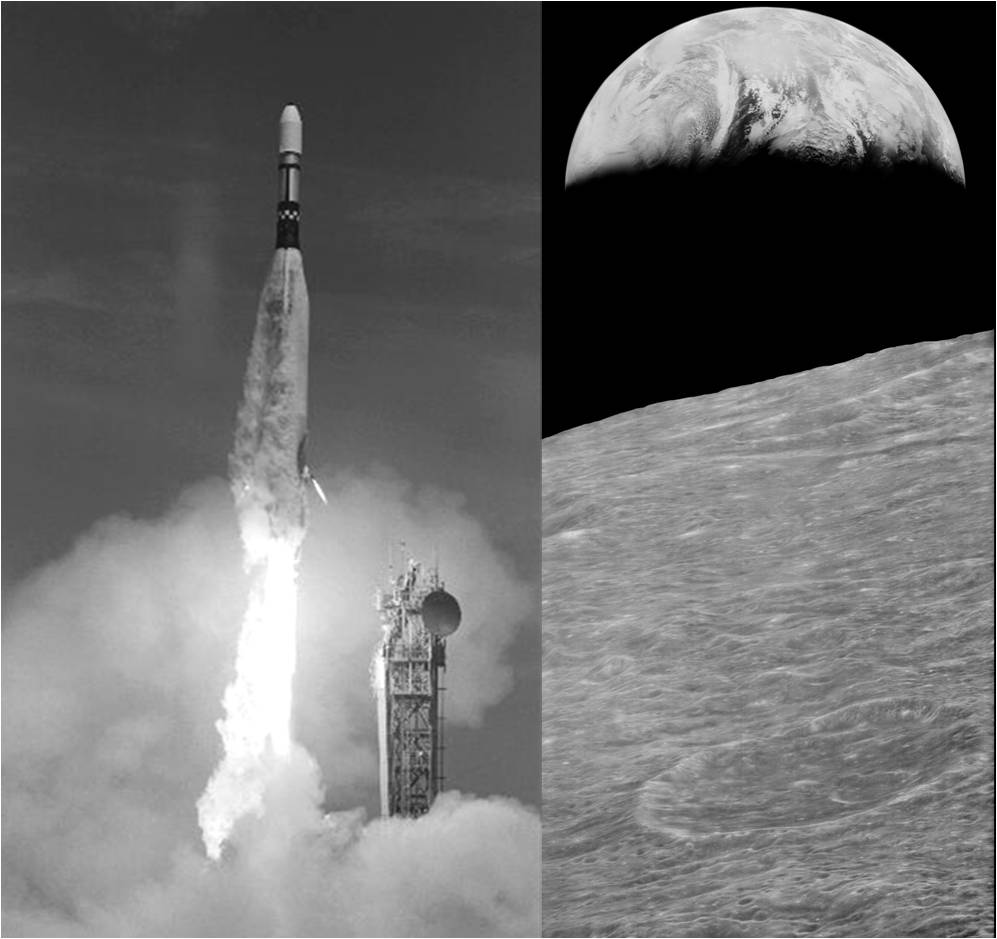
Forty-three years ago today, the Lunar Orbiter 1 spacecraft began its 92 hour trip to the Moon. Lunar Orbiter 1 rode into space aboard an Atlas-Agena D launch vehicle which lifted-off from Pad 13 at Cape Canaveral, Florida. Lift-off time was 19:26 UTC on Wednesday, 10 August 2009.
Lunar Orbiter 1 was the first of five moon mapping missions launched over a period of 12 months as part of the Lunar Orbiter Program. The primary purpose of this program was to thoroughly map the surface of Earth’s nearest neighbor in space preparatory to the historic Apollo lunar landings.
At 15:34 UTC on Sunday, 14 August 1966, Lunar Orbiter 1 was inserted into a highly elliptical lunar orbit that measured 117.5 miles by 1,160 miles. Orbital plane inclination and period of the 850-pound spacecraft was 12.2-deg and 208-minutes, respectively. By Friday, 26 August 1966, the Lunar Orbiter 1 perilune had been lowered to just 25.2-miles.
Lunar Orbiter 1 took photographs of the lunar surface between 18 August and 29 August. Onboard film processing was completed by 30 August and transmission to Earth of 211 high and medium resolution photographs was completed at 20:02 UTC on Wednesday, 14 September 1966. This event, which occurred on Mission Day 35, marked the completion of the photographic portion of the spacecraft’s mission.
Lunar Orbiter 1 imaged nearly 2 million square miles of the Moon’s surface to a resolution of 200 feet or better. This was 10 times better than that obtained from earth-based cameras. Lunar Orbiter 1 also provided the first views of earth as seen from the Moon.
Lunar Orbiter 1 would continue to orbit the Moon for another 45 days. As it did so, the spacecraft provided a wealth of micrometeoroid, gravitational, and radiation measurements that helped lunar scientists better understand the complex lunar environment.
The Lunar Orbiter 1 mission ended on Saturday, 29 October 1966 (Mission Day 80) during its 577th lunar orbit. This intentional action was necessary to make way for the next Lunar Orbiter mission in November. The impact site is located at 6.35-deg N and 160.72-deg E on the far side of the Moon.
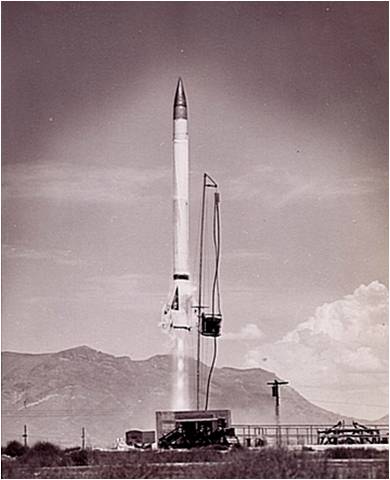
Fifty-eight years ago this week, a United States Navy Viking rocket soared to an altitude of 136 miles. In doing so, it eclipsed the previous single stage altitude record of 114 miles set by a captured German V-2 rocket on Tuesday, 17 December 1946. The mission was part of the Navy’s 12-flight Viking Rocket flight test series conducted between May 1949 and February 1955.
At 1659 UTC on Tuesday, 07 August 1951, Viking No. 7 was fired from LC-33 at White Sands Proving Ground (WSPG), New Mexico. Burnout velocity was 5,865 feet per second following a rocket motor burn time of 72 seconds. Viking No. 7 weighed 10,730 pounds at lift-off (roughly 8,000 pounds of which were propellants) and carried a scientific payload of 394 pounds.
Viking No. 7 was the last of the early Viking rocket configurations which measured 49-feet in length and had a diameter of 32-inches. Starting with Viking No. 8, the rocket’s airframe was modified to carry more propellants for greater altitude performance and measured 42-feet (length) by 45-inches (diameter). This modification allowed Viking No. 11, flown from WSPG on Monday, 24 May 1954, to capture the all-time Viking altitude record of 158 miles.
Although almost forgotten today, the Viking Rocket Program played a vital role in the history of American rocketry. Viking was the first large, liquid-fueled rocket developed by the United States. It’s rocket motor generated 21,000 pounds of lift-off thrust and employed an innovative two-axis gimbal system for pitch and yaw control. Fin-mounted reaction jets provided roll control.
The Viking Rocket Program provided a tremendous amount of scientific data about Earth’s atmospheric properties such as pressure, temperature, density, winds, and composition. Additionally, Viking formed the technological basis for a number of 1950’s rocket systems including the Navy’s Vanguard satellite launcher and the USAF Titan ICBM.
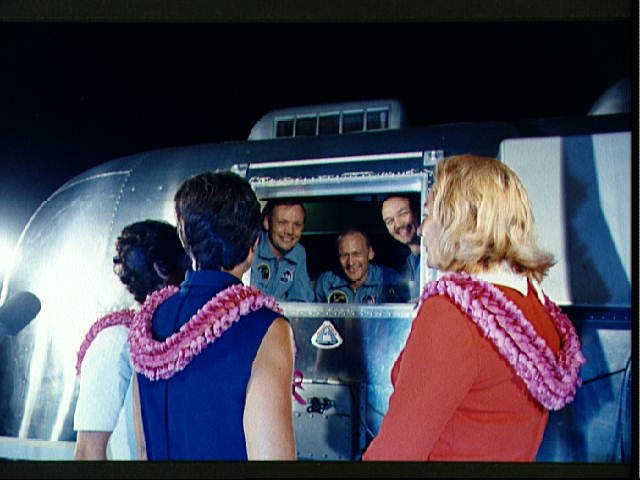
Forty years ago today, Apollo 11 astronauts Neil A. Armstrong, Edwin E. Aldrin, Jr., and Michael Collins arrived back at the Johnson Spacecraft Center (MSC) in Houston, Texas following their epic journey to and safe return from the Moon.
Following splashdown in the Pacific Ocean on Thursday, 24 July, 1969, the Apollo 11 astronauts and their Command Module Columbia were brought aboard the USS Hornet. Concerned that they would infect Earthlings with lunar pathogens, NASA quarantined the astronauts in the Mobile Quarantine Facility (MQF), which was a converted vacation trailer.
The Hornet steamed for Hawaii and transferred the MQF for airlift to Ellington Air Force Base, Texas. Following landing, the MQF and its heroic occupants were transported to the MSC. Once there, the astronauts and several medical staff were transferred from the MQF to more substantial accomodations known as the Lunar Receiving Laboratory (LRL).
Combined stay time in the MQF and LRL was 21 days. During their forced confinement, Armstrong, Aldrin, and Collins debriefed the Apollo 11 mission, rested, and mused about their unforgettable experiences at the Moon.
The Apollo 11 astronauts were released from the LRL on Thursday, 13 August 1969, having never contracted or transmitted a lunar disease.
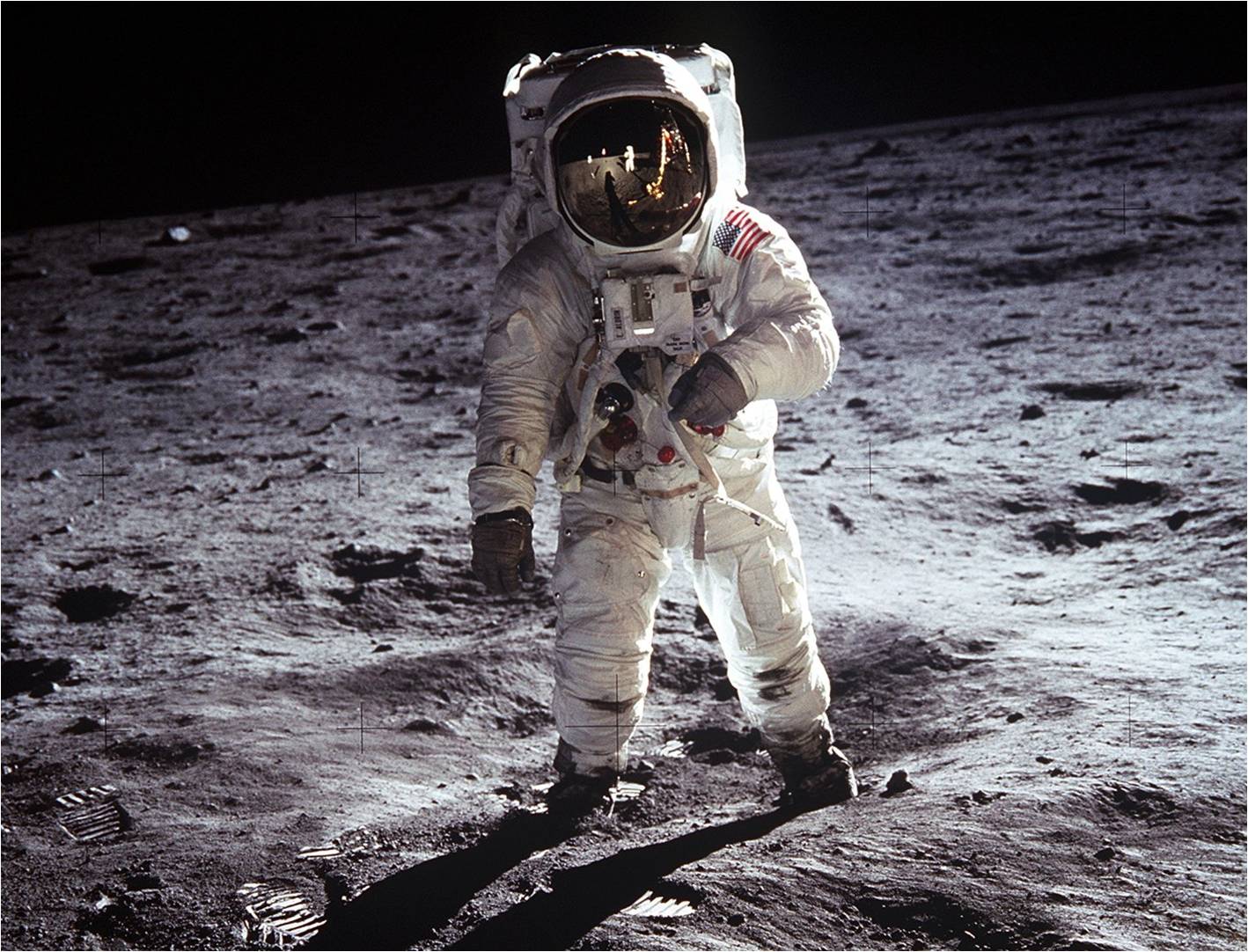
Forty years ago today, the United States of America landed two men on the surface of the Moon.
The Apollo 11 Lunar Module Eagle landed in Sea of Tranquility region of the Moon on Sunday, 20 July 1969 at 20:17:40 UTC. Less than seven hours later, astronauts Neil A. Armstrong and Edwin E. Aldrin, Jr. became the first human beings to walk upon Earth’s closest neighbor. Fellow crew member Michael Collins orbited high overhead in the Command Module Columbia.
As Apollo 11 commander, Neil A. Armstrong was accorded the privilege of being the first man to step foot upon the Moon. As he did so, Armstrong spoke these words: “That’s one small step for Man; one giant leap for Mankind”. He had intended to say: “That’s one small step for ‘a’ man; one giant leap for Mankind”.
Armstrong and Aldrin explored their Sea of Tranquility landing site for about two and a half hours. Total lunar surface stay time was 22 hours and 37 minutes. The Apollo 11 crew left a plaque affixed to one of the legs of the Lunar Module’s descent stage which read: “Here Men From the Planet Earth First Set Foot Upon the Moon; July 1969, A.D. We Came in Peace for All Mankind”.
Following a successful lunar lift-off, Armstrong and Aldrin rejoined Collins in lunar orbit. Approximately seven hours later, the Apollo 11 crew rocketed out of lunar orbit to begin the quarter million mile journey back to Earth. Columbia splashed-down in the Pacific Ocean at 16:50:35 UTC on Thursday, 24 July 1969. Total mission time was 195 hours, 18 minutes, and 35 seconds.
With completion of the flight of Apollo 11, the United States of America fulfilled President John F. Kennedy’s 25 May 1961 call to land a man on the Moon and return him safely to the Earth before the decade of the 1960’s was out. It had taken 2,982 demanding days and much national treasure to do so.
Mission Accomplished, Mr. President.
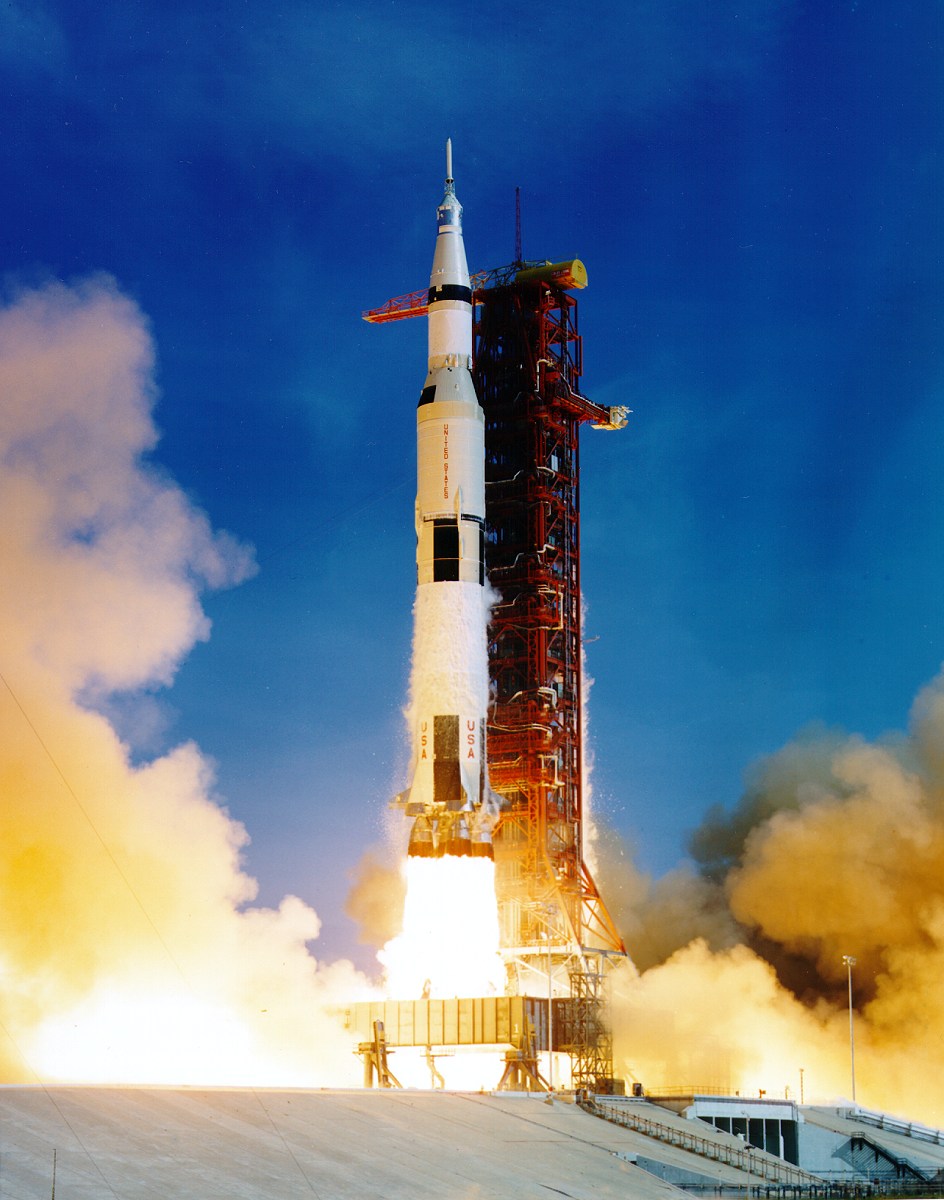
Forty years ago this week, the epic flight of Apollo 11, the first mission to land men on the Moon, began with launch from the Kennedy Space Center (KSC) at Merritt Island, Florida. Nearly 1-million people gathered around America’s famous space complex to witness the historic event. An estimated 1-billion viewers worldwide watched the proceedings on television.
The names of the Apollo 11 crew are now legend: Mission Commander Neil A. Armstrong, Lunar Module Pilot Edwin E. Aldrin, Jr., and Command Module Pilot Michael Collins. Each astronaut was making his second spaceflight.
The overall Apollo 11 spacecraft weighed roughly 100,000 pounds and consisted of 3 major components: Command Module, Service Module, and Lunar Excursion Module (LEM). Out of American history came the names used to distinguish two of these components from one another. The Command Module was named Columbia, the feminine personification of America, while the Lunar Excursion Module received the appellation Eagle in honor of America’s national bird.
The Apollo-Saturn V launch stack measured 363-feet in length, had a maximum diameter of 33-feet, and weighed 6.7-milllion pounds at ignition of its five F-1 engines. The vehicle rose from the Earth on 7.7-million pounds of lift-off thrust.
The acoustic energy produced by the Saturn’s first stage propulsion system was unlike anything in common experience. The sound produced was like intense, continuous thunder even miles away from the launch point. Ground and structure shook disturbingly and a person’s lungs vibrated within their chest cavity.
Lift-off of Apollo 11 (AS-506) from KSC’s LC-39A occurred at 13:32 UTC on Wednesday, 16 July 1969. The target for the day’s launch, the Moon, was 218,096 miles distant from Earth. It took 12 seconds just for the massive Apollo 11 launch vehicle to clear the launch tower. However, a scant 12 minutes later, the Apollo 11 spacecraft was safely in low earth orbit (LEO) traveling at 17,500 miles per hour.
Following checkout in earth orbit, trans-lunar injection, and earth-to-moon coast, Apollo 11 entered lunar orbit nearly 76 hours after lift-off. Now, the big question: Would they make it? Even Apollo 11’s Command Module Pilot, Michael Collins, estimated that the chance of a successful lunar landing on the first attempt was only 50/50. The answer would soon come. History’s first lunar landing attempt was now only 24 hours away.
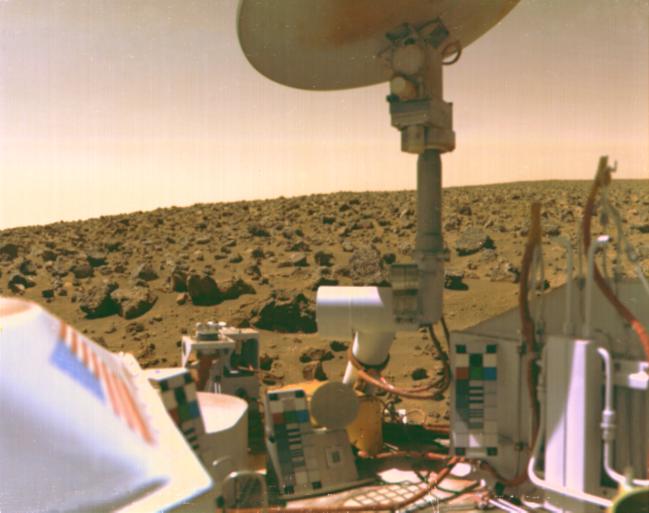
Thirty-three years ago this month, on the seventh anniversary of the first manned lunar landing, Viking I became the first spacecraft to successfully land on the surface of the planet Mars. The primary purpose of the mission was to search for signs of life on the Martian surface.
The Viking I mission began with launch from Earth on Wednesday, 20 August 1975. Lift-off of the Titan IIIE-Centaur launch vehicle from Cape Canaveral, Florida took place at 2122 UTC. The Viking I orbiter-lander payload mass at lift-off was 7,766 lbs.
After chasing Mars for 11 months and 500,000,000 miles, Viking I entered Martian orbit on Saturday, 19 June 1976. The original plan called for a landing on Sunday, 04 July. However, imaging of the intended landing site from orbit revealed that a landing there would be a high risk venture. With this revelation, Viking project scientists went into high stress mode to locate a suitable alternate landing location.
On Tuesday, 20 August 1976, the Viking I lander separated from the Viking orbiter at 0851 UTC in preparation for the deorbit burn.
The Viking I atmospheric deceleration sequence began at roughly 1,000,000 feet above the Martian surface. An ablating aeroshell both slowed and protected the vehicle from aerodynamic heating down to 19,000 feet. At this point, a 52.5-foot diameter parachute was deployed to provide further slowing. At 4,000 feet, the aeroshell and parachute were jettisoned and the craft’s retro-rockets were fired
The Viking I lander touched-down at Chryse Planitia (“Golden Plain” in the Greek) at 1153 UTC having completed the first successful Martian entry, descent, and landing (EDL) mission. The Viking I landing mass was on the order of 1,320 lbs. (Point of clarification: the photo above was taken by Viking II which landed on Mars at Utopia Planitia (“Nowhere Plain”) on Friday, 03 September 1976.)
Viking I went on to perform a variety of first-ever scientific investigations on Mars. Key instrumentation included several cameras, a surface sampler arm, a meterology boom, a seismometer, and a variety of other sensors. In its search for signs of life, Viking I was also configured with an internal biology compartment and gas chromatograph mass spectrometer.
The Viking I lander was designed to function for a minimum of 90 days on the surface of Mars. In reality, it continued to function and provide useful science for over 6 years (contact lost 13 November of 1982). While it rewrote the book in terms of Martian planetary science, Viking I did not in fact discover defintive signs of life on Mars.