Five years ago today, the NASA X-43A scramjet-powered flight research vehicle reached a record speed of over 6,600 mph (Mach 9.68). In doing so, the X-43A broke its own record speed of Mach 6.83 (4,600 mph) and became the fastest airbreathing aircraft of all time.
In 1996, NASA initiated a technology demonstration program known as HYPER-X. The central goal of the HYPER-X Program was to successfully demonstrate sustained supersonic combustion and thrust production of a flight-scale scramjet propulsion system at speeds up to Mach 10.
Also known as the HYPER-X Research Vehicle (HXRV), the X-43A aircraft was a scramjet test bed. The aircraft measured 12 feet in length, 5 feet in width, and weighed close to 3,000 pounds. The X-43A was boosted to scramjet take-over speeds with a modified Orbital Sciences Pegasus rocket booster.
The combined HXRV-Pegasus stack was referred to as the HYPER-X Launch Vehicle (HXLV). Measuring approximately 50 feet in length, the HXLV weighed slightly more than 41,000 pounds. The HXLV was air-launched from a B-52 mothership. Together, the entire assemblage constituted a 3-stage vehicle.
The third and final flight of the HYPER-X program took place on Tuesday, 16 November 2004. The flight originated from Edwards Air Force Base, California. Using Runway 04, NASA’s venerable B-52B (S/N 52-0008) started its take-off roll at approximately 21:08 UTC. The aircraft then headed for the Pacific Ocean launch point located just west of San Nicholas Island.
At 22:34:43 UTC, the HXLV fell away from the B-52B mothership. Following a 5 second free fall, rocket motor ignition occurred and the HXLV initiated a pull-up to start its climb and acceleration to the test window. It took the HXLV 75 seconds to reach a speed of slightly over Mach 10.
Following rocket motor burnout and a brief coast period, the HXRV (X-43A) successfully separated from the Pegasus booster at 109,440 feet and Mach 9.74. The HXRV scramjet was operative by Mach 9.68. Supersonic combustion and thrust production were successfully achieved. Total engine-on duration was approximately 11 seconds.
As the X-43A decelerated along its post-burn descent flight path, the aircraft performed a series of data gathering flight maneuvers. A vast quantity of high-quality aerodynamic and flight control system data were acquired for Mach numbers ranging from hypersonic to transonic. Finally, the X-43A impacted the Pacific Ocean at a point about 850 nautical miles due west of its launch location. Total flight time was approximately 15 minutes.
The HYPER-X Program was now history. Supersonic combustion and thrust production of an airframe-integrated scramjet had indeed been achieved for the first time in flight; a goal that dated back to before the X-15 Program. Along the way, the X-43A established a speed record for airbreathing aircraft and earned several Guinness World Records for its efforts.
As a footnote to the X-43A story, the HYPER-X Flight 3 mission would also be the last for NASA’s fabled B-52B mothership. The aircraft that launched many of the historic X-15, M2-F2, M2-F3, X- 24A, X-24B and HL-10 flight research missions, and all three HYPER-X flights, would take to the air no more. In tribute, B-52B (S/N 52-0008) now occupies a place of honor at a point near the North Gate of Edwards Air Force Base.
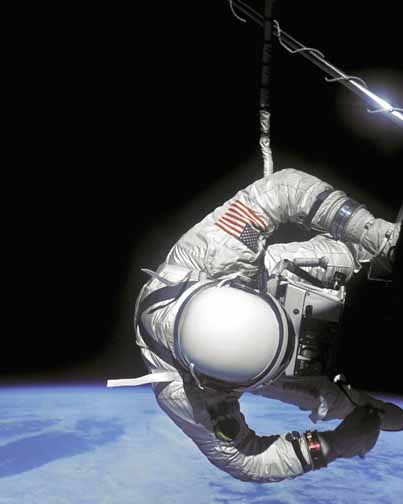
Forty-three years ago this month, NASA’s pioneering spaceflight program, Project Gemini, was brought to a successful conclusion with the 4-day flight of Gemini XII. Remarkably, the mission was the tenth Gemini flight in 20 months.
Boosted to Earth orbit by a two-stage Titan II launch vehicle, Gemini XII Command Pilot James A. Lovell, Jr. and Pilot Edwin E. “Buzz” Aldrin, Jr. lifted-off from Cape Canaveral’s LC-19 at 20:46:33 UTC on Friday, 11 November 1966. The flight was Lovell’s second trip into space and Aldrin’s first.
Like almost every Gemini mission before it, Gemini XII was not a glitch-free spaceflight. For instance, when the spacecraft’s rendezvous radar began acting oddly, the crew had to resort to sextant and chart to complete the last 65 nautical miles of the rendezvous with their Agena Target Vehicle. But, overcoming this and other obstacles served to provide the experience and instill the confidence needed to meet the truly daunting challenge that lay ahead; landing on the Moon.
Unquestionably, Gemini XII’s single most important contribution to the United States manned space effort was validating the notion that a well-trained astronaut could indeed do useful work in an Extra-Vehicular Activity (EVA) environment. The exhausting and even dangerous EVA experiences of Gene Cernan on Gemini IX and Dick Gordon on Gemini XI brought into sharp focus the challenge of performing even seemingly simple work assignments outside the Gemini spacecraft.
Buzz Aldrin performed a trio of EVA’s on Gemini XII. Two of these involved standing in his seat with the hatch open. The third involved a tethered EVA or space walk. On the latter, Aldrin successfully moved about the exterior of the Gemini-Agena combination without exhausting himself. He also used a special-purpose torque wrench to perform a number of important work tasks. Central to Aldrin’s success was the use of foot restraints and auxiliary tethers to anchor his body while floating in a weightless state.
Where others had struggled and not been able to accomplish mission EVA goals, Buzz Aldrin came off conqueror. One of the chief reasons for his success was effective pre-flight training. A pivotal aspect of this training was to practice EVA tasks underwater as a unique means of simulating the effects of weightlessness. This approach was found to be so useful that it has been used ever since to train American EVA astronauts.
Lovell and Aldrin did many more things during their highly-compressed 4-day spaceflight in November of 1966. Multiple dockings with the Agena, Gemini spacecraft maneuvering, tethered stationkeeping exercises, fourteen scientific experiments, and photographing a total eclipse occupied their time aloft.
On Tuesday, 15 November 1966, on their 59th orbit, a tired, but triumphant Gemini XII crew returned to Earth. The associated reentry flight profile was automated; that is, totally controlled by computer. Yet another first and vital accomplishment for Project Gemini. Splashdown was in the West Atlantic at 19:21:04 UTC.
While Gemini would fly no more, both Lovell and Aldrin certainly would. In fact, both men would play prominent roles in several historic flights to the Moon. Jim Lovell flew on Apollo 8 in December 1968 and Apollo 13 in April 1970. And of course, Buzz Aldrin would walk on the Moon at Mare Tranquilitatis in July 1969 as the Lunar Module Pilot for Apollo 11.
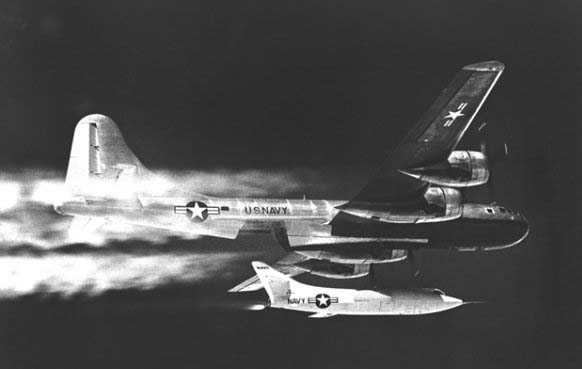
Fifty-six years ago this month, the USN/Douglas D-558-II Skyrocket became the first aircraft to fly at twice the speed of sound. This historic event took place on Friday, 20 November 1953 at Edwards Air Force Base, California.
The D-558-II was a United States Navy (USN) X-aircraft and first flew in February of 1948. It was contemporaneous with the USAF/Bell XS-1. The aircraft measured 42 feet in length with a wing span of 25 feet. Maximum take-off weight was 15,266 pounds. Douglas manufactured a trio of D-558-II aircraft (Bureau No.’s 37973, 37974 and 37975).
The original version of the swept-wing D-558-II had both rocket and turbojet propulsion. The latter system providing a ground take-off capability. However, like other early X-aircraft such as the XS-1, X-1A, X-2 and X-15), the D-558-II achieved max performance through the use of a mothership and rocket power alone.
On that record-setting day in November 1953, the D-558-II (Bureau No. 37974) was carried to the drop altitude of 32,000 feet by a USN P2B-1S (Bureau No. 84029). NACA test pilot A. Scott Crossfield was in the D-558-II cockpit. Although ailing with the flu, Crossfield was not about to let a little urpiness force him to miss today’s events!
Following drop, Crossfield ignited the Reaction Motors LR8-RM-6 (USN designation for the XLR-11) rocket motor and started uphill. After closely adhering to a carefully planned climb schedule, Crossfield initiated a pushover at 72,000 feet that resulted in a shallow dive. Passing through 62,000 feet, the D-558-II hit 1,291 mph; Mach 2.005.
The D-558-II reached Mach 2 due to a confluence of several factors. First, Crossfield flew the profile as briefed. Second, temperatures at altitude that day were unusually low. This lowered the speed of sound and thus increased Mach number. Third, the ground crew did an extraordinary job of optimizing the D-558-II for the max speed mission.
Expanding on the last point mentioned above, extension tubes were added to the LR8-RM-6 rocket motor. This increased thrust from 6,000 to 9,000 pounds. The aircraft was then cold-soaked overnight in an effort to maximize its propellant load. Finally, external airframe gaps and panel openings were taped over and the aircraft was waxed and polished in an effort to minimize aerodynamic drag.
Scott Crossfield received the 1954 Lawrence B. Sperry Award for his Mach 2 exploits. The record-setting aircraft (Bureau No. 37934) is currently displayed at the National Air and Space Museum in Washington, D.C. in tribute to its many contributions to aviation history.
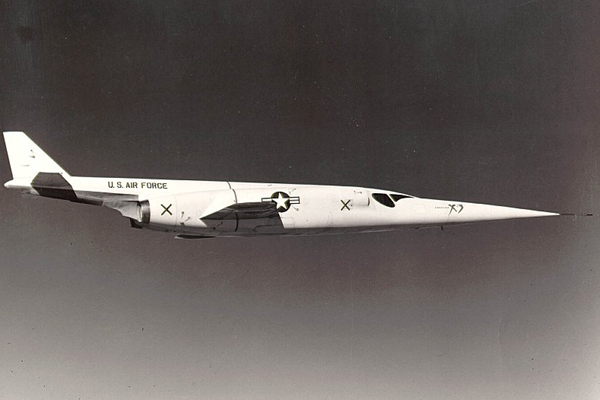
Fifty-five years ago this month, the USAF/Douglas X-3 Stiletto research aircraft exhibited a then little known dynamic instability mode during a flight test with NACA test pilot Joseph A. Walker at the controls.
The X-3 was designed to fly at speeds up to Mach 2. The aircraft was approximately 67 feet in length and had a wing span on the order of 23 feet. Gross weight was 23,840 pounds.
A pair of Westinghouse J46-WE-1 turbojets were intended to power the X-3. However, protracted developmental problems and installation issues with these powerplants would eventually prevent their use in the aircraft.
The X-3 was ultimately outfitted with a pair of Westinghouse J34-WE-17 turbojets. The result was that the X-3 was now underpowered and could barely fly supersonically. Maximum achieved Mach number was 1.21 and that was in a 30-deg dive!
Notwithstanding the above, the X-3 took to the air 54 times between October 1952 and May 1956 for the purpose of conducting transonic flight research. It would be on its 43rd flight that the X-3 would make its most important contribution to aviation.
On Wednesday, 27 October 1954, Joe Walker took-off in the X-3 (S/N 49-2892) from Edwards Air Force Base, California. At Mach 0.92 and 30,000 feet, Walker applied left aileron at fixed-rudder in an effort to develop a rapid roll response. To Walker’s utter amazement, the X-3 went wild in both pitch and yaw.
Although it seemed to last much longer, Walker was able to recover control of the X-3 within 5 seconds of his initial left aileron input. In true test pilot fashion, Walker again made an abrupt rudder-fixed left aileron input at Mach 1.05. The same thing happened. However, this time the aircraft’s motions were more violent.
Happily, Walker again recovered control of the X-3. Having had enough of flight test frontiersmanship for one day, Walker uneventfully recovered the aircraft to Edwards.
The phenomenon that Joe Walker and the X-3 encountered that day in 1954 is known as Inertial Roll Coupling. It is a resonant divergence in either pitch or yaw due to the presence of roll rate. Aircraft like the X-3, which have low longitudinal and/or directional static stability as well as high pitch-to-roll and yaw-to-roll moment of inertia ratios, are especially susceptible to this phenomenon.
As a postscript to our story, the phenomenon of Inertial Roll Coupling had been hypothesized by the NACA’s William H. Phillips back in June of 1948. For Joe Walker in October of 1954, engineering theory would become flight test fact in a few terrifying seconds high in the skies over Edwards Air Force Base.
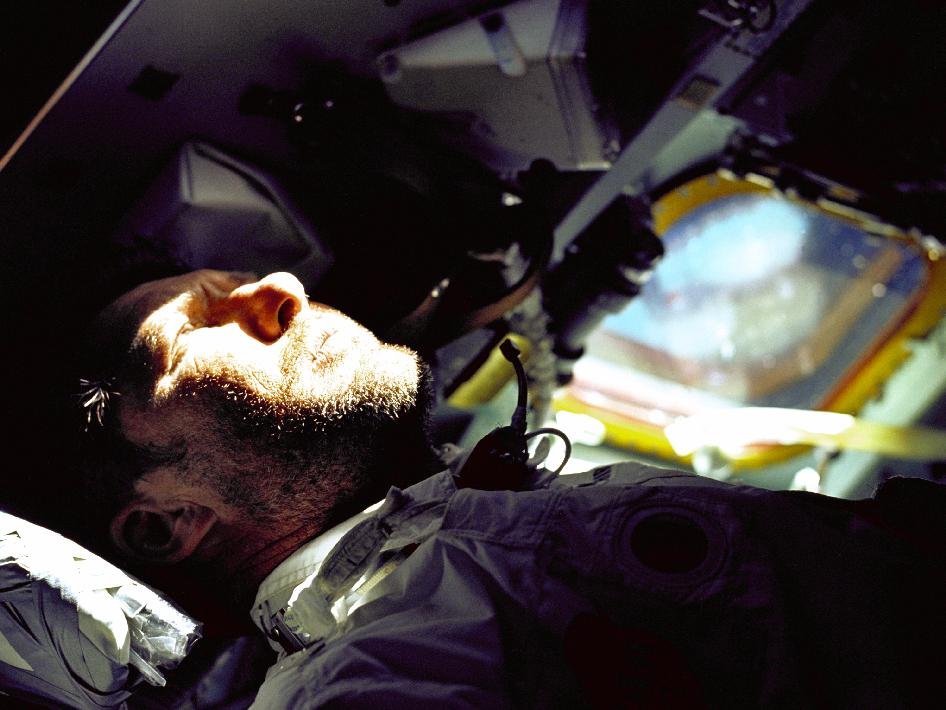
Forty-one years ago this month, NASA successfully conducted the first manned Apollo Earth-orbital mission with the flight of Apollo 7. This mission was a critically-important milestone along the path to the first manned lunar landing in July 1969.
The launch of Apollo 7 took place from Launch Complex 34 at Cape Canaveral Air Force Station, Florida at 15:02:45 UTC on Friday, 11 October 1968. The flight crew consisted of NASA astronauts Walter M. Schirra, Donn F. Eisele, and R. Walter Cunningham. Their primary goal was to thoroughly qualify the new Apollo Block II Command Module (CM) during 11 days in space.
Apollo 7 was not only the first flight of the Block II CM, but in fact the first manned mission in the Apollo Program. Apollo 7 also featured the first use of the Saturn IB launch vehicle in a manned mission. Apollo 7’s critical nature stemmed from the tragic Apollo 1 fire that took the lives of Virgil I. (Gus) Grissom, Edward H. White II, and Roger B. Chaffee on Friday, 27 January 1967.
The Apollo 1 fire was attributed to numerous deficiencies in the design, construction, and testing of its Block I CM. The Block II spacecraft flown on Apollo 7 was a major redesign of the Apollo Command Module and was in every sense superior to the Block I vehicle. However, it had taken 21 months to return to flight status and the Nation’s goal of a manned lunar landing within the decade of the 1960’s was in serious jeopardy.
The Apollo 7 crew orbited the Earth 163 times at an orbital altitude that varied between 125 and 160 nautical miles. In that time, they rigorously tested every aspect of their Block II CM. This testing included 8 firings of the Service Propulsion System (SPS) while in orbit. Apollo 7 splashdown occurred in the Atlantic Ocean near the Bermuda Islands at 11:11:48 UTC on Tuesday, 22 October 1968.
The Nation’s Lunar Landing Program overwhelmingly got the unqualified success that it desperately needed from the Apollo 7 mission. The Apollo Block II CM would provide yeoman service throughout the time of Apollo. The spacecraft would also go on to see service in the Skylab and Apollo-Soyuz Test Project programs.
While the technical performance of the Apollo 7 crew was unquestionably superb, their interaction with Mission Control at Johnson Spacecraft Center (JSC) in Houston, Texas was quite strained. The crew suffered from head colds through much of the mission and the food quality was poor. Coupled with Houston’s incessant attempts to cramp more tasks into each moment of the mission, Apollo 7 Commander Schirra took control of his ship and made the ultimate decisions as to what work would be performed onboard the spacecraft.
The flight of Apollo 7 would be Wally Schirra’s last mission in space as he had announced prior to flight. Schirra holds the distinction of being the only astronaut to have flown Mercury, Gemini, and Apollo missions.
Interestingly, Apollo 7 was not only Schirra’s last time in space, but it was Donn Eisele’s and Walt Cunningham’s first and last space mission as well. That there is a direct connection between this historical fact and the crew’s insubordinative behavior during Apollo 7 is obvious to the inquiring mind.
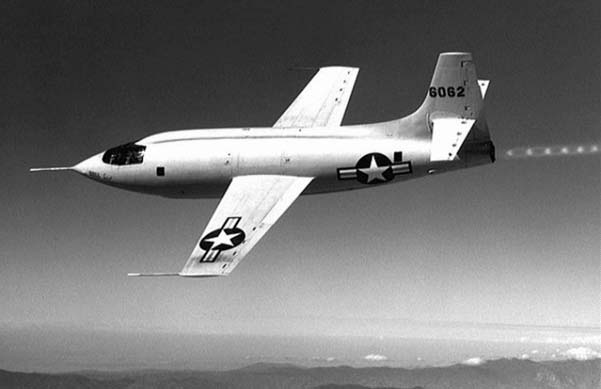
Sixty-two years ago this month, the legendary USAF/Bell XS-1 experimental aircraft exceeded the speed of sound when it reached a maximum speed of 700 mph (Mach 1.06) at 45,000 feet.
Bell Aircraft Corporation of Buffalo, New York built three copies of the XS-1 under contract to the United States Army Air Forces (USAAF). The aircraft were designed to approach and then fly beyond the speed of sound.
The Bell XS-1 was 31-feet in length and had a wing span of 28 feet. Gross take-off weight was around 12,500 lbs. The aircraft had an empty weight of about 7,000 lbs. Propulsion was provided by a Reaction Motors XLR-11 rocket motor capable of generating a maximum thrust of 6,000 lbs.
On the morning of Tuesday, 14 October 1947, the XS-1 (S/N 46-062) dropped away from its B-29 mothership (S/N 45-21800 ) as the pair flew at 220 mph and 20,000 feet. In the XS-1 cockpit was USAAF Captain and World War II ace Charles E. Yeager. The young test pilot had named the aircraft Glamorous Glennis in honor of his wife.
Following drop, Yeager sequentially-lit all four XLR-11 rocket chambers during a climb and push-over that ultimately brought him to level flight around 45,000 feet. The resulting acceleration profile propelled the XS-1 slightly beyond Mach 1 for about 20 seconds. Yeager then shutdown the rocket, decelerated to subsonic speeds, and landed the XS-1 on Muroc Dry Lake at Muroc Army Airfield, California.
The world would not find out about the daring exploits of 14 October 1947 until December of the same year. As it was, the announcement came from a trade magazine that even today is sometimes referred to as “Aviation Leak”.
Today, Glamorous Glennis is prominently displayed in the Milestones of Flight hall of the National Air and Space Museum located in Washington, DC. For his efforts in breaking the sound barrier, Chuck Yeager was a co-recipient of the 1948 Collier Trophy.
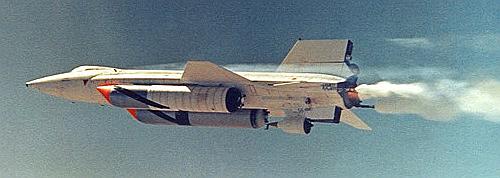
Forty-two years ago this month, USAF Major William J. “Pete” Knight piloted the fabled USAF/North American X-15A-2 hypersonic research aircraft to a record speed of 4,520 mph – about a mile and a quarter per second.
North American’s original X-15 production run consisted of three (3) aircraft. The X-15A-2 was a rebuild of the 2nd airframe (S/N 56-6671) which had been severely damaged during an emergency landing at Mud Lake, Nevada in November of 1962.
The rebuilt aircraft was configured with a pair of droppable propellant tanks that allowed the type’s XLR-99 rocket engine to operate 60 seconds beyond the stock X-15’s 80-second burn time. Among other modifications, the aircraft also carried a pylon-mounted dummy ramjet in the ventral region of the aft fuselage.
With the addition of the external propellant tanks, the X-15A-2 was really a three-stage vehicle. The first stage was the NASA NB-52B mothership which launched the X-15 at Mach 0.82 and 45,000 feet. The second stage consisted of the propellant-laden external tanks which were jettisoned at Mach 2.0 and 70,000 feet. The third stage was the X-15A-2 with its entire internal propellant load.
Due to the increased speed of the X-15A-2, the aircraft was covered with Martin MA-25S ablator to protect it from the higher aerodynamic heating loads. The baseline ablator was pink in color and gave the X-15A-2 a rather odd appearance. Fortunately, application of a white wear/sealer over the ablator gave the aircraft a more dignified look.
On Tuesday, 03 October 1967, Pete Knight and the X-15A-2 dropped away from the NB-52B (S/N 52-008) at the start of the X-15 Program’s 188th mission. Knight ignited the XLR-99 rocket engine and excuted a pull-up followed by a pushover to level flight at a little over 102,000 feet. Aircraft speed at XLR-99 burnout was 4,520 mph (Mach 6.7).
As the aircraft decelerated following burnout, Knight executed a series of pre-planned flight maneuvers to acquire vital aerodynamics data. However, passing through Mach 5.5, he received an indication in the cockpit that a high temperature condition existed in the XLR-99 engine bay.
Knight attempted to jettison the aircraft’s remaining propellants, but to no avail. The jettison tubes were welded shut by whatever was happening in the engine bay. This meant he would land heavier and faster than usual. Fortunately, Knight’s piloting skills allowed him to get the X-15A-2 on to Rogers Dry Lake in one piece.
As flight support personnel inspected the X-15A-2 airframe following Knight’s emergency landing, they were alarmed at what they found. The aft ventral region of the aircraft had incurred significant thermal damage. Further, the dummy ramjet was gone.
As reported in the classic NASA document, TM-X-1669, higher-than-expected aerodynamic heating levels were responsible for the damage to the X-15A-2.
First, shock wave/boundary layer interaction heating on the lower fuselage just ahead of the pylon (1) completely destroyed the ablator in that region and (2) penetrated the Inconel-X airframe structure. This introduced very high temperature air into the X-15 engine bay.
Second, impingement of the dummy ramjet nose shock on the detached bow shock coming off of the pylon produced a shear layer that focused on the pylon leading edge. The resulting heating rates were of sufficient magnitude and duration to both burn away the pylon ablator and burn through the pylon structure. The weakened pylon attachment eventually failed and the dummy ramjet departed the main airframe.
Pete Knight will forever hold the record for the fastest X-15 flight. However, the X-15A-2 never flew again. Only 11 more flights remained in the X-15 Program at the time. A lack of time and funding meant that little was to be gained by repairing the thermally-damaged aircraft.
As for the final disposition of the X-15A-2 (S/N 56-6671), the aircraft’s remaining ablator was removed with its external surface cleaned-up and original markings restored. The aircraft now resides in a place of honor at the National Museum of the United States Air Force located at Wright-Patterson AFB in Dayton, Ohio.
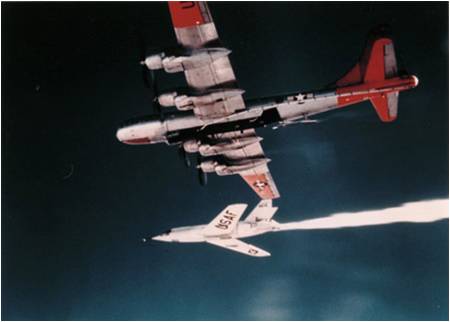
Fifty-three years ago this month, the Bell X-2 rocket-powered research aircraft reached a record speed of 2,094 mph with USAF Captain Milburn G. “Mel” Apt at the controls. This corresponded to a Mach number of 3.2 at 65,000 feet.
Mel Apt’s historic achievement came about because of the Air Force’s desire to have the X-2 reach Mach 3 before turning it over to the National Advisory Committee For Aeronautics (NACA) for further flight research testing. Just 20 days prior to Apt’s flight in the X-2, USAF Captain Iven C. Kincheloe, Jr. had flown the aircraft to a record altitude of 126,200 feet.
On Thursday, 27 September 1956, Apt and the last X-2 aircraft (S/N 46-674) dropped away from the USAF B-50 motherhip at 30,000 feet and 225 mph. Despite the fact that Apt had never flown an X-aircraft, he executed the flight profile exactly as briefed. In addition, the X-2’s twin-chamber XLR-25 rocket motor burned propellant 12.5 seconds longer than planned. Both of these factors contributed to the aircraft attaining a speed in excess of 2,000 mph.
Based on previous flight tests as well as flight simulator sessions, Apt knew that the X-2 had to slow to roughly Mach 2.4 before turning the aircraft back to Edwards. This was due to degraded directional stability, control reversal, and aerodynamic coupling issues that adversely affected the X-2 at higher Mach numbers.
However, Mel Apt was now faced with a difficult decision. If he waited for the X-2 to slow to Mach 2.4 before initiating a turn back to Edwards Air Force Base, he quite likely would not have enough energy and therefore range to reach Rogers Dry Lake. On the other hand, if he decided to initiate the turn back to Edwards at high Mach number, he risked having the X-2 depart controlled flight. Apt opted for the latter.
As Apt increased the aircraft’s angle-of-attack, the X-2 careened out of control and subjected him to a brutal pounding. Aircraft lateral acceleration varied between +6 and -6 g’s. The battered pilot ultimately found himself in a subsonic, inverted spin at 40,000 feet. At this point, Apt effected pyrotechnic separation of the X-2’s forebody which contained the cockpit and a drogue parachute.
X-2 forebody separation was clean and the drogue parachute deployed properly. However, Apt still needed to bail out of the X-2’s forebody and deploy his personal parachute to complete the emergency egress process. But, it was not to be. Mel Apt ran out of time, altitude, and luck. He lost his life when the X-2 forebody that he was trying to escape from impacted the ground at several hundred miles an hour.
Mel Apt’s flight to Mach 3.2 established a record that stood until the X-15 exceeded it in August 1960. However, the price for doing so was very high. The USAF lost a brave test pilot and the lone remaining X-2 on that fateful day in September 1956. The mishap also ended the USAF X-2 Program. NACA never did conduct flight research with the X-2.
However, for a few terrifying moments, Mel Apt was the fastest man alive.
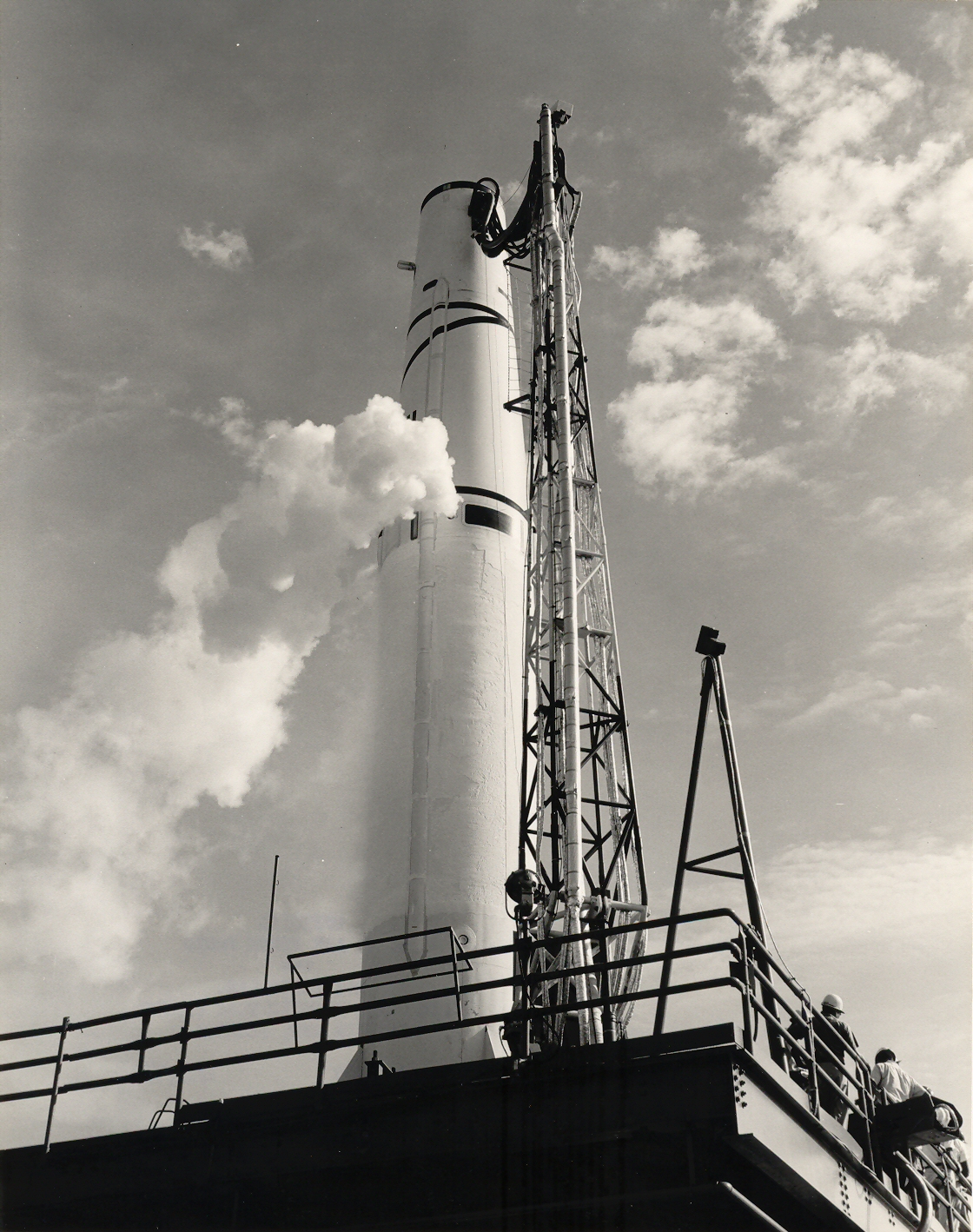
Fifty-two years ago this month, the United States successfully tested a USAF/Douglas Thor missile for the first time. Thor Vehicle 105, launched from Launch Complex 17 at Cape Canaveral, flew 1,100 miles down the Eastern Test Range (ETR) on Saturday, 21 September 1957.
Named after the Norse god of thunder, the Thor (PGM-17A) was designed as a nuclear-armed Intermediate Range Ballistic Missle (IRBM). Operational Thor missiles were armed with a single W49 nuclear warhead having an explosive yield equivalent to 1.44 megatons of TNT.
The Thor measured 65 feet in length and had a maximum diameter of 8 feet. Weighing 110,000 pounds at lift-off, the test vehicle climbed-out on 150,000 pounds of thrust generated by its single Rocketdyne LR79-NA-9 first stage rocket motor. The powerplant used LOX/Kerosene propellants and had a nominal burn time of 165 seconds. Specific impulse was around 280 seconds.
Following development flight testing, the Thor would become the first operational ballistic missile deployed by the United States. Sixty Thor missiles were tended by twenty RAF missile squadrons scattered throughout the United Kingdom from 1958 through 1963.
Although its tour of duty was brief, the Thor served as an effective deterent to Soviet agression until the arrival of the first true Intercontinental Ballistic Missiles (ICBM). Interestingly, the Thor IRBM would become the basis for the first Delta launch vehicles, descendants of which remain in active service up to the current day.
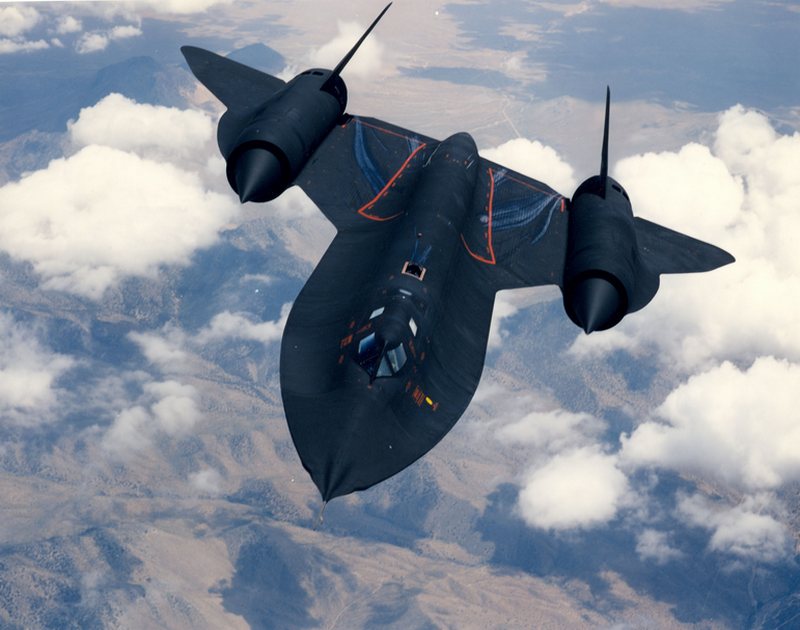
Thirty-five years ago this month, the legendary USAF/Lockheed SR-71A Blackbird triple-sonic aircraft established an official world speed record as it traversed the 5,446.87 statute miles between London and Los Angeles in 3 hours 47 minutes and 39 seconds. Average speed was 1,435.59 mph.
The all-USAF crew of Captain Harold B. Adams (Pilot) and Major William C. Machorek (RSO) flew the historic mission in aircraft S/N 61-17972 on Friday, 13 September 1974. In their rapid east-to-west journey, the record-setting aircraft and its crew crossed 7 separate time zones.
To gain an added appreciation for the Blackbird’s impressive performance, one might consider the following. The Earth rotates through an arc distance of a little over 1,000 miles in one hour. The Blackbird averaged over 1,400 miles arc distance in one hour. In that sense, the aircraft out-raced the sun as it flew more than one-fifth the total distance around the globe.
Fittingly, the crew of Adams and Machorek received the FAI’s prestigous De La Vaulx medal in honor of their London-to-Los Angeles world speed record which stands to this very day.