Forty-seven years ago this week, the USAF/General Dynamics F-111A Aardvark tactical strike aircraft successfully swept its variable-geometry wings for the first time in flight. Company test pilots Dick Johnson and Val Prahl flew this test on what was the second flight of Ship No 1. (S/N 63-9766). Flying out of Carswell Air Force Base in Fort Worth, Texas, the aircraft’s wings were swept through the full range of wing sweep (16 to 72.5-deg) without incident. This important milestone in the development of the all-weather, supersonic-capable, low-level penetration F-111A took place on Wednesday, 06 January 1965.

Twenty-five years ago this month, the storied Rutan Model 76 Voyager aircraft successfully completed history’s first non-stop, non-refueled flight around the world. The crew of Dick Rutan and Jeana Yeager departed Edwards Air Force on Sunday, 14 December 1986 and returned 216 hours, 3 minutes and 44 seconds later on Tuesday, 23 December 1986. The FAI-official distance covered during the flight was 21,707.6 nm. For their efforts, the flight crew, Burt Rutan (designer), and Bruce Evans (builder and crew chief) received the 1986 Collier Trophy.

Fifty-seven years ago today, the No. 1 USAF/Convair YF-102A (S/N 53-1787) aircraft flew for the first time on a flight that originated from Lindbergh Field near San Diego, California. A redesigned variant of the USAF/Convair YF-102, the delta wing aircraft incorporated a new drag-reducing design feature known as Whitecomb’s Area Rule. Applied for the first time on the YF-102A airframe, this innovative design technique proved to be entirely successful. Whereas the YF-102 could not go supersonic in level flight, the YF-102A was able easily exceed Mach 1 in a climb and cruise at Mach 1.2.
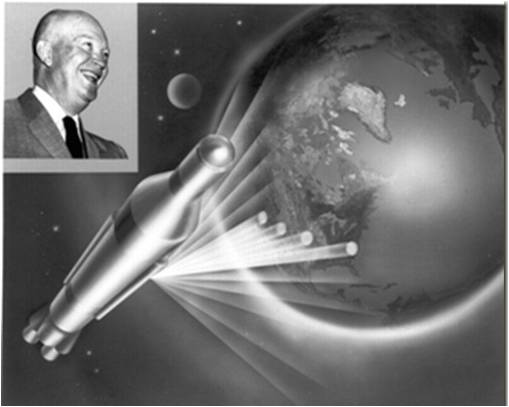
Fifty-three years ago this month, the USAF/RCA Project SCORE spacecraft became the world’s first communications satellite. Within 24 hours of being orbited by an Atlas B intercontinental ballistic missile (ICBM), the SCORE (Signal Communications Orbit Relay Equipment) payload broadcast a Christmas message to the world recorded by U. S. President Dwight D. Eisenhower. The president’s message was the first time a human voice was heard from space.

Sixty-four years ago this month, the USAF/Boeing XB-47 Stratojet took to the air for the first time. The legendary Stratojet would go on to become the first all-turbojet strategic bomber to enter operational service with the United States Air Force.

Fifty-seven years ago this month, the USAF/Boeing B-29 Superfortress strategic bomber was officially retired from the active inventory of the United States Air Force. The famed World War II-era aircraft had a service life of less than a dozen years.

Fifty-six years ago this month, the USAF/Bell X-2 Starbuster experimental flight research aircraft made its initial powered flight from Edwards Air Force Base, California. Legendary test pilot USAF Lt. Col. Frank K. “Pete” Everest was at the controls of the rocket-powered, swept-wing X-aircraft.
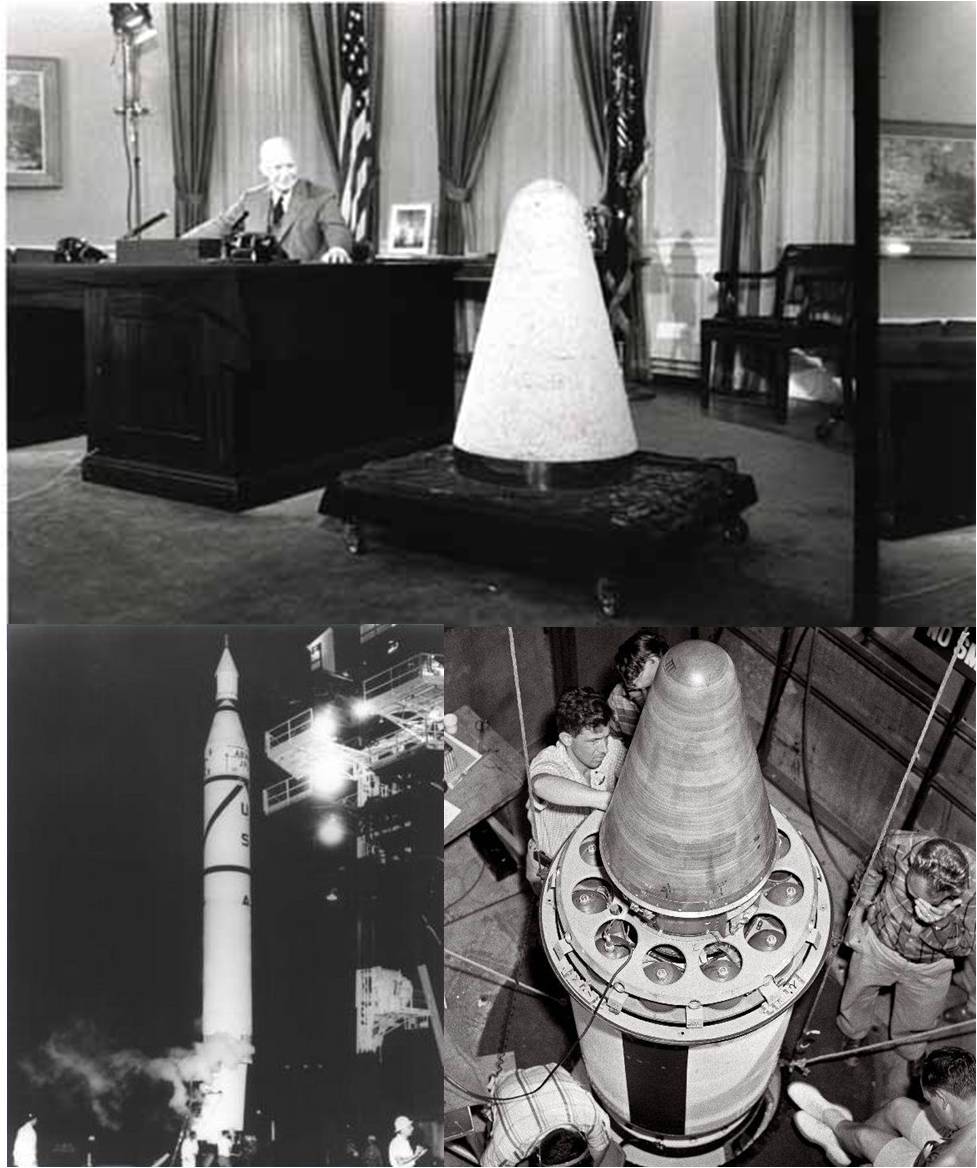
Fifty-four years ago this month, the first ablative nose cone to survive entry into the Earth’s atmosphere was formally presented to the American public. President Dwight D. Eisenhower displayed the recovered nose cone during a national television broadcast from the Oval Office.
An object making a hypersonic entry into the the Earth’s atmosphere from space possesses a great deal of kinetic energy. This energy of motion is transformed to thermal energy as aerodynamic drag slows the vehicle during atmospheric flight. A portion of the entry thermal energy is absorbed by the vehicle structure in a process referred to as aerodynamic heating. This heat transfer process causes the temperature of the external surface of the vehicle to significantly increase.
From a vehicle survivability standpoint, three parameters are key; (1) maximum heat transfer rate, (2) maximum surface temperature and (3) total thermal energy absorbed by the vehicle during entry. The concern is that there is enough kinetic energy in the entry flight domain to vaporize any known material if that energy is completely absorbed by the vehicle.
One has only to look into the heavens at night to become convinced of the ferocity of the entry environment. The streaks of white, yellow, green, blue, or red light that dramatically flash into and out of existence are associated with the vaporization of meteors transiting the atmosphere. Few meteors have enough original mass to allow a minor portion thereof to reach the ground. Those that do are referred to as meteorites.
The problem of surviving atmospheric entry was a major research topic in the 1950’s. Attention focused on protecting the nuclear warhead carried by the reentry vehicle of an Intercontinental Ballistic Missile (ICBM). A pair of research scientists at the NACA Ames Research Center in California, H. Julian Allen and Alfred J. Eggers, are credited with solving the problem. The key was to hemispherically-blunt or round the nose of a reentry vehicle.
A blunted forebody disposes a detached, hyperbolic-shaped shock wave which slows the post-shock flow to subsonic speeds in the stagnation region. A byproduct of this flow deceleration is a significant increase in post-shock static pressure and temperature. While this dramatically increases vehicle wave drag, most of the high temperature air passes around the vehicle and thus never physically comes in contact with it. The result is that only a small fraction of the overall thermal energy of the freestream flow is convected to the vehicle surface.
In contrast to the above, a sharp-nosed vehicle nose disposes an attached, highly-swept shock wave. This flow topology results in a large fraction of the overall thermal energy being convected to the vehicle surface. The is because the degree of post-shock flow slowing in such a situation is small. Indeed, the post-shock flow has a high supersonic Mach number. Now, due to the “no-slip” condition caused by fluid viscosity, the flow velocity at the vehicle surface is zero. Thus, the bulk of the flow deceleration has to occur within the boundary layer. The huge shearing stresses and temperature gradients that result generate extreme heat flux rates at the vehicle surface.
On Thursday, 08 August 1957, a Jupiter-C launch vehicle carrying a one-third scale version of a Jupiter IRBM nose was launched from LC-6 at Cape Canaveral, Florida. The nose cone traveled 1,168 nautical miles, reaching nearly 9,000 mph and an altitude of 260 nautical miles in the process. During reentry an ablative heat shield was used to protect the nose cone from the aerodynamic heating environment. The vehicle parachuted into the Atlantic Ocean and was recovered by Navy swimmers within three hours of launch.
On Thursday, 07 November 1957, President Dwight D. Eisenhower displayed the recovered Jupiter IRBM scaled nose cone in a nationally televised broadcast from the Oval Office. The excellent condition of the recovered vehicle was a stark testament to the effectiveness of a blunted, ablative nose cone to weather the rigors of reentry heating. This historic breakthrough would forever change the science of atmospheric entry. Indeed, it would ultimately make possible successful entry of Apollo astronauts returning from the Moon at 25,000 mph.
Today, one can view the recovered Jupiter IRBM subscale nose cone at the Smithsonian’s National Air and Space Museum in Washington, DC. Specifically, it is on public display in the Space Race Exhibition at the National Mall Building.
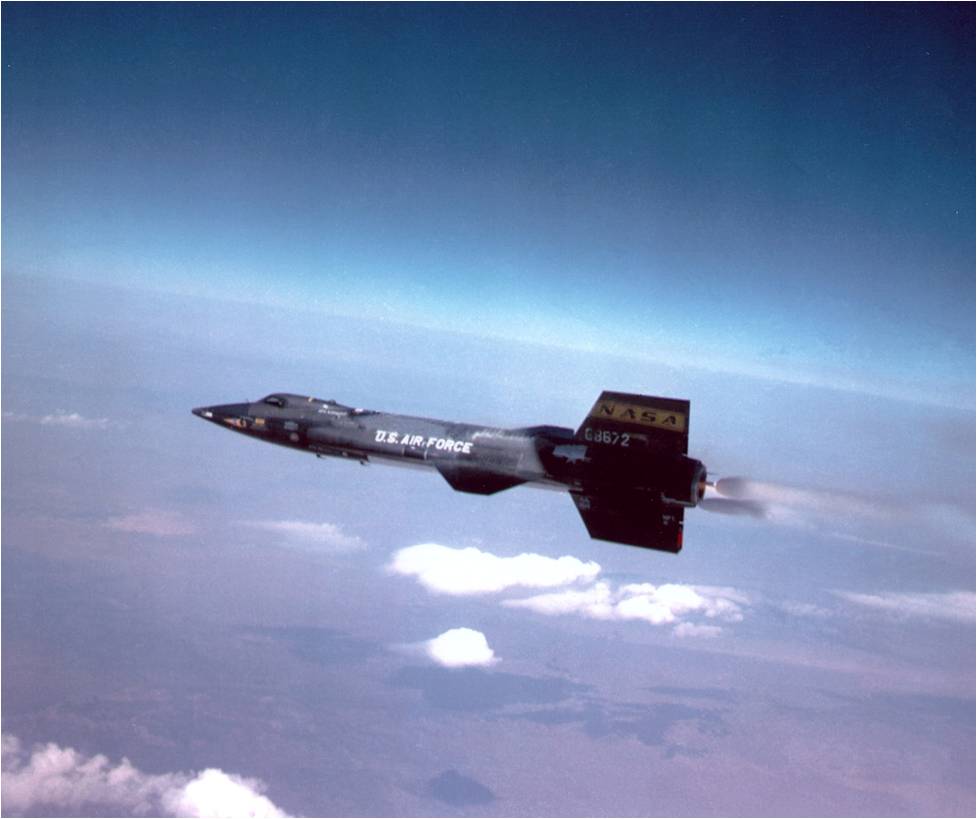
Forty-four years ago this month, the No. 3 USAF/North American X-15 research aircraft broke-up during a steep dive from an apogee of 266,000 feet. The pilot, USAF Major Michael J. Adams, died when his aircraft was torn apart by aerodynamic forces as it passed through 65,000 feet at more than 2,500 mph.
The hypersonic X-15 was arguably the most productive X-Plane of all time. Between 1959 and 1968, a trio of X-15 aircraft were flown by a dozen pilots for a total of 199 official flight research missions. Along the way, the fabled X-15 established manned aircraft records for speed (4,534 mph; Mach 6.72) and altitude (354,200 feet).
The X-15 was a rocket, aircraft and spacecraft all rolled into one. Burning anhydrous ammonia and liquid oxygen, its XLR-99 rocket engine generated 57,000 lbs of sea level thrust. Reaction controls were required for flight in vacuum. Each flight also required careful management of aircraft energy state to ensure a successful, one attempt only, unpowered landing.
On Wednesday, 15 November 1967, the No. 3 X-15 (S/N 56-6672) made the 191st flight of the X-15 Program. In the cockpit was USAF Major Michael J. Adams making his 7th flight in the X-15. He had been flying the aircraft since October of 1966. Like all X-15 pilots, he was a skilled, accomplished test pilot used to dealing with the demands and high risk of flight research work.
X-15 Ship No. 3 was launched from its B-52B (S/N 52-0008) mothership over Nevada’s Delamar Dry Lake at 18:30 UTC. As the X-15 fell away from the launch aircraft at Mach 0.82 and 45,000 feet, Adams fired the XLR-99 and started uphill along a trajectory that was supposed to top-out around 250,000 feet. If all went well, Adams would land on Rogers Dry Lake at Edwards Air Force Base in California roughly 10 minutes later.
Around 85,000 on the way upstairs, Adams became distracted when an electrical disturbance from an onboard flight experiment adversely affected the X-15’s flight control system, flight computer and inertial reference system. As a result, data on several key cockpit displays became corrupted. Though with some difficulty, Adams pressed-on with the flight which peaked-out around 266,000 feet approximately three (3) minutes from launch.
As a result of degraded flight systems and perhaps disoriented by vertigo, Mike Adams soon discovered that his aircraft was veering from the intended heading. He indicated to the control room at Edwards that his steed was not controlling correctly. Passing through 230,000 feet, Adams cryptically radioed that he was in a Mach 5 spin. Mission control was stunned. There was nothing in the X-15 flight manual that even addressed such a possibility.
Incredibly, Mike Adams somehow managed to recover from his hypersonic spin as the X-15 passed through 118,000 feet. However, the aircraft was inverted and in a 45-degree dive at Mach 4.7. Still, Adams may very well have recovered from this precarious flight state but for the appearance of another flight system problem just as he recovered the X-15 from its horrific spin.
X-15 Ship No. 3 was configured with a Minneapolis-Honeywell adaptive flight control system (AFCS). Known as the MH-96, the AFCS was supposed to help the pilot control the X-15 during high performance flight. Unfortunately, the unit entered a limit-cycle oscillation just after spin recovery and failed to change gains as the dynamic pressure rapidly increased during Ship No. 3’s final descent. This anomaly saturated the X-15 flight control system and effectively overrode manual inputs from the pilot.
The limit-cycle oscillation drove the X-15’s pitch rate to intolerably-high values in the face of rapidly increasing dynamic pressure. Passing through 65,000 feet at better than 2,500 mph (Mach 3.9), Ship No. 3 came apart northeast of Johannesburg, California. The main wreckage impacted just northwest of Cuddeback Dry Lake. Mike Adams had made his final flight.
For his flight to 266,000 feet, USAF Major Michael J. Adams was posthumously awarded Astronaut Wings by the United States Air Force. His name was included on the roll of the Astronaut Memorial at Kennedy Space Center (KSC) in 1991. Finally, on Saturday, 08 May 2004, a small memorial was erected to the memory of Major Adams near his X-15 crash site situated roughly 39 miles northeast of Edwards Air Force Base.

Fifty-four years ago today, the USAF/Northrop SNARK intercontinental cruise missile successfully flew its maximum range mission of 5,000 statute miles for the first time. SNARK would go on to become the only strategic cruise missile ever operationally deployed by the United States.
The SM-62A SNARK was designed to deliver nuclear ordnance at strategic ranges. The vehicle was conceived as an autonomous, winged, turbojet-powered aircraft with a high subsonic cruise capability. Ground launch was provided by a pair of disposable, high-thrust rocket boosters. The SNARK’s origins date back to the middle 1940’s.
The missile’s name, SNARK, is not an acronym. Rather, SNARK has reference to the mythical creature highlighted in Lewis Carroll’s poem, “The Hunting of the Snark”. Jack Northrop, president of Northrop Aircraft Company, developer of the SNARK, is credited with selection of the missile’s name.
SNARK engineering development and flight testing took place between 1946 and 1960. This protracted gestation period was partially due to mission requirements drift on the part of the Air Force. However, challenging technical problems, a flat funding profile and mission relevancy issues also served to draw-out the development effort.
The original SNARK prototype was designated as the N-25 by Northrop. The missile was designed to fly 1,550 statute miles and cruise at Mach 0.85. N-25 flight testing occurred between December of 1950 and March of 1952. While the results were not particularly encouraging, USAF still wanted a strategic cruise missile. This led to the development of a larger, more capable airframe designated as the N-69.
The N-69 SNARK configuration measured 67.2 feet in length and featured a wing span of 42.25 feet. Launch weight was roughly 49,000 lbs. Power was provided by a single Pratt and Whitney J-57 turbojet that generated a sea level thrust of 10,500 lbs. The missile carried a single W39 nuclear warhead with a yield of 3.8 megatons. The SNARK was ground-launched using a pair of Aerojet General solid propellant rocket boosters that produced a combined thrust of 260,000 lbs. The complete launch stack weighed 60,000 lbs.
The design operational range for the N-69 airframe was 5,500 nm. The type had a top cruise speed and ceiling of 650 mph and 50,000 feet, respectively. Maximum mission time was on the order of 11 hours. Northrop was constrained to use a celestial navigation system to get the SNARK to its distant target. The company optimistically advertised a CEP of 8,000 feet.
On Thursday, 31 October 1957, a SNARK N-69E airframe (S/N N-3324) successfully flew a strategic range flight for the first time. Launch occurred from either LC-1 or LC-2 (the historical record is unclear here) at Cape Canaveral, Florida. The missile flew 5,000 statute miles to its target near Ascension Island in the South Atlantic Ocean.
While the range achieved on the SNARK’s Halloween 1957 flight test was impressive, guidance system accuracy was quite poor. Indeed, guidance system performance deficiencies plagued the SNARK Program throughout its life. Witness the fact that through May of 1959, the best the SNARK guidance system could do on long range flights was impact within 4.3 nm of the target. Moreover, the first guidance flight to be successfully completed did not occur until February of 1960.
The latter 1950’s saw rapid development of successful Intercontinetal Ballistic Missile (ICBM) systems within the United States and the Soviet Union. These suborbital warhead delivery systems outperformed the SNARK by every measure. In spite of its obvious obsolescence, low reliability and marginal accuracy, USAF opted to field the weapon anyway.
The first and only SNARK missile wing, consisting of 30 airframes, was operationally-deployed at Presque Isle AFB, Maine in February of 1961. However, the type’s deployment period would be brief. Newly-inaugurated President John F. Kennedy cancelled the SNARK Missile Program soon after taking office. As a result, the SNARK missile wing at Presque Isle AFB was deactivated in June of 1961.
America’s aerospace history is filled with unique aerospace systems that saw limited or no operational service. Notable examples include the Navaho, B-70, F-107, X-20 and the X-33. While these vehicles never filled the measure of their creation, the technology and capability accrued during their development greatly benefitted succeeding generations of aerospace craft. Such is the case for SNARK. Indeed, historically importnant operational missile systems such as Jupiter, Atlas, Minuteman and Titan were direct heirs of technology, capability and technical lessons-learned derived from the SNARK experience.