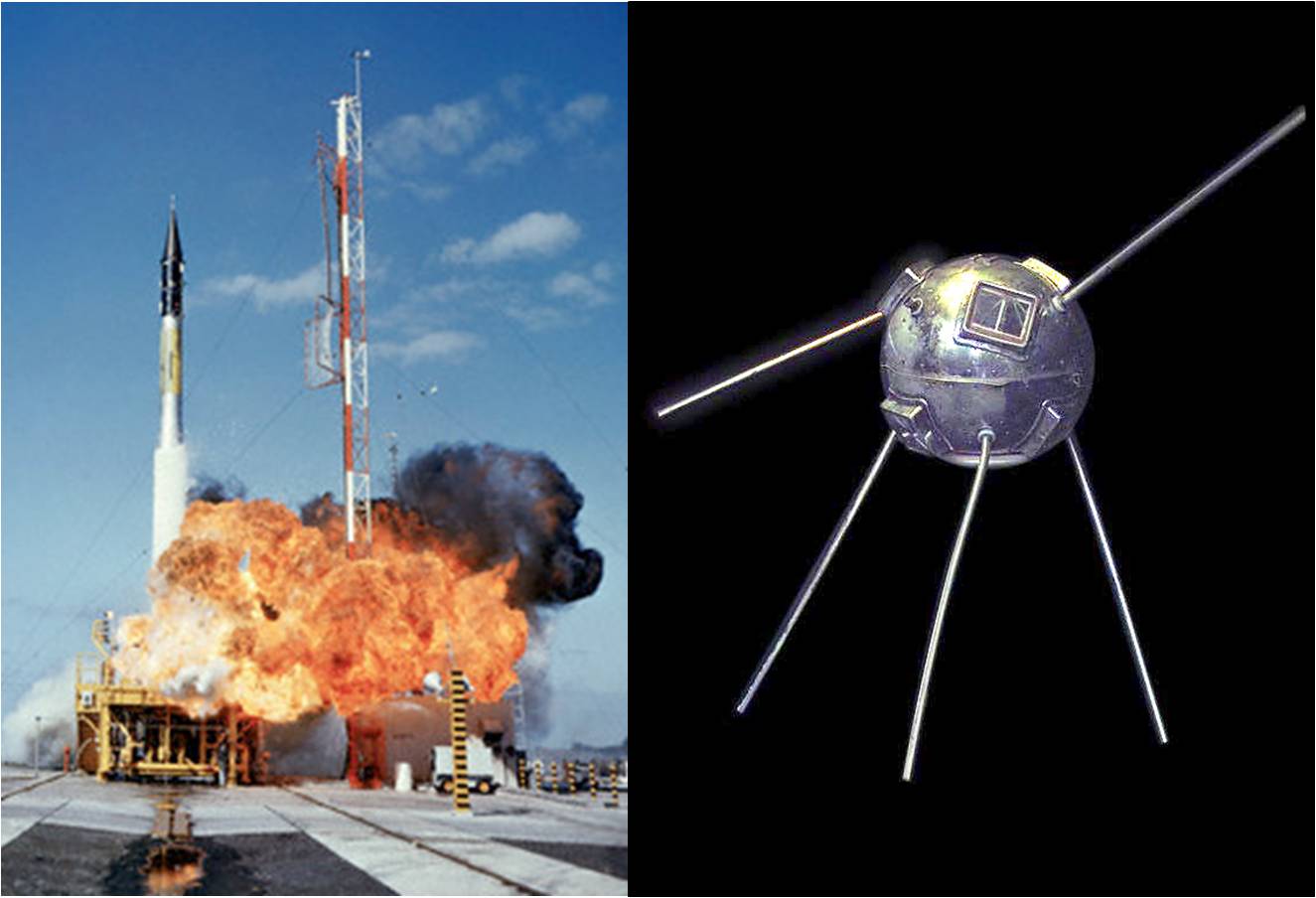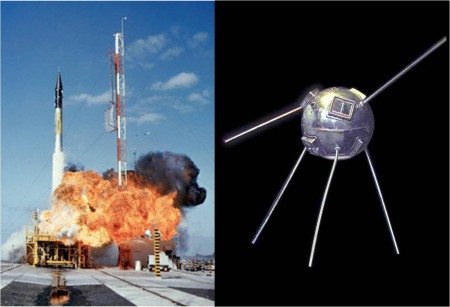
Fifty-five years ago this month, the United States attempted to launch the nation’s first satellite in response to the Soviet Union’s recent orbiting of Sputnik I. Unfortunately, the Vanguard TV-3 launch vehicle lost thrust moments after lift-off and exploded on the launch pad.
The International Geophysical Year (IGY) was a cooperative international scientific effort whose goal was to study the physical properties of the Earth. A total of sixty-seven (67) countries participated in the IGY which involved experimentation in eleven (11) physical science categories. The IGY lasted from 01 July 1957 to 31 December 1958.
Project Vanguard was established in 1955 by the United States for the purpose of orbiting the nation’s first satellite during the IGY. The Naval Research Laboratory (NRL) managed the project with the Martin Company, General Electric, Aerojet General and Grand Central Rocket Company as contractors.
Project Vanguard involved the development of both the launch vehicle and satellite payload. The Martin Company was the prime contractor for the Vanguard 3-stage launch vehicle while the NRL developed various Vanguard satellites. Launch took place from Cape Canaveral, Florida.
The Vanguard Satellite Launch Vehicle (SLV) was based on the design and technology of Martin’s single-stage Viking rocket. The SLV measured 75 feet in length and had a maximum diameter of 3.74 feet. Lift-off weight was 22,156 lbs. First, second and third stage average thrusts were rated at 30,303 lbs, 7,599 lbs and 2,599 lbs, respectively.
The original Vanguard satellite weighed a mere 3.25 lbs and included seven (7) mercury cell batteries, a pair of tracking radio transmitters, a temperature sensitive crystal, and six (6) solar cells mounted to its external surface. A total of six (6) data transmission and space tracking antennas protruded from the satellite’s spherical body as well.
On Friday, 04 October 1957, the Soviet Union orbited the world’s first artificial satellite, Sputnik I. Then, on Sunday, 03 November 1957, the Soviets orbited Sputnik II with the mongrel dog Laika onboard. These twin space feats both impressed the world and stunned the United States. As a result, success with Project Vanguard took on more significance and emphasis shifted to getting America into space pronto.
Vanguard Test Vehicle No. 3 (TV-3) was America’s first attempt to launch a Vanguard satellite into earth orbit. In truth, neither the Vanguard project nor Vanguard SLV was ready for the mission. However, the pressure to get America into space forced the project to expedite its carefully planned, but time-consuming flight test schedule. The results of doing so would not be good.
On Friday, 06 December 1957, Vanguard TV-3 lifted-off at 16:44:34 UTC from LC-18A at Cape Canaveral, Florida. Then, just 4 feet above the launch pad and 2 seconds into flight, the rocket’s first stage rocket motor lost thrust. TV-3 fell back onto the pad, rupturing its propellant tanks. The resulting massive explosion and fire totally consumed the vehicle and severely damaged the launch pad.
The TV-3 launch attempt was televised live to a worldwide audience numbering in the millions. Interestingly, the tiny Vanguard satellite somehow survived the post-crash inferno and was discovered intact at the edge of the launch complex apron. Though no longer flightworthy, the plucky satellite was dutifully beeping away as though it were in space.
The public response to the failed TV-3 mission was immediate and brutal. The ne’er-do-wells in the American press corps referred to the event with such delightfully derogatory terms as “Oopsnik”, “Kaputnik”, “Flopnik” and “Stayputnik”. However, the unkindest cut of all came from the mouth of Soviet Premier Nikita Khrushchev who mockingly described the diminutive Vanguard satellite as America’s little grapefruit.
The Vanguard Program would eventually see success. Indeed, the first Vanguard satellite (Vanguard 1) reached orbit on Monday, 17 March 1958. In fact, that satellite is still in space and is expected to remain there for at least two hundred more years. However, Vanguard 1 was Amerca’s second satellite to achieve orbit. The distinction of being first goes to the United States Army’s Explorer I satellite which was carried into orbit by a Jupiter-C launch vehicle on Friday, 31 January 1958.
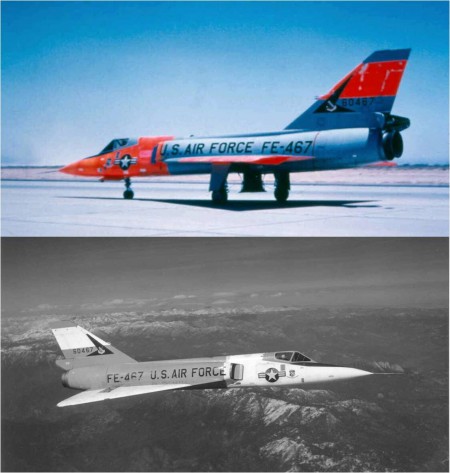
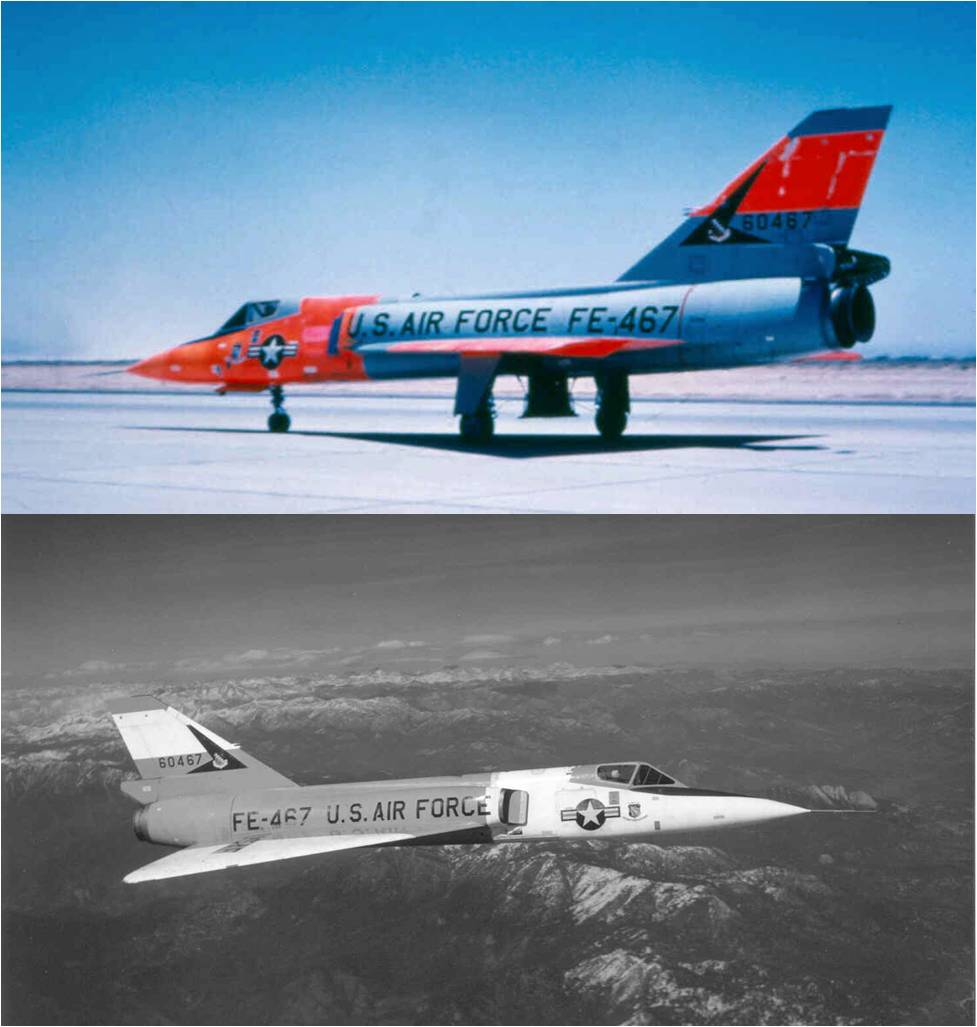
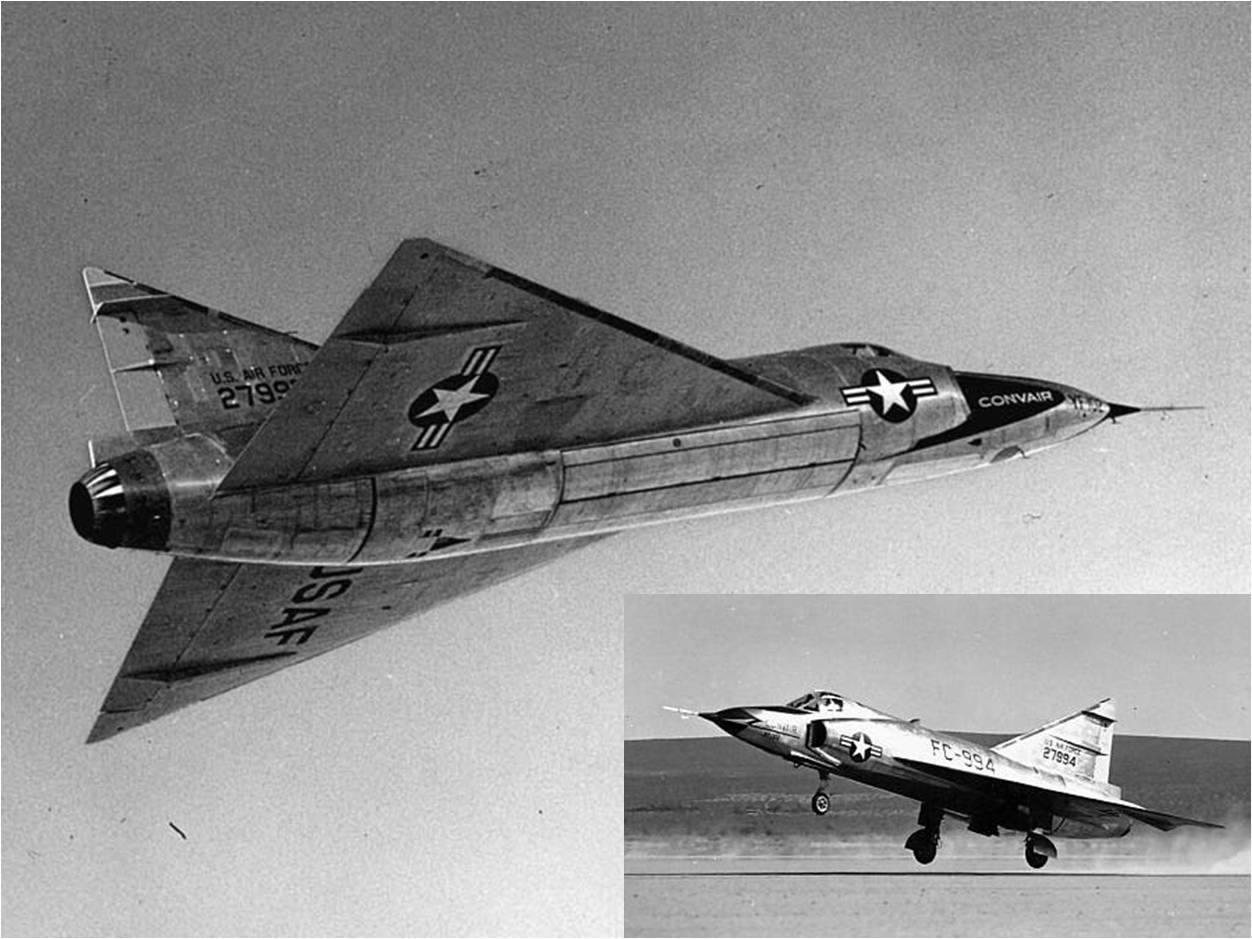
Fifty-three years ago this month, a USAF/Convair F-106A Delta Dart was clocked at 1,525.695 mph on an 11-mile straight course at Edwards Air Force Base, California. The mark still stands as an absolute speed record for single-engine turbojet-powered aircraft.
The USAF/Convair F-106 Delta Dart was designed for the all-weather interceptor role in defense of CONUS. As such, the Delta Dart’s primary mission was to seek out Soviet bomber formations and destroy same using its internally-carried missiles. Armament consisted of either (1) a quartet of Hughes AIM-4 Falcon missiles and a single AIM-26A Falcon missile or (2) a single Douglas AIR-2 Genie missile.
A member of the fabled Century Series, the Delta Dart was produced in two variants. The single place version was known as the F-106A while the dual place version was designated as the F-106B. Though primarily a trainer, this aircraft was also combat-capable. A total of 340 Delta Dart aircraft were manufactured by Convair; 277 F-106A’s and 63 F-106B’s.
The F-106A Delta Dart measured 70.7 feet in length and had a wing span of 38.25 feet. Gross Take-Off Weight (GTOW) and Empty Weight were 34,510 lbs and 24,420 lbs, respectively. Power was supplied by a single Pratt and Whitney J75-17 afterburning turbojet which produced 24,500 lbs of thrust at sea level.
The sleek Delta Dart was aerodynamically very clean. This was due in large measure to use of fuselage area ruling and a thin delta planform wing. The F-106A could climb at 29,000 feet per minute and had a service ceiling of 57,000 feet. Maximum unrefueled range was on the order of 2,700 nm.
Due to its impressive performance, USAF employed the F-106A in an attempt to regain the single-engine absolute speed record from the Soviets in late 1959. The existing record of 1,483.84 mph had been established in 1956 by a Soviet Ye-66 aircraft specially designed for setting the speed mark. The Air Force’s absolute speed record attempt was codenamed Project Firewall.
USAF originally selected F-106A (S/N 56-0459) to make the 1959 absolute speed record attempt. The aircraft was modified slightly to optimize its speed performance. However, 56-0459 experienced engine compressor stall problems and did not set the actual record. Rather, an unmodified F-106A (S/N 56-0467) was called into service and set the speed record reported here.
On Tuesday, 15 December 1959, USAF Major Joseph W. Rogers departed Edwards Air Force Base in a quest to establish a new absolute speed record for a single-engine turbojet-powered aircraft. Flying at 40,000 feet, Rogers and his F-106A averaged 1,525.695 mph over an 11-mile straight course to set a new speed mark.
For his remarkable airmanship on Project Firewall, Joe Rogers was presented with the Distinguished Flying Cross, the DeLavaulx Medal, and the Thompson Trophy. Rogers went on to a remarkable military career spanning 29 years. He retired in 1975 as a full colonel.
For its part, the Delta Dart went on to a 28-year operational life (1959-1987) with the United States Air Force and the Air National Guard. Considered by many to be the finest interceptor in aviation history, the Delta Dart is known to this day as the Ultimate Interceptor.
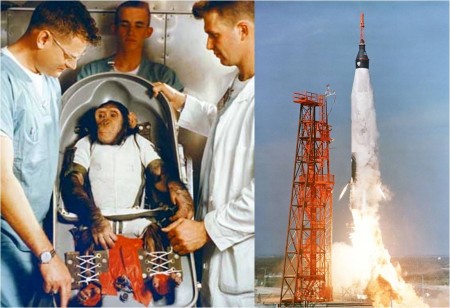
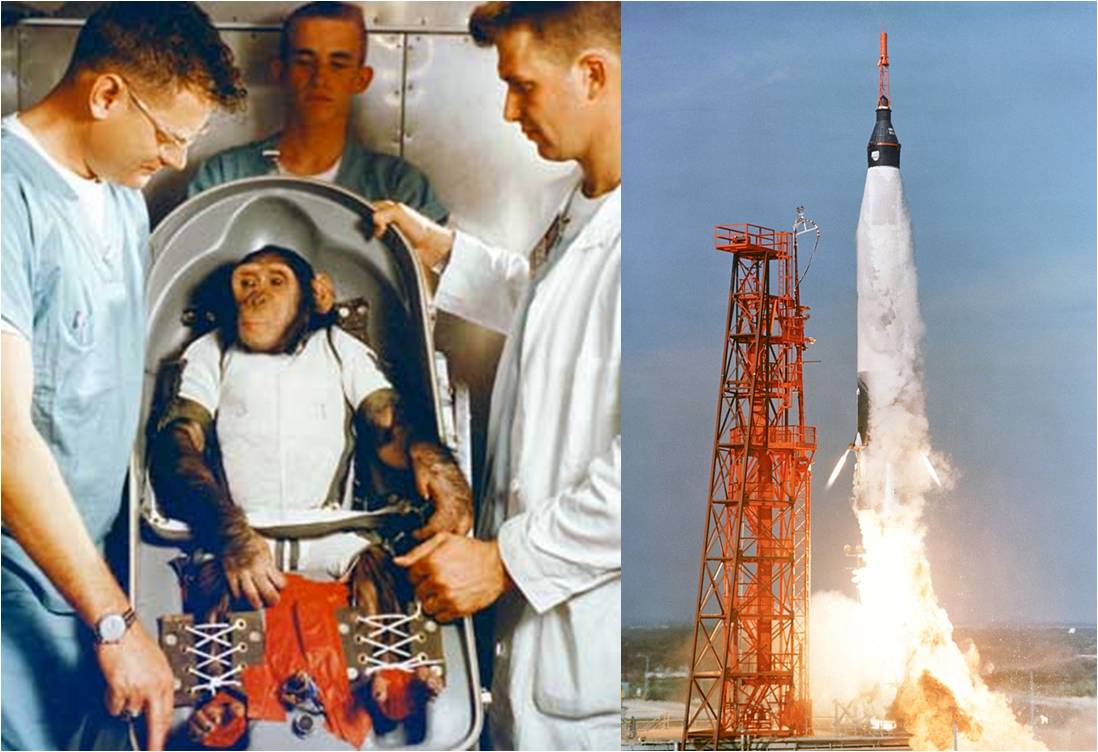
Fifty-one years ago this month, a Cameroonian chimpanzee by the name of Enos successfully flew a two-orbit mission around the Earth during the flight of Mercury-Atlas 5 (MA-5). This important mission paved the way for America’s first manned orbital spaceflight in February of 1962.
Project Mercury was the United States’ first manned spaceflight program. It consisted of two (2) suborbital and four (4) orbital manned missions flown between May 1961 and May 1963. These manned missions were preceded by animal flights in which chimpanzees served as surrogates for human crew.
A chimp named HAM successfully flew a suborbital Mercury mission in January of 1961. Known as Mercury-Redstone 2 (MR-2), this mission was a prelude to America’s first manned suborbital spaceflight in May of the same year. Flying aboard his Freedom 7 Mercury spacecraft, USN Commander Alan Bartlett Shepard, Jr. became America’s first astronaut during the flight of Mercury-Redstone 3 (MR-3).
Shepard’s pioneering spaceflight was followed by Mercury-Redstone 4 (MR-4) in July of 1961. Essentially a duplication of MR-3, USAF Captain Virgil Ivan “Gus” Grissom became America’s second astronaut. Flying his Liberty Bell 7 spacecraft, Grissom was the second member of the original Mercury Seven Astronauts to enter space.
Just as HAM’s flight preceded the successful suborbital missions of Shepard and Grissom, NASA wanted to orbit a chimp prior to the first attempt at manned orbital flight. Enter the astro-chimp Enos (which is Hebrew for “man”). Trained for spaceflight along with his backups Duane, Jim, Rocky, and HAM, Enos would fly as a passenger aboard a Mercury spacecraft. His survival would provide increased confidence that the vehicle was fit for manned orbital spaceflight.
Enos was rocketed into space from LC-14 at Cape Canaveral Florida on Wednesday, 29 November 1961. Lift-off came at 15:07:57 UTC. The Atlas LV-3B launch vehicle functioned nominally, placing the astro-chimp and his Mercury spacecraft into an elliptical orbit that measured 128 nm x 86 nm. The plan was for Enos to fly a three-orbit mission.
Other than an onboard clock that was 18 seconds too fast, Enos’ first orbit was uneventful. He performed the simple tasks for which he was trained in good fashion. When presented with a pattern of symbols, the space chimp would press one of three levers to indicate his selection. An incorrect answer would result in a mild electric shock being applied to the soles of his feet.
The Mercury spacecraft began to experience problems on Enos’ second orbit. First, the attitude control system exhibited degraded performance due to a thruster failure. Then, the environmental control system had problems maintaining the proper temperature within the spacecraft. Enos’ body temperature rose dangerously to 100.5 F and then stabilized.
However, the worst of it for Enos was that one of the three levers he used to respond to test problems malfunctioned. That meant he would receive an electrical shock even if he chose the corrrect lever! During two separate problem sessions, he incorrectly received 35 and 41 shocks, respectively. Nontheless, the plucky chimpanaut gamely continued responding to experimental inputs.
Flight controllers decided to bring Enos home one orbit early due to the above problems. Reentry came at the end of the second orbit with splashdown occurring in the Atlantic Ocean. Mission elapsed time was 3 hours, 20 minutes and 59 seconds.
It took over an hour for the USS Stormes (DD-780) to arrive on station with Enos and his spacecraft. By the time the two were fished out of the sea, brought on deck and the capsule hatch opened, Enos spent more than three hours waiting to be extracted.
Apparently, Enos did not particularly enjoy his time on the water. When handlers removed him from the spacecraft, they found that he had torn through his medical sensor garments. Most tellingly, Enos had also forcibly removed his urinary catheter while the internal anchoring balloon was still inflated.
Though Enos’ flight was far from trouble-free, the Mercury spacecraft was cleared for manned orbital flight. Indeed, history records that on Wednesday, 20 February 1962, Astronaut John Herschel Glenn, Jr. became the first American to orbit the Earth during Mercury-Atlas 6 (MA-6). Flying aboard Friendship 7, Glenn completed a three-orbit mission in 4 hours, 55 minutes and 23 seconds.
Enos the astro-chimp survived his eventful two-orbit mission none the worse for wear. However, in 1962 he contracted Shigellosis, a severe form of dysentery. Despite being treated aggressively with antibiotics and receiving constant care for two months, Enos succumbed to the illness on Sunday, 04 November 1962; less than one year after his successful space mission.
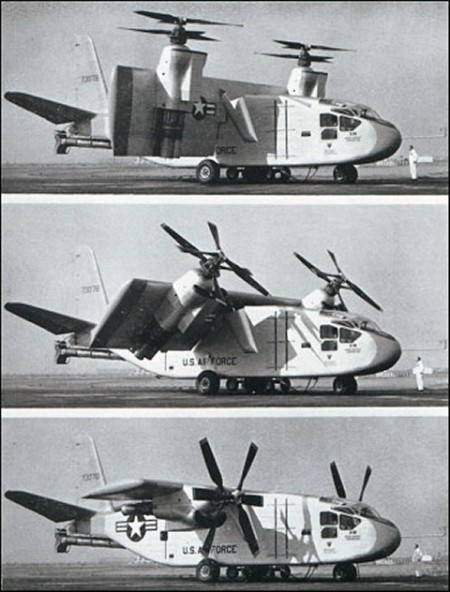
Fifty-three years ago this week, the USAF/Hiller X-18 Tilt-Wing research aircraft made its flight test debut at Edwards Air Force Base, California. Hiller test pilots George Bright and Bruce Jones were at the controls of the experimental VSTOL vehicle.
A VSTOL aircraft is one which is capable of Vertical and/or Short Take-Off and Landing. This ability to fly in the vertical provides a VSTOL aircraft with the tactical advantage of operating from small clearnings and short runways. While vertical flight is integral to it operation, a VSTOL aircraft flies the majority of its mission in horizontal flight just like conventional aircraft.
In the middle 1950’s, the rapidly-maturing state of aviation technology allowed aircraft designers to seriously consider the possibility of a VSTOL aircraft for the first time. A key technical hurdle was the transition from vertical to horizontal flight and back. To do so safely and effectively, particular attention had to be focused on aircraft flight control and propulsion.
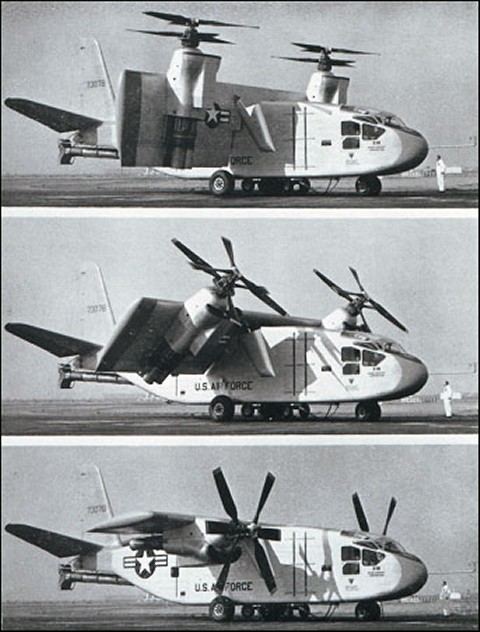
The Hiller X-18 VSTOL aircraft employed a unique tiltable wing that permitted it to fly both in the vertical and in the horizontal. Power was provided by twin Allison YT40-A-14 turboprop engines with a maximum rating of 5,850 hp. Each powerplant drove a counter-rotating propeller having a diameter of 193-in. The overall propulsion system was capable of producing 45,000 lbs of lift.
The X-18 employed a third powerplant for aircraft pitch control. In particular, a Westinghouse J34-WE-36 turbojet with a maximum thrust of 3,400 lbs was used for this purpose. Pitch control was effected by diverting the engine’s exhaust stream through a long, ventrally-mounted tailpipe, at the end of which was located a vertically-firing nozzle.
The X-18 aircraft measured 63 feet in length and featured a unique tiltable wing having a span of 48 feet. The wing tilt mechanism could rotate the thrustline of the twin turboprops from horizontal to vertical. Gross take-off and empty weights were 33,000 lbs and 27,272 lbs, respectively. The X-18 had a top speed of 253 mph and a maximum altitude of 35,300 feet.
The one and only X-18 VSTOL aircraft (S/N 57-3078) made its first flight test on Tuesday, 24 November 1959 at Edwards Air Force Base, California. With Hiller test pilots George Bright and Bruce Jones as the air crew, the X-18 flew for 18 minutes. Maximum altitude and speed were 4,000 ft AGL and 170 knots. The test flight was entirely nominal in all respects.
The X-18 flight test program ended just a year after it began. While the aircraft was found to be quite stable and easy to control, flight safety of the type was particularly sensitive to hardware failures. An event that occurred during the twentieth (20th) and final flight of the experimental vehicle illustrates this point.
On Friday, 04 November 1960, the X-18 suddenly departed controlled flight while flying at 11,000 feet over Edwards Air Force Base. Test pilots George Bright and Bruce Jones struggled to regain flight control as their ship flipped into an inverted spin. Displaying uncommon airmanship, the Hiller air crew regained control at 6,000 feet and managed to safely land their stricken steed. The initiating problem was later traced to a motor governor assembly which had all of its gear teeth stripped off.
Though it flew only briefly, the X-18 made notable contributions to early VSTOL technology. It was the first large-scale VSTOL aircraft flown in the United States and the first to employ the tilt-wing concept. Unfortunately, the X-18 airframe no longer exists. It met an ignominious end when it was dismantled and its parts sent to scrap sometime following termination of the type’s flight test program.
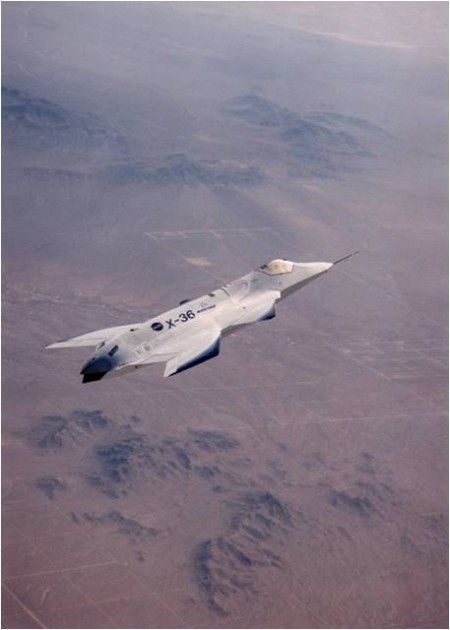
Fifteen-years ago today, the NASA/Boeing X-36 Tailless Fighter Agility Research Aircraft (TFARA) flew its final research mission from the NASA Dryden Flight Research Center (DFRC) at Edwards, California. The remotely piloted vehicle was designed to demonstrate flight control technologies aimed at improving the maneuverability and survivability of future fighter aircraft.
The X-36 was a 0.28-scale version of a notional advanced fighter aircraft. It measured 19 feet in length and had a wingspan of approximately 10 feet. Gross Take-Off Weight (GTOW) was on the order of 1,250 lbs. Power was provided by a Williams International F112 turbofan engine generating a maximum thrust of 700 lbs.
The X-36 did not have a conventional vertical tail and rudder assembly. Rather, the type utilized a unique set of aero-propulsive flight controls that included dual canards, split ailerons and a vectorable nozzle for aircraft directional control. Since the X-36 was longitudinally and directionally unstable, 3-axis flight control was provided via a digital fly-by-wire flight control system.
Boeing manufactured a pair of X-36 airframes. (A review of the historical record indicates that neither vehicle was officially assigned an airframe serial number.) The X-36 was remotely-controlled by a pilot sitting within a virtual cockpit at a ground station. A real-time video feed from a nose-mounted camera aboard the aircraft was transmitted to provide visual information to the pilot. A typical research flight from take-off to landing lasted between 35 to 45 minutes.
The X-36 flight research program began on Saturday, 17 May 1997 at Edwards Air Force Base, California. The last of 31 very successful research flights was flown on Wednesday, 12 November 1997. During this 6-month period, the aircraft amassed a total of 15 hours and 38 minutes of flight time. Peak performance marks included an altitude of 20,200 feet, speed in excess of 230 mph and a maximum angle-of-attack of 40 degrees.
The X-36 was both highly maneuverable, agile and controllable. The aircraft also served as a versatile testbed for testing innovative control law software. Flight testing of the X-36 aircraft measurably improved our understanding of the aerodynamic and flight control characteristics of futuristic aircraft configurations. In short, the X-36 Program was a very well conceived and executed flight test effort.
Happily, both X-36 aircraft survived the flight test program. One of these ships can be seen at the National Museum of the United States Air Force in Dayton, Ohio. The other aircraft is displayed in the Air Force Test Flight Center Museum at Edwards Air Force Base, California.
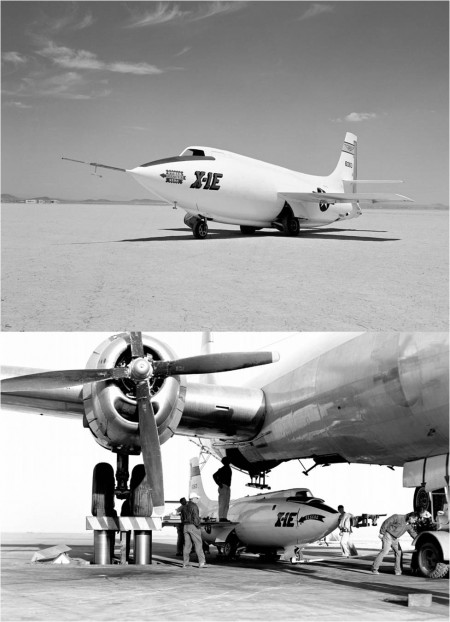
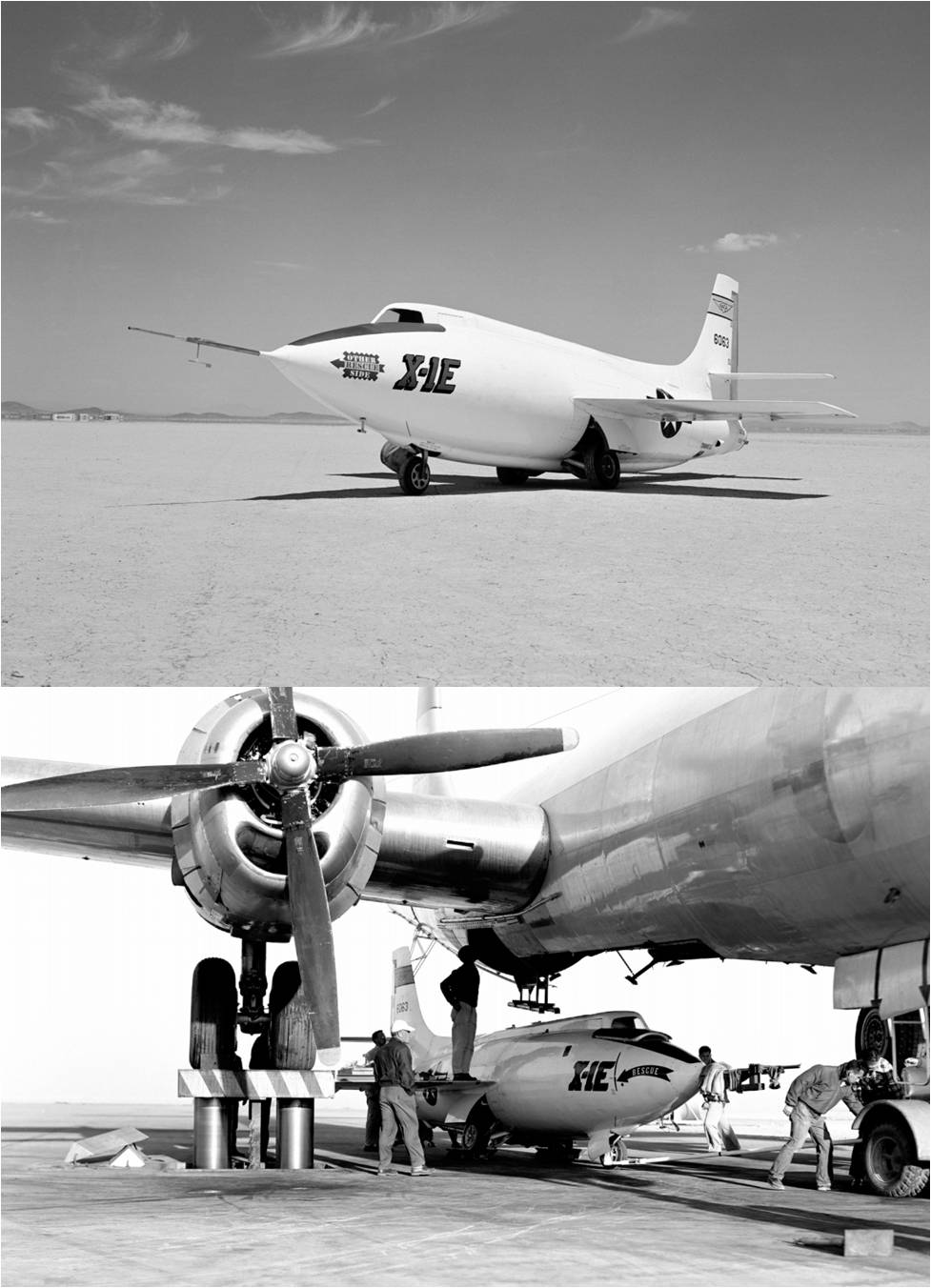
Fifty-four years ago this week, the famed Bell X-1E rocket-powered flight research aircraft flew for the twenty-sixth and final time. The flight marked the close of the highly productive twelve-year flight test history of the first series of X-aircraft.
In the years immediately following World War II, the United States began a relentless pursuit of increasing the speed and altitude capability of manned aircraft. Indeed, the effectual motto of that historic period was “Faster, Higher, and Farther”. The primary flight research tool for accomplishing this daunting objective was the now-famous X-aircraft series.
It all began with the USAF/Bell XS-1 rocket-powered flight research aircraft. With Bell Aircraft test pilot Jack Wollams at the controls, the XS-1 made its first glide flight at Pinecastle Army Airfield, Florida in January of 1946. Twenty-one months later (Tuesday, 14 October 1947), Captain Charles E. “Chuck” Yeager broke the sound barrier when he flew the XS-1 (Ship 1, S/N 46-062) to Mach 1.06 (700 mph).
Less than two years after the XS-1 first achieved supersonic flight, the type established performance records for both speed and altitude. Yeager hit Mach 1.45 (957 mph) in the XS-1 on Friday, 26 March 1948. Then, on Monday, 08 August 1949, USAF Major Frank K. “Pete” Everest soared to 71,902 feet at the controls of the same aircraft.
The USAF/Bell X-1A (S/N 48-1384) took aircraft performance to the next level in 1953 and 1954. In a flight in which he almost lost his life, USAF Major Charles E. “Chuck” Yeager flew the airplane to Mach 2.44 (1,620 mph) on Friday, 12 December 1953. This feat was followed by USAF Major Arthur “Kit” Murray when he flew the craft to an unofficial world altitude record of 90,440 feet on Thursday, 26 August 1954.
Meanwhile, the USAF/Bell X-1B (S/N 48-1385) first flew in September of 1954 with USAF Lt Col Jack Ridley doing the piloting honors. The X-1B was flown to Mach 2.3 (1,541 mph) by Pete Everest in December of 1954. NACA test pilot John B. “Jack” McKay hit an altitude of 62,952 feet in January of 1957. Although neither of these marks exceeded the X-1A’s performance records, the X-1B contributed significantly to the flight research database.
Neither the USAF/Bell X-1C nor USAF/Bell X-1D (S/N 48-1386) fulfilled the measure of their creation. In fact, the X-1C was never constructed. The X-1D made its initial glide flight on Tuesday, 24 July 1951 with Bell Aircraft test pilot Jean “Skip” Ziegler in the cockpit. However, the X-1D crashed to destruction on Wednesday, 22 August 1951 when it had to be jettisoned from its EB-50A launch aircraft due to unresolvable fuel system issues.
The USAF/Bell X-1E was actually a rebuild of the No. 3 XS-1 (S/N 46-063). The airplane’s XLR-11 propulsion system was upgraded via installation of a low-pressure turbopump system. Doing so eliminated the heavy and dangerous high-pressure fuel system utilized in previous X-1 aircraft. Other changes included the use of a new thin wing (4 percent thickness ratio) design and a streamlined, upward-opening canopy. The later feature permitted the first-time installation of an ejection seat in an X-1 vehicle.
The X-1E was flown 26 times between December of 1955 and November of 1958. NACA test pilot Joseph A. Walker flew the first 21 of these missions while fellow NACA test pilot John B. “Jack” McKay piloted the final 5 test sorties. Walker flew the maximum speed and altitude missions. He reached an altitude of 73,458 feet on Wednesday, 15 May 1957 and a speed of Mach 2.22 (1,487 mph) on Tuesday, 08 October 1957.
The final X-1E flight took place on Thursday, 06 November 1958 with Jack McKay at the controls. Although nondescript in terms of performance, the flight was historic in that it was the last of 239 flight tests in the pioneering X-1 series. From 1946 to 1958, a total of seven (7) X-1 aircraft and twenty-eight (28) Bell Aircraft, NACA and USAF pilots flew these missions.
The X-1E was retired after its twenty-sixth flight when structural cracks were discovered in its fuel tanks. Interstingly, this airframe flew 100 of the X-1 series flights (74 as the No. 2 XS-1 and 26 as the X-1E). Today, it is on public display in front of Building 4801 at NASA’s Dryden Flight Research Center (DFRC) at Edwards Air Force Base, California.
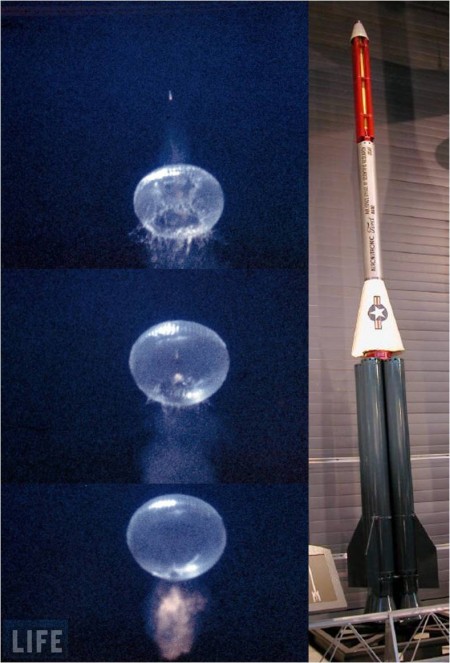
Fifty-five years ago this month, the final test shot in the Operation Farside test series took place near Eniwetok Atoll in the Marshall Islands. The final stage of the 4-stage research rocket reached a top speed close to 18,000 mph.
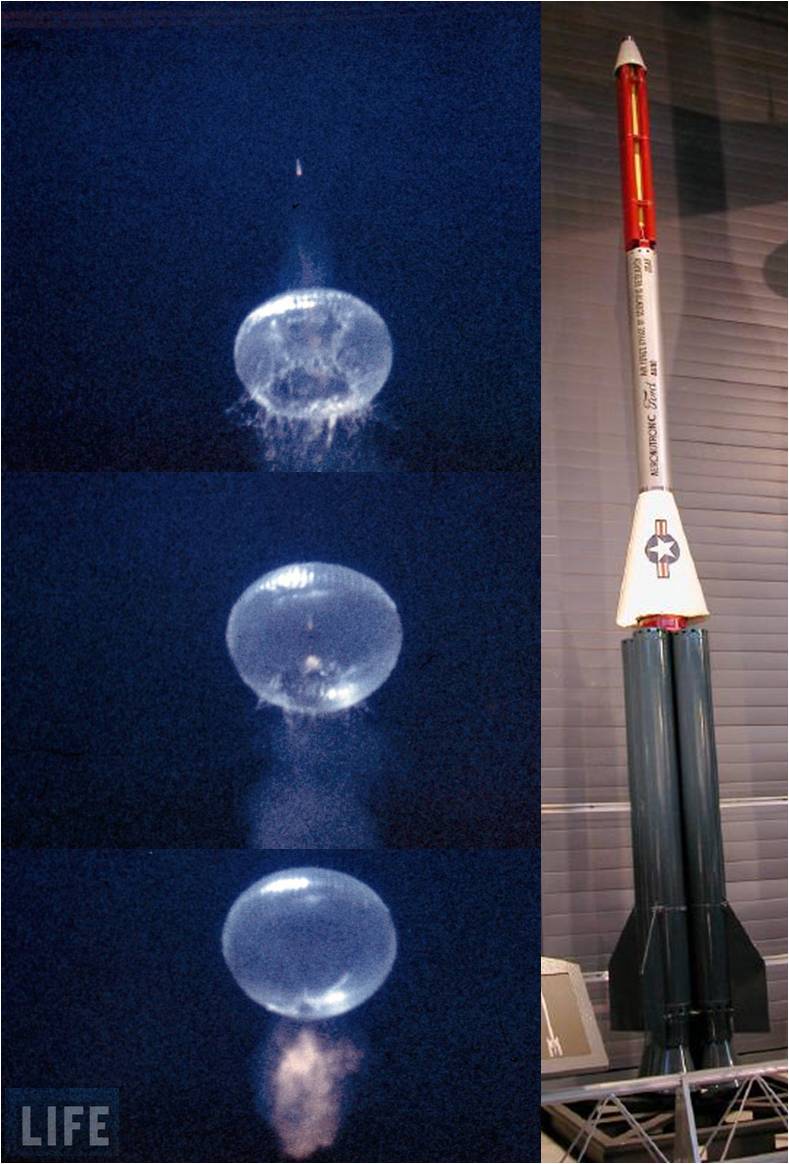
Operation Farside was a USAF Office of Scientific Research project intended to probe the space environment to altitudes as high as 3,400 nm. The approach taken for doing so involved launching a 4-stage rocket from a balloon floating at an altitude of 100,000 feet. Firing the rocket from this height significantly reduced the vehicle’s aerodynamic drag and allowed it to fly much higher than if launch had occurred at sea level.
The 4-stage Farside rocket measured 24 feet in length and had a maximum diameter of 1.5 feet. Firing weight of the Aeronutronics-developed vehicle was 1,900 lbs. Stages 1 and 2 utilized fins for providing static stability while Stage 3 and 4 were spin-stabilized. Each of these stages employed solid rocket propulsion.
The Farside payload weighed a mere 4 lbs. Its job was to measure the cosmic ray, electromagnetic radiation, space gas, and space dust environments and transmit the data back to Earth.
The Farside rocket was carried to launch altitude by a 3.75-million cubic foot, helium-filled, polyethelene film balloon. The vehicle was cradled within an aluminum lattice-work launch tower suspended directly below the balloon. Upon ignition of the first stage rocket motor, the Farside rocket fired right through the middle of its carrier balloon.
There were six (6) shots in the Operation Fireside test series. The first vehicle was launched on Wednesday, 25 September 1957. However, the mission failed when the carrier balloon malfunctioned. The remaining five (5) test rounds were fired in October of 1957. Unfortunately, the next three (3) flights suffered ignition failures in one or more stages.
Operation Farside finally enjoyed some success with Test Shot 5, flown on Sunday, 20 October 1957. While all of the stages functioned as planned, the probe’s telemetry system failed to transmit any scientific data back to the ground. The inoperative transmitter resulted in degraded tracking, with the result that the apogee altitude of the round was never known with accuracy.
The sixth and final Operation Farside test shot occurred on Tuesday, 22 October 1957. Ironically, the results of this flight were essentially the same as Test Shot 5. All of the stages fired, but telemetry system failure once again resulted in loss of mission environmental and performance data. At this point, Operation Farside was fresh out of balloons and rocket vehicles. And with that, the program was officially over.
The United States Air Force had hoped to follow Operation Farside with a more ambitious program to fly a 5-stage, rocket-powered vehicle within shouting distance of the moon. A review of the historical record reveals that such a program was never in fact pursued.
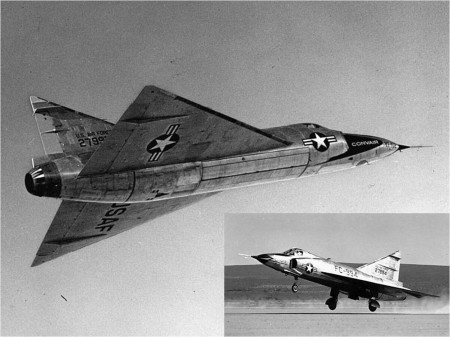
Fifty-nine years ago this week, the USAF/Convair YF-102 Delta Dagger all-weather interceptor prototype flew for the first time in the skies over Edwards Air Force Base. Convair test pilot Richard Lowe “Dick” Johnson was at the controls of the delta-winged, turbojet-powered aircraft.
The F-102 Delta Dagger was the third Century Series aircraft to enter production. Known as the Deuce, the aircraft was designed as an all-weather, supersonic interceptor. Its mission was protect the continental United States from attack by Soviet strategic bombers. The type’s primary armament consisted of a bevy of six (6) internally-carried Falcon air-to-air missiles.
The Deuce was the product of the 1954 Interceptor Project begun by USAF in the late 1940’s. A direct descendant of Convair’s pioneering XF-92A Dart, the Delta Dagger was that company’s second delta wing-configured, turbojet-powered aircraft. Convair’s clear preference for the delta wing planform was destined to become a company trademark throughout the 1950’s. Arguably the highest expression of this design feature came in the form of the Convair F-106 Delta Dart and B-58A Hustler supersonic aircraft.
First flight of the first YF-102 protype (S/N 52-7994) took place on Saturday, 24 October 1953. The aircraft was powered by a Pratt and Whitney J57 turbojet rated at 14,500 lbs of sea level thrust in afterburner. Unfortunately, this flight test and several that closely followed shocked Convair aircraft designers with the revelation that the Deuce could not fly supersonically. The aircraft simply generated too much transonic wave drag.
Faced with the gravity of the situation, Convair quickly went to work to markedly improve the performance of its troubled delta wing steed. Thanks largely to a fortuitously-timed discovery by NACA aerodynamicist Richard Whitcomb, the Delta Dagger’s performance potential would eventually be realized. Whitcomb’s aerodynamic breakthrough was referred to as the Transonic Area Rule.
Briefly, Richard Whitcomb discovered that the transonic wave drag of an aircraft could be reduced by ensuring a smooth variation of the aircraft’s nose-to-tail cross-sectional area development. Elimination of abrupt changes in this distribution corresponded to a reduction in the strength of localized shock waves.
Combined with an uprated version of the Deuce’s Pratt and Whitney J57 powerplant, application of Whitcomb’s Transonic Area Rule resulted in a sleeker and faster aircraft known as the YF-102A. While it took over a year to effect the necessary changes, the YF-102A easily achieved supersonic flight on Tuesday, 21 December 1954.
The Convair F-102 Delta Dagger went on to a fine operational career lasting 20 years with the United States Air Force and United States Air National Guard. The last of 1,000 airframes was retired from active piloted service in 1976.
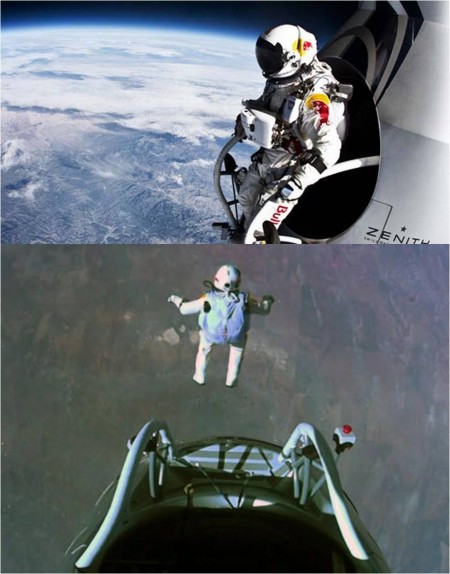
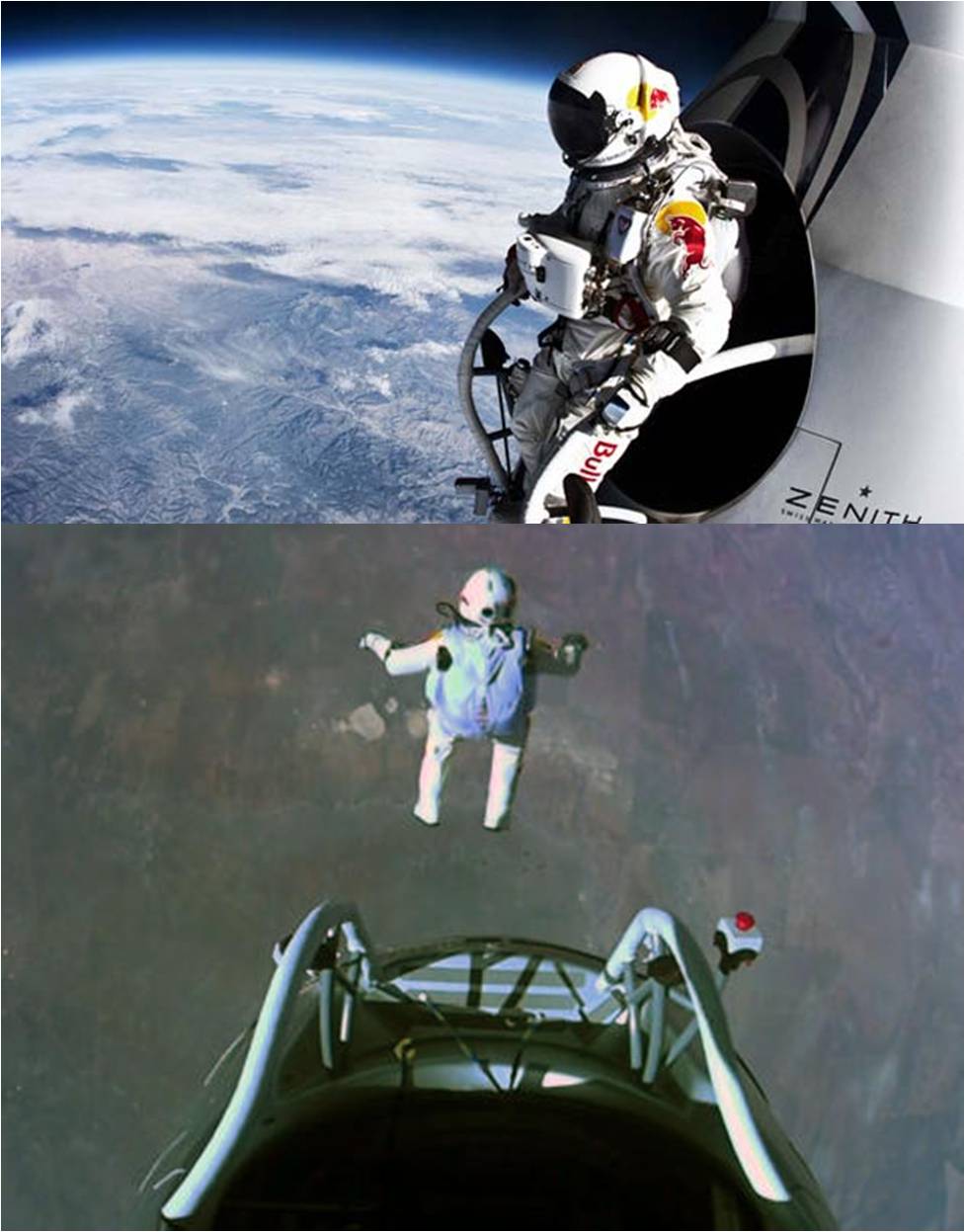
White Eagle Aerospace salutes Felix Baumgartner and the entire Red Bull Stratos Team for yesterday’s record breaking jump from the edge of space. Indeed, Sunday, 14 October 2012 will long be remembered, not only for one of the most remarkable achievements in aerospace history, but for a most uncommon display of human courage.
As of this writing, the prelimary accomplishments of this historic feat read as follows:
Highest Manned Balloon Flight: 128,097 feet above sea level
Longest Freefall Distance: 119,846 feet
Highest Velocity Achieved During a Freefall: 834 mph
First Supersonic Freefall: Mach 1.24
Baumgartner’s plunge to Earth lasted 9 minutes and 3 seconds with a freefall duration of 4 minutes and 20 seconds.
Baumgartner overcame many obstacles in his quest to jump from an altitude higher than any man before him. Key among these obstacles were the many physical dangers inherent in extreme altitude flight as well as a highly personal battle with claustrophobia when sealed within a full pressure suit.
It took 52 years for the freefall marks of the previous record holder (Joseph W. Kittinger, Jr.) to be eclipsed. And in a coming day, Baumgartner’s incredible achievements will be surpassed as well. But on this day, we pay tribute to an intrepid and courageous soul. Well done Mr. Baumgartner!
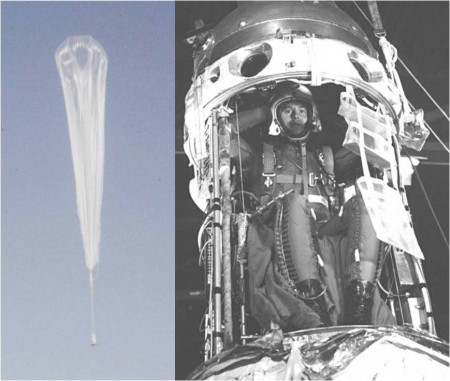
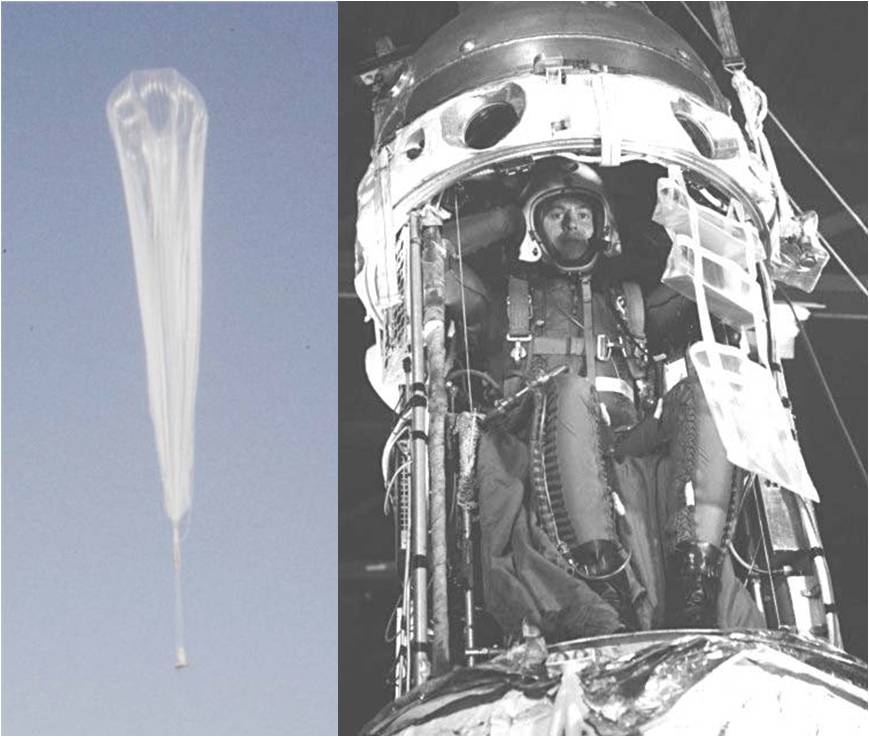
Fifty-four years ago today, USAF Lt Clifton M. McClure successfully completed the Manhigh III aeromedical mission in which he reached an altitude of 98,000 feet. During the descent phase of his nearly-12 hours aloft, McClure’s core body temperature reached an astounding 108.6 F.
Project Manhigh was a United States Air Force biomedical research program that investigated the human factors of spaceflight by taking men into a near-space environment. Preparations for the trio of Manhigh flights began in 1955. The experience and data gleaned from Manhigh were instrumental to the success of the nation’s early manned spaceflight effort.
The Manhigh target altitude was approximately 100,000 feet above sea level. A helium-filled polyethylene balloon, just 0.0015-inches thick and inflatable to a maximum volume of over 3-million cubic feet, carried the Manhigh gondola into the stratosphere. At float altitude, this balloon expanded to a diameter of about 200 feet.
The Manhigh gondola was a hemispherically-capped cylinder that measured 3-feet in diameter and 8-feet in length (increased to 9-feet for Manhiogh III). It was attached to the transporting balloon via a 40-foot diameter recovery parachute. Although compact, the gondola was amply provisioned with the necessities of flight including life support, power and communication systems. It also included expendable ballast for use in controlling the altitude of the Manhigh balloon.
The Manhigh test pilot wore a T-1 partial pressure suit during the Manhigh mission. This would protect him in the event that the gondola cabin lost pressure at extreme altitude. The pilot was hooked-up to a variety of sensors which transmitted his biomedical information to the ground throughout the flight. This allowed medicos on the ground to keep a constant tab on the pilot’s physical status.
The first two Manhigh missions were flown in 1957. USAF Captain Joseph W. Kittinger reached an altitude of 95,200 ft during the 6-hour, 32-minute Manhigh I mission of Sunday, 02 June 1957. USAF Major David G. Simons flew the 32-hour, 10-minute mission of Manhigh II on Sunday-Monday, 18-19 August 1957. Simons soared to a Project Manhigh record altitude of 101,516 feet.
Manhigh III was launched from Holloman Air Force Base in New Mexico on Wednesday, 08 October 1958. USAF Lt Clifton M. McClure was the pilot and research specimen for the mission. The huge Manhigh balloon lifted-off with McClure and his dimunitive capsule at 1151 UTC. The trip upstairs took roughly 3 hours and resulted in a float altitude of 98,000 feet.
Interestingly, a launch attempt the day before had been aborted when a wind gust tore the thin mylar balloon while the ground crew was preparing it for launch. The next day, as McClure awaited launch within the Manhigh III capsule, his chest-mounted emergency parachute inexplicably ejected and plopped into the pilot’s lap. Incredibly, McClure repacked the parachute (not once, but twice) and managed to avoid another mission abort.
Clifton McClure uneventfully went through his Manhigh flight plan until ground control noticed that the pilot was evidencing signs of degraded performance. The pilot’s pulse rate and core body temperature were elevated as well. It turned out that McClure had not ingested any water fover the previous 11 hours! However, after being instructed to hydrate himself, McClure could only get a few drops of water at a time due to a problem with his drinking tube. Within 10 minutes, he had fixed the problem and could then drink freely.
A significant reason that McClure’s body temperature began to rise was due to ineffective cooling of the Manhigh III capsule. On previous Manhigh missions, the capsule dome was repacked with dry ice just prior to launch. However, on Manhigh III, a decision was made to dispense with the repacking procedure. The result was that the heat generated by the Manhigh pilot’s body and capsule systems ultimately exceeded the cooling capacity of the environmental control system.
Around 1900 UTC, the decision was made to end the mission and bring McClure down. However, the trip back to Earth was excruciatingly slow. By 2100 UTC, the capsule was still at 87,000 feet and McClure’s core body temperature had risen to 104.1 F. It was all McClure could to just to remain conscious as his body temperature continued to soar. Finally, at 2342 UTC, the Manhigh III capsule settled onto the desert floor. In spite of the fact that McClure’s internal body temperature registered a phenomenal 108.6 F, the pilot egressed the Manhigh capsule under his own power.
During his Manhigh III experience, Clifton McClure exceeded by 137 percent what was then thought to be the limit for human heat tolerance. He received the USAF Distinguished Flying Cross in recognition of his superlative performance. Following his military career, McClure plied the engineer’s trade until retirement. Clifton M. McClure passed away in January of 2000 at the age of 68.