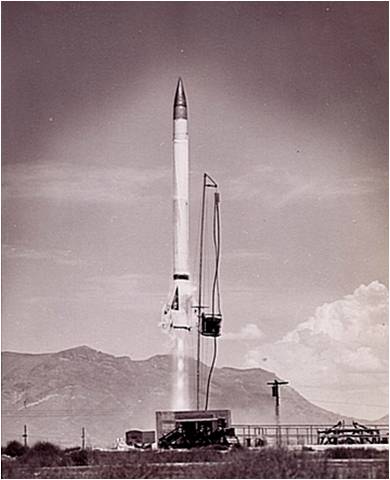
Fifty-eight years ago this week, a United States Navy Viking rocket soared to an altitude of 136 miles. In doing so, it eclipsed the previous single stage altitude record of 114 miles set by a captured German V-2 rocket on Tuesday, 17 December 1946. The mission was part of the Navy’s 12-flight Viking Rocket flight test series conducted between May 1949 and February 1955.
At 1659 UTC on Tuesday, 07 August 1951, Viking No. 7 was fired from LC-33 at White Sands Proving Ground (WSPG), New Mexico. Burnout velocity was 5,865 feet per second following a rocket motor burn time of 72 seconds. Viking No. 7 weighed 10,730 pounds at lift-off (roughly 8,000 pounds of which were propellants) and carried a scientific payload of 394 pounds.
Viking No. 7 was the last of the early Viking rocket configurations which measured 49-feet in length and had a diameter of 32-inches. Starting with Viking No. 8, the rocket’s airframe was modified to carry more propellants for greater altitude performance and measured 42-feet (length) by 45-inches (diameter). This modification allowed Viking No. 11, flown from WSPG on Monday, 24 May 1954, to capture the all-time Viking altitude record of 158 miles.
Although almost forgotten today, the Viking Rocket Program played a vital role in the history of American rocketry. Viking was the first large, liquid-fueled rocket developed by the United States. It’s rocket motor generated 21,000 pounds of lift-off thrust and employed an innovative two-axis gimbal system for pitch and yaw control. Fin-mounted reaction jets provided roll control.
The Viking Rocket Program provided a tremendous amount of scientific data about Earth’s atmospheric properties such as pressure, temperature, density, winds, and composition. Additionally, Viking formed the technological basis for a number of 1950’s rocket systems including the Navy’s Vanguard satellite launcher and the USAF Titan ICBM.
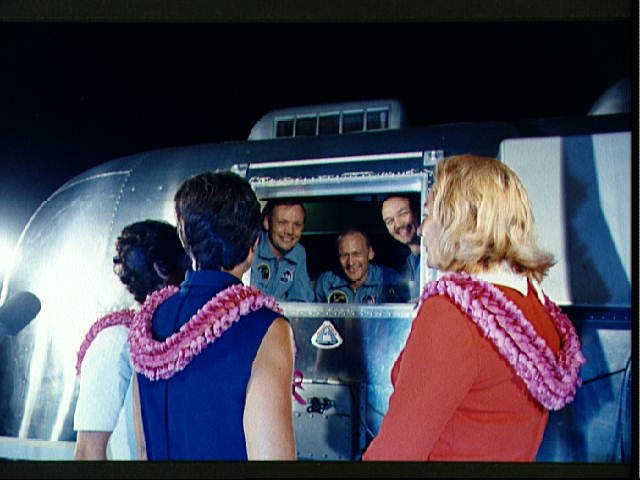
Forty years ago today, Apollo 11 astronauts Neil A. Armstrong, Edwin E. Aldrin, Jr., and Michael Collins arrived back at the Johnson Spacecraft Center (MSC) in Houston, Texas following their epic journey to and safe return from the Moon.
Following splashdown in the Pacific Ocean on Thursday, 24 July, 1969, the Apollo 11 astronauts and their Command Module Columbia were brought aboard the USS Hornet. Concerned that they would infect Earthlings with lunar pathogens, NASA quarantined the astronauts in the Mobile Quarantine Facility (MQF), which was a converted vacation trailer.
The Hornet steamed for Hawaii and transferred the MQF for airlift to Ellington Air Force Base, Texas. Following landing, the MQF and its heroic occupants were transported to the MSC. Once there, the astronauts and several medical staff were transferred from the MQF to more substantial accomodations known as the Lunar Receiving Laboratory (LRL).
Combined stay time in the MQF and LRL was 21 days. During their forced confinement, Armstrong, Aldrin, and Collins debriefed the Apollo 11 mission, rested, and mused about their unforgettable experiences at the Moon.
The Apollo 11 astronauts were released from the LRL on Thursday, 13 August 1969, having never contracted or transmitted a lunar disease.
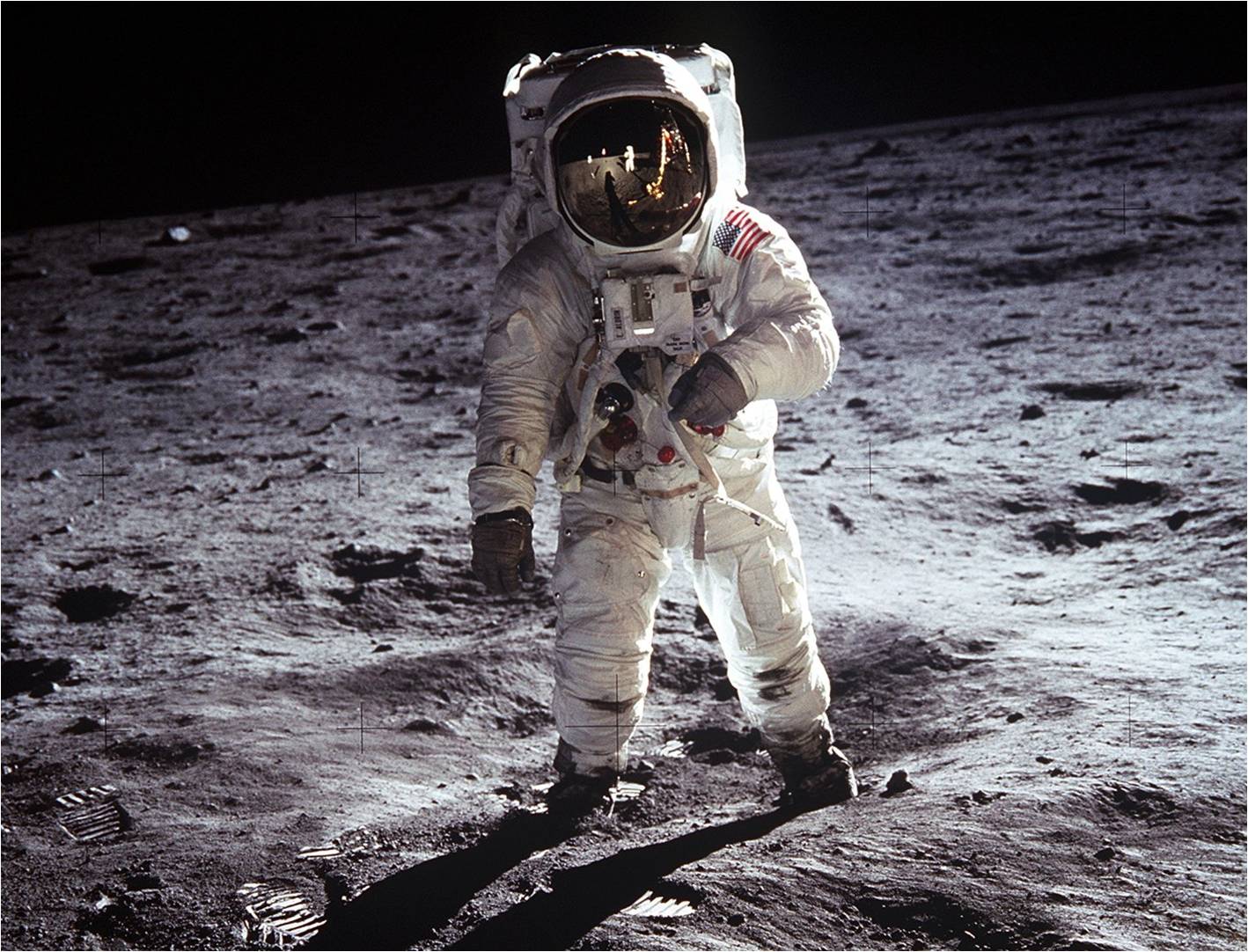
Forty years ago today, the United States of America landed two men on the surface of the Moon.
The Apollo 11 Lunar Module Eagle landed in Sea of Tranquility region of the Moon on Sunday, 20 July 1969 at 20:17:40 UTC. Less than seven hours later, astronauts Neil A. Armstrong and Edwin E. Aldrin, Jr. became the first human beings to walk upon Earth’s closest neighbor. Fellow crew member Michael Collins orbited high overhead in the Command Module Columbia.
As Apollo 11 commander, Neil A. Armstrong was accorded the privilege of being the first man to step foot upon the Moon. As he did so, Armstrong spoke these words: “That’s one small step for Man; one giant leap for Mankind”. He had intended to say: “That’s one small step for ‘a’ man; one giant leap for Mankind”.
Armstrong and Aldrin explored their Sea of Tranquility landing site for about two and a half hours. Total lunar surface stay time was 22 hours and 37 minutes. The Apollo 11 crew left a plaque affixed to one of the legs of the Lunar Module’s descent stage which read: “Here Men From the Planet Earth First Set Foot Upon the Moon; July 1969, A.D. We Came in Peace for All Mankind”.
Following a successful lunar lift-off, Armstrong and Aldrin rejoined Collins in lunar orbit. Approximately seven hours later, the Apollo 11 crew rocketed out of lunar orbit to begin the quarter million mile journey back to Earth. Columbia splashed-down in the Pacific Ocean at 16:50:35 UTC on Thursday, 24 July 1969. Total mission time was 195 hours, 18 minutes, and 35 seconds.
With completion of the flight of Apollo 11, the United States of America fulfilled President John F. Kennedy’s 25 May 1961 call to land a man on the Moon and return him safely to the Earth before the decade of the 1960’s was out. It had taken 2,982 demanding days and much national treasure to do so.
Mission Accomplished, Mr. President.
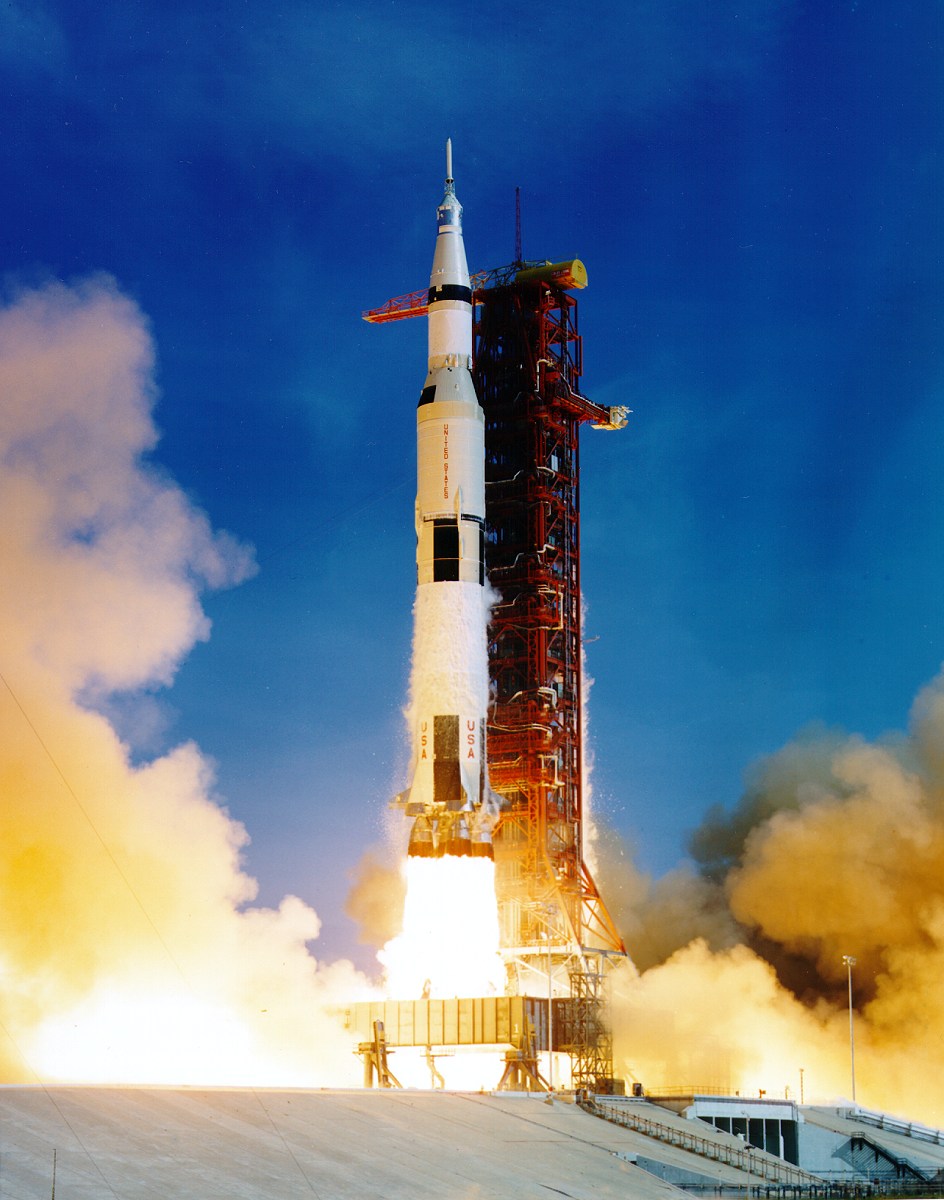
Forty years ago this week, the epic flight of Apollo 11, the first mission to land men on the Moon, began with launch from the Kennedy Space Center (KSC) at Merritt Island, Florida. Nearly 1-million people gathered around America’s famous space complex to witness the historic event. An estimated 1-billion viewers worldwide watched the proceedings on television.
The names of the Apollo 11 crew are now legend: Mission Commander Neil A. Armstrong, Lunar Module Pilot Edwin E. Aldrin, Jr., and Command Module Pilot Michael Collins. Each astronaut was making his second spaceflight.
The overall Apollo 11 spacecraft weighed roughly 100,000 pounds and consisted of 3 major components: Command Module, Service Module, and Lunar Excursion Module (LEM). Out of American history came the names used to distinguish two of these components from one another. The Command Module was named Columbia, the feminine personification of America, while the Lunar Excursion Module received the appellation Eagle in honor of America’s national bird.
The Apollo-Saturn V launch stack measured 363-feet in length, had a maximum diameter of 33-feet, and weighed 6.7-milllion pounds at ignition of its five F-1 engines. The vehicle rose from the Earth on 7.7-million pounds of lift-off thrust.
The acoustic energy produced by the Saturn’s first stage propulsion system was unlike anything in common experience. The sound produced was like intense, continuous thunder even miles away from the launch point. Ground and structure shook disturbingly and a person’s lungs vibrated within their chest cavity.
Lift-off of Apollo 11 (AS-506) from KSC’s LC-39A occurred at 13:32 UTC on Wednesday, 16 July 1969. The target for the day’s launch, the Moon, was 218,096 miles distant from Earth. It took 12 seconds just for the massive Apollo 11 launch vehicle to clear the launch tower. However, a scant 12 minutes later, the Apollo 11 spacecraft was safely in low earth orbit (LEO) traveling at 17,500 miles per hour.
Following checkout in earth orbit, trans-lunar injection, and earth-to-moon coast, Apollo 11 entered lunar orbit nearly 76 hours after lift-off. Now, the big question: Would they make it? Even Apollo 11’s Command Module Pilot, Michael Collins, estimated that the chance of a successful lunar landing on the first attempt was only 50/50. The answer would soon come. History’s first lunar landing attempt was now only 24 hours away.
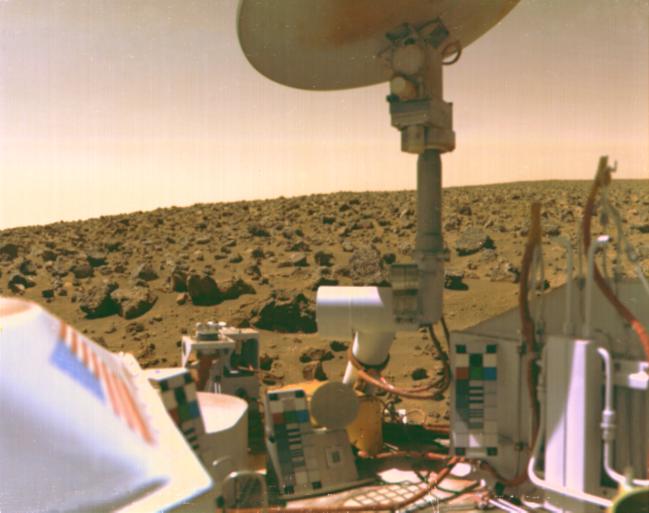
Thirty-three years ago this month, on the seventh anniversary of the first manned lunar landing, Viking I became the first spacecraft to successfully land on the surface of the planet Mars. The primary purpose of the mission was to search for signs of life on the Martian surface.
The Viking I mission began with launch from Earth on Wednesday, 20 August 1975. Lift-off of the Titan IIIE-Centaur launch vehicle from Cape Canaveral, Florida took place at 2122 UTC. The Viking I orbiter-lander payload mass at lift-off was 7,766 lbs.
After chasing Mars for 11 months and 500,000,000 miles, Viking I entered Martian orbit on Saturday, 19 June 1976. The original plan called for a landing on Sunday, 04 July. However, imaging of the intended landing site from orbit revealed that a landing there would be a high risk venture. With this revelation, Viking project scientists went into high stress mode to locate a suitable alternate landing location.
On Tuesday, 20 August 1976, the Viking I lander separated from the Viking orbiter at 0851 UTC in preparation for the deorbit burn.
The Viking I atmospheric deceleration sequence began at roughly 1,000,000 feet above the Martian surface. An ablating aeroshell both slowed and protected the vehicle from aerodynamic heating down to 19,000 feet. At this point, a 52.5-foot diameter parachute was deployed to provide further slowing. At 4,000 feet, the aeroshell and parachute were jettisoned and the craft’s retro-rockets were fired
The Viking I lander touched-down at Chryse Planitia (“Golden Plain” in the Greek) at 1153 UTC having completed the first successful Martian entry, descent, and landing (EDL) mission. The Viking I landing mass was on the order of 1,320 lbs. (Point of clarification: the photo above was taken by Viking II which landed on Mars at Utopia Planitia (“Nowhere Plain”) on Friday, 03 September 1976.)
Viking I went on to perform a variety of first-ever scientific investigations on Mars. Key instrumentation included several cameras, a surface sampler arm, a meterology boom, a seismometer, and a variety of other sensors. In its search for signs of life, Viking I was also configured with an internal biology compartment and gas chromatograph mass spectrometer.
The Viking I lander was designed to function for a minimum of 90 days on the surface of Mars. In reality, it continued to function and provide useful science for over 6 years (contact lost 13 November of 1982). While it rewrote the book in terms of Martian planetary science, Viking I did not in fact discover defintive signs of life on Mars.
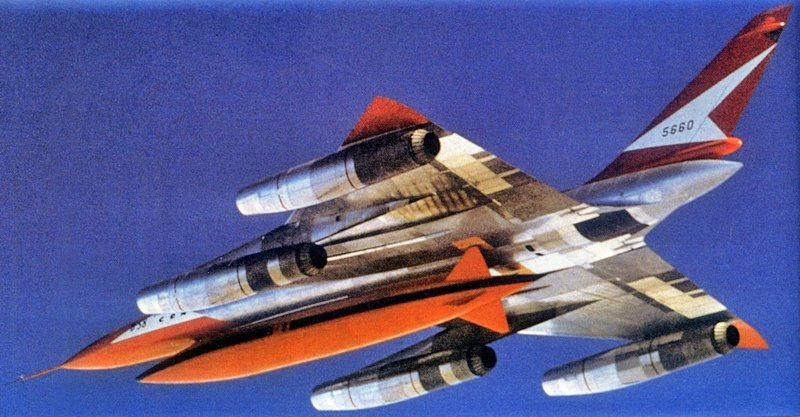
On Saturday, 29 June 1957, the USAF/Convair XB-58A (S/N 55-660) first attained its double-sonic design airspeed when it flew to Mach 2.03 at an altitude of 43,250 feet. This historic achievement took place on the type’s 24th flight. The mission totaled 1 hour and 55 minutes and was commanded by Convair test pilot B. A. Erickson
The B-58A Hustler was the United States first supersonic-capable bomber and was originally designed for the strategic mission. The aircraft was powered by four (4) General Electric J79-GE-5A turbojets generating 62,400 lbs of sea level thrust in afterburner. Maximum take-off weight was nearly 177,000 lbs.
Convair’s stunning delta-winged bomber was 97 feet in length with a wing span of 57 feet. Wing area was roughly 1,550 square feet. Aircraft maximum height was 30 feet as measured from the ground to the top of the vertical tail.
Flight crew for the B-58A consisted of the pilot, bombadier/navigator, and defensive systems operator. The crew was arranged in tandem with each crew member seated in a separate cockpit. The type carried thermonuclear ordnance. A total of 116 B-58A aircraft were manufactured.
The B-58A performance was impressive then and now. It had a maximum speed of 1,400 mph and a service ceiling of 63,400 feet. The aircraft could climb in excess of 17,000 feet per minute at gross take-off weight and up to 46,000 feet per minute near minimum weight.
The B-58A had a difficult gestation due to its advanced design and demanding performance requirements. A large number of aircraft and flight crews were lost due to a variety of flight control and structural problems. First flight took place on 11 November 1956 with the type finally entering the USAF inventory on 15 March 1960.
The USAF/Convair B-58A Hustler was operational for nearly 10 years and was retired on 31 January 1970. The aircraft was never used in anger.
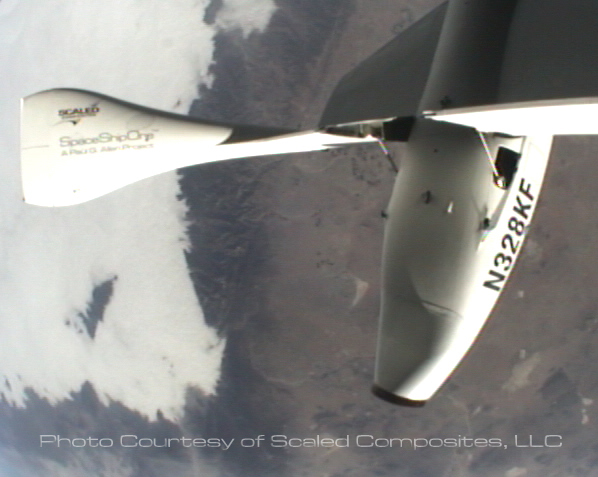
On Monday, 21 June 2004, Scaled Composite’s SpaceShipOne flew to an altitude of 62.214 statute miles. The flight marked the first time that a privately-developed flight vehicle had flown above the 62-statute mile boundary that entitles the flight crew to FAI-certified astronaut wings. As a result, SpaceShipOne pilot Mike Melvill became history’s first private citizen astronaut.
SpaceShipOne Mission 15P began with departure from California’s Mojave Spaceport at 0647 PDT. Carrying SpaceShipOne at the centerline station, Scaled’s White Knight aircraft climbed to the drop altitude of 47,000 feet.
At 0750 PDT, the 7,900-pound SpaceShipOne fell away from the White Knight and Melvill immediately ignited the 16,650-pound thrust hybrid rocket motor. Melvill quickly then pulled SpaceShipOne into a vertical climb.
Passing through 60,000 feet, SpaceShipOne experienced a series of uncommanded rolls as it encountered a wind shear. Melvill struggled with the controls in an attempt to arrest the roll transient. Then, late in the boost, the vehicle lost primary pitch trim control. In response, Melvill switched to the back-up system as he continued the ascent.
Rocket motor burnout occurred at 180,000 feet with SpaceShipOne traveling at 2,150 mph. It now only weighed 2,600 pounds. The vehicle then coasted to an apogee of 62.214 statute miles (328,490 feet). The target maximum altitude was 68.182 statute miles (360,000 feet). However, the control problems encountered going upstairs caused the trajectory to veer somewhat from the vertical.
Melvill experienced approximately 3.5 minutes of zero-g flight going over the top. He had some fun during this period as he released a bunch of M&M’s and watched the chocolate candy pieces float in the SpaceShipOne cabin.
Back to business now, Melvill transitioned SpaceShipOne to the high-drag feathered configuration in preparation for the critical entry phase of the mission. The vehicle initially accelerated to over 2,100 mph in the airless void before encountering the sensible atmosphere. At one point during atmospheric entry, Melvill experienced in excess of 5 g’s deceleration.
At 57,000 feet, Melvill reconfigured SpaceShipOne back to the standard aircraft configuration for powerless flight back to the Mojave Spaceport. Fortunately, the aircraft was a very good glider. The control problems encountered during the ascent resulted in atmospheric entry taking place 22 statute miles south of the targeted reentry point.
SpaceShipOne touched-down on Mojave Runway 12/30 at 0814 PDT; thus ending an historic, if not harrowing mission.
After the flight, Mike Melvill had much to say. But perhaps the following quote says it best for the rest of us who can only imagine what it was like: “And it was really an awesome sight, I mean it was like nothing I’ve ever seen before. And it blew me away, it really did. … You really do feel like you can reach out and touch the face of God, believe me.”
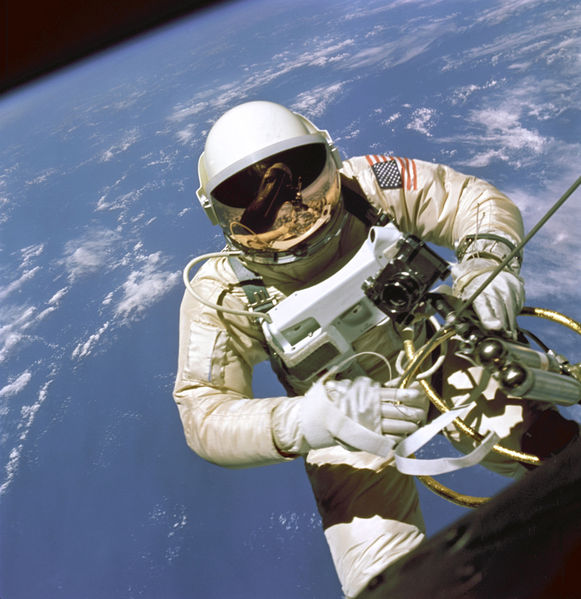
Forty-four years ago this month, Astronaut Edward H. White II became the first American to perform what in NASA parlance is referred to as an Extra Vehicular Activity (EVA). In simple terms; a space walk.
White, Mission Commander James A. McDivitt and their Gemini IV spacecraft were launched into low Earth orbit by a two-stage Titan II launch vehicle from LC-19 at Cape Canaveral Air Force Station, Florida. The mission clock started at 15:15:59 GMT on Thursday, 03 June 1965.
On the third orbit, less than five hours after launch, White opened the Gemini IV starboard hatch. He stood in his seat and mounted a camera to capture his historic space stroll. He then cast-off from Gemini IV and became a human satellite.
White was tethered to Gemini IV via a 15-foot umbilical that provided oxygen and communications to his EVA suit. A gold-plated visor on his helmet protected his eyes from the harsh glare of the sun. The space-walking astronaut was also outfitted with a hand-held maneuvering unit that used compressed oxygen to power its small thrusters. And, like any good tourist, he also took along a camera.
Ed White had the time of his all-too-brief life in the 22 minutes that he walked in space. The sight of the earth, the spacecraft, the sun, the vastness of space, the freedom of movement all combined to make him exclaim at one point, “I feel like a million dollars!”.
Presently, it was time to get back into the spacecraft. But, couldn’t he just stay outside a little longer? NASA Mission Control and Commander McDivitt were firm. It was time to get back in; now! He grudgingly complied with the request/order, plaintively saying: “It’s the saddest moment of my life!”
As Ed White got back into his seat, he and McDivitt struggled to lock the starboard hatch. Both men were exhausted, but ebullient as they mused about the successful completion of America’s first space walk.
Gemini IV would eventually orbit the Earth 62 times before splashing-down in the Atlantic Ocean at 17:12:11 GMT on Sunday, 07 June 1965. The 4-day mission was another milestone in America’s quest for the moon.
The mission was over and yet Ed White was still a little tired. But then, that was easy to understand. In the time that he was outside the spacecraft, Gemini IV had traveled almost a third of the way around the world.
Now, that’s a long walk.
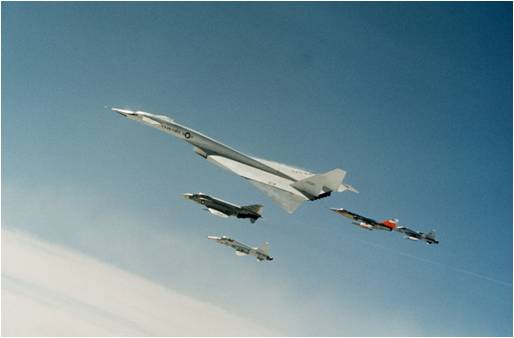
Forty-three years ago today, XB-70A Valkyrie Air Vehicle No. 2 (62-0207) took-off from Edwards Air Force Base, California for the final time.
The crew for this flight included aircraft commander and North American test pilot Alvin S. White and right-seater USAF Major Carl S. Cross. White would be making flight No. 67 in the XB-70A while Cross was making his first. For both men, this would be their final XB-70A flight.
In the past several months, Air Vehicle No. 2 had set speed (Mach 3.08) and altitude (74,000 feet) records for the type. But on this fateful day, 08 June 1966, the mission was a simple one; some minor flight research test points and a photo shoot.
The General Electric Company, manufacturer of the massive XB-70A’s YJ93-GE-3 turbojets, had received permission from Edwards USAF officials to photograph the XB-70A in close formation with a quartet of other aircraft powered by GE engines. The resulting photos were intended to be used for publicity.
The formation, consisting of the XB-70A, a T-38A (59-1601), an F-4B (BuNo 150993), an F-104N (N813NA), and an F-5A (59-4898), was in position at 25,000 feet by 0845. The photographers for this event, flying in a GE-powered Gates Learjet (N175FS) stationed about 600 feet to the left and slightly aft of the formation, began taking photos.
The photo session was planned to last 30 minutes, but went 10 minutes longer to 0925. Then at 0926, just as the formation aircraft were starting to leave the scene, the frantic cry of Midair! Midair Midair! came over the communications network.
Somehow, the NASA F-104N, piloted by NASA Chief Test Pilot Joe Walker, had collided with the right wing-tip of the XB-70A. Walker’s out-of-control F-104 then rolled inverted to the left and sheared-off the XB-70A’s twin vertical tails. The F-104N fuselage was severed just behind the cockpit and Walker died instantly in the process.
Curiously, the XB-70A continued on in steady, level flight for about 16 seconds despite the loss of its primary directional stability lifting surfaces. Then, as White attempted to control a roll transient, the XB-70A rapidly departed controlled flight.
As the doomed aircraft torturously pitched, yawed and rolled, its left wing structurally failed and fuel spewed furiously from its fuel tanks. White was somehow able to eject and survive. Cross never left the aircraft and rode it down to impact just north of Barstow, California.
A mishap investigation followed and (as always) blame was assigned. However, none of that changed the facts that on this, the Blackest Day at Edwards, American aviation lost two of its best men and aircraft in a flight mishap that never should have happened.
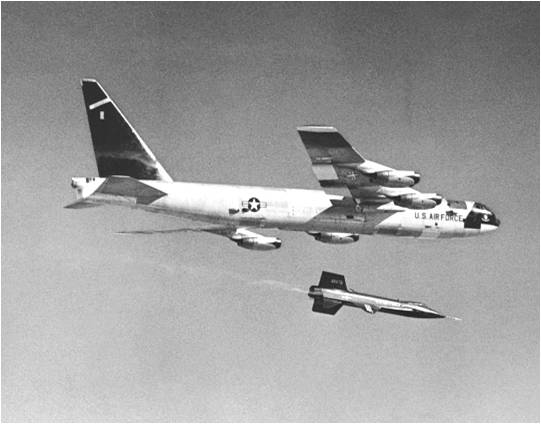
Fifty years ago this month, the USAF/North American X-15 made its first free flight with test pilot A. Scott Crossfield at the controls.
While bred for hypersonic flight, the aircraft still had to handle well enough at low speeds for a pilot to land it dead-stick. As a result, history records that the X-15’s first free flight was an unpowered affair which lasted 296.6 seconds from drop to touchdown.
The launch aircraft for this first X-15 mission was the USAF NB-52A (52-0003) with Captain Charlie Bock as command pilot and Captain Jack Allavie in the right seat.
The B-52A slowly climbed high into the skies above Edwards Air Force Base, California carrying Crossfield and the X-15, Ship No. 1 (56-6670) to the drop point over Rosamond Dry Lake. The X-15’s first free flight began at 37,550 feet above mean sea level and a Mach number of 0.79.
As it was released from the pylon, the NB-52A’s local flowfield caused the X-15 to roll 20 to 30 degrees clockwise as it fell away from the mothership. Crossfield quickly went to work in an attempt to learn how to fly the black rocket plane in real-time.
All proceeded well enough until Crossfield was on final approach to Rodgers Dry Lake.
As he neared the ground, Crossfield had the distinct sense that the X-15 was unstable in pitch as it went through wild, porpoising swings in angle-of-attack. It was all Crossfield could do to get the aircraft on the ground in one piece. Using the word “landing” to describe the aircraft’s return to earth would be much too kind a way of expressing it.
Post-flight analysis showed that the hydraulically-boosted pitch controls were not tuned correctly and thus deprived Crossfield of the expected level of pitch control authority. This key flight system was subsequently adjusted and the problem never surfaced again.
However, on 08 June 1959, the aircraft that would eventually fly as high as 354,200 feet and attain a speed of 4,530 mph, almost took a pratfall in its debut on the grand stage of American aviation.