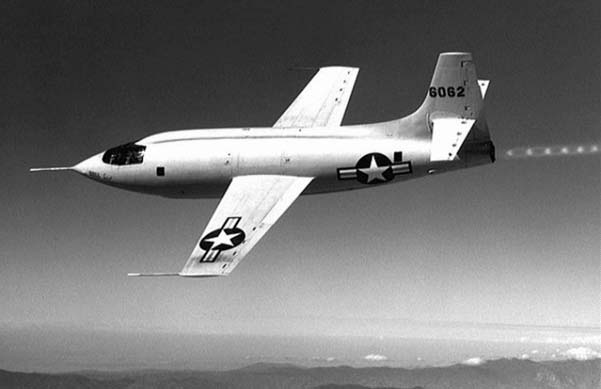
Sixty-two years ago this month, the legendary USAF/Bell XS-1 experimental aircraft exceeded the speed of sound when it reached a maximum speed of 700 mph (Mach 1.06) at 45,000 feet.
Bell Aircraft Corporation of Buffalo, New York built three copies of the XS-1 under contract to the United States Army Air Forces (USAAF). The aircraft were designed to approach and then fly beyond the speed of sound.
The Bell XS-1 was 31-feet in length and had a wing span of 28 feet. Gross take-off weight was around 12,500 lbs. The aircraft had an empty weight of about 7,000 lbs. Propulsion was provided by a Reaction Motors XLR-11 rocket motor capable of generating a maximum thrust of 6,000 lbs.
On the morning of Tuesday, 14 October 1947, the XS-1 (S/N 46-062) dropped away from its B-29 mothership (S/N 45-21800 ) as the pair flew at 220 mph and 20,000 feet. In the XS-1 cockpit was USAAF Captain and World War II ace Charles E. Yeager. The young test pilot had named the aircraft Glamorous Glennis in honor of his wife.
Following drop, Yeager sequentially-lit all four XLR-11 rocket chambers during a climb and push-over that ultimately brought him to level flight around 45,000 feet. The resulting acceleration profile propelled the XS-1 slightly beyond Mach 1 for about 20 seconds. Yeager then shutdown the rocket, decelerated to subsonic speeds, and landed the XS-1 on Muroc Dry Lake at Muroc Army Airfield, California.
The world would not find out about the daring exploits of 14 October 1947 until December of the same year. As it was, the announcement came from a trade magazine that even today is sometimes referred to as “Aviation Leak”.
Today, Glamorous Glennis is prominently displayed in the Milestones of Flight hall of the National Air and Space Museum located in Washington, DC. For his efforts in breaking the sound barrier, Chuck Yeager was a co-recipient of the 1948 Collier Trophy.
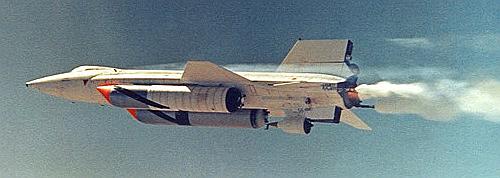
Forty-two years ago this month, USAF Major William J. “Pete” Knight piloted the fabled USAF/North American X-15A-2 hypersonic research aircraft to a record speed of 4,520 mph – about a mile and a quarter per second.
North American’s original X-15 production run consisted of three (3) aircraft. The X-15A-2 was a rebuild of the 2nd airframe (S/N 56-6671) which had been severely damaged during an emergency landing at Mud Lake, Nevada in November of 1962.
The rebuilt aircraft was configured with a pair of droppable propellant tanks that allowed the type’s XLR-99 rocket engine to operate 60 seconds beyond the stock X-15’s 80-second burn time. Among other modifications, the aircraft also carried a pylon-mounted dummy ramjet in the ventral region of the aft fuselage.
With the addition of the external propellant tanks, the X-15A-2 was really a three-stage vehicle. The first stage was the NASA NB-52B mothership which launched the X-15 at Mach 0.82 and 45,000 feet. The second stage consisted of the propellant-laden external tanks which were jettisoned at Mach 2.0 and 70,000 feet. The third stage was the X-15A-2 with its entire internal propellant load.
Due to the increased speed of the X-15A-2, the aircraft was covered with Martin MA-25S ablator to protect it from the higher aerodynamic heating loads. The baseline ablator was pink in color and gave the X-15A-2 a rather odd appearance. Fortunately, application of a white wear/sealer over the ablator gave the aircraft a more dignified look.
On Tuesday, 03 October 1967, Pete Knight and the X-15A-2 dropped away from the NB-52B (S/N 52-008) at the start of the X-15 Program’s 188th mission. Knight ignited the XLR-99 rocket engine and excuted a pull-up followed by a pushover to level flight at a little over 102,000 feet. Aircraft speed at XLR-99 burnout was 4,520 mph (Mach 6.7).
As the aircraft decelerated following burnout, Knight executed a series of pre-planned flight maneuvers to acquire vital aerodynamics data. However, passing through Mach 5.5, he received an indication in the cockpit that a high temperature condition existed in the XLR-99 engine bay.
Knight attempted to jettison the aircraft’s remaining propellants, but to no avail. The jettison tubes were welded shut by whatever was happening in the engine bay. This meant he would land heavier and faster than usual. Fortunately, Knight’s piloting skills allowed him to get the X-15A-2 on to Rogers Dry Lake in one piece.
As flight support personnel inspected the X-15A-2 airframe following Knight’s emergency landing, they were alarmed at what they found. The aft ventral region of the aircraft had incurred significant thermal damage. Further, the dummy ramjet was gone.
As reported in the classic NASA document, TM-X-1669, higher-than-expected aerodynamic heating levels were responsible for the damage to the X-15A-2.
First, shock wave/boundary layer interaction heating on the lower fuselage just ahead of the pylon (1) completely destroyed the ablator in that region and (2) penetrated the Inconel-X airframe structure. This introduced very high temperature air into the X-15 engine bay.
Second, impingement of the dummy ramjet nose shock on the detached bow shock coming off of the pylon produced a shear layer that focused on the pylon leading edge. The resulting heating rates were of sufficient magnitude and duration to both burn away the pylon ablator and burn through the pylon structure. The weakened pylon attachment eventually failed and the dummy ramjet departed the main airframe.
Pete Knight will forever hold the record for the fastest X-15 flight. However, the X-15A-2 never flew again. Only 11 more flights remained in the X-15 Program at the time. A lack of time and funding meant that little was to be gained by repairing the thermally-damaged aircraft.
As for the final disposition of the X-15A-2 (S/N 56-6671), the aircraft’s remaining ablator was removed with its external surface cleaned-up and original markings restored. The aircraft now resides in a place of honor at the National Museum of the United States Air Force located at Wright-Patterson AFB in Dayton, Ohio.
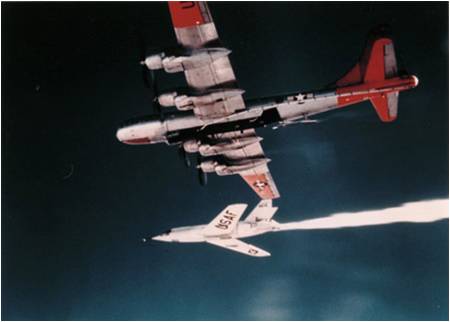
Fifty-three years ago this month, the Bell X-2 rocket-powered research aircraft reached a record speed of 2,094 mph with USAF Captain Milburn G. “Mel” Apt at the controls. This corresponded to a Mach number of 3.2 at 65,000 feet.
Mel Apt’s historic achievement came about because of the Air Force’s desire to have the X-2 reach Mach 3 before turning it over to the National Advisory Committee For Aeronautics (NACA) for further flight research testing. Just 20 days prior to Apt’s flight in the X-2, USAF Captain Iven C. Kincheloe, Jr. had flown the aircraft to a record altitude of 126,200 feet.
On Thursday, 27 September 1956, Apt and the last X-2 aircraft (S/N 46-674) dropped away from the USAF B-50 motherhip at 30,000 feet and 225 mph. Despite the fact that Apt had never flown an X-aircraft, he executed the flight profile exactly as briefed. In addition, the X-2’s twin-chamber XLR-25 rocket motor burned propellant 12.5 seconds longer than planned. Both of these factors contributed to the aircraft attaining a speed in excess of 2,000 mph.
Based on previous flight tests as well as flight simulator sessions, Apt knew that the X-2 had to slow to roughly Mach 2.4 before turning the aircraft back to Edwards. This was due to degraded directional stability, control reversal, and aerodynamic coupling issues that adversely affected the X-2 at higher Mach numbers.
However, Mel Apt was now faced with a difficult decision. If he waited for the X-2 to slow to Mach 2.4 before initiating a turn back to Edwards Air Force Base, he quite likely would not have enough energy and therefore range to reach Rogers Dry Lake. On the other hand, if he decided to initiate the turn back to Edwards at high Mach number, he risked having the X-2 depart controlled flight. Apt opted for the latter.
As Apt increased the aircraft’s angle-of-attack, the X-2 careened out of control and subjected him to a brutal pounding. Aircraft lateral acceleration varied between +6 and -6 g’s. The battered pilot ultimately found himself in a subsonic, inverted spin at 40,000 feet. At this point, Apt effected pyrotechnic separation of the X-2’s forebody which contained the cockpit and a drogue parachute.
X-2 forebody separation was clean and the drogue parachute deployed properly. However, Apt still needed to bail out of the X-2’s forebody and deploy his personal parachute to complete the emergency egress process. But, it was not to be. Mel Apt ran out of time, altitude, and luck. He lost his life when the X-2 forebody that he was trying to escape from impacted the ground at several hundred miles an hour.
Mel Apt’s flight to Mach 3.2 established a record that stood until the X-15 exceeded it in August 1960. However, the price for doing so was very high. The USAF lost a brave test pilot and the lone remaining X-2 on that fateful day in September 1956. The mishap also ended the USAF X-2 Program. NACA never did conduct flight research with the X-2.
However, for a few terrifying moments, Mel Apt was the fastest man alive.
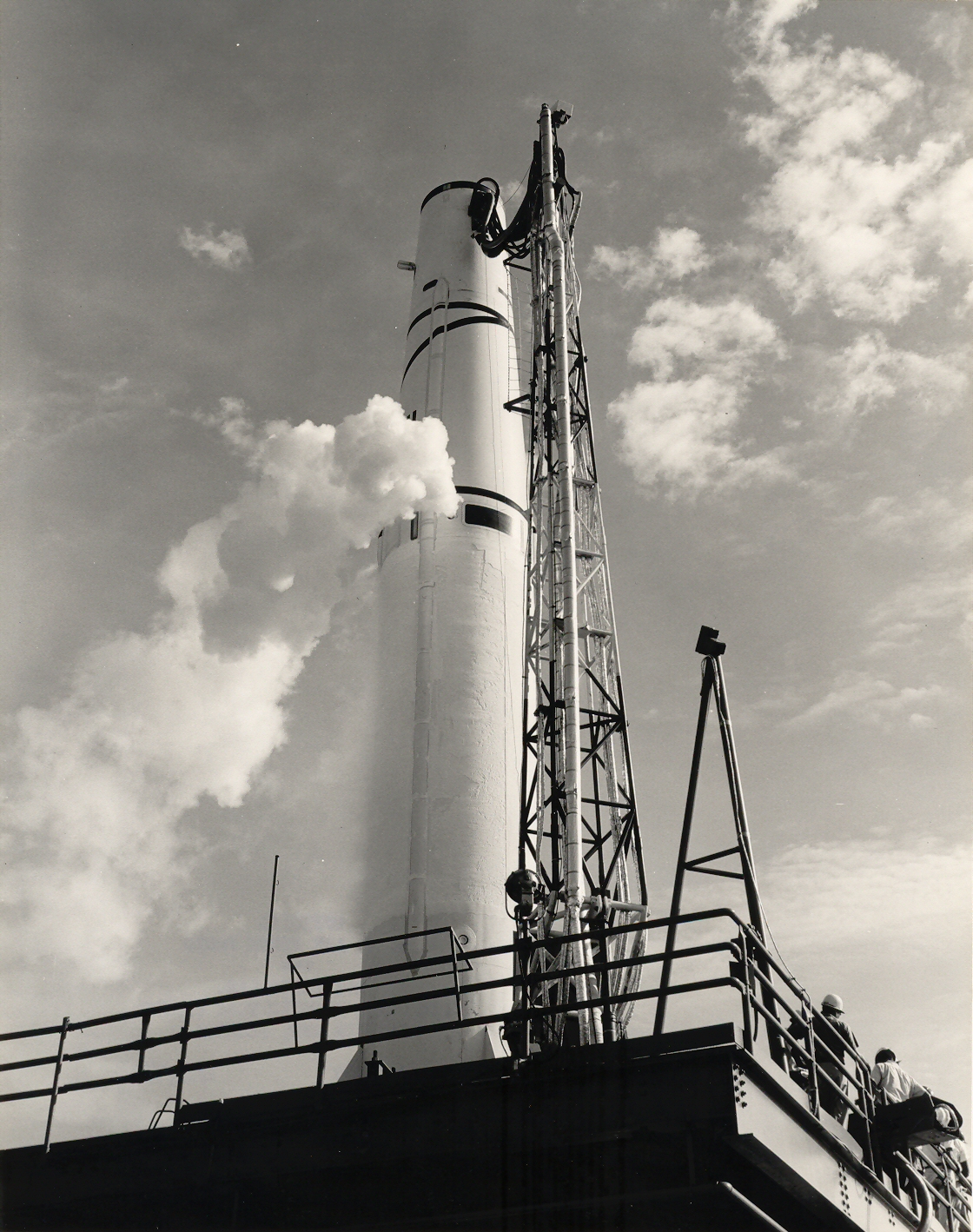
Fifty-two years ago this month, the United States successfully tested a USAF/Douglas Thor missile for the first time. Thor Vehicle 105, launched from Launch Complex 17 at Cape Canaveral, flew 1,100 miles down the Eastern Test Range (ETR) on Saturday, 21 September 1957.
Named after the Norse god of thunder, the Thor (PGM-17A) was designed as a nuclear-armed Intermediate Range Ballistic Missle (IRBM). Operational Thor missiles were armed with a single W49 nuclear warhead having an explosive yield equivalent to 1.44 megatons of TNT.
The Thor measured 65 feet in length and had a maximum diameter of 8 feet. Weighing 110,000 pounds at lift-off, the test vehicle climbed-out on 150,000 pounds of thrust generated by its single Rocketdyne LR79-NA-9 first stage rocket motor. The powerplant used LOX/Kerosene propellants and had a nominal burn time of 165 seconds. Specific impulse was around 280 seconds.
Following development flight testing, the Thor would become the first operational ballistic missile deployed by the United States. Sixty Thor missiles were tended by twenty RAF missile squadrons scattered throughout the United Kingdom from 1958 through 1963.
Although its tour of duty was brief, the Thor served as an effective deterent to Soviet agression until the arrival of the first true Intercontinental Ballistic Missiles (ICBM). Interestingly, the Thor IRBM would become the basis for the first Delta launch vehicles, descendants of which remain in active service up to the current day.
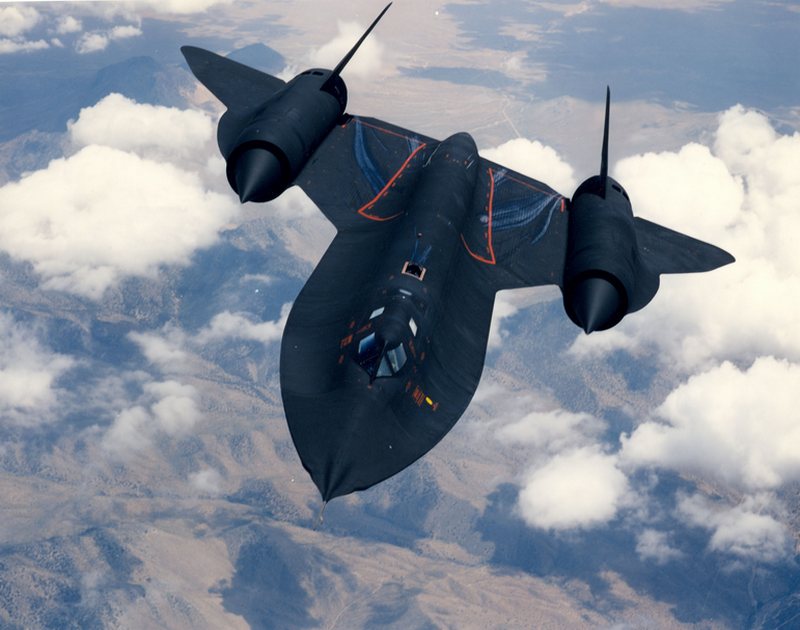
Thirty-five years ago this month, the legendary USAF/Lockheed SR-71A Blackbird triple-sonic aircraft established an official world speed record as it traversed the 5,446.87 statute miles between London and Los Angeles in 3 hours 47 minutes and 39 seconds. Average speed was 1,435.59 mph.
The all-USAF crew of Captain Harold B. Adams (Pilot) and Major William C. Machorek (RSO) flew the historic mission in aircraft S/N 61-17972 on Friday, 13 September 1974. In their rapid east-to-west journey, the record-setting aircraft and its crew crossed 7 separate time zones.
To gain an added appreciation for the Blackbird’s impressive performance, one might consider the following. The Earth rotates through an arc distance of a little over 1,000 miles in one hour. The Blackbird averaged over 1,400 miles arc distance in one hour. In that sense, the aircraft out-raced the sun as it flew more than one-fifth the total distance around the globe.
Fittingly, the crew of Adams and Machorek received the FAI’s prestigous De La Vaulx medal in honor of their London-to-Los Angeles world speed record which stands to this very day.
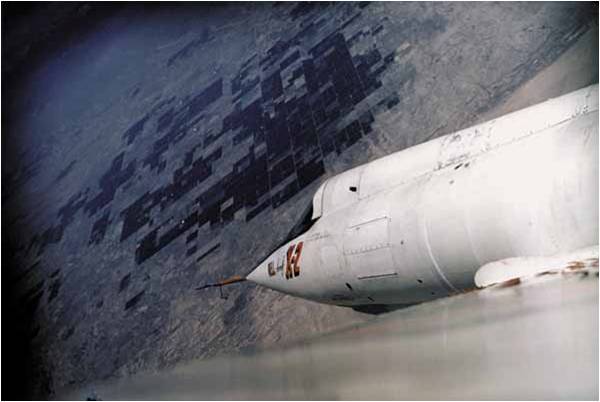
Fifty-three years ago today, the USAF/Bell X-2 research aircraft flew to an altitude of 126,200 feet. This accomplishment took place on the penultimate mission of the type’s 20-flight aeronautical research program. The date was Friday, 07 September 1956.
The X-2 was the successor to Bell’s X-1A rocket-powered aircraft which had recorded maximum speed and altitude marks of 1,650 mph (Mach 2.44) and 90,440 feet, respectively. The X-2 was designed to fly beyond Mach 3 and above 100,000 feet. The X-2’s primary mission was to investigate aircraft flight control and aerodynamic heating in the triple-sonic flight regime.
The X-2 had a gross take-off weight of 24,910 lbs and was powered by a Curtis-Wright XLR-25 rocket motor which generated 15,000-lbs of thrust. Aircraft empty weight was 12,375 lbs. Like the majority of X-aircraft, the X-2 was air-launched from a mothership. In the X-2’s case, an USAF EB-50D served as the drop aircraft. The X-2 was released from the launch aircraft at 225 mph and 30,000 feet.
The pilot for the X-2 maximum altitude mission was USAF Captain Iven Carl Kincheloe, Jr. Kicheloe was a Korean War veteran and highly accomplished test pilot. He wore a partial pressure suit for survival at extreme altitude.
While the dynamic pressure at the apex of his trajectory was only 19 psf, Kincheloe successfully piloted the X-2 with aerodynamic controls only. The X-2 did not have reaction controls. Mach number over the top was supersonic (approximately Mach 1.7).
Kicheloe’s maximum altitude flight in the X-2 (S/N 46-674) would remain the highest altitude achieved by a manned aircraft until August of 1960 when the fabled X-15 would fly just beyond 136,000 feet. However, for his achievement on this late summer day in 1956, the popular press would refer to Iven Kicheloe as the “First of the Space Men”.
We take pause this week from our regular aerospace retrospective and consider a topic of a different nature. Such a change-of-pace seems quite natural as summer wanes and legions of new and returning education seekers troop through the portals of our country’s universities. However, rather than focus on the matriculating crowd, we will set our sights on those who have completed their formal education and are now members of the American aerospace workforce.
Education does not end with the granting of a diploma or even a collection of diplomas. This is especially the case in today’s aerospace industry which encompasses so many disciplines and technical specialties. And the list grows as new technology emerges. For the successful aerospace engineer, learning and gaining technical knowledge is truly a daunting career-long process.
The majority of one’s technical skills, critical knowledge, and lessons-learned are acquired on the job. However, professional short courses also serve a vital role in one’s career development. A well designed and capably taught aerospace professional short course provides the engineer with critical specialty knowledge and disciplinary technical context in a very short amount of time. And it does so at low cost.
Aerospace professional short courses are most typically taught by subject matter experts (SME’s) who have successfully plied their trade over a career that often spans decades. These SME’s know their specialty area intimately by virtue of this vast experience. Further, they are often passionate about and notable contributors to their technical discipline.
Somewhat fortuitously, the majority of SME’s who teach aerospace professional short courses are often very good technical instructors. They understand what the learner needs to know and how to convey that knowledge. A capable aerospace professional short course instructor also has an uncanny ability to inspire his or her audience to learn and grow. That kind of instruction is infectious and makes it a true pleasure to learn.
While there is certainly more to say concerning the merits of the aerospace professional short course, it seems appropriate to end this session with the following observation. Among the most valuable aspects of the aerospace professional short course are (1) the review and understanding of key aerospace historical events and (2) the transmittal of hard-won engineering lessons-learned.
In the fast-paced, competitive, high-stakes and cost-conscious aerospace market of the 21st century, the victory will most often go to those who learn from and clearly remember the experiences of the past.
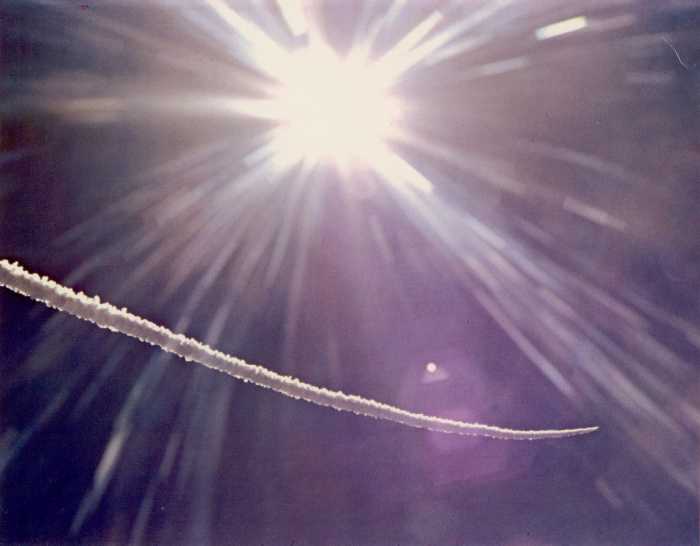
Forty-six years ago this month, NASA chief research pilot Joseph A. Walker flew X-15 Ship No. 3 (S/N 56-6672) to an altitude of 354,200 feet. This flight would mark the highest altitude ever achieved by the famed hypersonic research vehicle. The date was Thursday, 22 August 1963.
Carried aloft by NASA’s NB-52A (S/N 52-0003) mothership, Walker’s X-15 was launched over Smith Ranch Dry Lake, Nevada at 17:05:42 UTC. Following drop at around 45,000 feet and Mach 0.82, Walker ignited the X-15’s small, but mighty XLR-99 rocket engine and pulled into a steep vertical climb.
The XLR-99 was run at 100 percent power for 85.8 seconds with burnout occurring around 176,000 feet on the way uphill. Maximum velocity achieved was 3,794 miles per hour which tranlates to Mach 5.58 at the burnout altitude. Following burnout, Walker’s X-15 gained an additional 178,200 feet in altitude as it coasted to apogee.
Joe Walker went over the top at 354,200 feet (67 miles). Although he didn’t have much time for sight-seeing, the Earth’s curvature was strikingly obvious to the pilot as he started downhill from his lofty perch. Walker subsequently endured a hefty 5-g’s of eyeballs-in normal acceleration during the backside dive pull-out. The aircraft was brought to a wings-level attitude at 70,000 feet. Shortly after, Walker greased the landing on Rogers Dry Lake at Edwards Air Force Base, California.
The X-15 maximum altitude flight lasted 11 minutes and 8 seconds from drop to nose wheel stop. In that time, Walker and X-15 Ship 3 covered 305 miles in ground range. The mission was Ship No. 3’s 22nd flight and the 91st of the X-15 Program.
For Joseph Albert Walker, the 22nd of August 1963 marked his 25th and last flight in an X-15 cockpit. The mission qualified him for Astronaut Wings since he had exceeded the 328,000 foot (100 km) FAI/NASA standard set for such a distinction. Ironically, the historic record indicates that Joe Walker never officially received Astronaut Wings for this flight in which the X-15 design altitude was exceeded by over 100,000 feet.
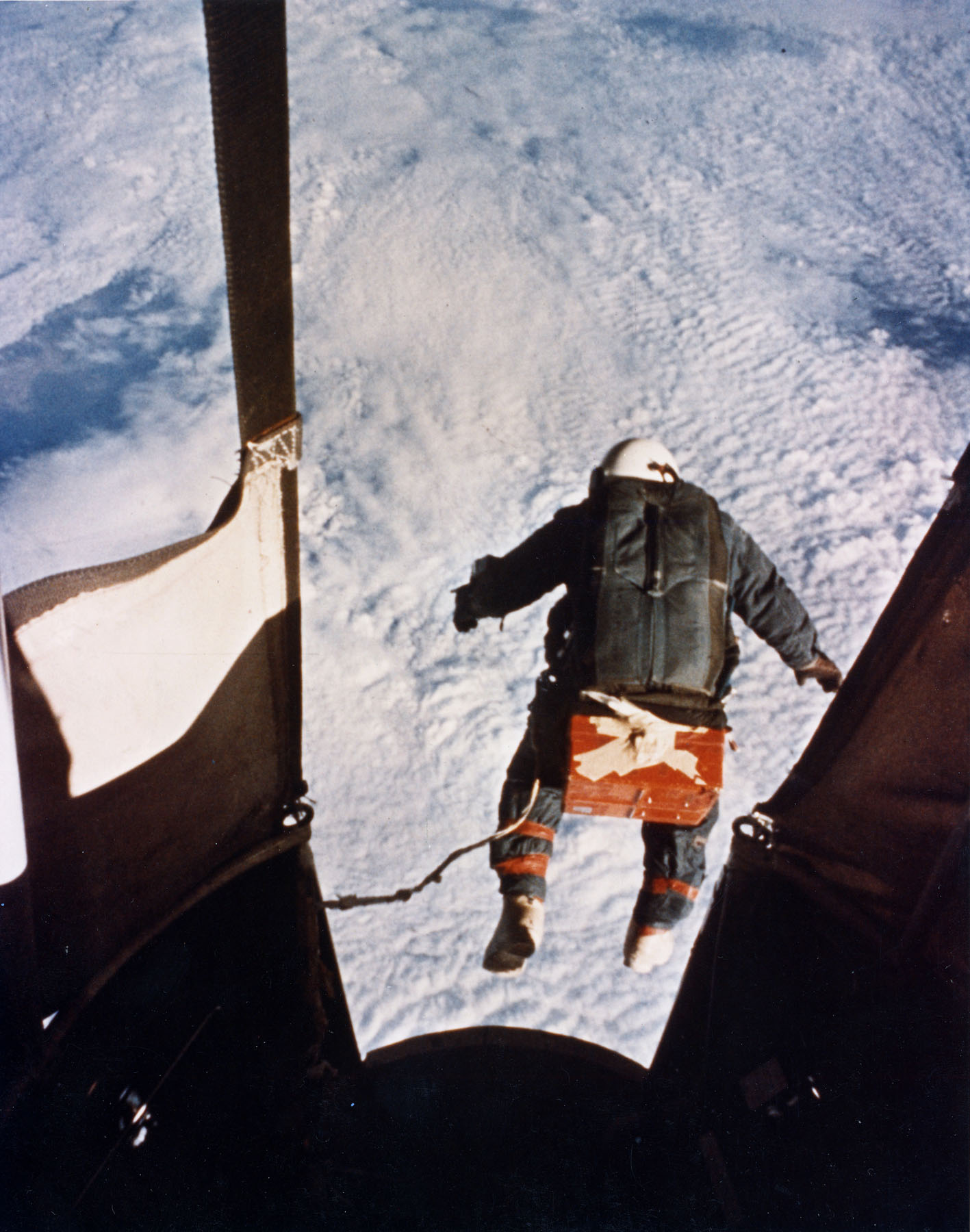
Forty-nine years ago this month, USAF Captain Joseph W. Kittinger, Jr. successfully completed a daring parachute jump from 102,800 feet (19.5 miles). The historic bailout took place on Tuesday, 16 August 1960 over the Tularosa Basin of New Mexico.
Kittinger’s jump was the final mission of the three-jump Project Excelsior flight research effort which focused on manned testing of the Beaupre Multi-Stage Parachute Parachute (BMSP). The system was being developed to provide USAF pilots with a means of survival from an extreme altitude ejection.
Transport to jump altitude was via a 3-million cubic foot helium balloon. Kittinger rode in an open gondola. He was protected from the harsh environment by an MC-3 partial pressure suit as well as an assortment of heavy cold-weather clothing. Kittinger and his jump wardrobe and flight gear weighed a total of 313 pounds
The Excelsior III mission was launched just north of Alamogordo, New Mexico at 11:29 UTC. Ninety-three minutes later, Kittinger’s fragile balloon reached float altitude. At 13:12 UTC, Kittinger stepped out of the gondola and into space. As he did so, he said: “Lord, take care of me now!”
The historic record shows that Joe Kittinger experienced a free-fall that lasted 4 minutes and 36 seconds. During this time, he fell 85,300 feet (16.2 miles). Incredibly, Kittinger reached a maximum free-fall velocity of 614 miles per hour (Mach 0.92) passing through 90,000 feet.
The BMSP worked as advertised. Kittinger entered the cloud deck obscuring his Tularosa Basin landing point at 21,000 feet. Main parachute deployment occurred at 17,500 feet. Total elapsed time from bailout to touchdown was 13 minutes and 45 seconds.
While Joe Kittinger and the Excelsior team focused on flight testing technology critical to the survival of fellow aviators, a byproduct of their efforts were aviation records that stand to this very day. Those achievements include: highest parachute jump (102,800 feet), longest free-fall duration (4 minutes 36 seconds), and longest free-fall distance (85,300 feet).
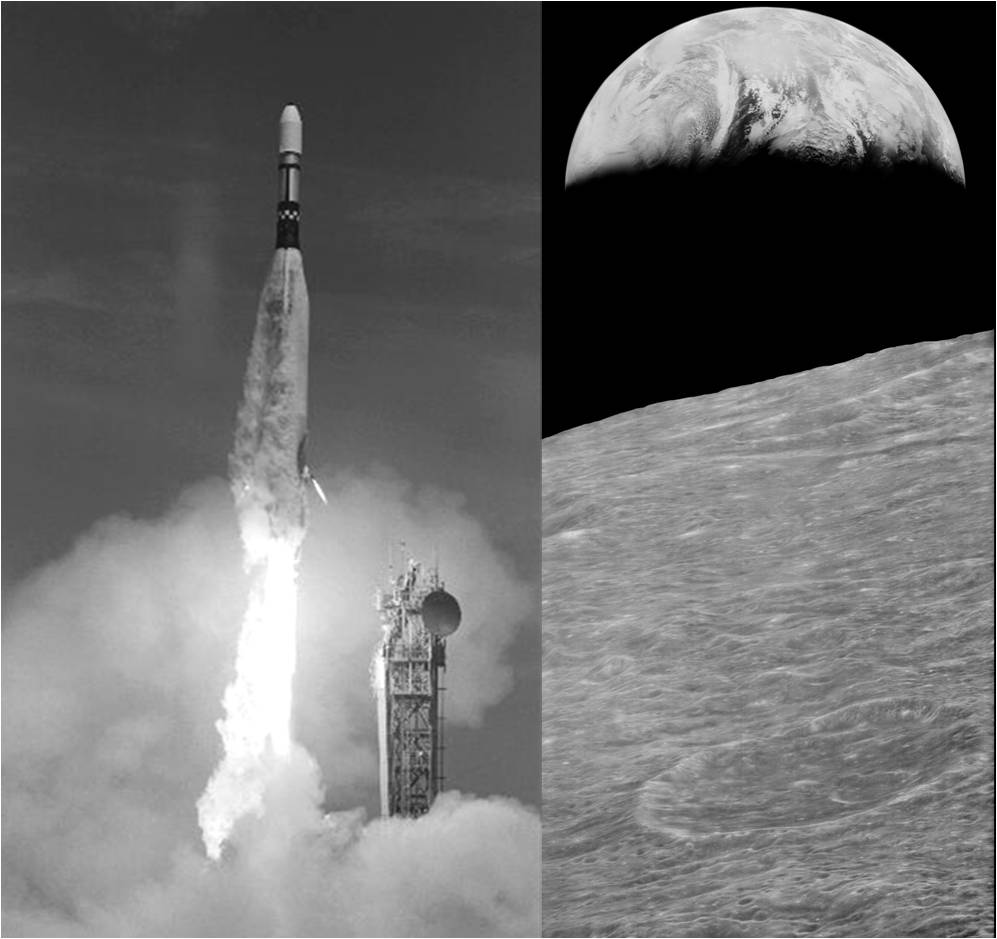
Forty-three years ago today, the Lunar Orbiter 1 spacecraft began its 92 hour trip to the Moon. Lunar Orbiter 1 rode into space aboard an Atlas-Agena D launch vehicle which lifted-off from Pad 13 at Cape Canaveral, Florida. Lift-off time was 19:26 UTC on Wednesday, 10 August 2009.
Lunar Orbiter 1 was the first of five moon mapping missions launched over a period of 12 months as part of the Lunar Orbiter Program. The primary purpose of this program was to thoroughly map the surface of Earth’s nearest neighbor in space preparatory to the historic Apollo lunar landings.
At 15:34 UTC on Sunday, 14 August 1966, Lunar Orbiter 1 was inserted into a highly elliptical lunar orbit that measured 117.5 miles by 1,160 miles. Orbital plane inclination and period of the 850-pound spacecraft was 12.2-deg and 208-minutes, respectively. By Friday, 26 August 1966, the Lunar Orbiter 1 perilune had been lowered to just 25.2-miles.
Lunar Orbiter 1 took photographs of the lunar surface between 18 August and 29 August. Onboard film processing was completed by 30 August and transmission to Earth of 211 high and medium resolution photographs was completed at 20:02 UTC on Wednesday, 14 September 1966. This event, which occurred on Mission Day 35, marked the completion of the photographic portion of the spacecraft’s mission.
Lunar Orbiter 1 imaged nearly 2 million square miles of the Moon’s surface to a resolution of 200 feet or better. This was 10 times better than that obtained from earth-based cameras. Lunar Orbiter 1 also provided the first views of earth as seen from the Moon.
Lunar Orbiter 1 would continue to orbit the Moon for another 45 days. As it did so, the spacecraft provided a wealth of micrometeoroid, gravitational, and radiation measurements that helped lunar scientists better understand the complex lunar environment.
The Lunar Orbiter 1 mission ended on Saturday, 29 October 1966 (Mission Day 80) during its 577th lunar orbit. This intentional action was necessary to make way for the next Lunar Orbiter mission in November. The impact site is located at 6.35-deg N and 160.72-deg E on the far side of the Moon.