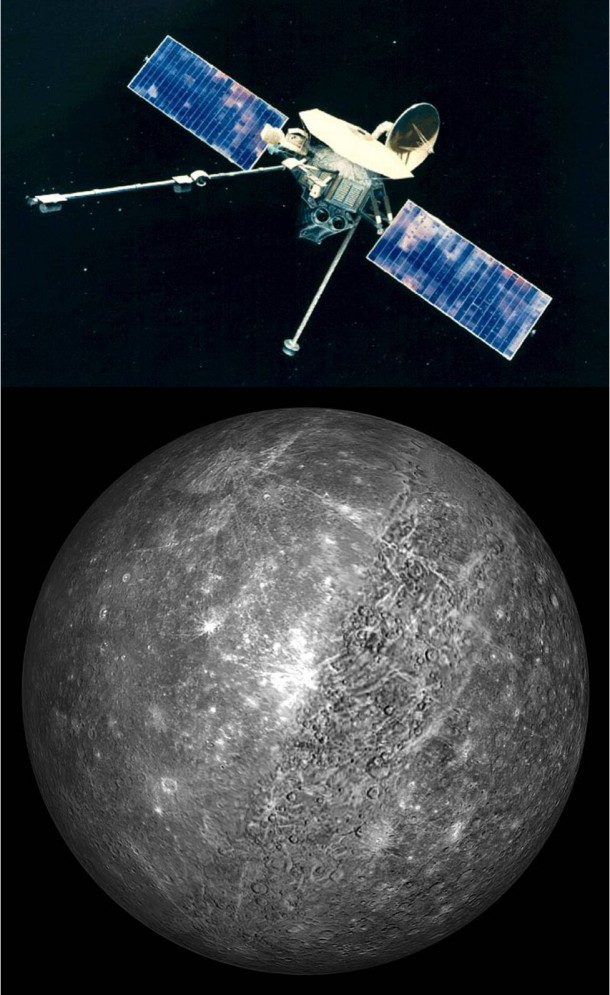
Forty-years ago this week, NASA’s Mariner 10 interplanetary probe conducted the first-ever flyby of the planet Mercury. Among other discoveries, Mariner 10 found that Mercury’s surface is heavily cratered much like the Moon.
Mercury is the smallest planet in the Solar System, having a diameter of slightly over 3,000 miles. Mercury is also the closest planet to the Sun, traveling in an elliptical orbit with an aphelion and perihelion of 43.3 and 28.6 million miles, respectively.
Its close proximity to the Sun explains why Mercury’s sunward surface temperature rise as high as 840 F. On the other hand, temperatures on the dark side of the planet can be as low as -275 F. This is the greatest known temperature differential for any planet in the Solar System.
Mercury is a fast mover by planetary standards. With an orbital velocity of about 112,000 mph, the tiny orb completes one orbit of the Sun in just 88 Earth-days.
NASA’s Mariner 10 interplanetary probe was the first spacecraft to conduct a flyby of the planet Mercury. This historic event occurred on Friday, 29 March 1974. The point of closest approach, only 437 miles above the Mercurian surface, took place at 20:47 UTC.
Mariner 10 found Mercury’s surface to be heavily pockmarked with impact craters. The probe also discovered that Mercury has a tenuous atmosphere composed mostly of helium, a very weak magnetic field, and a iron-rich core.
Mariner 10 went on to conduct flyby encounters with Mercury in September 1974 and March 1975. The third encounter brought the spacecraft within just 203 miles of the planet’s surface. More than 2,800 photographs of Mercury were taken by Mariner 10’s twin cameras during the historic trio of encounters.
As a footnote, Mariner 10 also conducted a flyby of the planet Venus in February 1974. The Mariner 10 mission was immensely successful and the last of the Mariner spacecraft series. Having long ago run out of attitude control system propellants and having its transmitter turned-off, Mariner 10 continues to silently orbit the Sun.
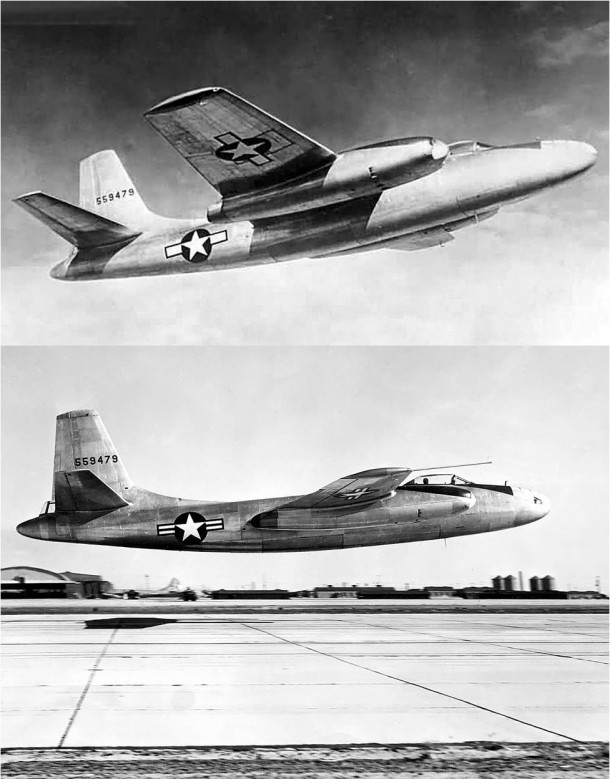
Sixty-seven years ago this week, the USAF/North American XB-45 Tornado bomber made its inaugural test flight at Muroc Army Air Field, California. The type would go on to become the United States first operational turbojet-powered bomber.
The XB-45 measured 74 feet in length, had a wingspan of 89.5 feet and a GTOW of 82,000 lbs. Power was provided by a quartet of Allison J35-A-7 turbojets producing a rather paltry 16,000 lbs of sea level thrust. With a maximum speed at sea level of roughly 500 mph, the service ceiling of the XB-45 was 37,600 feet.
A trio of XB-45 prototype aircraft were manufactured for the Air Force by North American. Serial numbers 45-59479, 45-59480, and 45-59481 were assigned to the three ships. Air crew consisted of two pilots who sat in tandem. The XB-45 flight test program included slightly more than 130 flights.
The first flight of the XB-45, Ship No. 1 (S/N 45-59479) took place on Monday, 17 March 1947 at Muroc Army Air Field, California. North American test pilot George W. Krebs was in the cockpit of the prototype bomber. The one-hour test hop was restricted to low speeds because the landing gear doors could not be fully closed.
Production versions of the Tornado included the B-45A, B-45C, and RB-45C. These aircraft were powered by General Electric J-47 turbojets and represented a great improvement relative to the XB-45 in terms of performance, operability, and reliability. Aircrew for the production Tornado variants included a pilot, co-pilot, bombardier-navigator, and tail gunner.
The Royal Air Force (RAF) used the RB-45C to fly clandestine recon missions over the Soviet Union between 1952 and 1954. Known as Operation Ju-jitsu, RB-45C aircrews gathered electronic and photographic intelligence information critical to the Free World’s defense posture. These high-risk RB-54C missions ultimately led to development of more capable recon aircraft; the Lockheed U-2 and SR-71.
The B-45 and RB-45 Tornado served in the Strategic Air Command (SAC) from 1950 through 1959. The B-45A holds the distinction of being USAF’s first operational jet-powered bomber as well as the first multi-jet bomber to be air-refueled. It was also the first jet bomber to carry and drop a nuclear weapon.
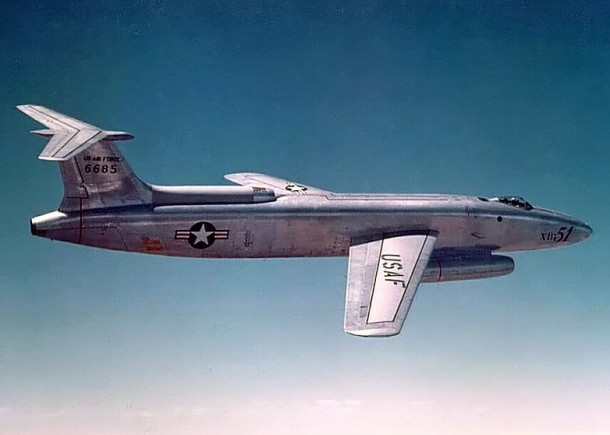
Fifty-eight years ago this month, the lone remaining USAF/Martin XB-51 light attack bomber prototype crashed during take-off from El Paso International Airport in Texas. The cause of the mishap was attributed to premature rotation of the aircraft leading to an unrecoverable stall.
A product of the post-WWII 1940’s, the Martin XB-51 was envisioned as a jet-powered replacement for the piston-driven Douglas A-26 Invader. The swept-wing XB-51 utilized a unique propulsion system which consisted of a trio of General Electric J47 turbojets. Demonstrated top speed was 560 knots at sea level.
The XB-51 was a good-sized airplane. With a length of 85 feet and a wing span of 53 feet, the XB-51 had a nominal take-off weight of around 56,000 lbs. The wings were swept 35 degrees aft and incorporated 6 degrees of anhedral. The latter feature to counter the large dihedral effect produced by the type’s tee-tail.
A pair of XB-51 aircraft were built by Martin for USAF. Ship No. 1 (S/N 46-0685) first took to the air in October of 1949 followed by the flight debut of Ship No. 2 (S/N 46-0686) in April of 1950. The air crew consisted of a pilot who sat underneath a large, clear canopy and a navigator housed within the fuselage.
While the XB-51 flew hundreds of hours in flight test and made many lasting contributions to the aviation field, the aircraft never went into production. This fate was primarily the result of having lost a head-to-head competitive fly-off against the English Electric Canberra B-57A light attack bomber in 1951.
The No. 1 XB-51 aircraft was lost on Sunday, 25 March 1956 during take-off from El Paso International Airport. The mishap aircraft accelerated more slowly than normal and with the end of the runway coming up quickly, the pilot rotated the aircraft in a attempt to get airborne. Unfortunately, the rotation was premature and the wing stalled. The aircraft exploded on impact and the crew of USAF Major James O. Rudolph and Staff-Sargent Wilbur R. Savage were killed.
The loss of the No. 1 XB-51 was preceded by the destruction of Ship No. 2 (S/N 46-0686) on Friday, 09 May 1952. That tragedy occurred during low-altitude aerobatic maneuvers at Edwards Air Force Base in California. The pilot, USAF Major Neil H. Lathrop, perished in the resulting post-impact explosion and inferno.
As a footnote, the XB-51 was never assigned an official nickname by the Air Force. However, it was unofficially referred to in some aviation circles as the Panther. Due to its prominently-long fuselage, the less majestic monicker of “Flying Cigar” was sometimes used as well.
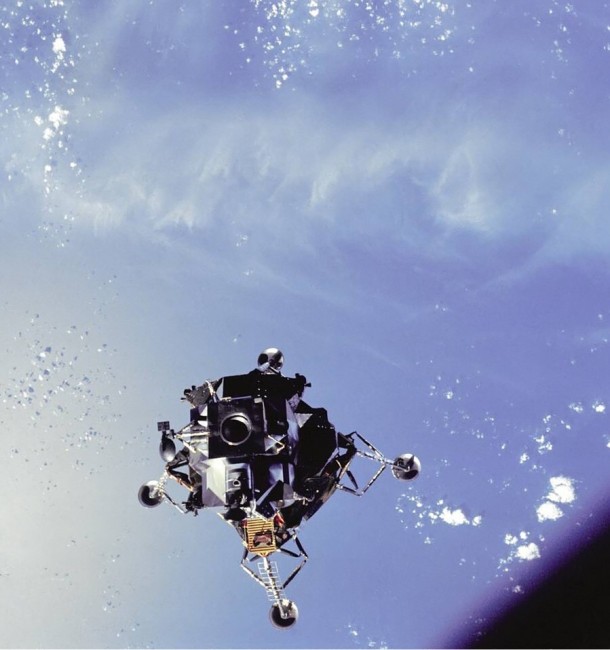
Forty-five years ago this month, the Apollo Lunar Module (LM) flew in space for the first time during the Apollo 9 earth-orbital mission. This technological achievement was critical to the success of the first lunar landing mission which occurred a little over 4 months later.
The Apollo Lunar Module (LM) was the world’s first true spacecraft in that it was designed to operate in vacuum conditions only. It was the third and final element of the Apollo spacecraft; the first two elements being the Command Module (CM) and the Service Module (LM).
The LM had its own propulsion, life-support and GNC systems. The vehicle weighed about 32,000 lbs on Earth and was used to transport a pair of astronauts from lunar orbit to the lunar surface and back into lunar orbit.
The spacecraft was really a two-stage vehicle; a descent stage and an ascent stage weighing 22,000 lbs and 10,000 lbs on Earth, respectively. The descent stage rocket motor was throttable and produced a maximum thrust of 10,000 lbs while the ascent stage rocket motor was rated at 3,500 lbs of thrust.
On Monday, 03 March 1969, Apollo 9 was rocketed into earth-orbit by the mighty Saturn V launch vehicle. The primary purpose of this mission was to put the first LM through its paces preparatory to the first lunar landing attempt.
During the 10-day mission, the crew of Commander James A. McDivitt, CM Pilot David R. Scott and LM Pilot Russell L. “Rusty” Schweickart fully verified all moon landing-specific operational aspects (short of an actual landing) of the LM. Key orbital activities included multiple-firings of both LM rocket motors and several rendezvous and docking exercises in which the LM flew as far away as 113 miles from the CM/SM pair.
By the time the crew splashed-down in the Atlantic Ocean on Thursday, 13 March 1969, America had a new operational spacecraft and a fighting chance to land men on the moon and safely return them to Earth by the end of the decade.
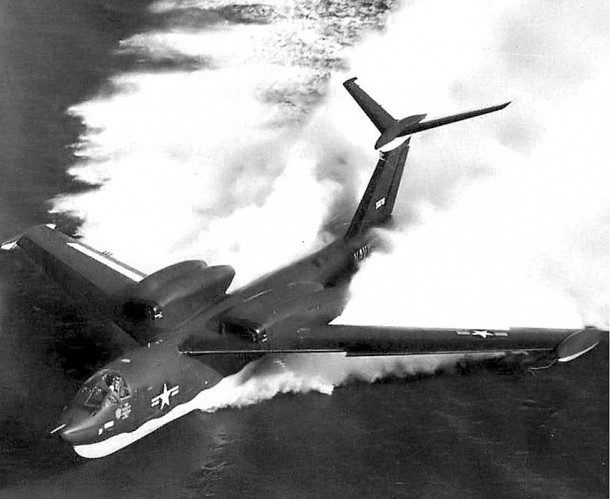
Fifty-five years ago this month, the U.S. Navy’s first production Martin P6M-2 SeaMaster flyingboat took-off from Chesapeake Bay on its maiden flight. Martin chief test pilot George A. Rodney was at the controls of the 4-man, swept-wing naval bomber as it took to the skies on Tuesday, 17 February 1959.
Featuring a fuselage length of 134 feet, wingspan of 102 feet, and a wing leading edge sweep of 40 degrees, the P6M-2 had a GTOW of about 175,000 lbs. Armament included an ordnance load of 30,000 lbs and twin 20 mm, tail-mounted cannon. Power was provided by a quartet of Pratt and Whitney J75-P-2 turbojets; each delivering a maximum sea level thrust of 17,500 lbs.
The SeaMaster’s demonstrated top speed at sea level was in excess of Mach 0.90. This on-the-deck performance is comparable to that of the USAF/Rockwell B-1B Lancer and USAF/Northrup B-2 Spirit and exceeds that of the USAF/Boeing B-52 Stratofortress.
P6M pilots reported that the swept-wing ship handled well below 5,000 feet when flying at Mach numbers between 0.95 and 0.99. While designed for low altitude bombing and mine-laying, the aircraft was flown as high as 52,000 feet. As a result, the Navy even considered the SeaMaster as a nuclear weapons platform.
Despite the type’s impressive performance and capabilities, the SeaMaster Program was cancelled in August of 1959. Budgetary issues and the emerging Fleet Ballistic Missile System (Polaris-Poseidon-Trident) led to this decision. Loss of the P6M SeaMaster Program was devastating to the Glenn L. Martin Company and resulted in this notable aerospace business never again producing another aircraft.
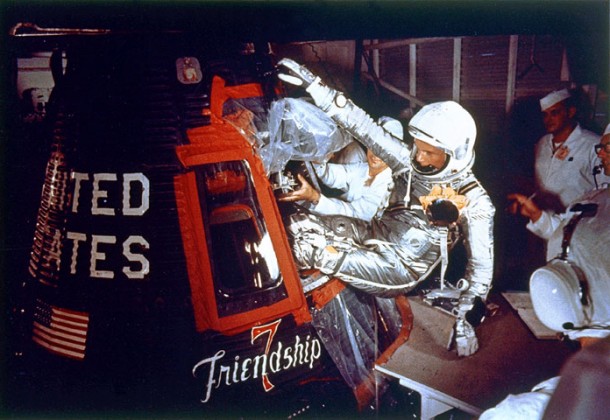
Fifty-two years ago today, Project Mercury Astronaut John Herschel Glenn, Jr. became the first American to orbit the Earth. Glenn’s spacecraft name and mission call sign was Friendship 7.
Mercury-Atlas 6 (MA-6) lifted-off from Cape Canaveral’s Launch Complex 14 at 14:47:39 UTC on Tuesday, 20 February 1962. It was the first time that the Atlas LV-3B booster was used for a manned spaceflight.
Three-hundred and twenty seconds after lift-off, Friendship 7 achieved an elliptical orbit measuring 143 nm (apogee) by 86 nm (perigee). Orbital inclination and period were 32.5 degrees and 88.5 minutes, respectively.
The most compelling moments in the United States’ first manned orbital mission centered around a sensor indication that Glenn’s heatshield and landing bag had become loose at the beginning of his second orbit. If true, Glenn would be incinerated during entry.
Concern for Glenn’s welfare persisted for the remainder of the flight and a decision was made to retain his retro package following completion of the retro-fire sequence. It was hoped that the 3 straps holding the retro package would also hold the heatshield in place.
During Glenn’s return to the atmosphere, both the spent retro package and its restraining straps melted in the searing heat of re-entry. Glenn saw chunks of flaming debris passing by his spacecraft window. At one point he radioed, “That’s a real fireball outside”.
Happily, the spacecraft’s heatshield held during entry and the landing bag deployed nominally. There had never really been a problem. The sensor indication was found to be false.
Friendship 7 splashed-down in the Atlantic Ocean at a point 432 nm east of Cape Canaveral at 19:43:02 UTC. John Glenn had orbited the Earth 3 times during a mission which lasted 4 hours, 55 minutes and 23 seconds. Within short order, spacecraft and astronaut were successfully recovered aboard the USS Noa.
John Glenn became a national hero in the aftermath of his 3-orbit mission aboard Friendship 7. It seemed that just about every newspaper page in the days following his flight carried some sort of story about his historic fete. Indeed, it is difficult for those not around back in 1962 to fully comprehend the immensity of Glenn’s flight in terms of what it meant to the United States.
John Herschel Glenn, Jr. will turn 93 on 18 July 2014. His trusty Friendship 7 spacecraft is currently on display at the Smithsonian National Air and Space Museum in Washington, DC.
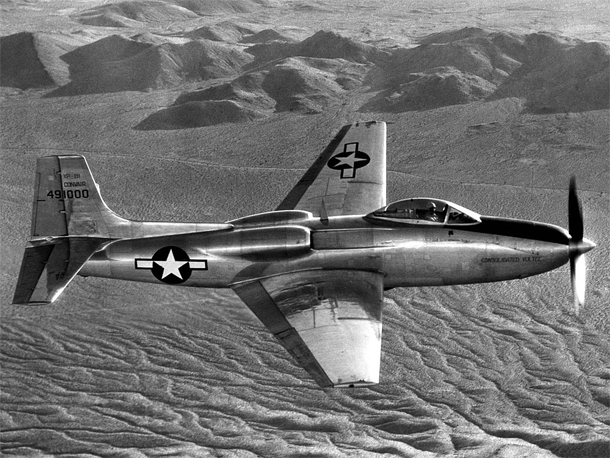
Sixty-nine years ago this month, the Consolidated Vultee XP-81 made its flight test debut at Muroc Army Air Field, California with Vultee test pilot Frank Davis in the cockpit. The XP-81 was a prototype long range escort fighter powered by a combination of single turbojet and single turboprop engines.
The XP-81 was designed to serve as an escort fighter for long range bomber aircraft. Its mission was to defend bomber formations from attack by enemy fighters. To fly and fight, an escort fighter had to match the range and endurance capabilities of the much larger bombers it was assigned to protect.
The military wanted an escort fighter with an operating range of 1,250 miles and a maximum speed of 500 mph. Consolidated Vultee Aircraft (Convair) chose a bi-mode propulsion system to meet these requirements. The idea was to combine the excellent fuel economy of a turboprop with the high-speed capability of a turbojet. The turboprop was intended for cruise while use of the turbojet was reserved for takeoff and high speed flight.
The XP-51 was a big airplane by fighter standards. It measured almost 45 feet in length and had a wing span of 50.5 feet. Gross take-off and empty weights were 19,500 and 12,755 lbs, respectively. The type’s predicted range was estimated to be 2,500 miles at 275 mph and 25,000 feet. Service ceiling was rated at 35,500 feet.
Convair built a pair of XP-81 aircraft. Ship No. 1 (S/N 44-91000) and Ship No. 2 (S/N 44-91001) were completed in 1945 and sent to Muroc Army Air Field for flight testing. Ship No. 1 made the type’s first flight on Wednesday, 07 February 1945 with Vultee test pilot Frank Davis at the controls. With the exception of rather marginal directional stability, Davis found the handling characteristics to be quite good.
Testing of the XP-81 prototypes consisted of just 10 hours in the air. While the aircraft showed decent promise, the entire program was cancelled in May of 1947. With VE having occurred in May of 1945 and VJ in August of 1945, the need for a long range escort fighter simply went away.
Following program cancellation, the XP-81 aircraft served for a season as photo targets on the Bombing Range at Edwards Air Force Base. Eventually they were rescued from that inglorious state and sent to storage at the National Museum of the United States Air Force in Dayton, Ohio.
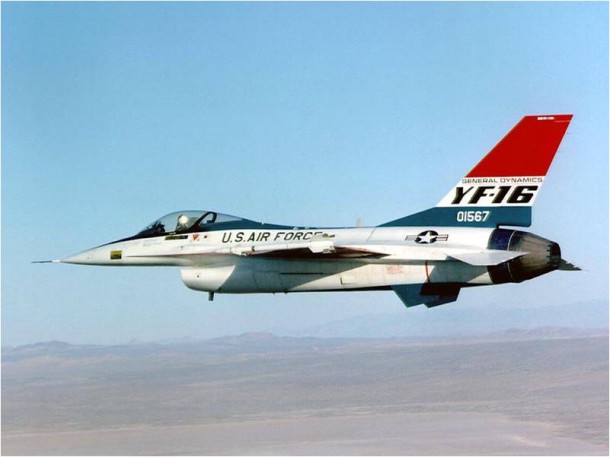
Forty years ago this week, the USAF/General Dynamics YF-16 Lightweight Fighter (LWF) took to the air on its official first flight with General Dynamics test pilot Phil Oestricher at the controls. The YF-16 would go on to win the Air Combat Fighter competition following a head-to-head fly-off against Northrop’s YF-17 Cobra.
The YF-16 was General Dynamics entry into the USAF Lightweight Fighter Program of the 1970’s. Its basic design was based on USAF Colonel John Boyd’s Energy Maneuverability (EM) Theory which posited that an aircraft with superior energy capability would defeat an aircraft of lesser energy capability in air combat. To achieve such, EM Theory dictated a small, lightweight aircraft having a high thrust-to-weight ratio, which permitted maneuvering at minimum energy loss. The YF-16 was an embodiment of this requirement.
The official first flight of the YF-16 (S/N 72-1567) took place on Saturday, 02 February 1974 at Edwards Air Force Base, California. General Dynamics test pilot Phil Oestricher (pronounced Ol-Striker) did the piloting honors. The nimble aircraft performed very well and was a delight to fly. Oestricher landed uneventfully following a brief test hop that saw the YF-16 reach 400 mph and 30,000 feet.
Interestingly, the real first flight of the YF-16 inadvertently occurred on Sunday, 20 January 1974 during what was supposed to be a high-speed taxi test. As the aircraft accelerated rapidly down the runway, Oestricher raised the nose slightly and applied aileron control to check lateral response. To the pilot’s surprise, the aircraft entered a roll oscillation with amplitudes so high that the left wing and right stabilator alternately struck the surface of the runway.
As Oestricher desperately fought to maintain control of his wild steed, the situation became increasingly dire as the YF-16 began to veer to the left. Realizing that going into the weeds at high speed was a prescription for disaster, the test pilot quickly elected to jam the throttle forward and attempt to get the YF-16 into the air. The outcome of this decision was not immediately obvious as Oestricher continued to struggle for control while waiting for his airspeed to increase to the point that there was lift sufficient for flight.
When the YF-16 finally became airborne, it departed the runway on a heading roughly 45 degrees to the left of the centerline. Oestricher somehow maintained control of the aircraft during the rugged lift-off and early climbout phases of flight. The pilot then successfully executed a go-around, entry into final approach, and landing back on the departure runway. A tough way to earn a day’s pay by any standard!
History records that the YF-16 went on to win the Air Combat Fighter (ACF) competition with Northrop’s YF-17 Cobra. The production aircraft became known as the F-16 Fighting Falcon, of which more than 4,500 aircraft, in numerous variants, were built between 1976 and 2010. The now-famous aircraft has clearly fulfilled the measure of its creation as evidenced by its presence in the military inventory of more than 25 countries worldwide. Significantly, America’s Ambassadors in Blue, The United States Air Force Thunderbirds, have flown the F-16 in air demonstrations since 1983.
While its initial foray into the air did not necessarily lend confidence that such would be the case, the YF-16 did survive its flight test career. Aviation aficionados may view the actual aircraft at the Virginia Air and Space Center located in Hampton, Virginia.
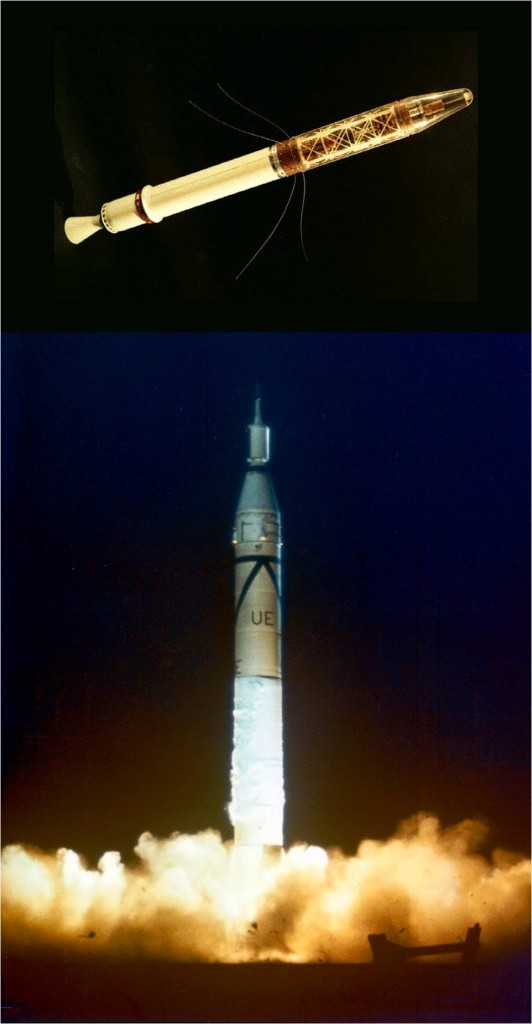
Fifty-six years ago this week, the United States successfully orbited the country’s first satellite. Known as Explorer I, the artificial moon went on to discover the system of radiation belts that surrounds the space environment of the Earth.
The Explorer I satellite was designed and fabricated by the Jet Propulsion Laboratory (JPL) under the direction of Dr. William J. Pickering. The satellite’s instrumentation unit measured 37.25 inches in length, 6.5 inches in diameter, and had a mass of only 18.3 lbs. With its burned-out fourth stage solid rocket motor attached, the total on-orbit mass of the pencil-like satellite was 30.8 lbs.
Explorer I was launched aboard a Jupiter-C (aka Juno I) launch vehicle from LC-26 at Cape Canaveral, Florida on Friday, 31 January 1958. Lift-off at occurred at 22:48 EST (0348 UTC). With all four stages performing as planned, Explorer I was inserted into a highly elliptical orbit having an apogee of 1,385 nm and a perigee of 196 nm.
Arguably the most historic achievement of the Explorer I mission was the discovery of a system of charged particles or plasma within the magnetosphere of the Earth. These belts extend from an altitude of roughly 540 to 32,400 nm above mean sea level. Most of the plasma that forms these belts originates from the solar wind and cosmic rays. The radiation levels within the Van Allen Radiation Belts (named in honor of the University of Iowa’s Dr. James A. Van Allen) are such that spacecraft electronics and astronaut crews must be shielded from the adverse effects thereof.
Explorer I operational life was limited by on-board battery life and lasted a mere 111 days. However, it soldiered-on in orbit until reentering the Earth’s atmosphere over the Pacific Ocean on Tuesday, 31 March 1970. During the 147 months it spent in space, Explorer I orbited the Earth more than 58,000 times. Data obtained and transmitted by the satellite contributed markedly to mankind’s understanding of the Earth’s space environment.
Perhaps the greatest legacy of Explorer I was that it was the first satellite orbited by the United States. Unknown to most today, this accomplishment was absolutely vital to America’s security, and indeed that of the free world, at the time. The Soviet Union had been first in space with the orbiting of the much larger Sputnik I and II satellites in late 1957. However, Explorer I showed that America also had the capability to orbit a satellite. History records that this capability would quickly grow and ultimately lead to the country’s preeminence in space.
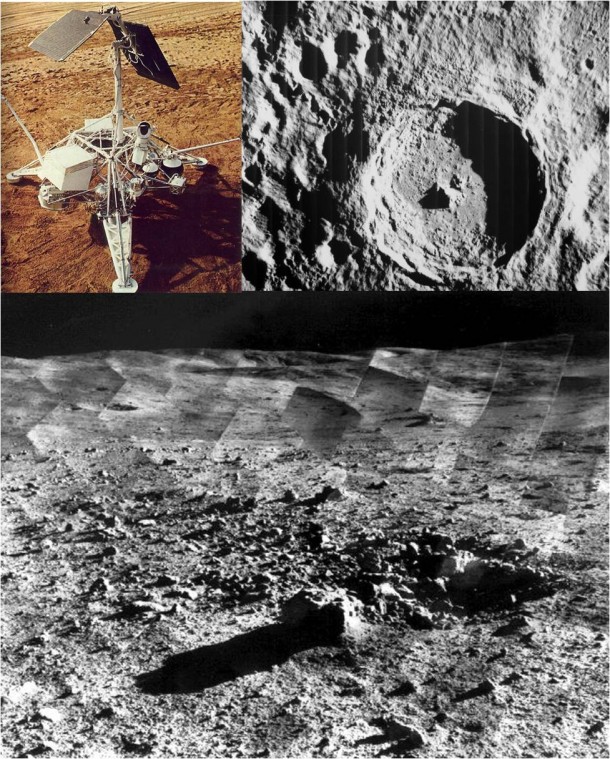
Forty-six years ago this month, the Surveyor 7 spacecraft soft-landed in the lunar highlands near the Crater Tycho. It was the fifth and final Surveyor vehicle to successfully perform an autonomous landing on the surface of the Moon.
In preparation for the first manned lunar landing, the United States conducted an extensive investigation of the Moon using Ranger, Lunar Orbiter and Surveyor robotic spacecraft.
Ranger provided close-up photographs of the Moon starting at a distance of roughly 1,100 nautical miles above the lunar surface all the way to impact. Nine (9) Ranger missions were flown between 1961 and 1965. Only the last three (3) missions were successful.
Lunar Orbiter spacecraft mapped 99% of the lunar surface with a resolution of 200 feet or better. Five (5) Lunar Orbiter missions were flown between 1967 and 1968. All were successful.
Surveyor spacecraft were tasked with landing on the Moon and providing detailed photographic, geologic and environmental information about the lunar surface. Seven (7) Surveyor missions were flown between 1966 and 1968. Five (5) spacecraft successfully landed.
The Surveyor spacecraft weighed 2,300 lbs at lift-off and 674 lbs at landing. The 3-legged vehicle stood within a diameter of 15 feet and measured almost 11 feet in height. Surveyor was configured with a television camera, a surface sampler and an alpha-scattering instrument to determine the chemical composition of the lunar soil.
Surveyor 7 was launched from Kennedy Space Center’s Launch Complex 36A at 06:30:00.545 UTC on Sunday, 07 January 1968. The ride to the Moon was provided by a General Dynamics Atlas-Centaur launch vehicle. It took almost 68 hours to reach the Moon.
On Wednesday, 10 January 1968, Surveyor 7 successfully landed at 01:05:36 UTC on the lunar surface near the North Rim of Tycho Crater. A total of 20,993 photographs were taken during Surveyor 7′s first lunar day. By Friday, 26 January 1968, Surveyor 7 was powered-down for its first lunar night.
On Monday, 12 February 1968, Surveyor 7 was powered-up for its second lunar day of surface operations. The spacecraft took an additional 45 photographs and operated erratically for 9 earth-days. At 00:24 UTC on Wednesday, 21 February 1968, contact with Surveyor 7 was lost for the final time. By 06:48 UTC, the Surveyor 7 mission was officially terminated.
Although seldom remembered today, the Surveyor Program provided America with a wealth of lunar surface information critical to the Apollo Program. Surveyor’s success provided an added measure of confidence in the attainability of a manned lunar landing. Indeed, seventeen (17) months after Surveyor 7 fell silent, Astronauts Neil A. Armstrong and Edwin E. Aldrin, Jr. imprinted the lunar surface with their bootprints at Mare Tranquilitatis.