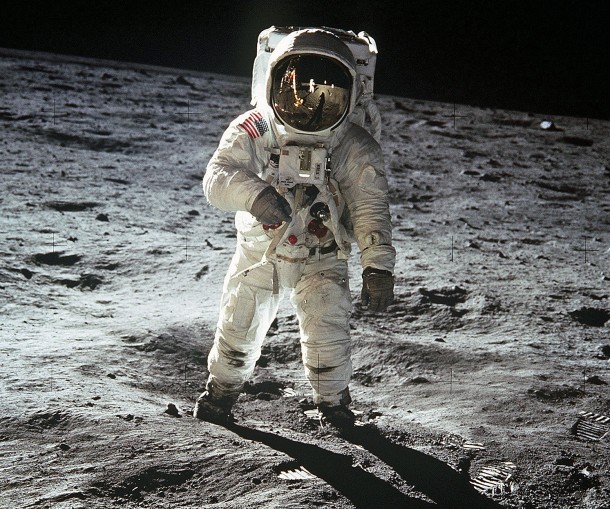
Forty-five years ago yesterday, the United States of America first landed men on the surface of the Moon.
The Apollo 11 Lunar Module Eagle landed in Sea of Tranquility region of the Moon on Sunday, 20 July 1969 at 20:17:40 UTC. Less than seven hours later, astronauts Neil A. Armstrong and Edwin E. Aldrin, Jr. became the first human beings to walk upon Earth’s closest neighbor. Fellow crew member Michael Collins orbited high overhead in the Command Module Columbia.
As Apollo 11 commander, Neil A. Armstrong was accorded the privilege of being the first man to step foot upon the Moon. As he did so, Armstrong spoke these words: “That’s one small step for Man; one giant leap for Mankind”. He had intended to say: “That’s one small step for ’a’ man; one giant leap for Mankind”.
Armstrong and Aldrin explored their Sea of Tranquility landing site for about two and a half hours. Total lunar surface stay time was 22 hours and 37 minutes. The Apollo 11 crew left a plaque affixed to one of the legs of the Lunar Module’s descent stage which read: “Here Men From the Planet Earth First Set Foot Upon the Moon; July 1969, A.D. We Came in Peace for All Mankind”.
Following a successful lunar lift-off, Armstrong and Aldrin rejoined Collins in lunar orbit. Approximately seven hours later, the Apollo 11 crew rocketed out of lunar orbit to begin the quarter million mile journey back to Earth. Columbia splashed-down in the Pacific Ocean at 16:50:35 UTC on Thursday, 24 July 1969. Total mission time was 195 hours, 18 minutes, and 35 seconds.
With completion of the flight of Apollo 11, the United States of America fulfilled President John F. Kennedy’s 25 May 1961 call to land a man on the Moon and return him (them) safely to the Earth before the decade of the 1960′s was out. It had taken 2,982 demanding days and much national treasure to do so.
Mission Accomplished, Mr. President.
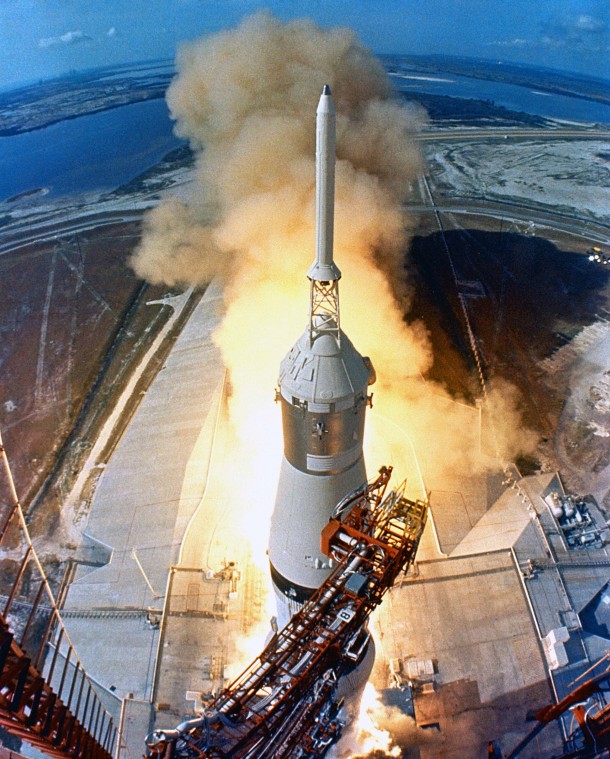
Forty-five years ago today, the epic flight of Apollo 11, the first mission to land men on the Moon, began with launch from the Kennedy Space Center (KSC) at Merritt Island, Florida. Nearly 1-million people gathered around America’s famous space complex to witness the historic event. An estimated 1-billion viewers worldwide watched the proceedings on television.
The names of the Apollo 11 crew are now legend: Mission Commander Neil A. Armstrong, Lunar Module Pilot Edwin E. Aldrin, Jr., and Command Module Pilot Michael Collins. Each astronaut was making his second spaceflight.
The overall Apollo 11 spacecraft weighed roughly 100,000 pounds and consisted of 3 major components: Command Module, Service Module, and Lunar Excursion Module (LEM). Out of American history came the names used to distinguish two of these components from one another. The Command Module was named Columbia, the feminine personification of America, while the Lunar Excursion Module received the appellation Eagle in honor of America’s national bird.
The Apollo-Saturn V launch stack measured 363-feet in length, had a maximum diameter of 33-feet, and weighed 6.7-milllion pounds at ignition of its five F-1 engines. The vehicle rose from the Earth on 7.7-million pounds of lift-off thrust.
The acoustic energy produced by the Saturn’s first stage propulsion system was unlike anything in common experience. The sound produced was like intense, continuous thunder even miles away from the launch point. Ground and structure shook disturbingly and a person’s lungs vibrated within their chest cavity.
Lift-off of Apollo 11 (AS-506) from KSC’s LC-39A occurred at 13:32 UTC on Wednesday, 16 July 1969. The target for the day’s launch, the Moon, was 218,096 miles distant from Earth. It took 12 seconds just for the massive Apollo 11 launch vehicle to clear the launch tower. However, a scant 12 minutes later, the Apollo 11 spacecraft was safely in low earth orbit (LEO) traveling at 17,500 miles per hour.
Following checkout in earth orbit, trans-lunar injection, and earth-to-moon coast, Apollo 11 entered lunar orbit nearly 76 hours after lift-off. Now, the big question: Would they make it? Even Apollo 11′s Command Module Pilot, Michael Collins, estimated that the chance of a successful lunar landing on the first attempt was only 50/50. The answer would soon come. History’s first lunar landing attempt was now only 24 hours away.
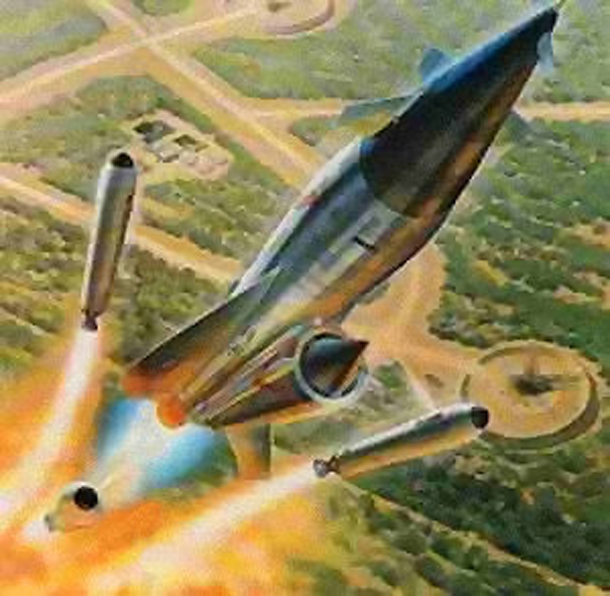
Fifty years ago this month, the United States abandoned a 7-year effort to develop a nuclear-armed, supersonic cruise missile. The joint USAF-AEC program was known as Project Pluto. The centerpiece of this program was the nuclear-fueled, ramjet-powered Supersonic Low-Altitude Missile (SLAM).
The 1950′s saw the development of myriad aircraft, missile and submarine concepts designed for delivery of nuclear weaponry over strategic distances. This developmental activity was driven by the escalating Cold War between the United States and the Soviet Union. In addition to weapons, the power of the atom was also considered for propulsion applications during this era.
SLAM was perhaps the most fearsome weapon ever conceived. The missile was designed to deliver as many as 26 nuclear bombs over the Soviet Union in a single mission. It would do this while flying at Mach 3 and less than 1,000 feet above ground level. SLAM’s shock wave overpressure alone (162 dB) would devastate structures and people along its flight path. And, as if that were not enough, the type’s nuclear-fueled ramjet would continuously spew radiation-contaminated exhaust all over the countryside.
The SLAM airframe was huge. It measured 88 feet in length, nearly 6 feet in diameter and weighed 61,000 pounds at launch. The vehicle would be fired from a ground-based launch site and accelerated to ramjet takeover speed by a trio of jettisionable rocket boosters. The nuclear-fueled ramjet was rated at 35,000 pounds of thrust.
To find its way to the target area(s), the Ling-Temco-Vought (LTV) SLAM would use a guidance system known today as TERCOM – Terrain Contour Matching. At a target, SLAM would eject an atomic warhead upwards from its payload bay. The resulting lofted trajectory gave SLAM time to depart the hot target area prior to weapon detonation. Following completion of its mission, the missile would then ditch itself by diving into a deep ocean graveyard.
The heart of the Project Pluto missile was the nuclear-fueled ramjet. An unshielded nuclear reactor, code named TORY, was devised, built and successfully tested. Testing was conducted at a special-purpose test site in Nevada. In its Tory II-C configuration, the SLAM ramjet produced over 500 megawatts of power in 5 minutes of continuous operation during a test conducted in May of 1964.
SLAM’s nap-of-the-earth, supersonic flight profile would subject the airframe to terrific airloads, vibrations and temperatures. The Project Pluto team successfully devised structural and thermal material solutions to handle the daunting flight environment. In addition, nuclear-hardened electronics and flight controls were successfully developed.
From a technological standpoint, Project Pluto proved to be entirely viable. However, doubts about its implementation started to arise as flight testing of the nuclear-powered missile was seriously considered. Where do you flight-test a radiation-spewing missile? What happens if you can’t turn-off the reactor? What do you do if the guidance system fails? Where do you dispose of the missile after a flight test? These and other disturbing questions began to trouble program officials.
Coupled with the above practical concerns of SLAM flight testing were growing political and mission obsolesence issues. Pentagon officials ultimately deemed Project Pluto as being highly provocative to the Soviet Union in the sense that the communist super power might feel compelled to develop their own SLAM. Further, American missilery was quickly developing to the point where ICBM-delivered warheads would do the job and at a lower per-unit cost.
So it was that on Wedneday, 01 July 1964, Project Pluto was canceled after 7 years of fruitful development. While no airframe was ever built and tested, SLAM technology was applied to a host of subsequent aerospace vehicle developments.
SLAM would truly have been “The Missile From Hades” had it matured to the point of flight. Indeed, the ethical issues concerning the missile’s use were quite sobering. And, owing to Murphy’s Law and its many corollaries, the chances for unintended catastrophe were high as well. Despite the allure of this ”technically sweet” solution to a national defense problem, the decision to cancel Project Pluto was ultimately the only correct course to follow.
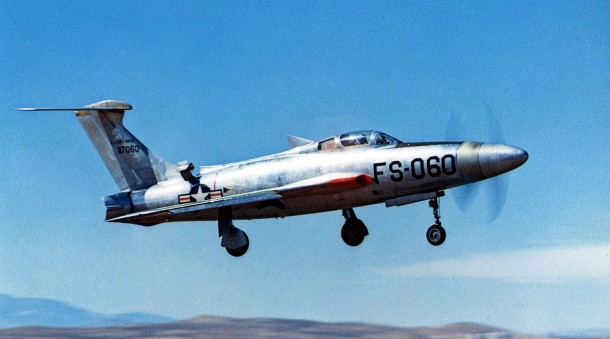
Fifty-nine years ago this month, the USAF/Republic XF-84H experimental turboprop fighter took to the air for the first time. The test hop originated from and recovered at Edwards Air Force Base, California.
The turbojet-powered XF-84H was a variant of Republic Aviation’s F-84 Thunderstreak. An Allison XT40-A-1 turboprop engine, rated at 5,850 hp, served as the power source for this novel aircraft. The XT40 drove a variable-pitch, 3-blade, 12-foot diameter propeller at 3,000 rpm. The propulsion system’s thrust level was changed by varying blade pitch.
Owing to its high rotational speed and large diameter, the outer 2 feet of the XF-84H propeller saw supersonic velocities. The shock waves that emanated from the prop produced a deafening wall of sound. The extreme sound level produced intense nausea and raging headaches in ground crewmen. As a result, the XF-84H was dubbed the Thunderscreech.
The prop wash from the aircraft’s powerful turboprop necessitated the use of a T-tail to keep the horizontal tail and elevator in clean air flow. The engine’s extreme torque was partially countered by incorporating differential deflection on the left and right wing flaps and by placement of the left wing root air intake a foot ahead of the right intake.
A pair of XF-84H prototype aircraft (S/N 51-17059 and S/N 51-17060) was built by Republic Aviation. The first flight of an XF-84H took place on Friday, 22 July 1955 at Edwards Air Force. The flight was made by Republic test pilot Henry G. “Hank” Beaird, Jr. in Ship No. 1 (S/N 51-17059). The flight was cut short by a forced landing.
A total of twelve (12) test flights were made in the two Thunderscreech prototypes; eleven (11) in Ship No. 1 and one (1) in Ship No. 2. Total flight time accumulated by these experimental airframes was 6 hours and 40 minutes. The majority of flights experienced forced landings for one reason or another.
The XF-84H suffered from reduced longitudinal stability and poor handling qualities. The aircraft was also plagued by frequent engine, hydraulic system, nose gear and vibration problems. Faced with the type’s obvious non-viability, USAF opted to cancel the XF-84H Program in September of 1956.
Historical records indicate that the XF-84H reached a top speed of 520 mph during its brief flight test life. This mark was a full 120 mph short of the aircraft’s design speed. Nonetheless, the XF-84H held the speed record for single-engine prop-driven aircraft until Monday, 21 August 1989. On that date, a specially modified Grumman F8F Bearcat established the existing record of 528.33 mph.
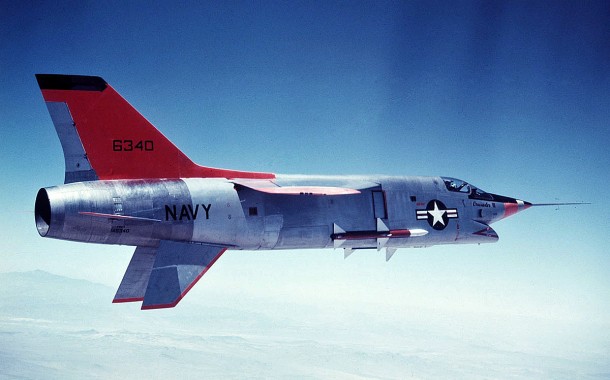
Fifty-eight years ago this month, the USN/Vought XF8U-3 Crusader III interceptor prototype took off on its maiden test flight at Edwards Air Force Base, California. Vought chief test pilot John W. Konrad was at the controls of the advanced high performance aircraft.
The Vought XF8U-3 was designed to intercept and defeat adversary aircraft. Although it bore a close external resemblance to its F8U-1 and F8U-2 forbears, the XF8U-3 was much more than just a block improvement in the Crusader line. It was considerably bigger, faster, and more capable than previous Crusaders and was in reality a new airplane.
The XF8U-3 measured 58.67 feet in length and had a wing span of an inch less than 40 feet. Gross Take-Off and empty weights tipped the scales at 38,770 lbs and 21,860 lbs, respectively. Power was provided by a single Pratt and Whitney J75-P-5A generating 29,500 lbs of sea level thrust in afterburner.
A distinctive feature of the XF8U-3 was a pair of ventrally-mounted vertical tails. These surfaces were installed to improve aircraft directional stability at high Mach number. Retracted for take-off and landing, the surfaces were deployed once the aircraft was in flight.
The No. 1 XF8U-3 (S/N 146340) first flew on Monday, 02 June 1958 at Edwards Air Force, California. Vought chief test pilot John W. Konrad did the first flight piloting honors. The aircraft flew well with no major discrepancies reported. Approach and landing back at Edwards were uneventful.
Subsequent flight testing verified that the XF8U-3 was indeed a hot airplane. The type reached a top speed of Mach 2.39 and could have flown faster had its canopy had been designed for higher temperatures. The flight test-determined absolute altitude of 65 KFT was exceeded by 25 KFT in a zoom climb.
Those who flew the XF8U-3 said that the aircraft was a real thrill to fly. The Crusader III displayed outstanding acceleration, maneuverability and high-speed flight stability. Control harmony in pitch, yaw, and roll was extremely good as well.
Despite its great promise, the XF8U-3 never proceeded to production. This was primarily the result of coming up short in a head-to-head competition with the McDonnell F4H-1 Phantom II during the second half of 1958. While the Crusader was faster and more maneuverable than the Phantom, the latter’s mission capability and payload capacity were better.
Most historical records indicate that a total of five (5) Crusader III airframes were built. The serial numbers assigned by the Navy were 146340, 146341, 147085, 147086, and 147087. None of these aircraft exist today.
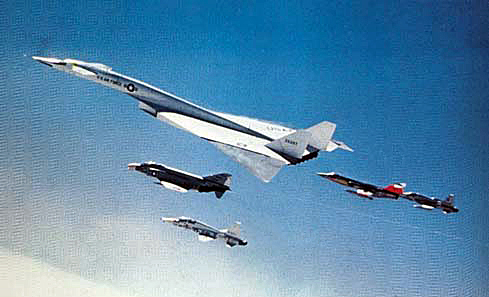
Forty-eight years ago this month, XB-70A Valkyrie Air Vehicle No. 2 (62-0207) took-off from Edwards Air Force Base, California for the final time.
The crew for this flight included aircraft commander and North American test pilot Alvin S. White and right-seater USAF Major Carl S. Cross. White would be making flight No. 67 in the XB-70A while Cross was making his first. For both men, this would be their final XB-70A flight.
In the past several months, Air Vehicle No. 2 had set speed (Mach 3.08) and altitude (74,000 feet) records for the type. But on this fateful Wednesday, 08 June 1966, the mission was a simple one; some run-of-the-mill flight research test points and a multi-aircraft formation photo shoot.
The General Electric Company, manufacturer of the massive XB-70A’s YJ93-GE-3 turbojets, had received permission from Edwards USAF officials to photograph the XB-70A in close formation with a quartet of other aircraft powered by GE engines. The resulting photos were intended to be used for publicity.
The formation, consisting of the XB-70A, a T-38A (59-1601), an F-4B (BuNo 150993), an F-104N (N813NA), and an F-5A (59-4898), was in position at 25,000 feet by 0845. The photographers for this event, flying in a GE-powered Gates Learjet (N175FS) stationed about 600 feet to the left and slightly aft of the multi-ship formation, began taking photos.
The photo session was planned to last 30 minutes, but went 10 minutes longer to 0925. Then at 0926, just as the formation aircraft were starting to leave the scene, the frantic cry of Midair! Midair Midair! came over the communications network.
Somehow, the NASA F-104N, piloted by NASA Chief Test Pilot Joe Walker, had collided with the right wing-tip of the XB-70A. Walker’s out-of-control F-104 then rolled inverted to the left and sheared-off the XB-70A’s twin vertical tails. The F-104N fuselage was severed just behind the cockpit and Walker was killed instantly in the process.
Curiously, the XB-70A continued on in steady, level flight for about 16 seconds despite the loss of its primary directional stability lifting surfaces. Then, as White attempted to control a roll transient, the XB-70A rapidly departed controlled flight.
As the doomed aircraft torturously pitched, yawed and rolled, its left wing structurally failed and fuel spewed furiously from its fuel tanks. White was somehow able to eject and survive. Cross never left the aircraft and rode it down to impact just north of Barstow, California.
A mishap investigation followed and (as always) blame was assigned. However, none of that changed the facts that on this, the Blackest Day at Edwards, American aviation lost two of its best men and aircraft in a flight mishap that never should have happened.
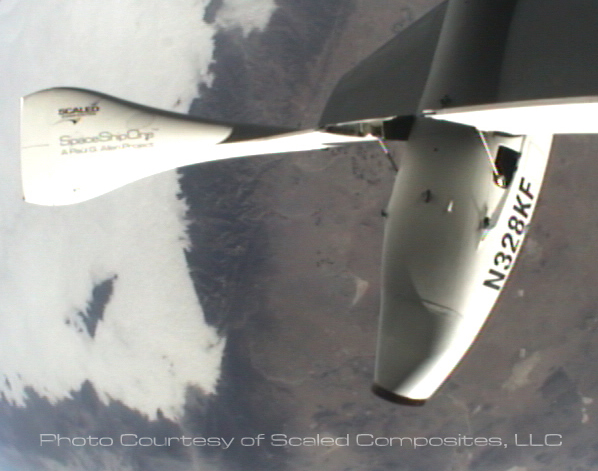
Ten years ago this month, Scaled Composite’s SpaceShipOne flew to an altitude of 62.214 statute miles. The flight marked the first time that a privately-developed flight vehicle had flown above the 62-statute mile boundary that entitles the flight crew to FAI-certified astronaut wings. As a result, SpaceShipOne pilot Mike Melvill became history’s first private citizen astronaut.
SpaceShipOne Mission 15P began with departure from California’s Mojave Spaceport at 0647 PDT. Carrying SpaceShipOne at the centerline station, Scaled’s White Knight aircraft climbed to the drop altitude of 47,000 feet.
At 0750 PDT on Monday, 21 June 2004, the 7,900-pound SpaceShipOne fell away from the White Knight and Melvill immediately ignited the 16,650-pound thrust hybrid rocket motor. Melvill quickly then pulled SpaceShipOne into a vertical climb.
Passing through 60,000 feet, SpaceShipOne experienced a series of uncommanded rolls as it encountered a wind shear. Melvill struggled with the controls in an attempt to arrest the roll transient. Then, late in the boost, the vehicle lost primary pitch trim control. In response, Melvill switched to the back-up system as he continued the ascent.
Rocket motor burnout occurred at 180,000 feet with SpaceShipOne traveling at 2,150 mph. It now only weighed 2,600 pounds. The vehicle then coasted to an apogee of 62.214 statute miles (328,490 feet). The target maximum altitude was 68.182 statute miles (360,000 feet). However, the control problems encountered going upstairs caused the trajectory to veer somewhat from the vertical.
Melvill experienced approximately 3.5 minutes of zero-g flight going over the top. He had some fun during this period as he released a bunch of M&M’s and watched the chocolate candy pieces float in the SpaceShipOne cabin.
Back to business now, Melvill transitioned SpaceShipOne to the high-drag feathered configuration in preparation for the critical entry phase of the mission. The vehicle initially accelerated to over 2,100 mph in the airless void before encountering the sensible atmosphere. At one point during atmospheric entry, Melvill experienced in excess of 5 g’s deceleration.
At 57,000 feet, Melvill reconfigured SpaceShipOne back to the standard aircraft configuration for powerless flight back to the Mojave Spaceport. Fortunately, the aircraft was a very good glider. The control problems encountered during the ascent resulted in atmospheric entry taking place 22 statute miles south of the targeted reentry point.
SpaceShipOne touched-down on Mojave Runway 12/30 at 0814 PDT; thus ending an historic, if not harrowing mission.
After the flight, Mike Melvill had much to say. But perhaps the following quote says it best for the rest of us who can only imagine what it was like: “And it was really an awesome sight, I mean it was like nothing I’ve ever seen before. And it blew me away, it really did. … You really do feel like you can reach out and touch the face of God, believe me.”
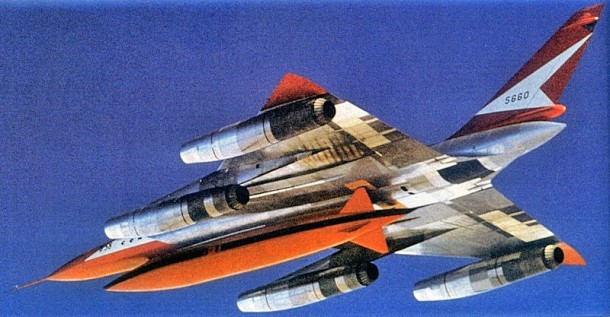
Fifty-seven years ago this month, the USAF/Convair XB-58A supersonic bomber exceeded twice the speed of sound for the first time. Convair test pilot Beryl A. Erickson was at the controls of the famed delta-winged beauty.
The B-58A Hustler was the United States first supersonic-capable bomber and was originally designed for the strategic mission. The aircraft was powered by four (4) General Electric J79-GE-5A turbojets generating 62,400 lbs of sea level thrust in afterburner. Maximum take-off weight was nearly 177,000 lbs.
Convair’s stunning delta-winged bomber was 97 feet in length with a wing span of 57 feet. Wing area was roughly 1,550 square feet. Aircraft maximum height was 30 feet as measured from the ground to the top of the vertical tail.
Flight crew for the B-58A consisted of the pilot, bombadier/navigator, and defensive systems operator. The crew was arranged in tandem with each crew member seated in a separate cockpit. The type carried thermonuclear ordnance. A total of 116 B-58A aircraft were manufactured.
The B-58A performance was impressive then and now. It had a maximum speed of 1,400 mph and a service ceiling of 63,400 feet. The aircraft could climb in excess of 17,000 feet per minute at gross take-off weight and up to 46,000 feet per minute near minimum weight.
On Saturday, 29 June 1957, USAF/Convair XB-58A (S/N 55-660) first attained its double-sonic design airspeed when it flew to Mach 2.03 at an altitude of 43,250 feet. This historic achievement took place on the type’s 24th flight. Mission total elapsed time was 1 hour and 55 minutes.
The Hustler had a difficult gestation due to its advanced design and demanding performance requirements. A number of aircraft and flight crews were lost due to a variety of baffling flight control and structural problems. First flight took place on 11 November 1956 with the type finally entering service on 15 March 1960.
The USAF/Convair B-58A Hustler was operational for just 10 years and was retired from the USAF inventory on 31 January 1970. The aircraft was never used in anger.
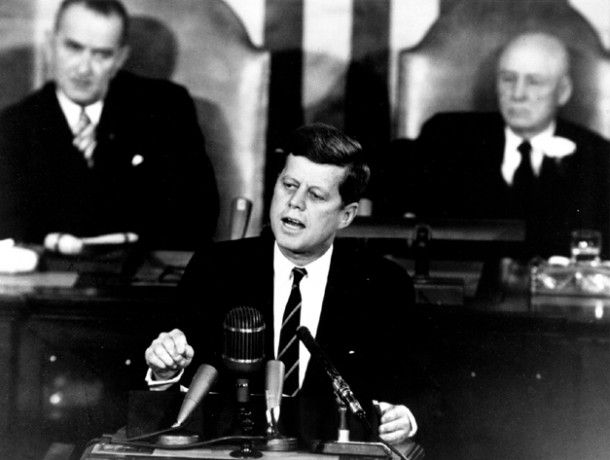
Fifty-three years ago this week, President John F. Kennedy boldly proposed that the United States conduct a manned lunar landing before the end of the 1960’s. The President’s clarion call to glory was delivered during a special session of the United States Congress which focused on “urgent national needs”.
The transcript of that historic speech given on Friday, 25 May 1962 indicates that the ninth and last issue addressed by President Kennedy was simply entitled SPACE. The most stirring words of that portion of his speech may well be these:
“I believe that this nation should commit itself to achieving the goal, before this decade is out, of landing a man on the moon and returning him safely to the earth. No single space project in this period will be more impressive to mankind, or more important for the long-range exploration of space; and none will be so difficult or expensive to accomplish.”
Although he did not live to see the fulfillment of that goal, history shows that 8 years, 1 month, and 26 days later, the United States of America did indeed land a man (men) on the moon and returned him (them) safely to earth before the decade was out.
Thus, as a country, we can say now, even as we said then to our departed leader: Mission Accomplished, Mr. President.
Forty-one years ago this month, astronauts Pete Conrad, Joe Kerwin and Paul Weitz became the first NASA crew to fly aboard the recently-orbited Skylab space station. Not only would the crew establish a new record for duration in earth orbit, they would effect critical repairs to the space station which had been seriously damaged during launch.
Skylab was America’s first space station. The program followed closely on the heels of the historic Apollo lunar landing effort. Skylab provided the United States with a unique space platform for obtaining vast quantities of scientific data about the Earth and the Sun. It also served as a means for ascertaining the effects of long-duration spaceflight on human beings.
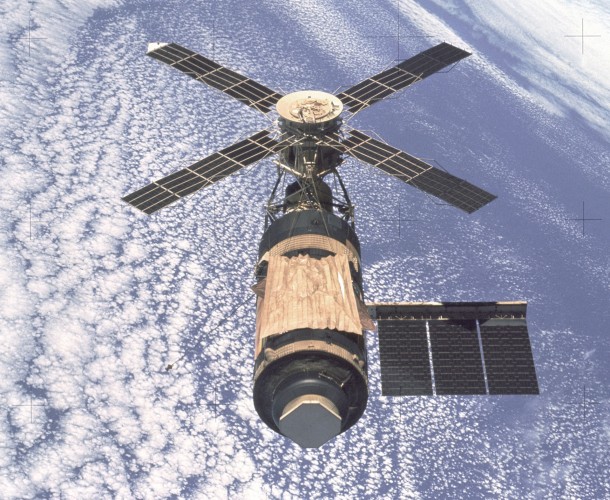
A Saturn IVB third stage served as Skylab’s core. This huge cylinder, which measured 48-feet in length and 22-feet diameter, was modified for human occupancy and was known as the Orbital Workshop (OWS). With the addition of a Multiple Docking Adapter (MDA) and Airlock Module (AM), Skylab had a total length of 83-feet.
Skylab was also outfitted with a powerful space observatory known as the Apollo Telescope Mount (ATM). This unit sat astride the MDA and was configured with a quartet of electricity-producing solar panels. The OWS had a pair of solar panels as well. The entire Skylab stack weighed 85 tons.
The Skylab space station (Skylab 1) was placed into a 270-mile orbit using a Saturn V launch vehicle on Monday, 14 May 1973. Upon reaching orbit, it quickly became apparent that all was far from well aboard the space station. The micro-meteoroid shield and solar panel on one side of the OWS had been lost during ascent. The other OWS solar panel was stuck and did not deploy as planned.
With the loss of an OWS solar panel, Skylab would not have enough electrical energy to conduct its mission. The station was also heating up rapidly (temperatures approached 190 F at one point). The lost micro-meteoroid shield also provided protection from solar heating. Sans this protection, internal temperatures could rise high enough to destroy food, medical supplies, film and other perishables and render the OWS uninhabitable.
NASA engineers quickly went to work developing fixes for Skylab’s problems. A mechanism was invented to free the stuck solar panel. A parasol of gold-plated flexible material, deployed from an OWS scientific airlock, was then fashioned and tested on the ground. This material would cover the exposed portion of the OWS and provide the needed thermal shielding.
The onus was now on the Skylab 2 crew of Conrad, Kerwin and Weitz to implement the requisite fixes in orbit. On Friday, 25 May 1973, the Skylab 2 crew and their Apollo Command and Service Module (CSM) were rocketed into orbit by a Saturn IB launch vehicle. They quickly rendezvoused with Skylab and verified its sad condition. It was time to get to work.
The first order of business was to try to free the stuck solar panel. As Conrad flew the CSM in close proximity to Skylab, Kerwin held Weitz by the feet as the latter leaned out of the open CSM hatch and attempted to release the stuck solar panel with a pair of special cutters. No joy in spaceville. The solar panel refused to deploy.
The Skylab 2 crew next attempted to dock with Skylab. They tried six times and failed. The CSM drogue and probe was not functioning properly. The crew had to fix it or go home. With great difficulty, they did so and were finally able to dock with Skylab. The objective now was to enter Skylab and deploy the parasol thermal shield.
With Conrad remaining in the CSM, Kerwin and Weitz sported gas masks and cautiously entered Skylab. The temperature inside of the OWS was 130 F. Fortunately, the air was found to be of good quality and the pair went to work deploying the thermal shield through a scientific airlock. The deployment was successful and the temperature started to slowly fall.
It would not be until Thursday, 07 June 1973 that the stuck solar panel finally would be freed. On that occasion, Conrad and Kerwin donned EVA suits and spent 8 hours working outside of Skylab. Their initial efforts with the cutters were unsuccesful.
Undeterred, Conrad and Kerwin improvised and were able to cut the strap that restrained the solar panel. Then, heaving with all their might, the pair finally freed the solar panel. In obedience to Newton’s 3rd Law, as the solar panel deployed in one direction, the astronauts went flying in the other. Happily, they were able to collect themselves and safely reenter the now adequately-powered Skylab.
Skylab 2 went on to spend 28 days in orbits; a record for the time. This record was quickly eclipsed by the Skylab 3 and Skylab 4 crews which spent 59 and 84 days in space, respectively. Skylab was an unqualified success and provided a plethora of terrestrial, solar and human factors data of immense importance to space science. These data played a vital role in the design and development of the ISS.
Skylab was abandoned following the Skylab 4 mission in February of 1974. The plan was to reactivate it and raise its orbit using the Space Shuttle when the latter became operational. Unfortunately, a combination of a rapidly deteriorating orbit and delays in flying the Shuttle conspired against bringing this plan to fruition. Skylab reentered the Earth’s atmosphere and broke-up near Australia in July of 1979.