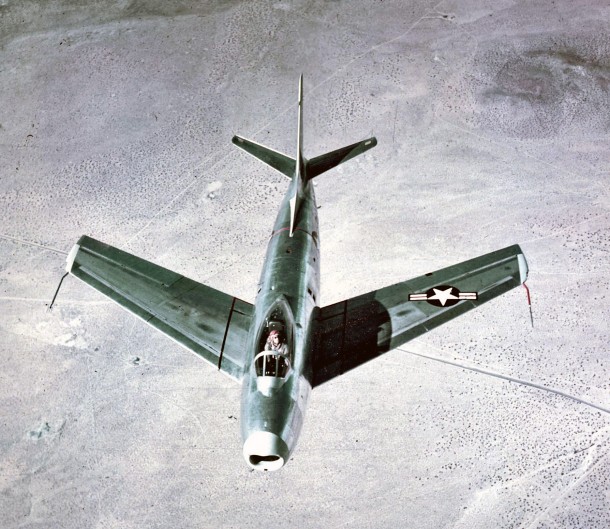
Sixty-seven years ago today, the swept-wing XP-86, the initial version of the famed USAF/North America F-86 Sabre, began flight testing at what is now Edwards Air Force Base. The iconic Mig Alley legend would be produced in numerous variants and ultimately rack-up a total production run of nearly 10,000 aircraft worldwide.
In the waning days of World War II, the United States Army Air Force (USAAF) issued the requirements for a new high-speed, jet-powered fighter/interceptor aircraft. North American Aviation (NAA) captured the USAAF’s attention with a prototype swept-wing aircraft known as the XP-86. The ”X” designation was shorthand for Experimental while the “P” stood for Pursuit.
The XP-86 (later designated as the XF-86 where “F” stood for Fighter) was the first United States fighter to incorporate wing sweep. The key benefit derived from sweeping the wings was to greatly reduce transonic wave drag. Based on aerodynamics data captured from the defeated Third Reich, NAA engineers designed the XF-86 with a wing sweep of 35 degrees.
A drawback to using wing sweep is that low-speed flight characteristics are adversely affected. The principal detrimental effect being a reduction in lift. However, NAA solved this problem by the incorporation of leading edge slats to enhance lift production at low speed.
The XF-86 measured roughly 37-feet both in length and wingspan. Empty weight was some 12,000 lbs. Power was provided by a Chevrolet J35-C-3 turbojet that generated a paltry 3,750 pounds of thrust. Later variants of the Sabre would be powered by jet engines generating nearly 10,000 pounds of thrust.
On Wednesday, 01 October 1947, XF-86 No. 1 (S/N 45-59597) took to the air for the first time from Muroc Army Air Field, California. USAAF Major and WW II 16-kill combat ace George S. “Wheaties” Welch was at the controls of the XF-86. While the evidence is largely anecdotal, it is entirely possible that Welch exceeded the speed of sound during a dive on that long-ago first flight test.
The case of George Welch is an intriguing sub-plot of the F-86 Sabre story. Welch was stationed at Pearl Harbor on 07 December 1941. He was one of the very few American pilots to get in the air and fight the attacking Japanese forces. Numerically overwhelmed, he nontheless splashed four (4) enemy aircraft and lived to fly and fight another day.
Welch served three (3) combat tours in WW II for a total of 348 combat missions. After leaving the service in 1944, he joined North American Aviation as a test pilot. Welch progressed quickly and became NAA’s Chief Test Pilot. This path ultimately led to Welch flight testing the XP-86 Sabre.
Although denied verification in official Air Force records, both oral history and compelling circumstantial evidence suggest that George Welch exceeded Mach 1 at least twice before the Bell XS-1 did so on Tuesday, 14 October 1947.
Incredibly, the first instance of Welch and the XF-86 exceeding Mach 1 was on the occasion of its first flight test! Welch dove the aircraft from 35,000 feet and reportedly generated a weak sonic boom.
The second instance of Mach 1 exceedance reportedly occurred on Tuesday, 14 October 1947. This time Welch dove the XF-86 from 37,000 feet and generated a stronger sonic boom. Apparently, this event took place just before the Bell XS-1, with USAAF Major Charles E. “Chuck” Yeager at the controls, achieved Mach 1.06 later that same morning.
Welch was never officially credited with being the first to achieve supesonic flight. A number of reasons account for this circumstance. First, his aircraft was not instrumented properly to verify flight performance at quasi-supersonic speeds. Additionally, Welch’s aircraft was not tracked by radar.
In addition to the technical reasons cited above, there was political intrigue surrounding Welch’s supersonic dive flights as well. NAA (and thus Welch) had been ordered not to exceed Mach 1 before the rocket-powered Bell XS-1 did so. Perhaps the only concession accorded Welch was that USAF later referred to Yeager’s historic superonic flight as the first time the sound barrier was broken in level flight.
While all of this is quite interesting, it must be stated that the above claims meet with vehement disagreement by those who hold that the historical record is unassailably true. However, while claiming absolute objectivity, the motivations of at least some of the critics appear to be political and self-serving. Suffice it to say that adherents in both camp remain adamant that theirs is the correct case!
George Welch went on to a distinguished, but all too brief flight test career. On Monday, 25 May 1953, he became the first man to exceed Mach 1 in level flight in a jet-powered production aircraft. That aircraft was the North American F-100 Super Sabre. Welch perished on Tuesday, 12 October 1954 when his YF-100A went out of control and distintegrated during a 7-g pull-up at Mach 1.55.
For its part, the F-86 Sabre ultimately served long and well in the air forces of the United States and a host of other western-friendly nations. Perhaps its greatest claim to fame accrues from the type’s remarkable aerial combat perfromance in the Korean War. Indeed, despite being numerically bested by Soviet-built MIG-15 aircraft, the official record shows that USAF pilots made 792 kills flying the Sabre. Compared with 76 kills made by the opposition, the Sabre registered a phenomenal 10:1 kill ratio.
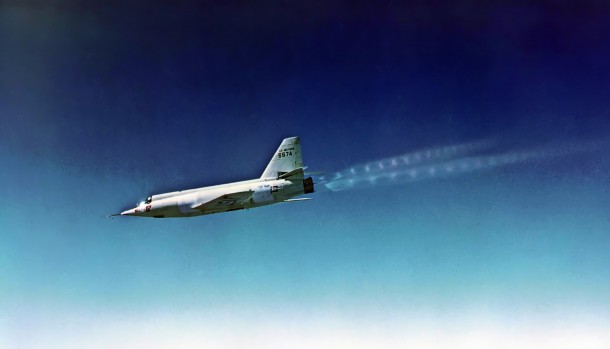
Fifty-eight years ago this week, the Bell X-2 rocket-powered research aircraft reached a record speed of 2,094 mph with USAF Captain Milburn G. “Mel” Apt at the controls. The new speed mark corresponded to a Mach number of 3.2 at an altitude of 65,000 feet.
Mel Apt’s historic achievement came about because of the Air Force’s desire to have the X-2 reach Mach 3 before turning it over to the National Advisory Committee For Aeronautics (NACA) for further flight research testing. Just 20 days prior to Apt’s flight in the X-2, USAF Captain Iven C. Kincheloe, Jr. had flown the aircraft to a record altitude of 126,200 feet.
On Thursday, 27 September 1956, Apt and the last X-2 aircraft (S/N 46-674) dropped away from the USAF B-50 motherhip at 30,000 feet and 225 mph. Despite the fact that Apt had never flown an X-aircraft, he executed the flight profile exactly as briefed. In addition, the X-2′s twin-chamber XLR-25 rocket motor burned propellant 12.5 seconds longer than planned. Both of these factors contributed to the aircraft attaining a speed in excess of 2,000 mph.
Based on previous flight tests as well as flight simulator sessions, Apt knew that the X-2 had to slow to roughly Mach 2.4 before turning the aircraft back to Edwards. This was due to degraded directional stability, control reversal, and aerodynamic coupling issues that adversely affected the X-2 at higher Mach numbers.
However, Mel Apt was now faced with a difficult decision. If he waited for the X-2 to slow to Mach 2.4 before initiating a turn back to Edwards Air Force Base, he quite likely would not have enough energy and therefore range to reach Rogers Dry Lake. On the other hand, if he decided to initiate the turn back to Edwards at high Mach number, he risked having the X-2 depart controlled flight. Flying in a coffin corner of the X-2’s flight envelope, Apt opted for the latter.
As Apt increased the aircraft’s angle-of-attack, the X-2 departed controlled flight and subjected him to a brutal pounding. Aircraft lateral acceleration varied between +6 and -6 g’s. The battered pilot ultimately found himself in a subsonic, inverted spin at 40,000 feet. At this point, Apt effected pyrotechnic separation of the X-2′s forebody which contained the cockpit and a drogue parachute.
X-2 forebody separation was clean and the drogue parachute deployed properly. However, Apt still needed to bail out of the X-2′s forebody and deploy his personal parachute to complete the emergency egress process. But, it was not to be. Mel Apt ran out of time, altitude, and luck. He lost his life when the X-2 forebody that he was trying to escape from impacted the ground at several hundred miles an hour.
Mel Apt’s flight to Mach 3.2 established a record that stood until the X-15 exceeded it in August 1960. However, the price for doing so was very high. The USAF lost a brave test pilot and the lone remaining X-2 on that fateful day in September 1956. The mishap also ended the USAF X-2 Program. NACA never did conduct flight research with the X-2.
However, for a few terrifying moments, Mel Apt was the fastest man alive.
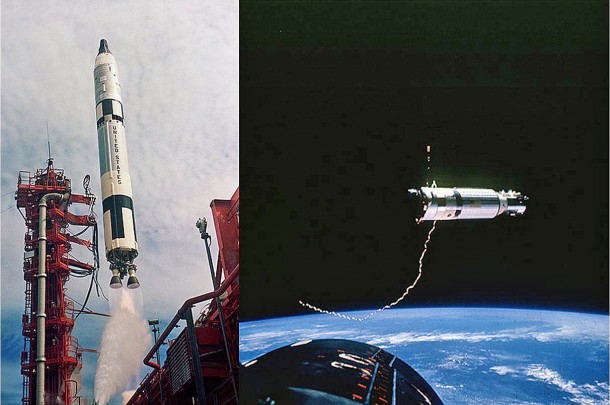
Forty-eight years ago today, Gemini 11 completed a spectacular 3-day mission that helped pave the way to the first manned lunar landing. The all-Navy crew included astronauts Charles P. Conrad, Jr. and Richard F. Gordon, Jr.
America’s manned space effort of the 1960′s and early 1970′s consisted of the Mercury, Gemini and Apollo Programs. Mercury put the first Americans into space and gave the country a basic manned spaceflight capability. Apollo put Americans on the Moon and returned them safely to the Earth. Gemini was the bridge. Without it, the United States could not have achieved the national goal of landing men on the Moon before the end of the 1960′s.
The Gemini Program consisted of ten (10) manned spaceflights that were flown between March of 1965 and December 1966. Gemini 11 was the penultimate mission. Its primary goals included performing a direct ascent rendezvous, increasing its orbital altitude by more than 500 NM, using tethered flight to produce artificial gravity, conducting several space walks and performing a computer-controlled precision landing.
Gemini 11 lifted-off from Cape Canaveral’s LC-19 at 14:42:26 UTC on Monday, 12 September 1966. The initial orbit was 151-NM (apogee) by 87-NM (perigee). Relying on radar and a primitive flight computer, it took Conrad and Gordon about 85 minutes to successfully perform history’s first direct ascent or first-orbit rendezvous. Their target was an Agena Target Vehicle (GATV-11) which had been launched 90 minutes prior to Gemini 11′s lift-off.
Approximately 24 hours into the Gemini 11 mission, Gordon initiated the first of two planned Extra Vehicular Activities (EVA’s). His first task was to connect a 100-foot tether between the Gemini and Agena spacecraft. While he did so successfully, Gordon was exhausted from the effort. He perspired so heavily that his helmet face plate fogged-over. The remainder of the EVA was cancelled when Conrad commanded Gordon to return to the Gemini.
At a mission elapsed time of about 40.5 hours, the Gemini 11 crew fired-up the Agena’s rocket engine for a 25 second burn. This action increased the apogee of the Gemini-Agena stack to a record altitude of 739 NM. Following two (2) highly-elliptical orbits, the Agena’s rocket engine was once again ignited. The result of this rocket engine burn was to lower the spacecraft and its crew to a near-circular 164 NM x 155 NM orbit.
Roughly 46 hours into the mission, Gordon conducted a second EVA. This time Gordon would simply stand-up in his seat and conduct several hours of photographic experiments. Doing so was not physically-taxing and Gordon’s efforts were entirely successful.
Following successful completion of the second EVA, the Gemini undocked from the ATV. With the spacecraft still connected by the 100-foot tether, the crew used the Gemini’s thrusters to establish a slow rotation of the pair until the tether became taut. The idea was to induce a small artificial gravity between the rotating spacecraft. Keeping the tether taut was not easy. While this was another first for Gemini, the maximum artificial gravity induced was a paltry 0.00015-g.
Upon completion of the tethered-flight experiment, the tether connecting Gemini 11 and the GATV-11 was released at a mission elapsed time of about 51 hours. The Gemini 11 crew performed additional spacecraft manuevers and conducted a variety of spaceflight experiments over the next 19 hours. However, Gemini 11 had one more historic space-first to accomplish before mission’s end.
As the 70th hour of flight neared completion, the crew fired the Gemini 11 retro rocket system to begin their return to Earth. For the first time, a Gemini crew would allow a computer to control the reentry. A so-called “hands-off” reentry. All previous Gemini reentries were manually controlled by the command pilot.
Gemini 11 splashed-down in the western Atlantic Ocean at 13:59:35 UTC on Thursday, 15 September 1966. The computer did a pretty good job of controlling the reentry too. The spacecraft landed within 2.4 NM of the USS Guam; only 1.3 NM off target. The accurate landing allowed recovery of, first the crew, then the spacecraft, aboard the Guam within an hour of landing. Mission total elapsed time was 71 hours, 17 minutes and 8 seconds.
For their significant efforts on Gemini 11, the crew of Conrad and Gordon would eventually fly to the Moon during the Apollo Program. Indeed, Pete Conrad was the Commander of Apollo 12 and the third American to walk on the Moon. (Alan Bean, the Apollo 12 Lunar Module Pilot, was the fourth man to walk the lunar surface.) The Apollo 12 Command Module Pilot was none other than Conrad’s good friend and Gemini 11 co-pilot Richard Gordon.
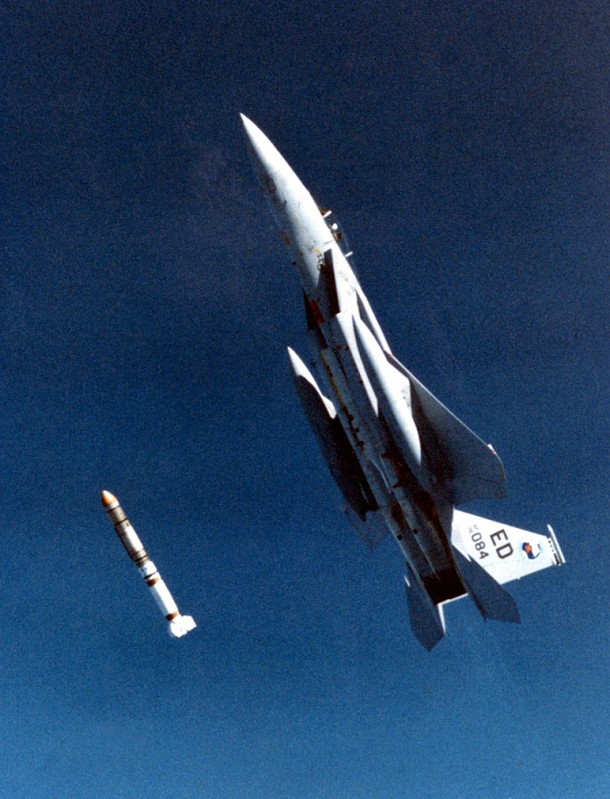
Twenty-nine years ago this week, the USAF/LTV ASM-135 anti-satellite missile successfully intercepted a target satellite orbiting 300 nautical miles above the Earth. The test was the first and only time that an aircraft-launched missile successfully engaged and destroyed an orbiting spacecraft.
The United States began testing anti-satellite missiles in the late 1950′s. These and subsequent vehicles used nuclear warheads to destroy orbiting satellites. A serious disadvantage of this approach was that a nuclear detonation intended to destroy an adversary satellite will likely damage nearby friendly satellites as well.
By the mid 1970′s, the favored anti-satellite (ASAT) approach had changed from nuclear detonation to kinetic kill. This latter approach required the interceptor to directly hit the target. The 15,000-mph closing velocity provided enough kinetic energy to totally destroy the target. Thus, no warhead was required.
The decision to proceed with development and deployment of an American kinetic kill weapon was made by President Jimmy Carter in 1978. Carter’s decision came in the aftermath of the Soviet Union’s successful demonstration of an orbital anti-satellite system.
LTV Aerospace was awarded a contract in 1979 to develop the Air-Launched Miniature Vehicle (ALMV) for the USAF. The resulting anti-satellite missile (ASM) system was designated the ASM-135. The two-stage missile was to be air-launched by a USAF F-15A Eagle executing a zoom climb. In essence, the aircraft acted as the first stage of what was effectively a 3-stage vehicle.
The ASM-135 was 18-feet in length and 20-inches diameter. The 2,600-lb vehicle was launched from the centerline station of the host aircraft. The ASM consisted of a Boeing SRAM first stage and an LTV Altair 3 second stage. The vehicle’s payload was a 30-lb kinetic kill weapon known as the Miniature Homing Vehicle (MHV).
The ASM-135 was first tested in flight on Saturday, 21 January 1984. While successful, the missile did not carry a MHV. On Tuesday, 13 November 1984, a second ASM-135 test took place. Unfortunately, the missile failed when the MHV that it was carrying was aimed at a star that served as a virtual target. Engineers went to work to make the needed fixes.
In August of 1985, a decision was made by President Ronald Reagan to launch the next ASM-135 missile against an orbiting US satellite. The Solwind P78-1 satellite would serve as the target. Congress was subsequently notified by the Executive Branch regarding the intended mission.
The historic satellite takedown mission occurred on Friday, 13 September 1985. USAF F-15A (S/N 77-0084), stationed at Edwards Air Force Base, California and code-named Celestial Eagle, departed nearby Vandenberg Air Force Base carrying the ASM-135 test package. Major Wilbert D. Pearson was at the controls of the Celestial Eagle.
Flying over the Pacific Ocean at Mach 1.22, Pearson executed a 3.8-g pull to achieve a 65-degree inertial pitch angle in a zoom climb. As the aircraft passed through 38,000-feet at Mach 0.93, the ASM-135 was launched at a point 200 miles west of Vandenberg. Both stages fired properly and the MHV intercepted the Solwind P78-1 satellite within 6-inches of the aim point. The 2,000-lb satellite was completely obliterated.
In the aftermath of the stunningly successful takedown of the Solwind P78-1 satellite, USAF was primed to continue testing the ASM-135 and then introduce it into the inventory. Plans called for upwards of 112 ASM-135 rounds to be flown on F-15A aircraft stationed at McChord AFB in Washington state and Langley AFB in Virginia. However, such was not to be.
Even before the vehicle flew, the United States Congress acted to increasingly restrict the ASM-135 effort. A ban on using the ASM-135 against a space target was put into effect in December 1985. Although USAF actually conducted successful additional ASM-135 flight tests against celestial virtual targets in 1986, the death knell for the program had been sounded.
In the final analysis, a combination of US-Soviet treaty concerns, tepid USAF support and escalating costs killed the ASM-135 anti-satellite effort. The Reagan Administration formally cancelled the program in 1988.
While the ASM-135 effort was relatively short-lived, the technology that it spawned has propagated to similar applications. Indeed, today’s premier exoatmospheric hit-to-kill interceptor, the United States Navy SM-3 Block IA anti-ballistic missile, is a beneficiary of ASM-135 homing guidance, intercept trajectory and kinetic kill weapon technologies.
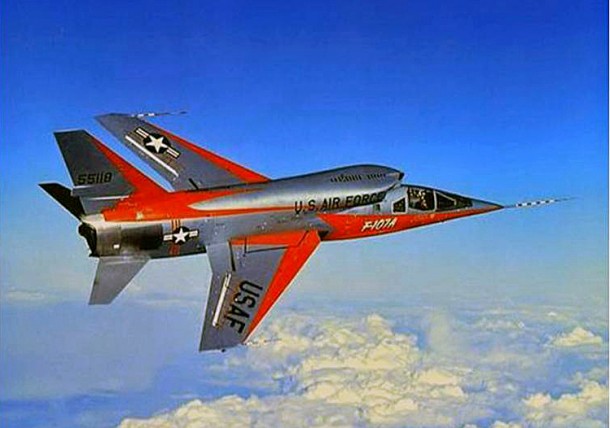
Fifty-eight years ago this month, the USAF/North American F-107A aircraft flew for the first time. Interestingly, the Mach 2-capable fighter-bomber prototype went supersonic on its maiden flight.
The F-107A was designed, developed and tested by North American Aviation (NAA) in the mid-1950′s. With it, the contractor hoped to satisfy Tactical Air Command’s (TAC) need for a front line fighter-bomber. However, Republic Aircraft also had a candidate for the same role; the F-105 Thunder Chief.
The competition between Republic and North American for the TAC fighter-bomber production contract has a story of its own. Suffice it to say here that the competitive effort was (1) extremely close and (2) tinged with political intrigue. In the end, Republic Aircraft reaped the spoils of victory.
Although the F-107A came out on the short end of the stick in the TAC fighter-bomber competition, such did not imply an inferiority in fulfilling the intended role. Indeed, like the Northtrop YF-23′s loss to the General Dynamics YF-22 in the ATF competition of the early 1990′s, North American’s failure to get the nod with the F-107A is still a subject of passionate debate.
The F-107A measured 60.8 feet in length and had a wing span of 36.6 feet. Gross take-off weight was around 41,000 pounds. The aircraft was powered by a single Pratt and Whitney YJ75-P-11 turbojet that produced 15,500 pounds of thrust in military power and 23,500 pounds of thrust in full afterburner.
F-107A longitudinal control was provided by an all-flying horizontal tail. Similarly, an all-flying vertical tail was employed for directional control. Lateral control was provided by a unique 3-segment spoiler-deflector system mounted on each wing. The aircraft was also configured with inboard flaps and leading edge slats for lift augmentation at low speeds.
A unique and prominent feature of the F-107A was its dorsal-mounted air induction system known as the Variable-Area Inlet Duct (VAID). Internally, this unit incorporated a system of adjustable ramps to efficiently decelerate and compress freestream prior to entering the engine compressor face. Ramp deflection scheduling with Mach number was controlled automatically. Ramp boundary layer bleed air was vented from the top of the VAID.
The F-107A carried weapons externally. In addition to wing pylon-mounted stores, the aircraft was designed to carry a single “special weapon” from a semi-submerged recess located on the aircraft ventral centerline. The term “special weapon” means that it was a tactical nuclear bomb. The Sandia-developed store could also be used in combination with a special saddle fuel tank to extend aircraft range.
A total of three (3) F-107A aircraft were built and flown. USAF-assigned tail numbers include 55-5118, 55-5119 and 55-5120. On Monday, 10 September 1956, the No. 1 ship (55-5118) took-off from Edwards Air Force Base on its first flight. NAA Chief Test Pilot Robert Baker, Jr. was at the controls. The aircraft attained a maximum Mach number of 1.03 in a 43 minute flight test.
The F-107A could really scream. The type had a maximum climb rate of around 40,000 feet per minute in full afterburner. The max demonstrated Mach number attained by the F-107A was Mach 2.18. Program engineers estimated that by increasing the inlet area slightly, the F-107A was capable of reaching roughly Mach 2.4.
The trio of F-107A aircraft flew 272 flight tests totalling 176.5 hours. Included in this testing was successful separation of a special store prototype at Mach 2. Test pilots of note who flew the F-107A included XB-70A pilot Al White and X-15 pilots Scott Crossfield, Bob White, Jack McKay and Forrest Peterson.
Though it never became a production aircraft, the F-107A contributed in significant ways to aviation progress. Indeed, many future aircraft would greatly benefit from F-107A flight control and air induction technology including the A-5 Vigilante, XB-70A, A-12, SR-71, YF-12A and F-15.
The F-107A was the last of NAA’s fighter aircraft which includes such notables as the P-51 Mustang, the F-86 Sabre and the F-100 Super Sabre. While the F-107A has often been referred to in print as the Ultra Sabre, Ultimate Sabre, Super Super Sabre or such, it was never officially assigned a nickname. Alas, there was never an XF-107A or YF-107A designation either. North American Aviation’s TAC fighter-bomber candidate was simply known as the F-107A.
Today, the No. 1 F-107A (55-5118) is displayed at the Pima Air and Space Museum (PASM) in Tucson, Arizona. The No. 2 ship (55-5119) resides at the USAF Museum at Wright-Patterson Air Force Base in Dayton, Ohio. The No. 3 airplane (55-5120) no longer exists as it was relegated to the status of a fire fighting prop and ultimately destroyed in that role sometime in 1961 or 1962.
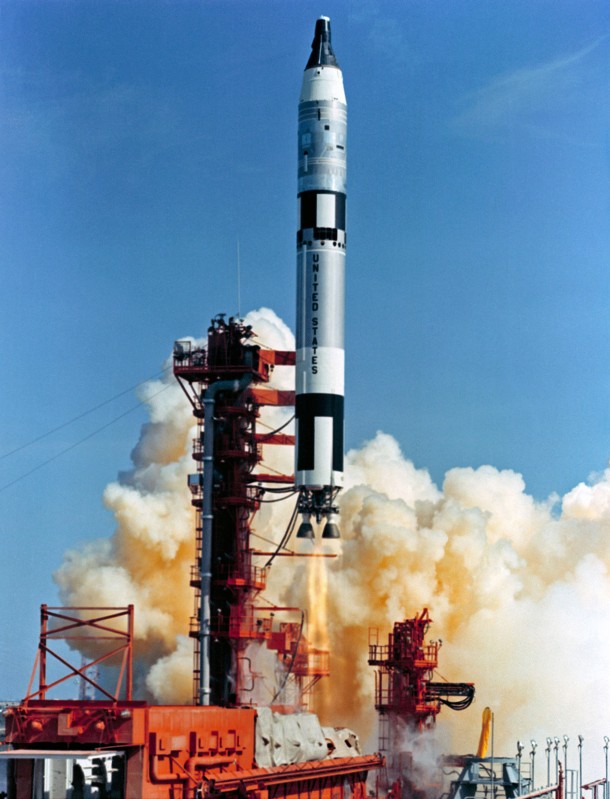
Forty-nine years ago this month, NASA astronauts Leroy Gordon Cooper and Charles M. “Pete” Conrad set a new spaceflight endurance record during the flight of Gemini 5. It was the third of ten (10) missions in the historic Gemini spaceflight series. The motto for the mission was “Eight Days or Bust”.
The purpose of Project Gemini was to develop and flight-prove a myriad of technologies required to get to the Moon. Those technologies included spacecraft power systems, rendezvous and docking, orbital maneuvering, long duration spaceflight and extravehicular activity.
The Gemini spacecraft weighed 8,500 pounds at lift-off and measured 18.6 feet in length. Gemini consisted of a reentry module (RM), an adapter module (AM) and an equipment module (EM).
The crew occupied the RM which also contained navigation, communication, telemetry, electrical and reentry reaction control systems. The AM contained maneuver thrusters and the deboost rocket system. The EM included the spacecraft orbit attitude control thrusters and the fuel cell system. Both the AM and EM were used in orbit only and discarded prior to entry.
Gemini-Titan V (GT-5) lifted-off at 13:59:59 UTC from LC-19 at Cape Canaveral, Florida on Saturday, 21 August 1965. The two-stage Titan II launch vehicle placed Gemini 5 into a 189 nautical mile x 87 nautical mile elliptical orbit.
A primary purpose of the Gemini 5 mission was to stay in orbit at least eight (8) days. This was the minimum time it would take to fly to the Moon, land and return to the Earth. Other goals of the Gemini 5 mission were to test the first fuel cells, deploy and rendezvous with a special rendezvous pod and conduct a variety of medical experiments.
Despite fuel cell problems, electrical system anomalies, reaction control system issues and the cancellation of various experiments, Gemini 5 was able to meet the goal of an 8-day flight. But it wasn’t easy. The last days of the mission were especially demanding since the crew didn’t have much to do. Pete Conrad called his Gemini 5 experience “8 days in a garbage can.”
On Sunday, 29 August 1965, Gemini 5 splashed-down in the Atlantic Ocean at 12:55:13 UTC. Mission elapsed time was 7 days, 22 hours, 55 minutes and 13 seconds. A new spaceflight endurance record.
Gemini 5 was Gordon Cooper’s last spaceflight. Cooper left NASA due to a deteriorating relationship with management. Pete Conrad flew three (3) more times in space. In particular, he commanded the Gemini 11, Apollo 12 and Skylab I missions. Indeed, Conrad’s Apollo 12 experience made him the third man to walk on surface of the Moon.
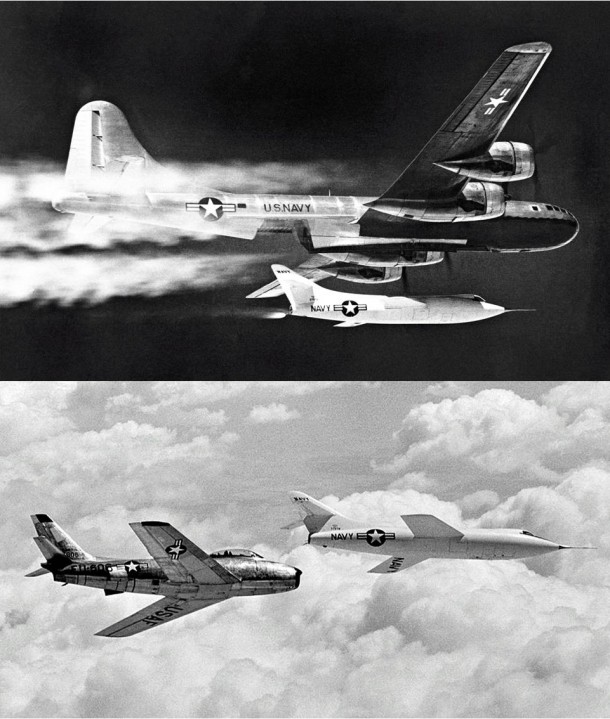
Sixty-one years ago today, the USN/Douglas D-558-II Skyrocket soared to an unofficial world record altitude of 83,235 feet. The Skyrocket’s record altitude mission was piloted by USMC test pilot and World War II triple-ace Lieutenant Colonel Marion E. Carl.
The D-558-II was a United States Navy (USN) X-aircraft and first flew in February of 1948. It was contemporaneous with the USAF/Bell XS-1. The aircraft measured 42 feet in length with a wing span of 25 feet. Maximum take-off weight was 15,266 pounds. Douglas manufactured a trio of D-558-II aircraft (Bureau No.’s 37973, 37974 and 37975).
The original version of the swept-wing D-558-II had both rocket and turbojet propulsion. The latter system provided a ground take-off capability. However, like other early X-aircraft such as the XS-1, X-1A, X-2 and X-15), the D-558-II achieved maximum performance through the use of a mothership and rocket power alone.
On Friday, 21 August 1953, D-558-II (Bureau No. 37974; NACA 144) was carried to a drop altitude of approximately 30,000 feet over Edwards Air Force Base by a USN P2B-1S launch aircraft. Following drop, Carl fired his LR-8 rocket motor and executed a pull-up in an effort to extract maximum altitude from the D-558-II. Carl hit a maximum Mach number of 1.728 and exceeded the existing altitude by about 3,800 feet.
Flying the D-558-II to altitudes beyond 65,000 feet required Carl to wear a full-pressure suit. The versions available to test pilots in the early 1950′s were crude by today’s standards. They were extremely uncomfortable and very confining. The pilot had to use reverse breathing to supply adequate oxygen to the lungs.
Reverse breathing involves the inhalation of air under pressure wherein oxygen is forced into the lungs by simply opening the mouth. One then has to make a conscious effort to exhale against that pressure in order rid the lungs of carbon dioxide. This unnatural breathing process had to be practiced by a pilot until it became second nature.
Flying the D-558-II (and other 1950′s high-speed research aircraft such as the X-1, X-1A and X-2) to extreme altitude was a sporty proposition. These aircraft exhibited disturbing lateral-directional control characteristics at low dynamic pressure. None of the early X-planes were configured with a 3-axis reaction control system. Control had to be maintained solely by aerodynamic means.
Marion Carl’s altitude mark in the D-558-II would stand until September of 1956 when USAF Captain Iven Kincheloe flew the USAF/Bell X-2 to an altitude of 126,200 feet. Today, the record-setting D-558-II (NACA 144) is displayed at the National Air and Space Museum in our Nation’s capital.
Marion Carl went on to serve his country until he retired from the Marine Corps in 1973 after having attained the rank of Major General. Sadly, Carl was shot to death in 1998 at the age of 82 as he defended his wife Edna from a home invader. A true American hero, Marion E. Carl was buried with full military honors at Arlington National Cemetery.
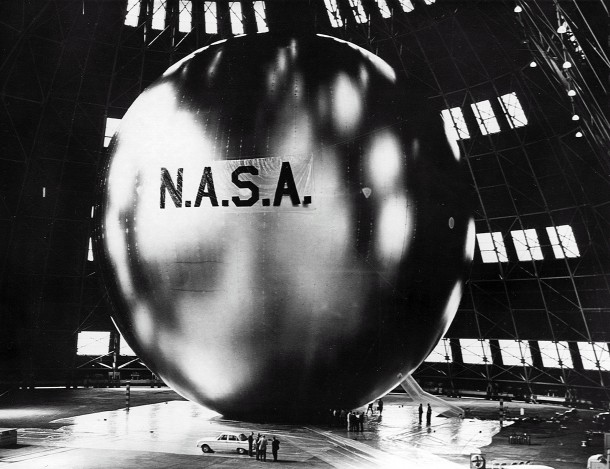
Fifty-four years ago this month, the United States successfully launched the Echo 1A passive communications satellite into Earth orbit. The 100-foot diameter balloon was among the largest objects ever to orbit the Earth.
A plethora of earth-orbiting communication satellites provide for a global connectivity that is commonplace today. Such was not always the case. Roll the clock back a half-century and we find that a global communications satellite system was just a concept. However, keen minds would soon go to work and provide mankind with yet another tangible space age benefit.
Communications satellites are basically of two types; passive and active. A passive communications satellite (PCS) simply reflects signals sent to it from a point on Earth to other points on the globe. An active communications satellite (ACS) can receive, store, modify and/or transmit Earth-based signals.
The earliest idea for a PCS involved the use of an orbiting spherical balloon. The balloon was fabricated from mylar polyester having a thickness of a mere 0.5 mil. The uninflated balloon was packed tightly into a small volume and inserted into a payload canister preparatory to launch. Once in orbit, the balloon was released and then inflated to a diameter of 100 feet.
The system described above materialized in the late 1950′s as Project Echo. The Project Echo satellite was essentially a huge spherical reflector for transcontinental and intercontinental telephone, radio and television signals. The satellite was configured with several transmitters for tracking and telemetry purposes. Power was provided by an array of nickel-cadmium batteries that were charged via solar cells.
Echo 1 was launched from Cape Canaveral, Florida on Friday, 13 May 1960. However, the launch vehicle failed and Echo 1 never achieved orbit. Echo 1A (sometimes referred to as Echo 1) lifted-off from Cape Canveral’s LC-17A at 0939 UTC on Friday, 12 August 1960. The Thor Delta launch vehicle successfully placed the 166-lb satellite into a 820-nm x 911-nm orbit.
An interesting characteristic of the Echo satellite was the large oscillation in the perigee of its orbit (485 nm to 811 nm) over several months. This was caused by the influences of solar radiation and variations in atmospheric density. While these factors are just part of the earth-orbital environment, their effects were much more noticeable for Echo due to the type’s large surface area-to-weight ratio.
Echo 1A orbited the Earth until it reentered the Earth’s atmosphere on Saturday, 25 May 1968. Echo 2 was a larger and improved version of Echo 1A. It measured 135-feet in diameter and weighed 547-lb. Echo 2 orbited the Earth between January of 1964 and June of 1969. Other than the Moon, both satellites were the brightest objects observable in the night sky due to their high reflectivity.
The Echo satellites served their function admirably. For a time, they were quite a novelty. However, progress on the ACS scene quickly relegated the PCS to obselescence. Today, virtually all communication satellites are of the ACS variety.
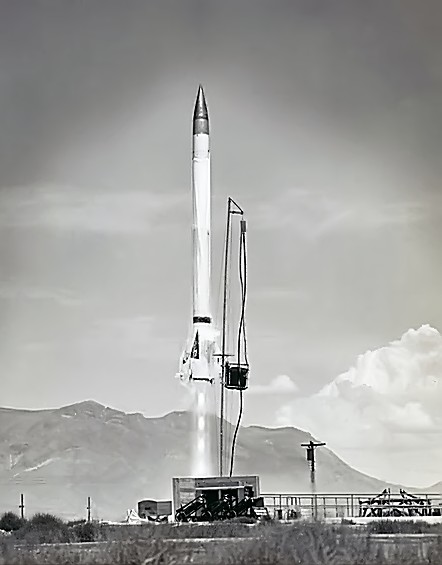
Sixty-three years ago today, a United States Navy Viking rocket soared to an altitude of 136 miles. In doing so, it eclipsed the previous single stage altitude record of 114 miles set by a captured German V-2 rocket on Tuesday, 17 December 1946. The mission was part of the Navy’s 12-flight Viking Rocket flight test series conducted between May 1949 and February 1955.
At 1659 UTC on Tuesday, 07 August 1951, Viking No. 7 was fired from LC-33 at White Sands Proving Ground (WSPG), New Mexico. Burnout velocity was 5,865 feet per second following a rocket motor burn time of 72 seconds. Viking No. 7 weighed 10,730 pounds at lift-off (roughly 8,000 pounds of which were propellants) and carried a scientific payload of 394 pounds.
Viking No. 7 was the last of the early Viking rocket configurations which measured 49-feet in length and had a diameter of 32-inches. Starting with Viking No. 8, the rocket’s airframe was modified to carry more propellants for greater altitude performance and measured 42-feet (length) by 45-inches (diameter). This modification allowed Viking No. 11, flown from WSPG on Monday, 24 May 1954, to capture the all-time Viking altitude record of 158 miles.
Although almost forgotten today, the Viking Rocket Program played a vital role in the history of American rocketry. Viking was the first large, liquid-fueled rocket developed by the United States. It’s rocket motor generated 21,000 pounds of lift-off thrust and employed an innovative two-axis gimbal system for pitch and yaw control. Fin-mounted reaction jets provided roll control.
The Viking Rocket Program provided a tremendous amount of scientific data about Earth’s atmospheric properties such as pressure, temperature, density, winds, and composition. Additionally, the Viking rocket formed the technological basis for a number of 1950′s launch vehicle systems including the Navy’s Vanguard satellite launcher and the USAF Titan ICBM.
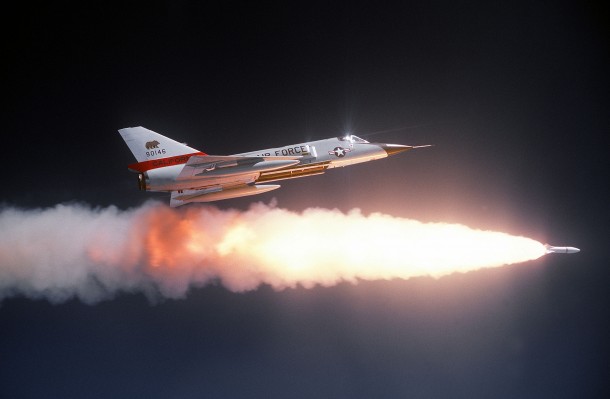
Fifty-seven years ago this month, the United States successfully conducted the only live-fire test of the only known nuclear-armed air-to-air missile ever developed by the West. The test took place in the skies over the Nuclear Test Site located at Yucca Flats, Nevada.
The Cold War between the Soviet Union and the United States gave rise to the development of myriad nuclear weapons. Both superpowers ultimately relied on a triad of platforms, consisting of bombers, missiles and submarines, to deliver nuclear ordnance. Each side used these same types of platforms in a defensive role as well.
The United States employed land-based interceptor aircraft for defending against the Soviet bomber threat. These aircraft would go out to engage and destroy Soviet bomber groups before the latter could penetrate US airspace. The weapon of choice for taking out the bombers was the air-to-air missile.
The most fearsome of air-to-air missiles was armed with a nuclear warhead. The idea was simple. A defending aircraft would fire the nuclear-armed missile into a bevy of Soviet bombers. Detonation of the warhead would in theory destroy an entire bomber group with a single atomic blast.
The Douglas Aircraft Company produced just such a missile for the United States Air Force in the mid-1950′s. The subject missile was originally known as the MB-1 Genie (aka Bird Dog, Ding-Dong, and High Card). The type’s 1.5 kiloton nuclear device had a blast radius on the order of 1,000 feet.
The Genie measured 9.67 feet in length and had a nominal diameter of 17.5 inches. Firing weight was 822 pounds. Genie’s Thiokol SR49-TC-1 solid rocket motor had a rated thrust of 36,500 pounds. The resulting high thrust-to-weight ratio allowed the missile to quickly accelerate to the target. Genie had a top Mach number of 3.3 and a range of slightly over 6 miles.
Genie was carried by the top USAF interceptor aircraft of its day; the Northrop F-89 Scorpion, McDonnell F-101B VooDoo and Convair F-106 Delta Dart. The missile was unguided. That is, Genie was simply a point and shoot weapon. The warhead would detonate only after rocket motor burnout. This delay permitted the carrier aircraft to quickly depart the area following launch.
The only in-flight detonation of a Genie warhead occurred during the summer of 1957 as part of Operation Plumbbob. This program was series of nuclear weapons tests conducted from May to October of the subject year at the Yucca Flats Nuclear Test Site in Nevada.
At 1400 UTC on Friday, 19 July 1957, USAF Captain Eric Hutchison fired a single Genie missile from his Northrop F-89J aircraft. The missile’s W25 warhead detonated at 15,000 feet above ground level shortly after rocket motor burnout. A group of USAF officers was positioned directly below the air burst to prove that the missile could be used over populated areas. The men were reported to be unharmed.
Genie was never fired in anger. Approximately 3,150 missiles were produced by the time Thiokol closed down the production line in 1963. This production run included a number of improved variants known as the MB-1-T, ATR-2A, AIR-2A and AIR-2B. Genie ultimately served with both the USAF and the Canadian Air Force. It was withdrawn from service in 1985.