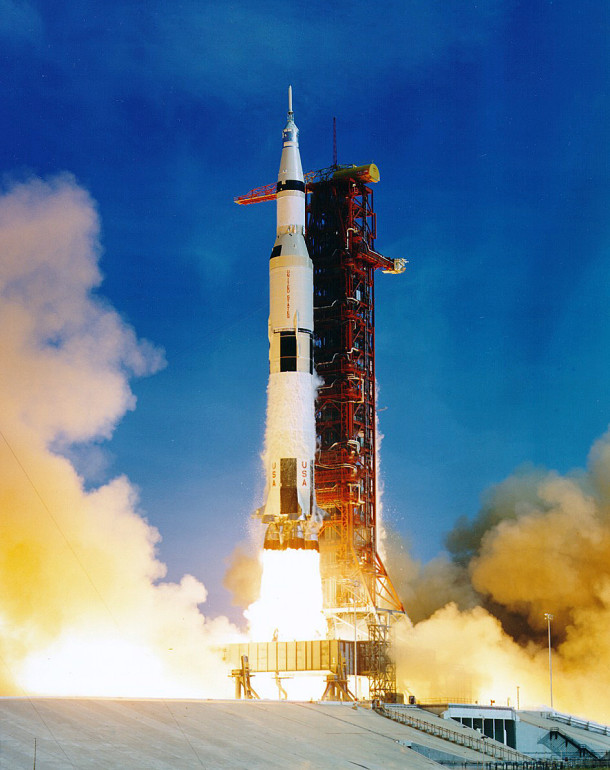
Forty-six years ago this week, the epic flight of Apollo 11, the first mission to land men on the Moon, began with launch from the Kennedy Space Center (KSC) at Merritt Island, Florida. Nearly 1-million people gathered around America’s famous space complex to witness the historic event. An estimated 1-billion viewers worldwide watched the proceedings on television.
The names of the Apollo 11 crew are now legend: Mission Commander Neil A. Armstrong, Lunar Module Pilot Edwin E. Aldrin, Jr., and Command Module Pilot Michael Collins. Each astronaut was making his second spaceflight.
The overall Apollo 11 spacecraft weighed over 100,000 pounds and consisted of 3 major components: Command Module, Service Module, and Lunar Excursion Module (LEM). Out of American history came the names used to distinguish two of these components from one another. The Command Module was named Columbia, the feminine personification of America, while the Lunar Excursion Module received the appellation Eagle in honor of America’s national bird.
The Apollo-Saturn V launch stack measured 363-feet in length, had a maximum diameter of 33-feet, and weighed 6.7-milllion pounds at ignition of its five F-1 engines. The vehicle rose from the Earth on 7.7-million pounds of lift-off thrust.
The acoustic energy produced by the Saturn’s first stage propulsion system was unlike anything in common experience. The sound produced was like intense, continuous thunder even miles away from the launch point. Ground and structure shook disturbingly and a person’s lungs vibrated within their chest cavity.
Lift-off of Apollo 11 (AS-506) from KSC’s LC-39A occurred at 13:32 UTC on Wednesday, 16 July 1969. The target for the day’s launch, the Moon, was 218,096 miles distant from Earth. It took 12 seconds just for the massive Apollo 11 launch vehicle to clear the launch tower. However, a scant 12 minutes later, the Apollo 11 spacecraft was safely in low earth orbit (LEO) traveling at 17,500 miles per hour.
Following checkout in earth orbit, trans-lunar injection, and earth-to-moon coast, Apollo 11 entered lunar orbit nearly 76 hours after lift-off. Now, the big question: Would they make it? Even Apollo 11’s Command Module Pilot, Michael Collins, estimated that the chance of a successful lunar landing on the first attempt was only 50/50. The answer would soon come. History’s first lunar landing attempt was now only 24 hours away.
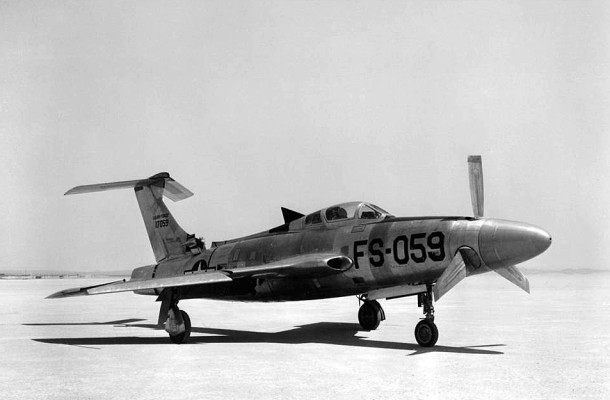
Sixty years ago this month, the USAF/Republic XF-84H experimental turboprop fighter took to the air on its maiden flight. The test sortie was flown at Edwards Air Force Base with Republic test pilot Henry G. “Hank” Beaird, Jr. at the controls.
The XF-84H was an experimental variant of Republic Aviation’s turbojet-powered F-84 Thunderstreak. An Allison XT40-A-1 turboprop engine, rated at 5,850 hp, served as the power source for this novel aircraft. The XT40 drove a variable-pitch, 3-blade, 12-foot diameter propeller at 3,000 rpm. Thrust level was changed by varying blade pitch.
Owing to its high rotational speed and large diameter, the outer 2 feet of the XF-84H propeller saw supersonic velocities. The shock waves that emanated from the prop produced a deafening wall of sound. The extreme sound level produced intense nausea and raging headaches in ground crewmen. As a result, the XF-84H was dubbed the Thunderscreech.
The prop wash from the aircraft’s powerful turboprop necessitated the use of a T-tail to keep the horizontal tail and elevator in clean air flow. The engine’s extreme torque was partially countered by differential deflection on the left and right wing flaps and by placement of the aircraft’s left wing root air intake a foot ahead of the its right intake.
A pair of XF-84H prototype aircraft (S/N 51-17059 and S/N 51-17060) was built by Republic Aviation. The inaugural flight of an XF-84H took place on Friday, 22 July 1955 at Edwards Air Force. This test hop, performed in Ship No. 1 (S/N 51-17059), was cut short by a forced landing.
A total of twelve (12) test flights were made in the two Thunderscreech prototypes; eleven (11) in Ship No. 1 and one (1) in Ship No. 2. Total flight time accumulated by these experimental airframes was 6 hours and 40 minutes. The majority of flights experienced forced landings for one reason or another.
The XF-84H suffered from reduced longitudinal stability and poor handling qualities. The aircraft was also plagued by frequent engine, hydraulic system, nose gear and vibration problems. Faced with the type’s obvious non-viability, USAF opted to cancel the XF-84H Program in September of 1956.
Historical records indicate that the XF-84H reached a top speed of 520 mph during its brief flight test life. This figure was a full 120 mph short of the aircraft’s design speed. Nonetheless, the XF-84H held the speed record for single-engine prop-driven aircraft until Monday, 21 August 1989. On that date, a specially modified Grumman F8F Bearcat established the existing record of 528.33 mph.
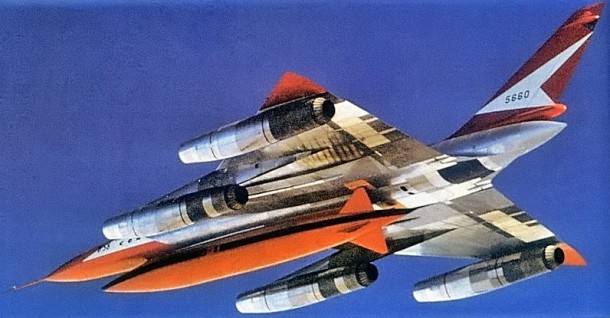
Fifty-eight years ago today, the USAF/Convair XB-58A (S/N 55-660) Hustler first attained its double-sonic design airspeed when it was flown to Mach 2.03 at an altitude of 43,250 feet. This historic achievement took place at Edwards Air Force Base on the type’s 24th test flight. The mission totaled 1 hour and 55 minutes with famed Convair test pilot Beryl Arthur Erickson at the controls.
The B-58A Hustler was the United States first supersonic-capable bomber and was originally designed for the strategic mission. The aircraft was powered by four (4) General Electric J79-GE-5A turbojets generating 62,400 lbs of sea level thrust in afterburner. Maximum take-off weight was nearly 177,000 lbs.
Convair’s stunning delta-winged bomber was 97 feet in length with a wing span of 57 feet. Wing area was roughly 1,550 square feet. Aircraft maximum height was 30 feet as measured from the ground to the top of the vertical tail.
Flight crew for the B-58A consisted of the pilot, bombadier/navigator, and defensive systems operator. The crew was arranged in tandem with each crew member seated in a separate cockpit. The type carried thermonuclear ordnance. A total of 116 B-58A aircraft were manufactured.
The Hustler’s performance was impressive then and now. It had a maximum speed of 1,400 mph and a service ceiling of 63,400 feet. The aircraft could climb in excess of 17,000 feet per minute at gross take-off weight and up to 46,000 feet per minute near minimum weight.
The B-58A had a difficult gestation due to its advanced design and demanding performance requirements. A large number of aircraft and flight crews were lost due to a variety of flight control and structural problems. First flight took place on 11 November 1956 with the type finally entering the USAF inventory on 15 March 1960.
The USAF/Convair B-58A Hustler was operational for nearly 10 years and was retired on 31 January 1970. The aircraft was never used in anger.
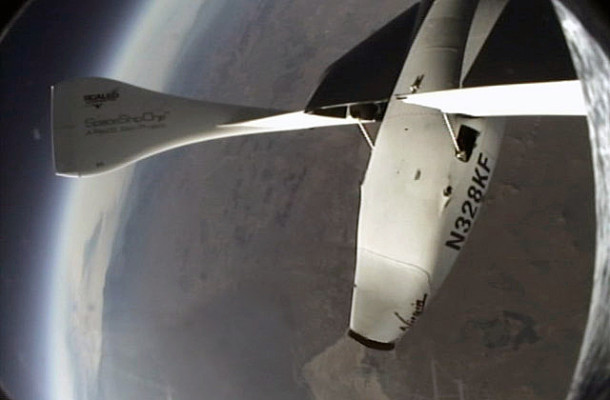
Eleven years ago this week, Scaled Composite’s SpaceShipOne flew to an altitude of 62.214 statute miles. The flight marked the first time that a privately-developed flight vehicle had flown above the 62-statute mile boundary that entitles the flight crew to FAI-certified astronaut wings. As a result, SpaceShipOne pilot Mike Melvill became history’s first private citizen astronaut.
On Monday, 21 June 2004, SpaceShipOne Mission 15P began with departure from California’s Mojave Spaceport at 0647 PDT. Carrying SpaceShipOne at the centerline station, Scaled’s White Knight aircraft climbed to the drop altitude of 47,000 feet.
At 0750 PDT, the 7,900-pound SpaceShipOne fell away from the White Knight and Melvill immediately ignited the 16,650-pound thrust hybrid rocket motor. Melvill quickly then pulled SpaceShipOne into a vertical climb.
Passing through 60,000 feet, SpaceShipOne experienced a series of uncommanded rolls as it encountered a wind shear. Melvill struggled with the controls in an attempt to arrest the roll transient. Then, late in the boost, the vehicle lost primary pitch trim control. In response, Melvill switched to the back-up system as he continued the ascent.
Rocket motor burnout occurred at 180,000 feet with SpaceShipOne traveling at 2,150 mph. It now only weighed 2,600 pounds. The vehicle then coasted to an apogee of 62.214 statute miles (328,490 feet). The target maximum altitude was 68.182 statute miles (360,000 feet). However, the control problems encountered going upstairs caused the trajectory to veer somewhat from the vertical.
Melvill experienced approximately 3.5 minutes of zero-g flight going over the top. He had some fun during this period as he released a bunch of M&M’s and watched the chocolate candy pieces float in the SpaceShipOne cabin.
Back to business now, Melvill transitioned SpaceShipOne to the high-drag feathered configuration in preparation for the critical entry phase of the mission. The vehicle initially accelerated to over 2,100 mph in the airless void before encountering the sensible atmosphere. At one point during atmospheric entry, Melvill experienced in excess of 5 g’s deceleration.
At 57,000 feet, Melvill reconfigured SpaceShipOne back to the standard aircraft configuration for powerless flight back to the Mojave Spaceport. Fortunately, the aircraft was a very good glider. The control problems encountered during the ascent resulted in atmospheric entry taking place 22 statute miles south of the targeted reentry point.
SpaceShipOne touched-down on Mojave Runway 12/30 at 0814 PDT; thus ending an historic, if not harrowing mission.
After the flight, Mike Melvill had much to say. But perhaps the following quote says it best for the rest of us who can only imagine what it was like: “And it was really an awesome sight, I mean it was like nothing I’ve ever seen before. And it blew me away, it really did. … You really do feel like you can reach out and touch the face of God, believe me.”
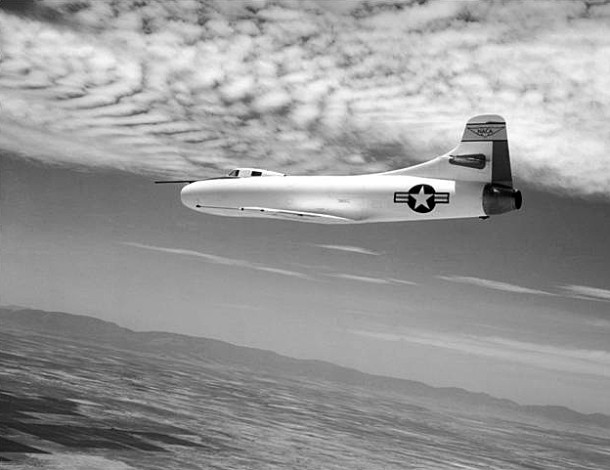
Sixty-two years ago this month, NACA test pilot A. Scott Crossfield piloted the United States Navy/Douglas D-558-I Skystreak transonic research aircraft on the last of 230 flights. The type’s final test flight was flown on Wednesday, 10 June 1953 at Edwards Air Force Base, California.
Flight near and beyond the speed of sound is characterized by large variations in flowfield density. Variable density flow is known as compressible flow. A key compressible flow phenomenon is the formation of shock waves which result when the supersonic freestream is deflected or turned by the presence of the aircraft.
As every aircraft has a distinct shape, it also has its own distinct shock wave system. The topology and strength of this 3-dimensional shock wave system significantly affects aircraft flight performance, stability and control, handling qualities, airframe buffet characteristics and airloads.
Following World War II, the United States initiated a sustained flight research effort in the realm of transonic and supersonic flight. In league with the US military and the National Advisory Committee For Aeronautics (NACA), the American aeronautical industry designed and built a variety of aircraft used to conduct flight research during the 1940’s and 1950’s. These experimental aircraft were the first of the fabled X-planes.
In June of 1945, the Douglas Aircraft Company was awarded a contract by the United States Navy (USN) to build a total of six (6) flight research aircraft. These vehicles would be used in a two phase flight research program. Phase I was devoted to transonic flight testing while Phase II would investigate supersonic flight. The Phase I aircraft was known as the D-558-I Skystreak while the Phase II airplane was called the D-558-II Skyrocket.
The USN/Douglas D-558-I Skystreak measured 36-feet in length and had a wingspan of 25-feet. The straight-winged aircraft weighed a bit over 10,000 pounds and was powered by an Allison J35 turbojet rated at 5,000 pounds of sea level thrust. The aircraft was single place and employed ground take-off. Three (3) copies were made; BuAer tail numbers 37970, 37971 and 37972.
Later painted white to improve visibility, each Skystreak external airframe was originally painted a stunning red. This led to the type’s nickname of the “Crimson Test Tube”. Other nicknames included the “Flying Stove Pipe” and the “Supersonic Test Tube”. This last moniker is misleading in that the aircraft could only go slightly supersonic and only in a dive.
Along with its D-558-II companion, the D-558-I helped write the book on transonic aircraft aerodynamics. The D-558-I Skystreak acquired vital flight data relative to aircraft stability and control, handling qualities, airframe buffet and airloads. Those data are used to support aircraft design efforts down to the present day.
Pilots reported that the D-558-I exhibited generally favorable handling qualities. However, the Skystreak had its share of peculiar transonic aerodynamic attributes as well. Wing drop due to asymmetric shock-induced separation was one such phenomenon. Reduced control effectiveness and severe lateral-directional oscillations, both due to shock wave-induced flow separation at high Mach number, were exhibited as well.
Beyond 0.94 Mach number, the D-558-I experienced a phenomenon known as “Mach Tuck”. This condition is attributable to an aftward shift in the aircraft transonic center-of-pressure location as the pressure pattern over the aircraft changes with Mach number. This is equivalent to an increase in nose down pitching moment. Taken to extremes, the “Mach Tuck” flight condition is unrecoverable due to an exceedance of pitch control authority.
Approximately 15 men flew the D-558-I Skystreak 230 times between April of 1947 and June of 1953. One aircraft and one pilot was lost during the type’s flight research program. NACA test pilot Howard Lilly died and aircraft 37971 was destroyed when a J35 turbojet compressor blade failed during take-off on Tuesday, 25 November 1947.
Today the surviving aircraft are publically displayed in tribute to the Skystreak’s contributions to aeronautics. Tail No 37970 is displayed at the Naval Air Museum in Pensacola, Florida while Tail No. 37972 can be viewewd at the Carolinas Avaiation Museum in Charlotte, North Carolina.
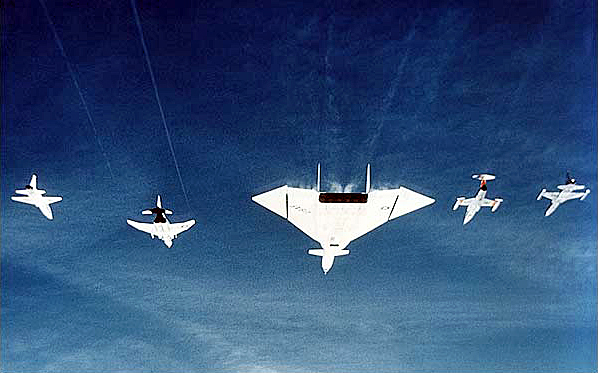
Forty-nine years ago today, XB-70A Valkyrie Air Vehicle No. 2 (62-0207) and a NASA F-104N Starfighter (N813NA) were destroyed following a midair collision near Bartsow, CA. USAF Major Carl S. Cross and NASA Chief Test Pilot Joseph A. Walker perished in the tragedy.
On Wednesday, 08 June 1966, XB-70A Valkyrie Air Vehicle No. 2 took-off from Edwards Air Force Base, California for the final time. The crew for this flight included aircraft commander and North American test pilot Alvin S. White and right-seater USAF Major Carl S. Cross. White would be making flight No. 67 in the XB-70A while Cross was making his first. For both men, this would be their final flight in the majestic Valkyrie.
In the past several months, Air Vehicle No. 2 had set speed (Mach 3.08) and altitude (74,000 feet) records for the type. But on this fateful day, the mission was a simple one; some minor flight research test points and a photo shoot.
The General Electric Company, manufacturer of the massive XB-70A’s YJ93-GE-3 turbojets, had received permission from Edwards USAF officials to photograph the XB-70A in close formation with a quartet of other aircraft powered by GE engines. The resulting photos were intended to be used for publicity.
The formation, consisting of the XB-70A, a T-38A Talon (59-1601), an F-4B Phantom II (BuNo 150993), an F-104N Starfighter (N813NA), and an F-5A Freedom Fighter (59-4898), was in position at 25,000 feet by 0845. The photographers for this event, flying in a GE-powered Gates Learjet Citation (N175FS) stationed about 600 feet to the left and slightly aft of the formation, began taking photos.
The photo session was planned to last 30 minutes, but went 10 minutes longer to 0925. Then at 0926, just as the formation aircraft were starting to leave the scene, the frantic cry of Midair! Midair Midair! came over the communications network.
Somehow, the NASA F-104N, piloted by NASA Chief Test Pilot Joe Walker, had collided with the right wing-tip of the XB-70A. Walker’s out-of-control F-104 then rolled inverted to the left and sheared-off the XB-70A’s twin vertical tails. The F-104N fuselage was severed just behind the cockpit and Walker died instantly in the terrifying process.
Curiously, the XB-70A continued on in steady, level flight for about 16 seconds despite the loss of its primary directional stability lifting surfaces. Then, as White attempted to control a roll transient, the XB-70A rapidly departed controlled flight.
As the doomed aircraft torturously pitched, yawed and rolled, its left wing structurally failed and fuel spewed furiously from its fuel tanks. White was somehow able to eject and survive. Cross never left the aircraft and rode it down to impact just north of Barstow, California.
A mishap investigation followed and (as always) blame was assigned and new procedures implemented. However, none of that changed the facts that on this, the Blackest Day at Edwards Air Force Base, American aviation lost two of its best men and aircraft in a flight mishap that was, in the final analysis, preventable.
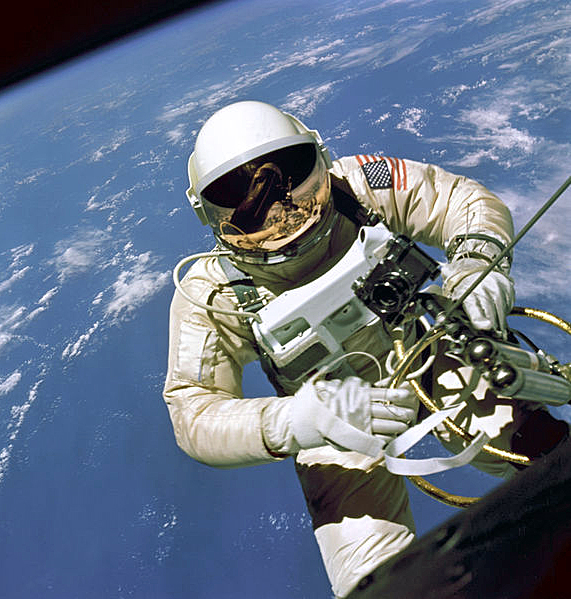
Fifty years ago today, Astronaut Edward H. White II became the first American to walk in space. Known in official NASA parlance as an Extra Vehicular Activity (EVA), White’s space feat took place during the historic 4-day mission of Gemini IV.
White, Mission Commander James A. McDivitt and their Gemini IV spacecraft were launched into low Earth orbit by a two-stage Titan II launch vehicle from LC-19 at Cape Canaveral Air Force Station, Florida. The mission clock started at 15:15:59 UTC on Thursday, 03 June 1965.
On the third orbit, less than five hours after launch, White opened the Gemini IV starboard hatch. He stood in his seat and mounted a camera to capture his historic space stroll. He then cast-off from Gemini IV and became a human satellite.
White was tethered to Gemini IV via a 15-foot umbilical that provided oxygen and communications to his EVA suit. A gold-plated visor on his helmet protected his eyes from the searing glare of the sun. The space-walking astronaut was also outfitted with a hand-held maneuvering unit that used compressed oxygen to power its small thrusters. And, like any good tourist, he also took along a camera.
Ed White had the time of his all-too-brief life in the 22 minutes that he walked in space. The sight of the earth, the spacecraft, the sun, the vastness of space, the freedom of movement all combined to make him exclaim at one point, “I feel like a million dollars!”.
Presently, it was time to get back into the spacecraft. But, couldn’t he just stay outside a little longer? NASA Mission Control and Commander McDivitt were firm. It was time to get back in; now! He grudgingly complied with the request/order, plaintively saying: “It’s the saddest moment of my life!”
As Ed White got back into his seat, he and McDivitt struggled to lock the starboard hatch. Both men were exhausted, but ebullient as they mused about the successful completion of America’s first space walk.
Gemini IV would eventually orbit the Earth 62 times before splashing-down in the Atlantic Ocean at 17:12:11 GMT on Sunday, 07 June 1965. The 4-day mission was another milestone in America’s quest for the moon.
The mission was over and yet Ed White was still a little tired. But then, that was really quite easy to understand. In the time that he was working outside the spacecraft, Gemini IV had traveled almost a third of the way around the Earth.
Now, that’s a long walk!
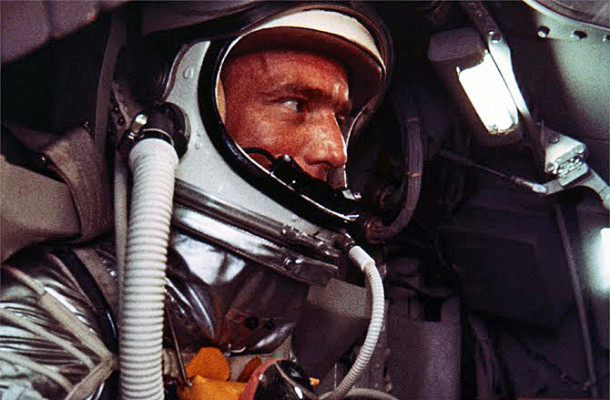
Fifty-three years ago this month, Mercury Astronaut M. Scott Carpenter orbited the Earth three times aboard his Aurora 7 Mercury spacecraft. In doing so, Carpenter became the second American to reach Earth orbit.
Project Mercury was America’s first manned spaceflight program. A total of six (6) flights took place between May of 1961 and May of 1963. The first two (2) flights were suborbital missions while the remainder achieved low Earth orbits. In February of 1962, John H. Glenn, Jr. became the first American to orbit the Earth during the Mercury-Atlas 6 (MA-6) mission.
Deke Slayton was to fly the Mercury-Atlas 7 (MA-7) mission. However, before that happened, the dreaded flight surgeon cabal grounded Slayton for what they deemed was a heart murmur. Despite Slayton’s utter incredulity and vehement protests, the decision held. Project Mercury officials maintained that the space program could ill afford the negative political fallout occasioned by the death of an astronaut on-orbit.
With Slayton grounded indefinitely, NASA selected Malcom Scott Carpenter to pilot the Mercury-Atlas 7 mission. Carpenter was member of the Original Seven selected by NASA for the Mercury Program in 1959. He was well prepared for the flight since he had just trained as Glenn’s MA-6 backup. As was the practice at that time, Carpenter named his Mercury spacecraft. The appellation he gave his celestial chariot was Aurora 7.
The launch of MA-7 took place on Thursday, 24 May 1962 from LC-14 at Cape Canaveral, Florida. Lift-off time was 12:45:16 UTC. Ascent performance of the stage-and-a-half Atlas D booster was nearly flawless as it inserted Aurora 7 into a 140-nm x 83-nm elliptical orbit. Having been cleared for at least 3 orbits, Carpenter quickly got down to the business of spaceflight.
Much of the activity on the first and second orbits involved Carpenter maneuvering his spacecraft, conducting scientific experiments and observing the Earth from space. Among other discoveries, he discerned that John Glenn’s mysterious “fireflies” were simply particles of ice and frost that had accumulated on the shadow side of the spacecraft. When the spacecraft structure was bumped or vibrated, these particles would disperse from the external surface of the spacecraft and float away into space. Once in the presence of strong sunlight, the particles appeared to glow or be luminescent.
A combination of the astronaut’s spacecraft maneuvering and an intermittently malfunctioning pitch horizon scanner left Carpenter with less than half of his maneuvering fuel left at the start of the third and final orbit. Carpenter compensated admirably by barely using his thrusters during Orbit 3. Indeed, nearing the time of retro-fire, Aurora 7 still had 40 percent of his fuel remaining in both the manual and automatic flight control systems.
As retro-fire approached, the intermittent pitch horizon scanner malfunction reappeared at a most inopportune moment. The automatic stabilization and control system suddenly would not hold Aurora 7 in the proper attitude for retro-fire; heatshield 34 degrees above the horizon at zero yaw angle. Carpenter subsequently switched to manual mode in an attempt to align the spacecraft properly for retro-fire.
When nominal time for retro-fire came, the retro-rockets did not automatically ignite. Carpenter had to do that manually. But he was 3 seconds late. Worst, Aurora 7 was still yawed 25 degree to the right. And to top it off, retro-thrust was 3 percent low. All of this meant that Aurora 7 would overshoot the nominal landing point by 215 nautical miles.
The trip down through the atmosphere was sporty in that Carpenter ran out of attitude control system fuel early during the descent. This meant that there was no means to propulsively damp the side-to-side oscillations that the Mercury spacecraft normally exhibited during reentry. These oscillations became dangerous when they exceeded about 10 degrees. That is, the spacecraft could tumble end-over-end if left unchecked.
Carpenter simultaneously eyed the altimeter and spacecraft angle-of-attack. As the latter built-up dangerously, his only recourse was to manually fire the drogue earlier than planned in attempt to arrest Aurora 7’s oscillatory motion. He did so at 25,000 feet. The spacecraft’s side-to-side oscillations were stopped. Carpenter then deployed his main parachute at 9,500 feet. Splashdown occurred at 17:41:21 UTC at a point 108 nautical miles northeast of Puerto Rico.
Since Aurora 7 was listing badly and help was about an hour away, Carpenter extricated himself from the spacecraft and deployed his life raft. While a radio beacon helped recovery forces locate him, there was no voice communication between the astronaut and his rescuers. Carpenter was on the surface of the briny deep nearly 3 hours before being picked-up by rescue helicopters and safely delivered to the carrier USS Intrepid. Some six (6) hours later, Aurora 7 was brought onboard the USS John R. Pierce.
Mercury-Atlas 7 was Scott Carpenter’s only space mission. A combination of factors, including less than amicable relations with Mercury Mission Control management, led to this being the case. During the intervening years, many stories alluding to pilot error or inattention as the cause of Aurora 7’s landing overshoot have been circulated. Indeed, much like Gus Grissom’s experience with the loss of his Liberty Bell spacecraft, these stories and explanations have been around long enough that they are now accepted as the “truth”.
Criticism of another’s performance comes easily in this world. However, as Theodore Roosevelt once pointed out, it really is “The Man in the Arena” who counts most. It is he and he alone who faces and reacts to the actual moment of trial. No one but he knows the utter reality of that moment and the vicissitudes thereof. While others may criticize, we go on record here to acknowledge and honor M. Scott Carpenter for his heroic and pioneering contributions to early American manned spaceflight.
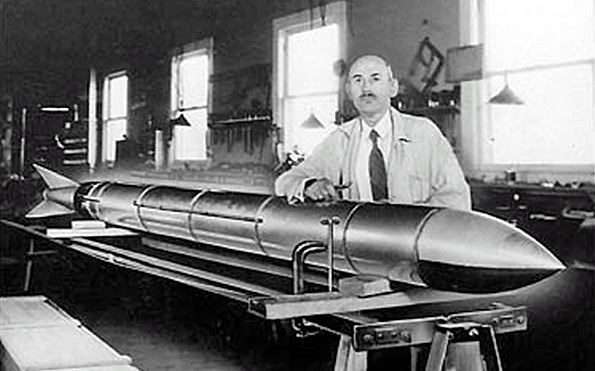
Eighty years ago this month, pioneering rocket scientist Robert H. Goddard and staff fired a liquid-fueled rocket to a record altitude of 7,500 feet above ground level. The record-setting flight took place at Roswell, New Mexico.
Robert Hutchings Goddard was born in Worcester, Massachusetts on Thursday, 05 October 1882. He was enamored with flight, pyrotechnics, rockets and science fiction from an early age. By the time he was 17, Goddard knew that his life’s work would combine all of these interests.
Goddard was a sickly youth, but spent his well moments as a voracious reader of all manner of science-oriented literature. He graduated in 1904 from South High School in Worcester as the valedictorian of his class. He matriculated at Worcester Polytechnic and graduated with a Bachelor of Science degree in physics in 1908. A Master of Science degree and Ph.D. from Worcester’s Clark University followed in 1910 and 1911, respectively.
Goddard spent the next eight years of his life working on numerous propulsion and rocket-related projects. Then, in 1919, he published his now-famous scientific treatise entitled A Method of Reaching Extreme Altitudes. In that paper, the press glommed on to Goddard’s passing mention that a multi-staged rocket could conceivably fly all the way to the Moon.
Goddard was roundly ridiculed for his fanciful prognostications about Moon flight. The New York Times was especially derogatory in its estimation of Goddard’s ideas and accused him of junk science. A Times editorial even criticized Goddard for his “misconception” that a rocket could produce thrust in the vacuum of space.
Even the United States government largely ignored Goddard. The negative treatment to which Goddard was subjected profoundly affected the American rocket scientist. So much so that he spent the remainder of his life completely alienated from the scorning dolts of both media and government.
Despite the blow to his professional reputation, Goddard resolutely pressed on with his rocket research. Indeed, after more that five years of intense development effort, Goddard and his staff launched the first liquid-fueled rocket on Tuesday, 16 March 1926 in Auburn, Massachusetts. The flight duration was short (2.5 seconds) and the peak altitude tiny (41 feet), but Goddard proved that liquid rocket propulsion was feasible.
Goddard’s liquid-fueled rocket testing would ultimately lead him from the countryside of New England to the desert of the Great South West. With financial support from Harry Guggenheim and the public backing of Charles Lindbergh, Goddard transfered his testing activities to Roswell, New Mexico in 1930. He would continue liquid-fueled rocket testing there until May 1941.
On Friday, 31 May 1935, experimental rocket flight A-8 took to the air from Goddard’s Roswell, New Mexico test site at 1430 UTC. Roughly 15 feet in length and weighing approximately 90 pounds at lift-off, the 9-inch diameter A-8 achieved a maximum altitude of 7,500 feet (1.23 nautical miles) above the desert floor. Only a flight in March of 1937 would go higher (9,000 feet).
Robert Goddard was ultimately credited with 214 U.S. patents for his rocket development work. Only 83 were awarded in his life time. His far-reaching inventions included rocket nozzle design, regenerativley cooled rocket engines, turbopumps, thrust vector controls, gyroscopic control systems and more.
Goddard died at the age of 62 from throat cancer in Baltimore, Maryland on Friday, 10 August 1945. Many years would pass before the full import of his accomplishments was comprehended. Then, the posthumously-bestowed recognition came in torrents. In 1959, Congress issued a special gold medal in Goddard’s honor. The Goddard Spaceflight Center was so named by NASA in 1959 as well. Many more such bestowals followed.
Perhaps the most meaningful of the recognitions ever accorded Robert Hutchings Goddard occurred 24 years after his passing. It was in connection with the first manned lunar landing in July of 1969. And it was poetic not only in terms of its substance and timing, but more particularly in light of the source from whence the recognition came.
A terse statement in the New York Times corrected a long-standing injustice. It read: “Further investigation and experimentation have confirmed the findings of Issac Newton in the 17th century, and it is now definitely established that a rocket can function in a vaccum as well as in an atmosphere. The Times regrets the error.”
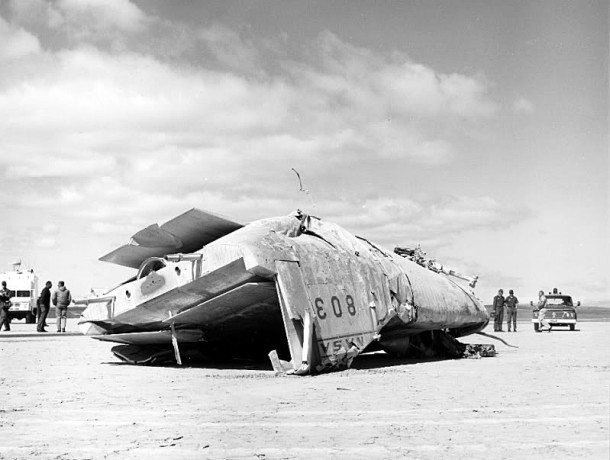
Forty-eight years ago this week, NASA’s experimental M2-F2 lifting body flight research aircraft was demolished in a horrific landing mishap on Rogers Dry Lake at Edwards Air Force Base. Although critically injured, NASA test pilot Bruce A. Peterson survived the mishap.
A lifting body is a wingless aircraft wherein the aerodynamic lift required for flight is derived solely from the fuselage. Interest in such a configuration stems from the type’s inherent suitability for lifting atmospheric entry from space. The primary attributes of same being favorable cross-range capability and aerodynamic heating performance.
Lifting body concepts date back to at least the 1950’s. From 1963 to 1975, both NASA and the United States Air Force conducted a number of manned lifting body flight research programs. The aircraft involved were the M2-F1, M2-F2, M2-F3, HL-10, X-24A and X-24B. All were flown out of Edwards Air Force Base between 1963 and 1975.
The favorable hypersonic flight performance of lifting bodies comes at a price. Specifically, lifting bodies are not particularly good subsonic aircraft from the standpoint of lateral-directional handling qualities. The type also falls like a rock in the approach and landing phase. Due to characteristically-low values of subsonic lift-to-drag ratio, touchdown speeds can exceed 250 knots.
The M2-F2 was the first of the heavy weight lifting bodies. It measured 22 feet in length and 9.4 feet in span. The aircraft had an empty weight of 4,630 pounds. The M2-F2 had boosted hydraulic 3-axis flight controls and a stability augmentation system. The vehicle was also configured with a quartet of hydrogen peroxide rockets rated at 400 pounds of thrust each.
On Wednesday, 10 May 1967, the M2-F2 (NASA S/N 803) fell away from the fabled B-52B (S/N 52-0008) launch aircraft at an altitude of 44,000 feet. NASA test pilot Bruce A. Peterson was at the controls of the M2-F2. This was Peterson’s 3rd flight in the M2-F2 and the aircraft’s 16th overall. It would be the last research flight for both man and machine.
The early part of the mission was unremarkable. Then the flight test gremlins made their presence known. Passing through 7,000 feet in a steep glide, Peterson pushed forward on the control column and brought the M2-F2 to quasi-zero angle-of-attack. The aircraft quickly entered a Dutch Roll which resulted in extreme, rapid lateral excusions.
Peterson increased angle-of-attack to arrest the wild lateral-directional motions of the M2-F2. However, he was no longer pointed toward Runway 18 on Rogers Dry Lake as intended. The ground was coming up rapidly and he would have to land the M2-F2 on a part of the lakebed that did not have the typical visual aids required for correctly judging height above surface level.
Peterson might have gotten himself and the M2-F2 on the ground in one piece except for the helicopter that now loomed directly ahead in his landing path. Not that it was the helicopter pilot’s fault. It was just that the M2-F2 had strayed so far from its intended flight path that the helicopter was suddenly a navigational hazard.
Managing to somehow avoid a collision with the flight support helicopter, Peterson now fired his landing rockets in an attempt to stay in the air a little longer. He then hit the landing gear switch. In 1.5 seconds the gear would be down and locked. Unfortunately for Peterson, there was only one second of flight time remaining before touchdown.
As the M2-F2 contacted the lakebed at 220 knots, its main landing gear was jammed back up into the fuselage. That was the end of the ball game. Sickeningly, the M2-F2 tumbled end-over-end across Rogers Dry Lake shearing off the canopy, main gear and right vertical tail. The battered and twisted airframe finally came to rest inverted on the ancient lakebed.
Incredibly, rescue crews found Bruce Peterson still alive as they came upon the crash scene. He was even conscious. However, the pilot was terribly hurt. Peterson’s oxygen mask had been torn off as the M2-F2 tumbled six (6) times before coming to a stop. He received severe facial injuries due to repeated impact with the lakebed surface. In addition, Peterson suffered a fractured skull, severe damage to his right eye and a broken hand.
Bruce Peterson came back from his brush with eternity. He needed extensive reconstructive surgery on his face and lost the sight in his right eye. Peterson served as a project engineer for a number of NASA flight programs and even flew as a Marine reservist. He later served as a safety officer on the B-2 flight test effort. Bruce Peterson passed away at the age of 72 on 01 May 2006.
For those who remember, “The Six-Million-Dollar Man” was a television series about a fictional test pilot who had been badly injured in an aircraft accident. In the storyline, the fictional character was “rebuilt” by doctors using bionic technology. Trivia buffs may be interested to know that the basis for “The Six-Million-Dollar Man” was Bruce Peterson’s M2-F2 experience.
For those that remember, the “The Six-Million-Dollar Man” was a televison series about a fictional test pilot who had been badly injured in an aircraft accident. In the storyline, the fictional character was “rebuilt” by doctors using bionic technology. Trivia buffs may be interested to know that the basis for “The Six-Million-Dollar Man” was Bruce Peterson’s terrifying M2-F2 crash.