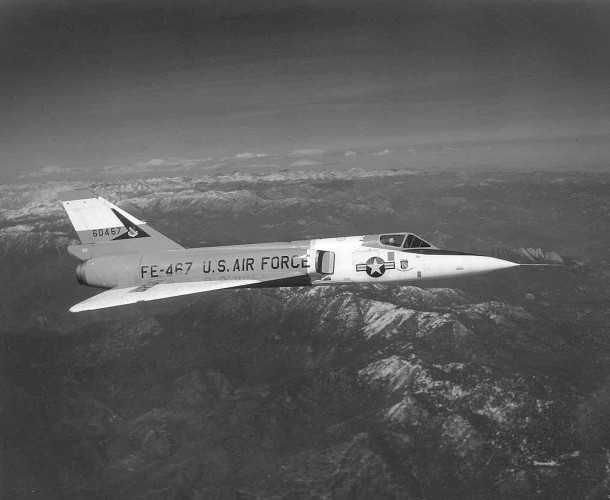
Fifty-six years ago this month, a USAF/Convair F-106A Delta Dart interceptor was clocked at 1,525.695 mph on an 11-mile straight course at Edwards Air Force Base, California. This mark still stands as an absolute speed record for a single-engine turbojet-powered aircraft.
The USAF/Convair F-106 Delta Dart was designed for the all-weather interceptor role in defense of CONUS. As such, the Delta Dart’s primary mission was to seek out Soviet bomber formations and destroy same using its internally-carried missiles. Armament consisted of either (1) a quartet of Hughes AIM-4 Falcon missiles and a single AIM-26A Falcon missile or (2) a single Douglas AIR-2 Genie missile.
A member of the fabled Century Series, the Delta Dart was produced in two variants. The single place version was known as the F-106A while the dual place version was designated as the F-106B. Though primarily a trainer, this aircraft was also combat-capable. A total of 340 Delta Dart aircraft were manufactured by Convair; 277 F-106A’s and 63 F-106B’s.
The F-106A Delta Dart measured 70.7 feet in length and had a wing span of 38.25 feet. Gross Take-Off Weight (GTOW) and Empty Weight were 34,510 lbs and 24,420 lbs, respectively. Power was supplied by a single Pratt and Whitney J75-17 afterburning turbojet which produced 24,500 lbs of thrust at sea level.
The sleek Delta Dart was aerodynamically very clean. This was due in large measure to use of fuselage area ruling and a thin delta planform wing. The F-106A could climb at 29,000 feet per minute and had a service ceiling of 57,000 feet. Maximum unrefueled range was on the order of 2,700 nm.
Due to its impressive performance, USAF employed the F-106A in an attempt to regain the single-engine absolute speed record from the Soviets in late 1959. The existing record of 1,483.84 mph had been established in 1956 by a Soviet Ye-66 aircraft specially designed for setting the speed mark. The Air Force’s absolute speed record attempt was codenamed Project Firewall.
USAF originally selected F-106A (S/N 56-0459) to make the 1959 absolute speed record attempt. The aircraft was modified slightly to optimize its speed performance. However, 56-0459 experienced engine compressor stall problems and did not set the actual record. Rather, an unmodified F-106A (S/N 56-0467) was called into service and set the speed record reported here.
On Tuesday, 15 December 1959, USAF Major Joseph W. Rogers departed Edwards Air Force Base in a quest to establish a new absolute speed record for a single-engine turbojet-powered aircraft. Flying at 40,000 feet, Rogers and his F-106A averaged 1,525.695 mph over an 11-mile straight course to set a new speed mark.
For his remarkable airmanship on Project Firewall, Joe Rogers was presented with the Distinguished Flying Cross, the DeLavaulx Medal, and the Thompson Trophy. Rogers went on to a remarkable military career spanning 29 years. He retired in 1975 as a full colonel.
For its part, the Delta Dart went on to a 28-year operational life (1959-1987) with the United States Air Force and the Air National Guard. Considered by many to be the finest interceptor in aviation history, the Delta Dart is known to this day as the Ultimate Interceptor.
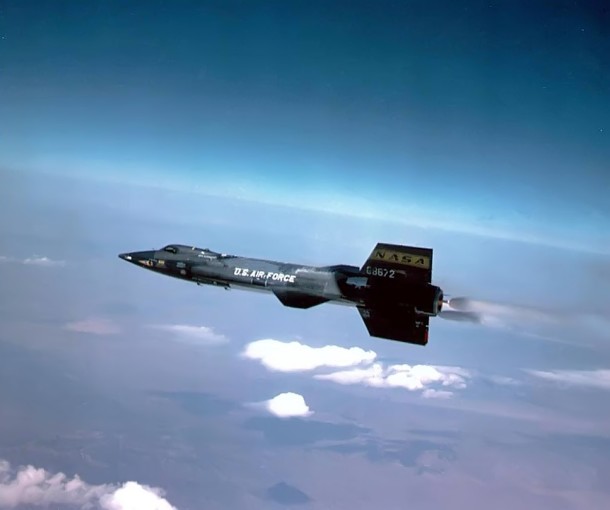
Forty-eight years ago this month, the No. 3 USAF/North American X-15 research aircraft broke-up during a steep dive from an apogee of 266,000 feet. The pilot, USAF Major Michael J. Adams, perished when his aircraft was ripped apart by aerodynamic forces as it passed through 65,000 feet at more than 2,500 mph.
The hypersonic X-15 was arguably the most productive X-Plane of all time. Between 1959 and 1968, a trio of X-15 aircraft were flown by a dozen pilots for a total of 199 official flight research missions. Along the way, the fabled X-15 established manned aircraft records for speed (4,534 mph; Mach 6.72) and altitude (354,200 feet).
The X-15 was a rocket, aircraft and spacecraft all rolled into one. Burning anhydrous ammonia and liquid oxygen, its XLR-99 rocket engine generated 57,000 lbs of sea level thrust. Reaction controls were required for flight in vacuum. Each flight also required careful management of aircraft energy state to ensure a successful, one attempt only, unpowered landing.
On Wednesday, 15 November 1967, the No. 3 X-15 (S/N 56-6672) made the 191st flight of the X-15 Program. In the cockpit was USAF Major Michael J. Adams making his 7th flight in the X-15. He had been flying the aircraft since October of 1966. Like all X-15 pilots, he was a skilled, accomplished test pilot used to dealing with the demands and high risk of flight research work.
X-15 Ship No. 3 was launched from its B-52B (S/N 52-0008) mothership over Nevada’s Delamar Dry Lake at 18:30 UTC. As the X-15 fell away from the launch aircraft at Mach 0.82 and 45,000 feet, Adams fired the XLR-99 and started uphill along a trajectory that was supposed to top-out around 250,000 feet. If all went well, Adams would land on Rogers Dry Lake at Edwards Air Force Base in California roughly 10 minutes later.
Around 85,000 on the way upstairs, Adams became distracted when an electrical disturbance from an onboard flight experiment adversely affected the X-15’s flight control system, flight computer and inertial reference system. As a result, data on several key cockpit displays became corrupted. Though with some difficulty, Adams pressed-on with the flight which peaked-out around 266,000 feet approximately three (3) minutes from launch.
As a result of degraded flight systems and perhaps disoriented by vertigo, Mike Adams soon discovered that his aircraft was veering from the intended heading. He indicated to the control room at Edwards that his steed was not controlling correctly. Passing through 230,000 feet, Adams cryptically radioed that he was in a Mach 5 spin. Mission control was stunned. There was nothing in the X-15 flight manual that even addressed such a possibility.
Incredibly, Mike Adams somehow managed to recover from his hypersonic spin as the X-15 passed through 118,000 feet. However, the aircraft was inverted and in a 45-degree dive at Mach 4.7. Still, Adams may very well have recovered from this precarious flight state but for the appearance of another flight system problem just as he recovered the X-15 from its horrific spin.
X-15 Ship No. 3 was configured with a Minneapolis-Honeywell adaptive flight control system (AFCS). Known as the MH-96, the AFCS was supposed to help the pilot control the X-15 during high performance flight. Unfortunately, the unit entered a limit-cycle oscillation just after spin recovery and failed to change gains as the dynamic pressure rapidly increased during Ship No. 3’s final descent. This anomaly saturated the X-15 flight control system and effectively overrode manual inputs from the pilot.
The limit-cycle oscillation drove the X-15’s pitch rate to intolerably-high values in the face of rapidly increasing dynamic pressure. Passing through 65,000 feet at better than 2,500 mph (Mach 3.9), Ship No. 3 came apart northeast of Johannesburg, California. The main wreckage impacted just northwest of Cuddeback Dry Lake. Mike Adams had made his final flight.
For his flight to 266,000 feet, USAF Major Michael J. Adams was posthumously awarded Astronaut Wings by the United States Air Force. His name was included on the roll of the Astronaut Memorial at Kennedy Space Center (KSC) in 1991. Finally, on Saturday, 08 May 2004, a small memorial was erected to the memory of Major Adams near his X-15 crash site situated roughly 39 miles northeast of Edwards Air Force Base.
Eleven years ago today, the NASA X-43A scramjet-powered flight research vehicle reached a record speed of over 6,600 mph (Mach 9.68). In doing so, the X-43A eclipsed its own record speed of Mach 6.83 (4,600 mph) and became the fastest airbreathing aircraft of all time.
In 1996, NASA initiated a technology demonstration program known as HYPER-X. The central goal of the HYPER-X Program was to successfully demonstrate sustained supersonic combustion and thrust production of a flight-scale scramjet propulsion system at speeds up to Mach 10.
Also known as the HYPER-X Research Vehicle (HXRV), the X-43A aircraft was a scramjet test bed. The aircraft measured 12 feet in length, 5 feet in width, and weighed close to 3,000 pounds. The X-43A was boosted to scramjet take-over speeds with a modified Orbital Sciences Pegasus rocket booster.
The combined HXRV-Pegasus stack was referred to as the HYPER-X Launch Vehicle (HXLV). Measuring approximately 50 feet in length, the HXLV weighed slightly more than 41,000 pounds. The HXLV was air-launched from a B-52 mothership. Together, the entire assemblage constituted a 3-stage vehicle.
The third and final flight of the HYPER-X program took place on Tuesday, 16 November 2004. The flight originated from Edwards Air Force Base, California. Using Runway 04, NASA’s venerable B-52B (S/N 52-0008) started its take-off roll at approximately 21:08 UTC. The aircraft then headed for the Pacific Ocean launch point located just west of San Nicholas Island.
At 22:34:43 UTC, the HXLV fell away from the B-52B mothership. Following a 5 second free fall, rocket motor ignition occurred and the HXLV initiated a pull-up to start its climb and acceleration to the test window. It took the HXLV 75 seconds to reach a speed of slightly over Mach 10.
Following rocket motor burnout and a brief coast period, the HXRV (X-43A) successfully separated from the Pegasus booster at 109,440 feet and Mach 9.74. The HXRV scramjet was operative by Mach 9.68. Supersonic combustion and thrust production were successfully achieved. Total engine-on duration was approximately 11 seconds.
As the X-43A decelerated along its post-burn descent flight path, the aircraft performed a series of data gathering flight maneuvers. A vast quantity of high-quality aerodynamic and flight control system data were acquired for Mach numbers ranging from hypersonic to transonic. Finally, the X-43A impacted the Pacific Ocean at a point about 850 nautical miles due west of its launch location. Total flight time was approximately 15 minutes.
The HYPER-X Program was now history. Supersonic combustion and thrust production of an airframe-integrated scramjet had indeed been achieved for the first time in flight; a goal that dated back to before the X-15 Program. Along the way, the X-43A established a speed record for airbreathing aircraft and earned several Guinness World Records for its efforts.
As a footnote to the X-43A story, the HYPER-X Flight 3 mission would also be the last for NASA’s fabled B-52B mothership. The aircraft that launched many of the historic X-15, M2-F2, M2-F3, X- 24A, X-24B and HL-10 flight research missions, and all three HYPER-X flights, would take to the air no more. In tribute, B-52B (S/N 52-0008) now occupies a place of honor at a point near the North Gate of Edwards Air Force Base.
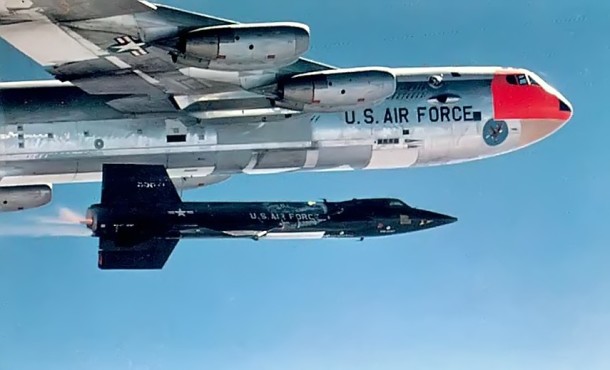
Fifty-four years ago this week, the USAF/NASA/North American X-15 became the first manned aircraft to exceed Mach 6. United States Air Force test pilot Major Robert M. White was at the controls of the legendary hypersonic flight research aircraft.
The North American X-15 was the first manned hypersonic aircraft. It was designed, engineered, constructed and first flown in the 1950’s. As originally conceived, the X-15 was designed to reach 4,000 mph (Mach 6) and 250,000 feet. Before its flight test career was over, the type would meet and exceed both performance goals.
North American built a trio of X-15 airframes; Ship No. 1 (S/N 56-6670), Ship No. 2 (56-6671) and Ship No. 3 (56-6672). The X-15 measured 50 feet in length, had a wing span of 22 feet and a GTOW of 33,000 lbs. Ship No. 2 would later be modified to the X-15A-2 enhanced performance configuration. The X-15A-2 had a length of 52.5 feet and a GTOW of around 56,000 lbs.
The Reaction Motors XLR-99 rocket engine powered the X-15. The small, but mighty XLR-99 generated 57,000 pounds of sea level thrust at full-throttle. It weighed only 910 pounds. The XLR-99 used anhydrous ammonia and LOX as propellants. Burn time varied between 83 seconds for the stock X-15 and about 150 seconds for the X-15A-2.
The X-15 was carried to drop conditions (typically Mach 0.8 at 42,000 feet) by a B-52 mothership. A pair of aircraft were used for this purpose; a B-52A (S/N 52-003) and a B-52B (S/N 52-008). Once dropped from the mothership, the X-15 pilot lit the XLR-99 to accelerate the aircraft. The X-15A-2 also carried a pair of drop tanks which provided propellants for a longer burn time than was possible with the stock X-15 flight.
The X-15 employed both aerodynamic and reaction flight controls. The latter were required to maintain vehicle attitude in space-equivalent flight. The X-15 pilot wore a full-pressure suit in consequence of the aircraft’s extreme altitude capability. The typical X-15 drop-to-landing flight duration was on the order of 10 minutes. All X-15 landings were performed deadstick.
On Thursday, 09 November 1961, USAF Major Robert M. White would fly his 11th X-15 mission. The X-15 and White had already become respectively the first aircraft and pilot to hit Mach 4 and Mach 5. On this particular day, White would be at the controls of X-15 Ship No. 2. The planned maximum Mach number for the mission was Mach 6.
At 17:57:17 UTC of the aforementioned day, X-15 Ship No. 2 was launched from the B-52B mothership commanded by USAF Captain Jack Allavie. Bob White lit the XLR-99 and pulled into a steep climb. Mid-way through the climb, White pushed-over and ultimately leveled-off at 101,600 feet. XLR-99 burnout occurred 83 seconds after ignition. At this point, White was traveling at 4,093 mph or Mach 6.04.
On this record flight, the X-15 was exposed to the most severe aerodynamic heating environment it had experienced to date. Decelerating through Mach 2.7, the right window pane on the X-15’s canopy shattered due to thermal stress. The glass pane remained intact, but White could not see out of it. Fortunately, he could see out of the left pane and made a successful deadstick landing on Rogers Dry Lake at Edwards AFB.
For his Mach 6+ flight, Bob White was a recipient of both the 1961 Collier Trophy and the Iven C. Kincheloe Award. The year before, White had received the Harmon Trophy for his X-15 flight test work. He would go on to fly the X-15 to a still-standing FAI altitude record of 314,750 feet in July of 1962. For this accomplishment, White was awarded USAF Astronaut Wings.
Bob White flew the X-15 a total of sixteen (16) times. He was one (1) of only twelve (12) men to fly the aircraft. White left X-15 Program and Edwards AFB in 1963. He went on to serve his country in numerous capacities as a member of the Air Force including flying 70 combat missions in Viet Nam. He returned to Edwards AFB as AFFTC Commander in August of 1970.
Major General Robert M. White retired from the United States Air Force in 1981. During his period of military service, he received numerous decorations and awards including the Air Force Cross, Distinguished Service Medal, Silver Star with three oak leaf clusters, Legion of Merit, Distinguished Flying Cross with four oak leaf clusters, Bronze Star Medal, and Air Medal with 16 oak leaf clusters.
Bob White was a true American hero. He was one of those heroes who neither sought nor received much notoreity for his accomplishments. He served his country and the aviation profession well. Bob White’s final flight occurred on Wednesday, 17 March 2010. He was 85 years of age.
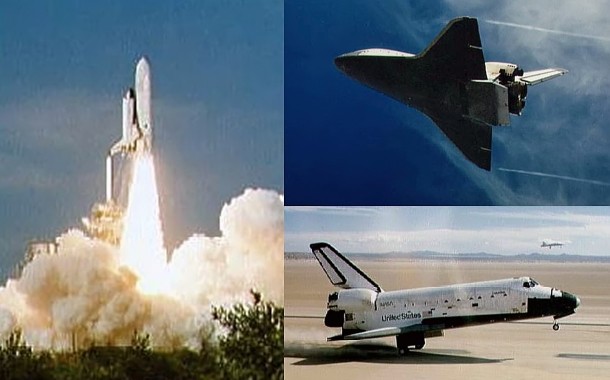
Thirty-four years ago this month, the Space Shuttle Columbia completed the second mission of the Space Shuttle Program. Designated STS-2, the mission marked the first reuse of a space vehicle for manned orbital flight.
America’s early manned spacecraft – Mercury, Gemini and Apollo – were single-flight vehicles. That is, a new spacecraft was required for each space mission. This was appropriate for meeting the aims of the early space program which concentrated on getting America to the moon before the end of the 1960’s.
The concept of space vehicle reusability came into vogue with the introduction of the Space Transportation System (STS). The original goal of the STS was to provide frequent and routine access to space via a fleet of Space Shuttle vehicles. For the STS to achieve economic viability, this meant flying a Space Shuttle once every two weeks. History records that this projected flight rate was much too optimistic.
The Space Shuttle vehicle was ultimately configured as a 3-element system consisting of (1) a winged orbiter, (2) a pair of solid rocket boosters (SRB’s) and (3) an external tank (ET). Both the orbiter and the SRB’s were designed to be reusable. The ET would be the only disposable element of the system since higher costs would be incurred in the recovery and refurbishment of this piece of flight hardware than in simply using a new one for each flight.
The Space Shuttle was designed to haul large payloads; on the order of 60,000 and 50,00 lbs into and out of orbit, respectively. With a maximum landing weight of 230,000 lbs, the Space Shuttle Orbiter needed wings to generate the required aerodynamic lift force. Wings were needed to satisfy the Orbiter’s 1,100-nm entry cross range requirement as well.
Following the successful first flight (STS-1) of the Space Shuttle Columbia in April of 1981, preparations began immediately to ready the Orbiter for its equally monumental second flight. The STS-2 flight crew would consist of Commander Joe Henry Engle and Pilot Richard Harrison Truly. STS-2 would be the first orbital spaceflight for both men.
On Thursday, 12 November 1981, the Space Shuttle Columbia lifted-off at 15:09:59 UTC from Cape Canaveral’s LC-39A. Ascent flight was nominal and Columbia was placed into a 125-nm x 120-nm orbit. At this point, Columbia became the first manned spacecraft to achieve Earth-orbit twice. It was an extra special occasion for Richard Truly inasmuch as it was his 44th birthday.
Engle and Truly anticipated 5-days in orbit with their orbital steed. However, one of Columbia’s three fuel cells failed early-on and the mission was reduced to just over two days. Nonetheless, the crew achieved 90 percent of the mission’s goals. They even remained awake during a scheduled sleep period to exercise the new Canadian Remote Manipulator System (RMS).
On Saturday, 14 November 1981, Columbia and her crew successfully completed STS-2 by landing on Rogers Dry Lake at Edwards Air Force Base, California. Main gear touchdown occurred at 21:23:11 UTC. Joe Engle flew the entire reentry manually. He holds the distinction of being the only pilot to manually fly a lifting space vehicle all the way from orbit to landing. Engle completed a total of 29 Programmed Test Input (PTI) aerodynamic maneuvers in the process.
STS-2 was a monumental success. Columbia became the first space vehicle to be reused for manned orbital space operations. Other Orbiters would follow including Challenger, Atlantis, Discovery and Endeavor. The final mission of the Space Shuttle Program (STS-135) was flown by Atlantis in July 2011.
As a footnote, Joe Engle went on to command one more Space Shuttle mission in 1985 (STS-51I). He retired from the USAF in November of 1986. Richard Truly served as Commander of STS-8 in 1983. That mission featured the first night launch and landing of the Space Shuttle. Richard Truly also served as NASA Administrator from May of 1989 to May of 1992.
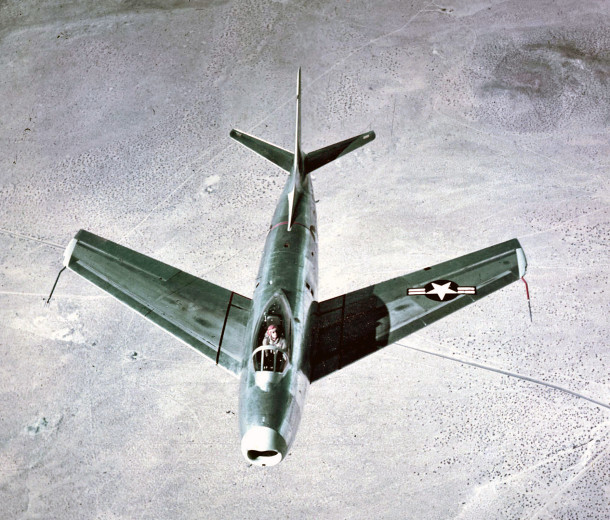
Sixty-eight years ago this month, the swept-wing XP-86, the initial version of the famed USAF/North America F-86 Sabre, began flight testing at what is now Edwards Air Force Base. The popular Mig Alley legend would be produced in numerous variants and ultimately rack-up a total production run of nearly 10,000 aircraft worldwide.
In the waning days of World War II, the United States Army Air Force (USAAF) issued the requirements for a new high-speed, jet-powered fighter/interceptor aircraft. North American Aviation (NAA) captured the USAAF’s attention with a prototype swept-wing aircraft known as the XP-86. The “X” designation was shorthand for Experimental while the “P” stood for Pursuit.
The XP-86 (later designated as the XF-86 where “F” stood for Fighter) was the first United States fighter to incorporate wing sweep. The key benefit derived from sweeping the wings was to greatly reduce transonic wave drag. Based on aerodynamics data captured from the defeated Third Reich, NAA engineers designed the XF-86 with a wing sweep of 35 degrees.
A drawback to using wing sweep is that low-speed flight characteristics are adversely affected. The principal detrimental effect being a reduction in lift. However, NAA solved this problem by the incorporation of leading edge slats to enhance lift production at low speed.
The XF-86 measured roughly 37-feet both in length and wingspan. Empty weight was some 12,000 lbs. Power was provided by a Chevrolet J35-C-3 turbojet that generated a paltry 3,750 pounds of thrust. Later variants of the Sabre would be powered by jet engines generating nearly 10,000 pounds of thrust.
On Wednesday, 01 October 1947, XF-86 No. 1 took to the air for the first time from Muroc Army Air Field, California. USAAF Major and WW II 16-kill ace George S. “Wheaties” Welch was at the controls of the XF-86. Intestingly, the historical record strongly suggests that Welch exceeded the speed of sound during a dive on that first flight test.
The case of George Welch is an intriguing sub-plot of the F-86 Sabre story. Welch was stationed at Pearl Harbor on 07 December 1941. He was one of the very few American pilots to get in the air and fight the attacking Japanese forces. Numerically overwhelmed, he nontheless splashed four (4) enemy aircraft and lived to fly and fight another day.
Welch served three (3) combat tours in WW II for a total of 348 combat missions. After leaving the service in 1944, he joined North American Aviation as a test pilot. Welch progressed quickly and became NAA’s Chief Test Pilot. This path ultimately led to Welch flight testing the XP-86 Sabre.
Although denied verification in official Air Force records, both oral history and strong circumstantial evidence points to the high likelihood that Welch exceeded Mach 1 at least twice before the Bell XS-1 did so on Tuesday, 14 October 1947.
Incredibly, the first instance of Welch and the XF-86 exceeding Mach 1 was on the occasion of its first flight test! Welch dove the aircraft from 35,000 feet and reportedly generated a weak sonic boom.
The second instance of Mach 1 exceedance reportedly occurred on Tuesday, 14 October 1947. This time Welch dove the XF-86 from 37,000 feet and generated a stronger sonic boom. Apparently, this event took place just before the Bell XS-1, with USAAF Major Charles E. “Chuck” Yeager at the controls, achieved Mach 1.06 later that same morning.
Welch was never officially credited with being the first to achieve supesonic flight. A number of reasons account for this circumstance. First, his aircraft was not instrumented properly to verify flight performance at quasi-supersonic speeds. Additionally, Welch’s aircraft was not tracked by radar.
In addition to the technical reasons cited above, there was political intrigue surrounding Welch’s supersonic dive flights as well. NAA (and thus Welch) had been ordered not to exceed Mach 1 before the rocket-powered Bell XS-1 did so. Perhaps the only concession accorded Welch was that USAF later referred to Yeager’s historic superonic flight as the first time the sound barrier was broken in level flight.
George Welch went on to a distinguished, but all too brief flight test career. On Monday, 25 May 1953, he became the first man to exceed Mach 1 in level flight in a jet-powered production aircraft. That aircraft was the North American F-100 Super Sabre. Welch perished on Tuesday, 12 October 1954 when his YF-100A went out of control and distintegrated during a 7-g pull-up at Mach 1.55.
For its part, the F-86 Sabre ultimately served long and well in the air forces of the United States and a host of other western-friendly nations. Perhaps its greatest claim to fame accrues from the type’s remarkable aerial combat perfromance in the Korean War. Indeed, despite being numerically bested by Soviet-built MIG-15 aircraft, the official record shows that USAF pilots made 792 kills flying the Sabre. Compared with 76 kills made by the opposition, the Sabre registered a phenomenal 10:1 kill ratio.
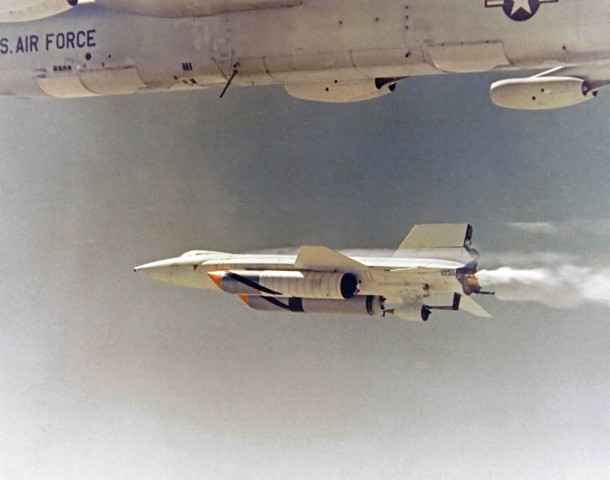
Forty-eight years ago this month, USAF Major William J. “Pete” Knight piloted the fabled USAF/North American X-15A-2 hypersonic research aircraft to a record speed of 4,520 mph – about a mile and a quarter per second.
North American’s original X-15 production run consisted of three (3) aircraft. The X-15A-2 was a rebuild of the 2nd airframe (S/N 56-6671) which had been severely damaged during an emergency landing at Mud Lake, Nevada in November of 1962.
The rebuilt aircraft was configured with a pair of droppable propellant tanks that allowed the type’s XLR-99 rocket engine to operate 60 seconds beyond the stock X-15’s 80-second burn time. Among other modifications, the aircraft also carried a pylon-mounted dummy ramjet in the ventral region of the aft fuselage.
With the addition of the external propellant tanks, the X-15A-2 was really a three-stage vehicle. The first stage was the NASA NB-52B mothership which launched the X-15 at Mach 0.82 and 45,000 feet. The second stage consisted of the propellant-laden external tanks which were jettisoned at Mach 2.0 and 70,000 feet. The third stage was the X-15A-2 with its entire internal propellant load.
Due to the increased speed of the X-15A-2, the aircraft was covered with Martin MA-25S ablator to protect it from the higher aerodynamic heating loads. The baseline ablator was pink in color and gave the X-15A-2 a rather odd appearance. Fortunately, application of a white wear/sealer over the ablator gave the aircraft a more dignified look.
On Tuesday, 03 October 1967, Pete Knight and the X-15A-2 dropped away from the NB-52B (S/N 52-008) at the start of the X-15 Program’s 188th mission. Knight ignited the XLR-99 rocket engine and excuted a pull-up followed by a pushover to level flight at a little over 102,000 feet. Aircraft speed at XLR-99 burnout was 4,520 mph (Mach 6.7).
As the aircraft decelerated following burnout, Knight executed a series of pre-planned flight maneuvers to acquire vital aerodynamics data. However, passing through Mach 5.5, he received an indication in the cockpit that a high temperature condition existed in the XLR-99 engine bay.
Knight attempted to jettison the aircraft’s remaining propellants, but to no avail. The jettison tubes were welded shut by whatever was happening in the engine bay. This meant he would land heavier and faster than usual. Fortunately, Knight’s piloting skills allowed him to get the X-15A-2 on to Rogers Dry Lake in one piece.
As flight support personnel inspected the X-15A-2 airframe following Knight’s emergency landing, they were alarmed at what they found. The aft ventral region of the aircraft had incurred significant thermal damage. Further, the dummy ramjet was gone.
As reported in the classic NASA document, TM-X-1669, higher-than-expected aerodynamic heating levels were responsible for the damage to the X-15A-2.
First, shock wave/boundary layer interaction heating on the lower fuselage just ahead of the pylon (1) completely destroyed the ablator in that region and (2) penetrated the Inconel-X airframe structure. This introduced very high temperature air into the X-15 engine bay.
Second, impingement of the dummy ramjet nose shock on the detached bow shock coming off of the pylon produced a shear layer that focused on the pylon leading edge. The resulting heating rates were of sufficient magnitude and duration to both burn away the pylon ablator and burn through the pylon structure. The weakened pylon structural attachment eventually failed and the dummy ramjet departed the main airframe.
Pete Knight will forever hold the record for the fastest X-15 flight. However, the X-15A-2 never flew again. Only 11 more flights remained in the X-15 Program at the time. A lack of time and funding meant that little was to be gained by repairing the thermally-damaged aircraft.
As for the final disposition of the X-15A-2 (S/N 56-6671), the aircraft’s remaining ablator was removed with its external surface cleaned-up and original markings restored. The aircraft now resides in a place of honor at the National Museum of the United States Air Force located at Wright-Patterson AFB in Dayton, Ohio.
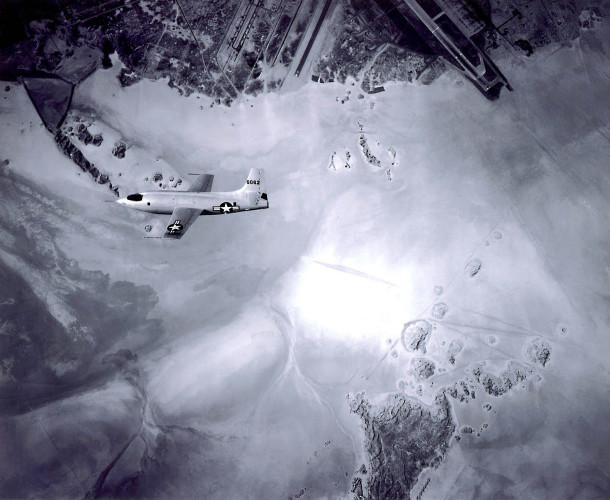
Sixty-eight years ago this week, the legendary USAF/Bell XS-1 experimental aircraft exceeded the speed of sound when it reached a maximum speed of 700 mph (Mach 1.06) at 45,000 feet.
Bell Aircraft Corporation of Buffalo, New York built three copies of the XS-1 under contract to the United States Army Air Forces (USAAF). The aircraft were designed to approach and then fly beyond the speed of sound.
The Bell XS-1 was 31-feet in length and had a wing span of 28 feet. Gross take-off weight was around 12,500 lbs. The aircraft had an empty weight of about 7,000 lbs. Propulsion was provided by a Reaction Motors XLR-11 rocket motor capable of generating a maximum thrust of 6,000 lbs.
On the morning of Tuesday, 14 October 1947, the XS-1 (S/N 46-062) dropped away from its B-29 mothership (S/N 45-21800 ) as the pair flew at 220 mph and 20,000 feet. In the XS-1 cockpit was USAAF Captain and World War II ace Charles E. Yeager. The young test pilot had named the aircraft Glamorous Glennis in honor of his wife.
Following drop, Yeager sequentially-lit all four XLR-11 rocket chambers during a climb and push-over that ultimately brought him to level flight around 45,000 feet. The resulting acceleration profile propelled the XS-1 slightly beyond Mach 1 for about 20 seconds. Yeager then shutdown the rocket, decelerated to subsonic speeds, and landed the XS-1 on Muroc Dry Lake at Muroc Army Airfield, California.
The world would not find out about the daring exploits of 14 October 1947 until December of the same year. As it was, the announcement came from a trade magazine that even today is sometimes referred to as “Aviation Leak”.
Today, Glamorous Glennis is prominently displayed in the Milestones of Flight hall of the National Air and Space Museum located in Washington, DC. For his intrepid piloting efforts in breaking the sound barrier, Chuck Yeager was a co-recipient of the 1948 Collier Trophy.
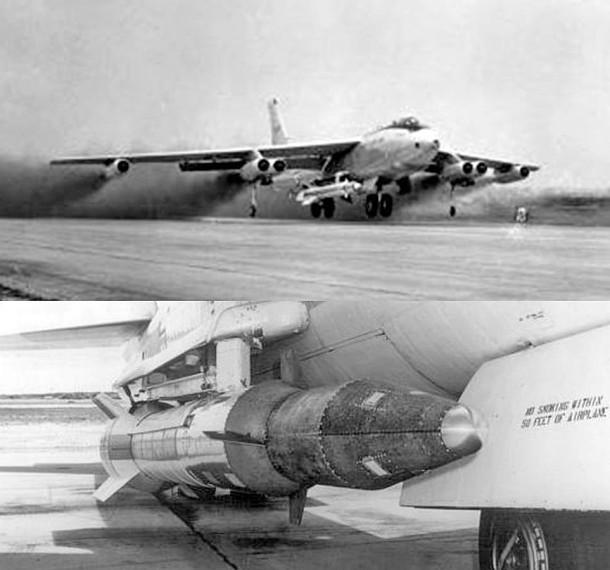
Fifty-six years ago this month, the USAF Bold Orion air-launched ballistic missile performed a successful intercept of the Explorer VI satellite. This event marked the first time in history that a endoatmospherically-launched missile intercepted a target vehicle in space.
Bold Orion was a 1950’s-era air-launched ballistic missile (ALBM) prototype developed by Martin Aircraft for the United States Air Force (USAF). It was part of USAF’s Weapons System 199 (WS-199) research and development program. The goal of WS-199 was to develop technology to be used in emerging strategic weapons systems by the Strategic Air Command (SAC).
The Bold Orion was developed using components obtained from existing missile systems as a cost savings measure. The missile was initially configured as a single stage vehicle. Power was provided by a Thiokol TX-20 Sergeant solid rocket motor. However, preliminary flight tests showed that the vehicle lacked sufficient kinematic performance. The addition of an ABL X-248 Altair solid rocket motor made Bold Orion a two-stage vehicle.
The two-stage Bold Orion configuration was 37 feet in length and had a maximum diameter of 31 inches. The vehicle was air-launched from a USAF/Boeing B-47 Stratojet aircraft. Missile launch occurred while the carrier aircraft executed a zoom climb maneuver. The option was available to fly either a maximum range endoatmospheric mission (about 1,000 nm) or achieve exoatmospheric altitudes as high as 150 nm.
The Bold Orion flight test program consisted of a dozen missions. The first six of these were single-stage vehicles which were flown between May and November of 1958. The remaining rounds were two-stage configurations which were tested between December of 1958 and October of 1959. All missions were air-launched off the coast of Florida and flown down the Eastern Test Range.
Bold Orion’s grandest moment came on the occasion of its final flight. The goal was to test the vehicle’s ability to perform in the anti-satellite (ASAT) role. The Explorer VI satellite served as the mission target. A direct hit was not required since a tactical interceptor would be configured with a nuclear warhead. Detonation of the nuclear device within several miles of the target would be sufficient to destroy it.
Bold Orion’s ASAT mission occurred on Tuesday, 13 October 1959. Launch took place within the Atlantic Missile Range Drop Zone (AMR DZ). The altitude, latitude and longitude of the drop point were 35,000 feet, 29 deg North and 79 deg West, respectively. Bold Orion successfully intercepted the Explorer VI satellite, passing its target at a range of less than 3.5 nm and an altitude of 136 nm.
The Bold Orion ASAT test marked the first interception of a satellite in space and verified the feasibility of an ASAT system. However, negative political ramifications came along with technical success. Specifically, the Eisenhower Administration intended to keep space neutral. Bold Orion’s overtones of hostile intent did not play well with that mandate. As a result, ASAT development within the United States was halted not long after Bold Orion’s final mission.
Bold Orion’s success gave USAF the flight experience and technology to develop the Skybolt ALBM. Known as GAM-87, this two-stage missile sported a W59 thermonuclear warhead with a yield of 1.2 megatons. A quartet of pylon-mounted Skybolt missiles would be carried by and air-launched from a USAF/Boeing B-52H Stratofortress. While Skybolt’s kinematic performance was impressive, test problems and the development of the Submarine-Launched Ballistic Missile (SLBM) ultimately led to its cancellation.
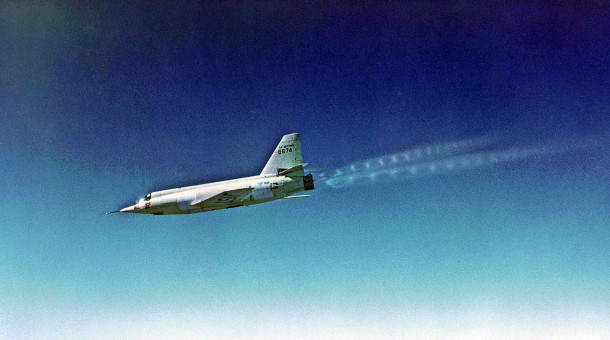
Fifty-nine years ago yesterday, the No. 1 USAF/Bell X-2 rocket-powered flight research aircraft reached a record speed of 2,094 mph with USAF Captain Milburn G. “Mel” Apt at the controls. However, victory quickly turned to tragedy when the aircraft departed controlled flight, crashed to destruction, and Apt perished.
Mel Apt’s historic achievement came about because of the Air Force’s desire to have the X-2 reach Mach 3 before turning it over to the National Advisory Committee For Aeronautics (NACA) for further flight research testing. Just 20 days prior to Apt’s flight in the X-2, USAF Captain Iven C. Kincheloe, Jr. had flown the aircraft to a record altitude of 126,200 feet.
On Thursday, 27 September 1956, Apt and the X-2 (Ship No. 1, S/N 46-674) dropped away from the USAF B-50 motherhip at 30,000 feet and 225 mph. Despite the fact that Mel Apt had never flown an X-aircraft, he executed the flight profile exactly as briefed. In addition, the X-2′s twin-chamber XLR-25 rocket motor burned propellant 12.5 seconds longer than planned. Both of these factors contributed to the aircraft attaining a speed in excess of 2,000 mph.
Apt and his aerial steed hit a peak Mach number of 3.2 at an altitude of 65,000 feet. Based on previous flight tests as well as flight simulator sessions, Apt knew that the X-2 had to slow to roughly Mach 2.4 before turning the aircraft back to Edwards. This was due to degraded directional stability, control reversal, and aerodynamic coupling issues that adversely affected the X-2 at higher Mach numbers.
However, Mel Apt was now faced with a difficult decision. If he waited for the X-2 to slow to Mach 2.4 before initiating a turn back to Edwards Air Force Base, he quite likely would not have enough energy and therefore range to reach Rogers Dry Lake. On the other hand, if he decided to initiate the turn back to Edwards at high Mach number, he risked having the X-2 depart controlled flight. Flying in a coffin corner of the X-2’s flight envelope, Apt opted for the latter.
As Apt increased the aircraft’s angle-of-attack, the X-2 departed controlled flight and subjected him to a brutal pounding. Aircraft lateral acceleration varied between +6 and -6 g’s. The battered pilot ultimately found himself in a subsonic, inverted spin at 40,000 feet. At this point, Apt effected pyrotechnic separation of the X-2′s forebody which contained the cockpit and a drogue parachute.
X-2 forebody separation was clean and the drogue parachute deployed properly. However, Apt still needed to bail out of the X-2′s forebody and deploy his personal parachute to complete the emergency egress process. However, it was not to be. Mel Apt ran out of time, altitude, and luck. The young pilot lost his life when the X-2 forebody from which he was trying to escape impacted the ground at a speed of one hundred and twenty miles an hour.
Mel Apt’s flight to Mach 3.2 established a record that stood until the X-15 exceeded it in August 1960. However, the price for doing so was very high. The USAF lost a brave test pilot and the lone remaining X-2 on that fateful day in September 1956. The mishap also ended the USAF X-2 Program. NACA never did conduct flight research with the X-2.
However, for a few terrifying moments, Mel Apt was the fastest man alive.