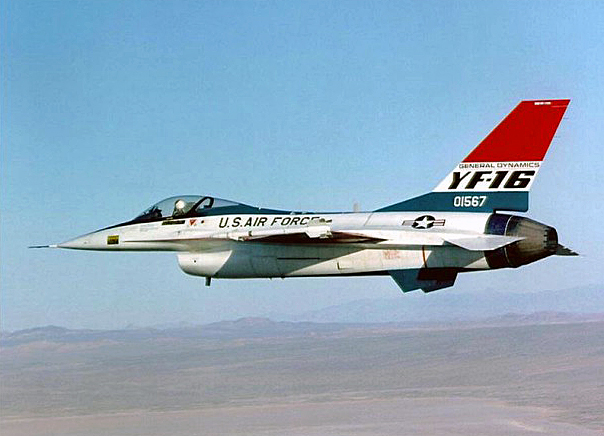
Forty-two years ago this week, the USAF/General Dynamics YF-16 Lightweight Fighter (LWF) took to the air on its first official flight with General Dynamics test pilot Phil Oestricher at the controls. The YF-16 would go on to win the Air Combat Fighter competition following a head-to-head fly-off with Northrop’s YF-17 Cobra.
The YF-16 was General Dynamics entry into the USAF Lightweight Fighter Program of the 1970’s. Its basic design was based on USAF Colonel John Boyd’s Energy Maneuverability (EM) Theory which posits that an aircraft with superior energy capability will defeat an aircraft of lesser energy capability in air combat. To achieve such, EM Theory dictated a small, lightweight aircraft having a high thrust-to-weight ratio, which permitted high-g maneuvering at minimum energy loss. The YF-16 was an embodiment of this requirement.
The official first flight of the YF-16 (S/N 72-1567) took place on Saturday, 02 February 1974 at Edwards Air Force Base, California. General Dynamics test pilot Phil Oestricher (pronounced Ohl-Striker) did the piloting honors. The nimble aircraft performed very well and was a delight to fly. Oestricher landed uneventfully following a brief test hop that saw the YF-16 reach 400 mph and 30,000 feet.
Interestingly, the real first flight (historically known as Flight 0) of the YF-16 inadvertently occurred on Sunday, 20 January 1974 during what was supposed to be a high-speed taxi test. As the aircraft accelerated rapidly down the runway, Oestricher raised the nose slightly and applied aileron control to check lateral response. To the pilot’s surprise, the aircraft entered a roll oscillation with amplitudes so high that the left wing and right stabilator alternately struck the surface of the runway.
As Oestricher desperately fought to maintain control of his wild steed, the situation became increasingly dire as the YF-16 began to veer to the left. Realizing that going into the weeds at high speed was a prescription for disaster, the test pilot quickly elected to jam the throttle forward and attempt to get the YF-16 into the air. The outcome of this decision was not immediately obvious as Oestricher continued to struggle for control while waiting for his airspeed to increase to the point that there was lift sufficient for flight.
When the YF-16 finally became airborne, it departed the runway on a heading roughly 45 degrees to the left of the centerline. Oestricher somehow maintained control of the aircraft during the rugged lift-off and early climbout phases of flight. The pilot then successfully executed a go-around, entry into final approach, and landing back on the departure runway. A tough way to earn a day’s pay!
History records that the YF-16 went on to win the Air Combat Fighter (ACF) competition with Northrop’s YF-17 Cobra. The production aircraft became known as the F-16 Fighting Falcon, of which more than 4,500 aircraft, in numerous variants, were built between 1976 and 2010. The now-famous aircraft has clearly fulfilled the measure of its creation as evidenced by its presence in the military inventory of more than 25 countries worldwide. Significantly, America’s Ambassadors in Blue, The United States Air Force Thunderbirds, have flown the F-16 in aerial demonstrations worldwide since 1983.
While its initial foray into the air did not necessarily lend confidence that such would be the case, the YF-16 did survive its flight test career. Aviation aficionados may view the actual aircraft at the Virginia Air and Space Center located in Hampton, Virginia.
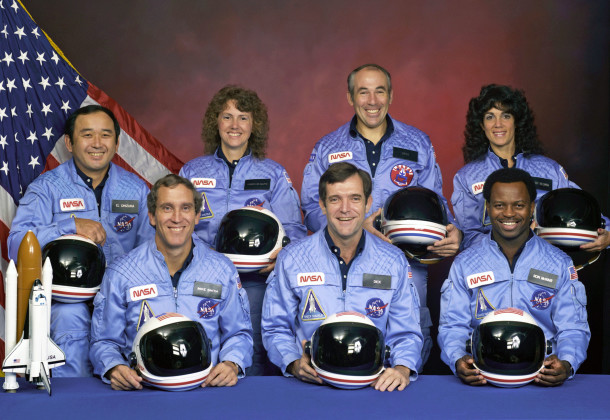
Thirty years ago today, the seven member crew of STS-51L were killed when the Space Shuttle Challenger disintegrated 73 seconds after launch from LC-39B at Cape Canaveral, Florida. The tragedy was the first fatal in-flight mishap in the history of American manned spaceflight.
In remarks made at a memorial service held for the Challenger Seven in Houston, Texas on Friday, 31 January 1986, President Ronald Wilson Reagan expressed the following sentiments:
“The future is not free: the story of all human progress is one of a struggle against all odds. We learned again that this America, which Abraham Lincoln called the last, best hope of man on Earth, was built on heroism and noble sacrifice. It was built by men and women like our seven star voyagers, who answered a call beyond duty, who gave more than was expected or required and who gave it little thought of worldly reward.”
We take this opportunity to remember the noble fallen:
Francis R. (Dick) Scobee, Commander
Michael John Smith, Pilot
Ellison S. Onizuka, Mission Specialist One
Judith Arlene Resnik, Mission Specialist Two
Ronald Erwin McNair, Mission Specialist Three
S.Christa McAuliffe, Payload Specialist One
Gregory Bruce Jarvis, Payload Specialist Two
Speaking for grieving families and countrymen, President Reagan closed his eulogy with these words:
“Dick, Mike, Judy, El, Ron, Greg and Christa – your families and your country mourn your passing. We bid you goodbye. We will never forget you. For those who knew you well and loved you, the pain will be deep and enduring. A nation, too, will long feel the loss of her seven sons and daughters, her seven good friends. We can find consolation only in faith, for we know in our hearts that you who flew so high and so proud now make your home beyond the stars, safe in God’s promise of eternal life.”
Tuesday, 28 January 1986. We Remember.
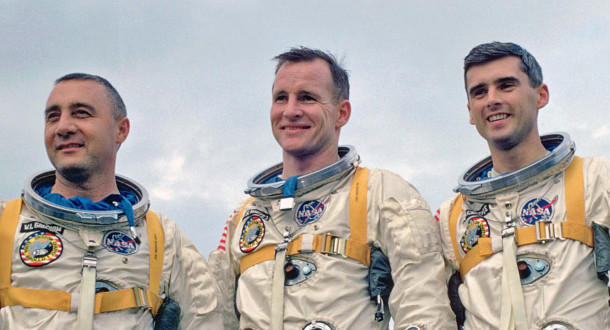
Forty-nine years ago today, the Apollo 204 prime crew perished as fire swept through their Apollo Block I Command Module (CM). The Apollo 204 crew of Command Pilot Vigil I. “Gus” Grissom, Senior Pilot Edward H. White II and Pilot Roger B. Chaffee had been scheduled to make the first manned flight of the Apollo Program some three weeks hence.
On Friday, 27 January 1967, during a plugs-out ground test on LC-34 at Cape Canaveral, Florida, a fire broke out in the Apollo 204 spacecraft at 23:31:04 UTC (6:31:04 pm EST). Shortly after, a chilling cry was heard across the communications network from Astronaut Chaffee: “We’ve got a fire in the cockpit”.
Believed to have started just below Grissom’s seat, the fire quickly erupted into an inferno that claimed the men’s lives in less than 30 seconds. While each received extensive 3rd degree burns, death was attributed to toxic smoke inhalation.
The Apollo 204 fire was most likely brought about by some minor malfunction or failure in equipment or wire insulation. This failure, which was never positively identified, initiated a sequence of events that culminated in the conflagration.
The post-mishap investigation uncovered numerous defects in CM Block I design, manufacturing, and workmanship. The use of a (1) pure oxygen atmosphere pressurized to 16.7 psia and (2) complex 3-component hatch design (that took a minimum of 90 seconds to open) sealed the astronauts’ fate.
A haunting irony of the tragedy is that America lost her first astronaut crew, not in the sideral heavens, but in a spacecraft that was firmly rooted to the ground.
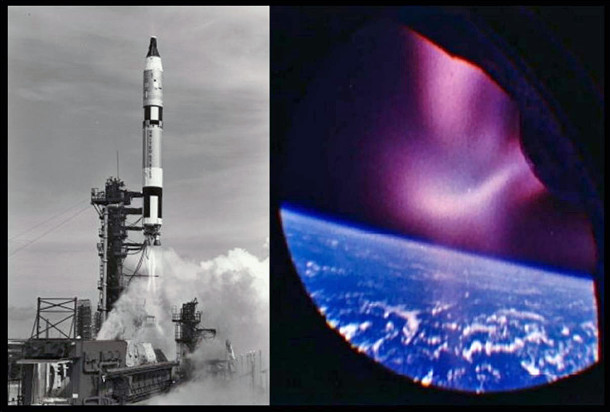
Fifty-one years ago to the day, NASA successfully completed the unmanned Gemini-Titan 2 (GT-2) space mission. The suborbital spaceflight served as a final test that cleared the way for the first manned Gemini orbital mission (GT-3) flown several months later.
The Gemini Program was America’s second manned space project. Gemini pioneered key technologies required to land men on the Moon including space navigation, rendezvous, docking, orbital maneuvering, long-duration spaceflight and extra-vehicular activity (EVA). Without Gemini, the United States would not have achieved the goal of landing men on the Moon before the end of the 1960’s.
The two-man Gemini spacecraft weighed 8,500 pounds at lift-off and measured 18.6 feet in length. Gemini consisted of a reentry module (RM), an adapter module (AM) and an equipment module (EM).
The crew occupied the RM which also contained ships’ navigation, communication, telemetry, electrical and reentry reaction control systems. The AM contained maneuver thrusters and the deboost rocket system. The EM included the spacecraft orbital attitude control thrusters and the fuel cell system. Both the AM and EM were used in orbit only and discarded prior to entry.
A two-stage Titan II launch vehicle served as the chariot that Gemini rode into space. Designed for the Intercontinental Ballistic Missile (ICBM) role, the native reliability of the Titan II had to be substantially improved for the vehicle to safely carry men into space. The history of spaceflight records that the man-rated Titan II truly fulfilled the measure of its creation by successfully launching ten (10) Gemini crews into earth orbit.
Gemini-Titan (GT-2) was the second and last unmanned flight test of the Gemini spacecraft. Since the primary goal was to flight-prove the craft’s heat shield performance during reentry, the mission was suborbital in nature. GT-2 lifted-off from Cape Canaveral’s LC-19 at 14:22:14 UTC on Tuesday, 19 January 1965. The vehicle’s arcing ballistic trajectory took it over the Atlantic Ocean on a flight that lasted only 18 minutes and 16 seconds. Maximum altitude and impact range were 92.4 nm and 1,847.5 nm, respectively.
Gemini 2’s ablative heat shield functioned as designed and came through the fiery reentry in excellent condition. Most of the spacecraft’s other flight systems performed satisfactorily during the vehicle’s brief sojourn into the heavens. Exceptions here included the fuel cell system which failed prior to lift-off and cooling system temperatures which exceeded design requirements.
Gemini 2’s splashdown point was situated approximately 45 nm from the USS Lake Champlain. About 90 minutes after splashdown, Gemini 2 was hauled aboard the recovery ship. Engineers found that the spacecraft came through the flight in such good shape that it actually flew a second suborbital reentry in November of 1966. Along with the OPS 0855 boilerplate spacecraft, the Gemini 2 reentry module was flown aboard a Titan IIIC launch vehicle in support of the USAF Manned Orbiting Laboratory (MOL) Program.
The successful completion of GT-2 (along with the previous GT-1 orbital mission) provided NASA with the confidence needed to proceed with manned Gemini missions. The first of ten (10) such missions, GT-3, was successfully flown in March of 1965. A mere 20 months later (December 1966), the Gemini Program was brought to a successful conclusion with the splashdown of Gemini 12.
The Gemini Program was remarkable for its many significant and historic spaceflight achievements that paved the way to the moon. The brief mission of Gemini-Titan 2 was a small, but important part of that larger story. Today, aerospace aficionados can view the twice-flown Gemini 2 reentry module at the Air Force Space and Missile Museum, Cape Canaveral, Florida.
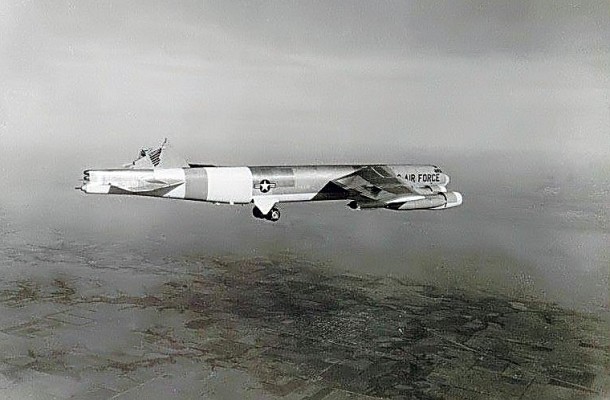
Fifty-two years ago this week, a USAF/Boeing B-52H Stratofortress landed safely following structual failure of its vertical tail during an encounter with unusually severe clear air turbulence. The harrowing incident occurred as the aircraft was undergoing structural flight testing in the skies over East Spanish Peak, Colorado.
Turbulence is the unsteady, erratic motion of an atmospheric air mass. It is attributable to factors such as weather fronts, jet streams, thunder storms and mountain waves. Turbulence influences the motion of aircraft that are subjected to it. These effects range from slight, annoying disturbances to violent, uncontrollable motions which can structurally damage an aircraft.
Clear Air Turbulence (CAT) occurs in the absence of clouds. Its presence cannot be visually observed and is detectable only through the use of special sensing equipment. Hence, an aircraft can encounter CAT without warning. Interestingly, the majority of in-flight injuries to aircraft crew and passengers are due to CAT.
On Friday, 10 January 1964, USAF B-52H (S/N 61-023) took-off from Wichita, Kansas on a structural flight test mission. The all-Boeing air crew consisted of instructor pilot Charles Fisher, pilot Richard Curry, co-pilot Leo Coors, and navigator James Pittman. The aircraft was equipped with accelerometers and other sensors to record in-flight loads and stresses.
An 8-hour flight was scheduled on a route that from Wichita southwest to the Rocky Mountains and back. The mission called for 10-minutes runs of 280, 350 and 400 KCAS at 500-feet AGL using the low-level mode of the autopilot. The initial portion of the mission was nominal with only light turbulence encountered.
However, as the aircraft turned north near Wagon Mound, New Mexico and headed along a course parallel to the mountains, increasing turbulence and tail loads were encountered. The B-52H crew then elected to discontinue the low level portion of the flight. The aircraft was subsequently climbed to 14,300 feet AMSL preparatory to a run at 350 KCAS.
At approximately 345 KCAS, the Stratofortress and its crew experienced an extreme turbulence event that lasted roughly 9 seconds. In rapid sequence the aircraft pitched-up, yawed to the left, yawed back to the right and then rolled right. The flight crew desperately fought for control of their mighty behemoth. But the situation looked grim. The order was given to prepare to bailout.
Finally, the big bomber’s motion was arrested using 80% left wheel authority. However, rudder pedal displacement gave no response. Control inputs to the elevator produced very poor response as well. Directional stability was also greatly reduced. Nevertheless, the crew somehow kept the Stratofortress flying nose-first.
The B-52H crew informed Boeing Wichita of their plight. A team of Boeing engineering experts was quickly assembled to deal with the emergency. Meanwhile, a Boeing-bailed F-100C formed-up with the Stratofortress and announced to the crew that most of the aircraft’s vertical tail was missing! The stricken aircraft’s rear landing was then deployed to add back some directional stability.
With Boeing engineers on the ground working with the B-52H flight crew, additional measures were taken in an effort to get the Stratofortress safely back on the ground. These measures included a reduction in airspeed, controlling aircraft center-of-gravity via fuel transfer, judicious use of differential thrust, and selected application of speedbrakes.
Due to high surface winds at Wichita, the B-52H was vectored to Eaker AFB in Blytheville, Arkansas. A USAF/Boeing KC-135 was dispatched to escort the still-flying B-52H to Eaker and to serve as an airborne control center as both aircraft proceeded to the base. Amazingly, after flying 6 hours sans a vertical tail, the Stratofortress and her crew landed safely.
Safe recovery of crew and aircraft brought additional benefits. There were lots of structural flight test data! It was found that at least one gust in the severe CAT encounter registered at nearly 100 mph. Not only were B-52 structural requirements revised as a result of this incident, but those of other existing and succeeding aircraft as well.
B-52H (61-023) was repaired and returned to the USAF inventory. It served long and well after its close brush with catastrophy in January 1964. The aircraft spent the latter part of its flying career as a member of the 2nd Bomb Wing at Barksdale AFB, Louisiana. The venerable bird was retired from active service in July of 2008.
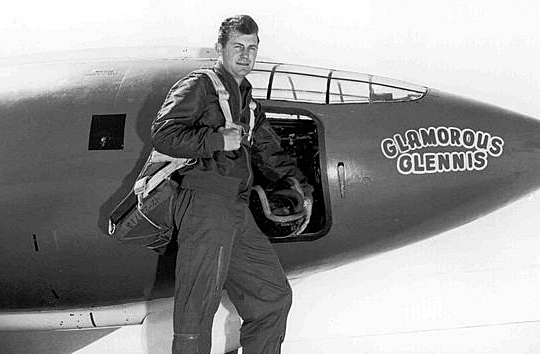
Sixty-seven years ago today, the USAF/Bell XS-1 became the first aircraft of any type to achieve supersonic flight during a climb from a ground take-off. The daring feat took place at Muroc Air Force Base with USAF Captain Charles E. “Chuck” Yeager at the controls of the rocket-powered XS-1.
Rocket-powered X-aircraft such as the XS-1, X-1A, X-2 and X-15 were air-launched from a larger carrier aircraft. With the test aircraft as its payload, this “mothership” would take-off and climb to drop altitude using its own fuel load. This capability permitted the experimental aircraft to dedicate its entire propellant load to the flight research mission proper.
The USAF/Bell XS-1 was the first X-aircraft. It was carried to altitude by a USAF/Boeing B-29 mothership. XS-1 air-launch typically occurred at 220 mph and 22,000 feet. On Tuesday, 14 October 1947, the XS-1 first achieved supersonic flight. The XS-1 would ultimately fly as fast as Mach 1.45 and as high as 71,902 feet.
All but two (2) of the early X-aircraft were Air Force developments. The exceptions were products of the United States Navy flight research effort; the USN/Douglas D-558-I Skystreak and USN/Douglas D-558-II Skyrocket. The Skystreak was a turbojet-powered, straight-winged, transonic aircraft. The Skyrocket was supersonic-capable, swept-winged, and rocket-powered. Each aircraft was originally designed to be ground-launched.
In the best tradition of inter-service rivalry, the Navy claimed that the D-558-I at the time was the only true supersonic airplane since it took to the air under its own power. Interestingly, the Skystreak was able fly beyond Mach 1 only in a steep dive. Nonetheless, the Air Force was indignant at the Navy’s insinuation that the XS-1 was somehow less of an X-aircraft because it was air-launched.
Motivated by the Navy’s afront to Air Force honor, the junior military service devised a scheme to ground-launch the XS-1 from Rogers Dry Lake at Muroc (now Edwards) Air Force Base. The aircraft would go supersonic in what was essentially a high performance take-off and climb. To boot, the feat was timed to occur just before the Navy was to fly its rocket-powered D-558-II Skyrocket. Justice would indeed be served!
XS-1 Ship No. 1 (S/N 46-062) was selected for the ground take-off mission. Captain Charles E. Yeager would pilot the sleek craft with Captain Jackie L. Ridley providing vital engineering support. Due to its somewhat fragile landing gear, the XS-1 propellant load was restricted to 50% of capacity. This provided approximately 100 seconds of rocket-powered flight.
On Wednesday, 05 January 1949, Yeager fired all four (4) barrels of his XLR-11 rocket motor. Behind 6,000 pounds of thrust, the XS-1 quickly accelerated along the smooth surface of the dry lake. After a take-off roll of only 1,500 feet and with the XS-1 at 200 mph, Yeager pulled back on the control yoke. The XS-1 virtually leapt into the desert air.
The aerodynamic loads were so high during gear retraction that the actuator rod broke and the wing flaps tore away. Unfazed, Yeager’s eager steed climbed rapidly. Eighty seconds after brake release, the XS-1 hit Mach 1.03 passing through 23,000 feet. Yeager then brought the XS-1 to a wings level flight attitude and shutdown his XLR-11 powerplant.
Following a brief glide back to the dry lake, Yeager executed a smooth dead-stick landing. Total flight time from lift-off to touchdown was on the order of 150 seconds. While a little worst for wear, the plucky XS-1 had performed like a champ and successfully accomplished something that it was really not designed to do.
Yeager was so excited during the take-off roll and high performance climb that he forgot to put his oxygen mask on! Potentially, that was a problem since the XS-1 cockpit was inerted with nitrogen. Fortunately, late in the climb, Yeager got his mask in place just before he went night-night for good.
Suffice it to say that the United States Navy was not particularly fond of the display of bravado and airmanship exhibited on that long-ago January day. The Air Force had emerged victorious in a classic contest of one-upmanship. Indeed, Air Force honor had been upheld. And, as was often the case in the formative years of the United States Air Force, it was a test pilot named Chuck Yeager who brought victory home to the blue suiters.

Forty-seven years ago this month, three American astronauts became the first men to orbit the Earth’s Moon during the flight of Apollo 8. This epic mission also featured the first manned flight of the mighty Saturn V launch vehicle as well as history’s first superorbital entry of a manned spacecraft.
Following the Apollo 1 tragedy in January of 1967, the United States would not fly another manned space mission until October 1968. That flight, Apollo 7, was a highly successful earth-orbital mission in which the new Block II Apollo Command Module was thoroughly flight-proven.
Notwithstanding Apollo 7’s accomplishments, only 14 months remained for the United States to meet the national goal of achieving a manned lunar landing before the end of the 20th century’s 7th decade. The view held by many in late 1968 was that an already daunting task was now unachievable in the narrow window of time that remained to accomplish it.
The pessimism about reaching the Moon before the end of the decade was easy to understand. The Saturn V moon rocket had not been man-rated. The Lunar Module had not flown. Lunar Orbit Rendezvous (LOR) was untried. Men had not even so much as orbited the Moon. Yet, history would record that the United States would find a way to accomplish that which had never before been achieved.
George Low, manager of NASA’s Apollo Spacecraft Program Office, came up with the idea. Low proposed that the first manned flight of the Saturn V be a trip all the way to the Moon. It was something that Low referred to as the “All-Up Testing” concept. The newly-conceived mission would be flown in December 1968 near Christmas time.
While initially seen as too soon and too risky by many in NASA’s management hierarchy, Low’s bold proposal was ultimately accepted as the only way to meet the national lunar landing goal. Yes, there was additional risk. However, the key technologies were ready, the astronauts were willing, and the risk was tolerable.
Apollo 8 lifted-off from LC-39A at the Kennedy Space Center in Florida on Saturday, 21 December 1968 at 12:51 hours UTC. The crew consisted of NASA astronauts Frank Borman, James A. Lovell, Jr. and William A. Anders. Their target – the Moon – was 220,000 miles away.
After a 69-hour outbound journey, Apollo 8 entered lunar orbit on Tuesday, 24 December 1968 – Christmas Eve. The Apollo 8 crew photographed the lunar surface, studied the geologic features of its terrain, and made other observations from a 60-nautical mile circular orbit. The spacecraft circled the Moon 10 times in slightly over 20 hours.
The most poignant and memorable event in Apollo 8′s historic journey occurred on Christmas Eve night when each of the flight crew took turns reading from the Book of Genesis in the Holy Bible. The solemnity of the moment was evident in the voices of the astronauts. They had seen both the Moon and the Earth from a perspective that none before them had. Fittingly, they expressed humble reverence for the Creator of the Universe on the anniversary of the birth of mankind’s Redeemer.
Apollo 8 departed lunar orbit a little over 89 hours into the mission. Following a nearly 58-hour inbound trip, Apollo 8 reentered the earth’s atmosphere at 36, 221 feet per second on Friday, 27 December 1968. The first manned superorbital reentry was performed in total darkness. It was entirely successful as Apollo 8 landed less than 1 nautical mile from its target in the Pacific Ocean. The USS YORKTOWN effected recovery of the weary astronauts and their trustworthy spacecraft. Mission total elapsed time was 147 hours and 42 seconds.
The year 1968 was a tumultuous one for the United States of America. Martin Luther King and Robert Kennedy had been assassinated. American military blood flowed on the battlefields of Vietnam and civilian blood was let in countless demonstrations taking place in the nation’s cities. The ill-posed sexual revolution continued to eat away at the country’s moral moorings.
But, as is so often the case, an event from the realm of flight, now newly extended to lunar space, reminded us of our higher nature and potential. For a too brief moment, Apollo 8 put our collective purpose for being here into sharp focus. Perhaps a short phrase in a telegram sent to Frank Borman from someone he had never met said it best: “You saved 1968!”
However, looking through the lens of history, we now know that Apollo 8 did much more than end the penultimate year of the 1960’s on a positive note. Indeed, it may be said that Apollo 8 saved the entire Apollo Program.
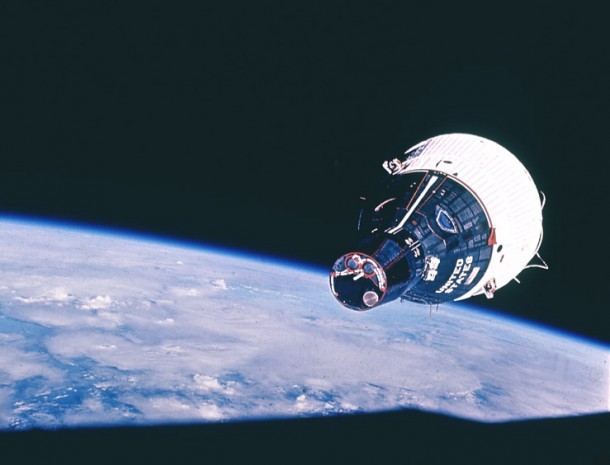
Fifty years ago this month, Gemini 7 set a new record for long-duration manned spaceflight. The official lift-off-to-splashdown flight duration was 330 hours, 35 minutes and 1 second or nearly fourteen days.
Project Gemini was the critical bridge between America’s fledgling manned spaceflight effort – Project Mercury – and the bold push to land men on the Moon – Project Apollo. While the events and importance of this program have faded with the passage of time, there would have been no manned lunar landing in the decade of the 1960′s without Project Gemini.
On Thursday, 25 May 1961, President John F. Kennedy addressed a special session of the U.S. Congress on the topic of “Urgent National Needs”. Near the end of his prepared remarks, President Kennedy proposed that the United States “should commit itself to achieving the goal, before this decade is out, of landing a man on the moon and returning him safely to the earth.”
At the time of the President’s clarion call to go to the Moon, the United States had accrued a total of 15 minutes of manned spaceflight experience. That quarter hour of space faring activity had come just 20 days previous. Indeed, Alan B. Shepard became the first American to be launched into space when he rode his Freedom 7 Mercury spacecraft on a sub-orbital trajectory down the Eastern Test Range on Tuesday, 05 May 1961.
America responded enthusiastically to the manned lunar landing goal. However, no one really knew exactly how to go about it! After considering several versions of direct ascent from the Earth to the Moon, NASA ultimately decided to use a method proposed by engineer John C. Houbolt known as Lunar Orbit Rendezvous (LOR). As a result, NASA would have to invent and master the techniques of orbital rendezvous.
Project Gemini provided the technology and flight experience required for a manned lunar landing and return. In the 20 months between March of 1965 and November of 1966, a total of 10 two-man Gemini missions were flown. During that time, the United States learned to navigate, rendezvous and dock in space, fly for long durations and perform extra-vehicular activities.
The primary purpose of Gemini 7 was to conduct a 14-day orbital mission. This was important since the longest anticipated Apollo mission to the Moon and back would be about the same length of time. Gemini 7 was flown to show that men and spacecraft could indeed function in space for the required period. A secondary goal of Gemini 7 was to serve as the target for Gemini 6 in achieving the world’s first rendezvous between two manned spacecraft.
Gemini-Titan Seven (GT-7) lifted-off from Cape Canaveral’s LC-19 at 19:30:03 UTC on Saturday, 04 December 1965. The Gemini 7 flight crew consisted of Commander Frank F. Borman II and Pilot James A. Lovell, Jr. The astronauts were successfully inserted into a 177-nm x 87-nm low-earth orbit. This initial orbit was later circularized to 162-nm.
Borman and Lovell spent the first 10-days of their mission conducting a variety of space experiments. They wore special lightweight spacesuits that were supposed to improve comfort level for their long stay in space. However, these suits were not all that comfortable and by their second week in space, the astronauts were flying in just their long-johns.
On their 11th day in space, the Gemini 7 crew had visitors. Indeed, Gemini 6 was launched into Earth orbit from Cape Canaveral and subsequently executed the first rendezvous in space with Gemini 7 on Wednesday, 15 December 1965. Gemini 6, with Commander Walter M. Schirra, Jr. and Pilot Thomas P. Stafford on board, ultimately maneuvered to within 1 foot of the Gemini 7 spacecraft.
While Gemini 6 returned to Earth within 24 hours of launch, Gemini 7 and her weary crew soldiered on. The monotony was brutal. Borman and Lovell had conducted all of their planned space experiments. They had to drift through space to conserve fuel. They couldn’t sleep because they weren’t tired. Borman later indicated that those last 3 days on board Gemini 7 were some of the toughest of his life.
On the 14th day of flight, Saturday, 18 December 1965, Borman and Lovell successfully returned to Earth. Reentry was entirely nominal. Splashdown occurred at 14:05:04 UTC in the Atlantic Ocean roughly 400 miles east of Nassau in The Bahamas. Crew and spacecraft were recovered by the USS Wasp.
Frank Borman and Jim Lovell had orbited the Earth 206 times during their 14-day mission. Each crew member was tired and a little unsteady as he walked the flight deck of the recovery ship. However, each man quickly recovered his native strength and vitality.
The 14 days that the Gemini 7 crew spent in space were physically and emotionally demanding. Life within the cramped confines of their little spacecraft was akin to two guys living inside a telephone booth for two weeks. Notwithstanding the challenges of that demanding existence, the Gemini 7 crew did their job. Gemini 7 was a resounding success. More, Project Gemini had achieved another key milestone. The Moon now seemed a bit closer.
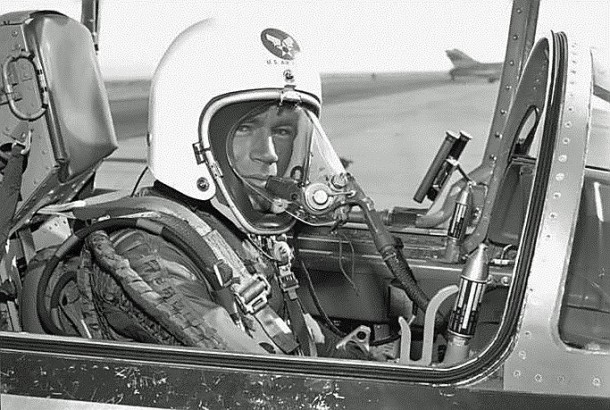
Fifty-six years ago today, USAF Captain Joe B. Jordan zoomed a modified USAF/Lockheed F-104C Starfighter to a world altitude record of 103,395.5 feet above mean sea level. The flight originated from and recovered to the Air Force Flight Test Center (AFFTC) at Edwards Air Force Base, California.
On Tuesday, 14 July 1959, the USSR established a world altitude record for turbojet-powered aircraft when Soviet test pilot Vladimir S. Ilyushin zoomed the Sukhoi T-43-1 (a prototype of the Su-9) to an absolute altitude of 94,661 feet. By year’s end, the Soviet achievement would be topped by several American aircraft.
FAI rules stipulate that an existing absolute altitude record be surpassed by at least 3 percent for a new mark to be established. In the case of the Soviet’s 1959 altitude record, this meant that an altitude of at least 97,501 feet would need to be achieved in a record attempt.
On Sunday, 06 December 1959, USN Commander Lawrence E. Flint wrested the months-old absolute altitude record from the Soviets by zooming to 98,561 feet. Flint piloted the second USN/McDonnell Douglas YF4H-1 (F4 Phantom II prototype) in accomplishing the feat. In a show of inter-service cooperation, the record flight was made from the AFFTC at Edwards Air Force Base.
Meanwhile, USAF was feverishly working on its own record attempt. The aircraft of choice was the Lockheed F-104C Starfighter. However, with the record now held by the Navy, the Starfighter would have to achieve an absolute altitude of at least 101,518 feet to set a new mark. (Per the FAI 3 percent rule.)
On Tuesday, 24 November 1959, the AFFTC accepted delivery of the record attempt aircraft, F-104C (S/N 56-0885), from the Air Force Special Weapons Center at Kirtland AFB in New Mexico. This aircraft was configured with a J79-GE-7 turbojet capable of generating nearly 18,000 pounds of sea level thrust in afterburner.
Modifications were made to the J79 to maximize the aircraft’s zoom kinematic performance. The primary enhancements included increasing afterburner fuel flow rate by 10 percent and maximum RPM from 100 to 103.5 percent. Top reset RPM was rated at 104.5 percent. Both the ‘A’ and ‘B’ engine flow bypass flaps were operated in the open position as well. These changes provided for increased thrust and stall margin.
An additional engine mod involved reducing the minimum engine fuel flow rate from 500 to 250 pounds per hour. Doing so increased the altitude at which the engine needed to be shut down to prevent overspeed or over-temperature conditions. Another change included increasing the maximum allowable compressor face temperature from 250 F to 390 F.
The F-104C external airframe was modified for the maximum altitude mission as well. The compression cones were lengthened on the bifurcated inlets to allow optimal pressure recovery at the higher Mach number expected during the record attempt. High Mach number directional stability was improved by swapping out the F-104C empannage with the larger F-104B tail assembly.
USAF Captain Joe B. Jordan was assigned as the altitude record attempt Project Pilot. USAF 1st Lt and future AFFTC icon Johnny G. Armstrong was assigned as the Project Engineer. Following an 8-flight test series to shake out the bugs on the modified aircraft, the record attempt proper started on Thursday, 10 December 1959.
On Monday, 14 December 1959, F-104C (S/N 56-0885) broke the existing absolute altitude record for turbojet-powered aircraft on its 5th attempt. Jordan did so by accelerating the aircraft to Mach 2.36 at 39,600 feet. He then executed a 3.15-g pull to an inertial climb angle of 49.5 degrees. Jordan came out of afterburner at 70,000 feet and stop-cocked the J79 turbojet at 81,700 feet.
Roughly 105 seconds from initiation of the pull-up, Joe Jordan reached the top of the zoom. The official altitude achieved was 103,395.5 feet above mean sea level based on range radar and Askania camera tracking. True airspeed over the top was on the order of 455 knots. Jordan started the pull-up to level flight at 60,000 feet; completing the recovery at 25,000 feet. Landing was entirely uneventful.
Jordan’s piloting achievement in setting the new altitude record was truly remarkable. His conversion of kinetic energy to altitude (potential energy) during the zoom was extremely efficient; realizing only a 2.5 percent energy loss from pull-up to apex. Jordan also exhibited exceptional piloting skill in controlling the aircraft over the top of the zoom where the dynamic pressure was a mere 14 psf. He did so using aerodynamic controls only. The aircraft did not have a reaction control system ala the X-15.
Armstrong’s contributions to shattering the existing altitude record were equally substantial. Skillful flight planning and effective use of available resources (including time available for the record attempt) were pivotal to mission success. Armstrong significantly helped maximize aircraft zoom performance through proper selection of pull-up flight conditions and intelligent use of accurate day-of-flight meteorological information.
For his skillful piloting efforts in setting the world absolute altitude record for turbojet-powered aircraft in December of 1959, Joe Jordan received the 1959 Harmon Trophy.
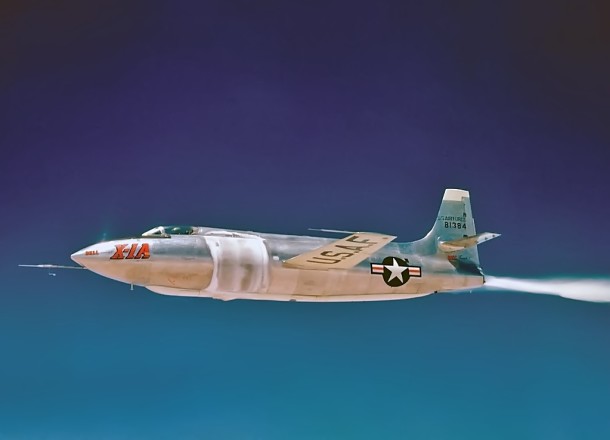
Sixty-two years ago this week, USAF Major Charles E. Yeager set an unofficial world speed record of 1,650 mph (Mach 2.44) in the Bell X-1A flight research aircraft. In the process, the legendary test pilot very nearly lost his life.
The USAF/Bell X-1A was a second generation X-aircraft intended to explore flight beyond Mach 2. It measured 35.5 feet in length and had a wing span of 28 feet. Gross take-off weight was 16,500 pounds.
Like its XS-1 forebear, the X-1A was powered by an XLR-11 rocket motor which produced a maximum sea level thrust of 6,000 lbs. The XLR-11 burned 9,200 pounds of propellants (alcohol and liquid oxygen) in roughly 270 seconds of operation.
Departing Edwards Air Force Base, California on Saturday, 12 December 1953, Yeager and the X-1A (S/N 48-1384) were carried to altitude by a USAF B-29 mothership (S/N 45-21800 ). X-1A drop occurred at 240 knots and 30,500 feet. Within ten seconds, Yeager lit off three of the XLR-11’s four rocket chambers and started to climb upstairs.
Yeager fired the 4th chamber of the XLR-11 passing through 43,000 feet and initiated a pushover at 62,000 feet. The maneuver was completed at 76,000 feet; higher than planned. In level flight now and traveling at Mach 1.9, the X-1A continued to accelerate in the thin air of the stratosphere.
Yeager quickly exceeded Scott Crossfield’s briefly-held Mach 2.005 record set on Friday, 20 November 1953. However, he now had to be very careful. Wind tunnel testing had revealed that the X-1A would be neutrally stable in the directional channel as it approached Mach 2.3.
As Yeager cut the throttle around Mach 2.44, the X-1A started an uncommanded roll to the left. Yeager quickly countered with aileron and rudder. The X-1A then rapidly rolled right. Full aileron and opposite rudder failed to control the roll. After 8 to 10 complete revolutions, the aircraft ceased rolling, but was now inverted.
In an instant, the X-1A started rolling left and then went divergent in all three axes. The aircraft tumbled and gyrated through the sky. Control inputs had no effect. Yeager was in serious trouble. He could not control his aircraft and punching-out was not an option. The X-1A had no ejection seat.
Chuck Yeager took a tremendous physical and emotional beating for more than 70 seconds as the X-1A wildly tumbled. Normal acceleration varied between plus-8 and negative 1.3 G’s. His helmet hit the canopy and cracked it. He struck the control column so hard that it was physically bent. His frantic air-to-ground communications were distinctly those of a man who was convinced that he was about to die.
As the X-1A tumbled, it decelerated and lost altitude. At 33,000 feet, a battered and groggy Yeager found himself in an inverted spin. The aircraft suddenly fell into a normal spin from which Yeager recovered at 25,000 feet over the Tehachapi Mountains situated northwest of Edwards. Somehow, Yeager managed to get himself and the X-1A back home intact.
The culprit in Yeager’s wide ride was the then little-known phenomenon identified as roll inertial coupling. That is, inertial moments produced by gyroscopic and centripetal accelerations overwhelmed aerodynamic control moments and thus caused the aircraft to depart controlled flight. Roll rate was the critical mechanism since it coupled pitch and yaw motion.
The X-1A held the distiction of being the fastest-flying of the early X-aircraft until the Bell X-2 reached 1,900 mph (Mach 2.87) in July of 1956. Yeager’s harrowing experience in December 1953 would be his last flight at the controls of a rocket-powered X-aircraft. For his record-setting X-1A mission, he was awarded the 1953 Harmon Trophy.