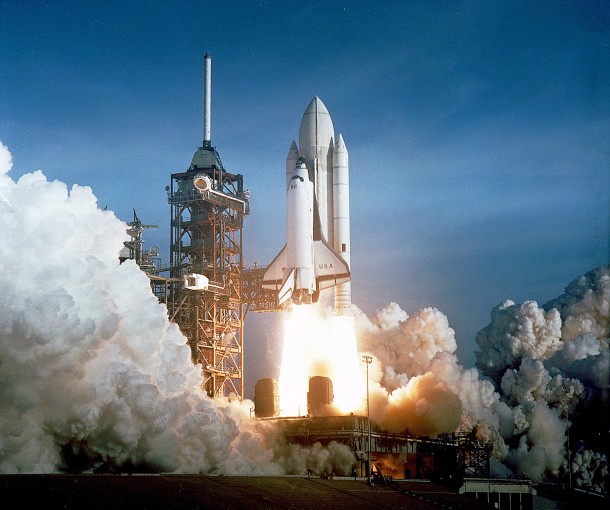
Thirty-five years ago today, the United States successfully launched the Space Shuttle Columbia into orbit around the Earth. It was the maiden flight of the Nation’s Space Transportation System (STS).
The Space Shuttle was unlike any manned space vehicle ever flown. A giant aircraft known as the Orbiter was side-mounted on a huge liquid-propellant stage called the External Tank (ET). Flanking opposing sides of the ET was a pair of Solid Rocket Boosters (SRB). The Orbiter, SRB’s and ET measured 122 feet, 149 feet and 154 feet in length, respectively.
The Space Shuttle system was conceived with an emphasis on reusability. Each Orbiter (Columbia, Challenger, Atlantis, Discovery and Endeavor) was designed to fly 100 missions. Each SRB was intended for multiple mission use as well. The only single-use element was the ET since it was more cost effective to use a new one for each flight than to recover and refurbish a reusable version.
NASA called STS-1 the boldest test flight in history. Indeed, the STS-1 mission marked the first time that astronauts would fly a space vehicle on its inaugural flight! STS-1 was also the first time that a manned booster system incorporated solid rocket propulsion. Unlike liquid propellant rocket systems, once ignited, the Shuttle’s solid rockets burned until fuel exhaustion.
And then there was the Orbiter element which had its own new and flight-unproven propulsion systems. Namely, the Space Shuttle Main Engines (SSME) and Orbital Maneuvering System (OMS). Each of the three (3) SSME’s generated 375,000 pounds of thrust at sea level. Thrust would increase to 475,000 pounds in vacuum. Each OMS rocket engine produced 6,000 pounds of thrust in vacuum.
The Orbiter was also configured with a reusable thermal protection system (TPS) which consisted of silica tiles and reinforced carbon-carbon material. The TPS for all previous manned space vehicles utilized single-use ablators. Would the new TPS work? How robust would it be in flight? What post-flight care would be needed? Answers would come only through flight.
To add to the “excitement” of first flight, the Orbiter was a winged vehicle and would therefore perform a hypersonic lifting entry. The vehicle energy state would have to be managed perfectly over the 5,000 mile reentry flight path from entry interface to runway touchdown. Since the Orbiter flew an unpowered entry, it would land dead-stick. There would only be one chance to land.
On Sunday,12 April 1981, the Space Shuttle Columbia lifted-off from Pad 39A at Cape Canaveral, Florida. Official launch time was 12:00:03 UTC. The flight crew consisted of Commander John W. Young and Pilot Robert L. Crippen. Their Columbia launch stack tipped the scales at 4.5 million pounds and thundered away from the pad on over 7 million pounds of thrust.
Columbia went through maximum dynamic pressure (606 psf) at Mach 1.06 and 26.5 KFT. SRB separation occurred 120 seconds into flight at Mach 3.88 and 174,000 feet; 10,000 feet higher than predicted. This lofting of the ascent trajectory was later attributed to unmodeled plume-induced aerodynamic effects in the Orbiter and ET base region.
Following separation, Columbia rode the ET to burnout at Mach 21 and 389.7 KFT. Following ET separation, Columbia’s OMS engines were fired minutes later to achieve a velocity of 17,500 mph and a 166-nautical mile orbit.
Young and Crippen would orbit the Earth 37 times before coming home on Tuesday, 14 April 1981. In doing so, they successfully flew the first hypersonic lifting reentry from orbit. Though unaware of it at the time, the crew came very close to catastrophe as the Orbiter’s body flap had to be deflected 8 degrees more than predicted to maintain hypersonic pitch control.
The reason for this “hypersonic anomaly” was that ground test and aero modeling had failed to capture the effects of high temperature gas dynamics on Orbiter pitch aerodynamics. Specifically, the vehicle was more stable in hypersonic flight than had been predicted. This necessitated greater nose-down body flap deflections to trim the vehicle in pitch. It was a close-call. But Columbia and its crew lived to fly another day.
Columbia touched-down at 220 mph on Runway 23 at Edwards Air Force Base, California at 18:20:57 UTC. Young and Crippen were euphoric with the against-the-odds success of the Space Shuttle’s first mission.
NASA too reveled in the Shuttle’s accomplishment. And so did America. This was the country’s first manned space mission since 1975. The longest period of manned spaceflight inactivity ever in the Nation’s history.
Fittingly, a well-known national news magazine celebrated Columbia’s success with a headline which read: “America is Back!”
And while it nor any of its stablemates fly no more, we remember with fondness that first Orbiter, its first flight, and its many subsequent accomplishments. To which we say: Hail Columbia!
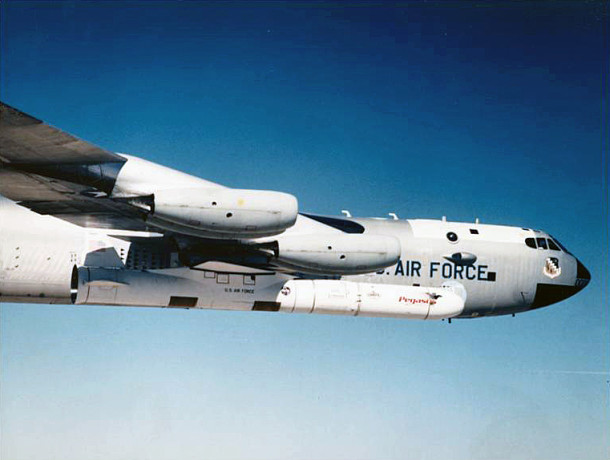
Twenty-five years ago today, the Orbital Sciences Corporation (OSC) orbited a PegSat satellite using the then-new Pegasus 3-stage launch vehicle. This historic event marked the first successful implementation of the air-launched satellite launcher concept.
The concept of air-launch dates back to the 1940’s and the early days of United States X-plane flight research. A multi-engine aircraft known as the mothership was employed to transport a smaller test aircraft to altitude. The test aircraft was subsequently released from the mothership and went on to conduct the flight research mission.
A clear benefit of air-launch was that all of the fuel and propulsion required to get to the test aircraft drop point was provided by the mothership. Thus, the test aircraft was allowed to use all of its own fuel for the flight research mission proper. In that sense, the mothership-test aircraft combination functioned as a two-stage launch vehicle.
The value and efficacy of the air-launch concept was demonstrated on numerous X-plane programs. Flight research aircraft such as the Bell XS-1, Bell X-1A, Bell X-1E, Bell X-2, Douglas D-558-II, and North American X-15 were all air-launched. More recently, the X-43A and X-51A scramjet-powered flight research vehicles also employed the air-launch concept.
An added benefit of the air-launch technique is that the launch site is highly portable! This provides enhanced mission flexibility compared to fixed position launch sites. The associated operating costs are much lower for the air-launched concept as well.
Orbital Science’s original Pegasus launch vehicle configuration was designed to fit within the same dimensional envelope of the X-15. The standard Pegasus external configuration measured 50 feet in length and featured a wingspan of 22 feet. The same dimensions as the baseline X-15 rocket airplane. Pegasus body diameter and launch weight were 50 inches and 41,000 pounds, respectively.
A key design feature of the Pegasus 3-stage launch vehicle configuration was the vehicle’s trapezodal-planform wing which provided the aerodynamic lift required to shape the endoatmospheric portion of the ascent flight path. This made Pegasus even more like the X-15.
The defining difference between Pegasus and the X-15 was propulsion. The X-15 flew a sub-orbital trajectory using an XLR-99 liquid rocket engine rated at 57,000 pounds of sea level thrust. Pegasus employed a combination of three (3) Hercules solid rocket motors to perform an earth-orbital mission. The first, second and third stage rocket motors were rated at 109,000, 26,600 and 7,800 pounds of vacuum thrust, respectively.
On Thursday, 05 April 1990, the first Pegasus launch took place over the Pacific Ocean within an area known as the Point Arguello Western Air Drop Zone (WADZ) . Pegasus 001 fell away from its NASA B-52B (S/N 52-0008) mothership at 19:10 UTC as the pair flew at Mach 0.8 and 43,000 feet. Pegasus first stage ignition took place 5 seconds after drop.
Following first stage ignition, the Pegasus executed a pull-up to begin the trip upstairs. The second and third stage rocket motors fired on time. The stage separation and payload fairing jettison events worked as planned. Roughly 10 minutes after drop, the 392-pound PegSat payload arrived in a 315 mile x 249 mile elliptical orbit.
Since that triumphant day in April 1990, both the Pegasus launch vehicle configuration and mission have signifcantly grown and matured. Of a total of 42 official Pegasus orbital missions to date, 37 have been flown successfully.
Twelve years ago this month, the NASA X-43A scramjet-powered flight research vehicle reached a record speed of over 4,600 mph (Mach 6.83). The test marked the first time in the annals of aviation that a flight-scale scramjet accelerated an aircraft in the hypersonic Mach number regime.
NASA initiated a technology demonstration program known as HYPER-X in 1996. The fundamental goal of the HYPER-X Program was to successfully demonstrate sustained supersonic combustion and thrust production of a flight-scale scramjet propulsion system at speeds up to Mach 10.
Also known as the HYPER-X Research Vehicle (HXRV), the X-43A aircraft was a scramjet test bed. The aircraft measured 12 feet in length, 5 feet in width, and weighed nearly 3,000 pounds. The X-43A was boosted to scramjet take-over speeds with a modified Orbital Sciences Pegasus rocket booster.
The combined HXRV-Pegasus stack was referred to as the HYPER-X Launch Vehicle (HXLV). Measuring approximately 50 feet in length, the HXLV weighed slightly more than 41,000 pounds. The HXLV was air-launched from a B-52 mothership. Together, the entire assemblage constituted a 3-stage vehicle.
The second flight of the HYPER-X program took place on Saturday, 27 March 2004. The flight originated from Edwards Air Force Base, California. Using Runway 04, NASA’s venerable B-52B (S/N 52-0008) started its take-off roll at approximately 20:40 UTC. The aircraft then headed for the Pacific Ocean launch point located just west of San Nicholas Island.
At 21:59:58 UTC, the HXLV fell away from the B-52B mothership. Following a 5 second free fall, rocket motor ignition occurred and the HXLV initiated a pull-up to start its climb and acceleration to the test window. It took the HXLV about 90 seconds to reach a speed of slightly over Mach 7.
Following rocket motor burnout and a brief coast period, the HXRV (X-43A) successfully separated from the Pegasus booster at 94,069feet and Mach 6.95. The HXRV scramjet was operative by Mach 6.83. Supersonic combustion and thrust production were successfully achieved. Total power-on flight duration was approximately 11 seconds.
As the X-43A decelerated along its post-burn descent flight path, the aircraft performed a series of data gathering flight maneuvers. A vast quantity of high-quality aerodynamic and flight control system data were acquired for Mach numbers ranging from hypersonic to transonic. Finally, the X-43A impacted the Pacific Ocean at a point about 450 nautical miles due west of its launch location. Total flight time was approximately 15 minutes.
The HYPER-X Program made history that day in late March 2004. Supersonic combustion and thrust production of an airframe-integrated scramjet were achieved for the first time in flight; a goal that dated back to before the X-15 Program. Along the way, the X-43A established a speed record for airbreathing aircraft and earned a Guinness World Record for its efforts.
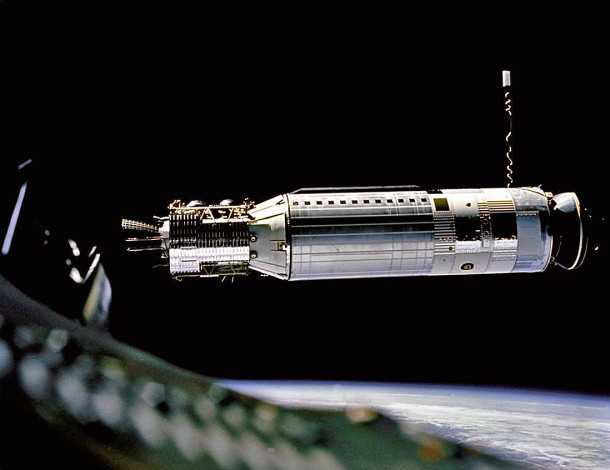
Fifty years ago this month, the crew of Gemini VIII successfully regained control of their tumbling spacecraft following failure of an attitude control thruster. The incident marked the first life-threatening on-orbit emergency and resulting mission abort in the history of Amercian manned spaceflight.
Gemini VIII was the sixth manned mission of the Gemini Program. The primary mission objective was to rendezvous and dock with an orbiting Agena Target Vehicle (ATV). Successful accomplishment of this objective was seen as a vital step in the Nation’s quest for landing men on the Moon.
The Gemini VIII crew consisted of Command Pilot Neil A. Armstrong and Pilot USAF Major David R. Scott. Both were space rookies. To them would go both the honor of achieving the first successful docking in orbit as well as the challenge of dealing with the first life and death space emergency involving an American spacecraft.
Gemini VIII lifted-off from Cape Canaveral’s LC-19 at 16:41:02 UTC on Wednesday, 16 March 1966. The crew’s job was to chase, rendezvous and then physically dock with an Agena that had been launched 101 minutes earlier. The Agena successfully achieved orbit and waited for Gemini VIII in a 161-nm circular Earth orbit.
It took just under six (6) hours for Armstrong and Scott to catch-up and rendezvous with the Agena. The crew then kept station with the target vehicle for a period of about 36 minutes. Having assured themselves that all was well with the Agena, the world’s first successful docking was achieved at a Gemini mission elasped time of 6 hours and 33 minutes.
Once the reality of the historic docking sank in, a delayed cheer erupted from the NASA and contractor team at Mission Control in Houston, Texas. Despite the complex orbital mechanics and delicate timing involved, Armstrong and Scott had actually made it look easy. Unfortunately, things were about to change with an alarming suddeness.
As the Gemini crew maneuvered the Gemini-Agena stack, their instruments indicated that they were in an uncommanded 30-degree roll. Using the Gemini’s Orbital Attiude and Maneuvering System (OAMS), Armstrong was able to arrest the rolling motion. However, once he let off the restoring thruster action, the combined vehicle began rolling again.
The crew’s next action was to turn off the Agena’s systems. The errant motion subsided. Several minutes elapsed with the control problem seemingly solved. Suddenly, the uncommanded motion of the still-docked pair started again. The crew noticed that the Gemini’s OAMS was down to 30% fuel. Could the problem be with the Gemini spacecraft and not the Agena?
The crew jettisoned the Agena. That didn’t help matters. The Gemini was now tumbling end over end at almost one revolution per second. The violent motion made it difficult for the astronauts to focus on the instrument panel. Worse yet, they were in danger of losing consciousness.
Left with no other alternative, Armstrong shut down his OAMS and activated the Reentry Control System reaction control system (RCS) in a desperate attempt to stop the dizzying tumble. The motion began to subside. Finally, Armstrong was able to bring the spacecraft under control.
That was the good news. The bad news for the crew of Gemini VIII was that the rest of the mission would now have to be aborted. Mission rules dictated that such would be the case if the RCS was activated on-orbit. There had to be enough fuel left for reentry and Gemini VIII had just enough to get back home safely.
Gemini VIII splashed-down in the Pacific Ocean 4,320 nm east of Okinawa. Mission elapsed time was 10 hours, 41 minutes and 26 seconds. Spacecraft and crew were safely recovered by the USS Leonard F. Mason.
In the aftermath of Gemini VIII, it was discovered that OAMS Thruster No. 8 had failed in the ON position. The probable cause was an electrical short. In addition, the design of the OAMS was such that even when a thruster was switched off, power could still flow to it. That design oversight was ultimately remediated so that subsequent Gemini missions would not be threatened by a reoccurence of the Gemini VIII anomaly.
Neil Armstrong and David Scott met their goliath in orbit and defeated the beast. Armstrong received a quality increase for his exceptional efforts on Gemini VIII while Scott was promoted to Lieutenant Colonel. Both men were also awarded the NASA Exceptional Service Medal.
More significantly, their deft handling of the Gemini VIII emergency elevated both Armstrong and Scott within the ranks of the astronaut corps. Indeed, each man would ultimately land on the Moon and serve as mission commander in doing so; Neil Armstrong on Apollo 11 and David Scott on Apollo 15.
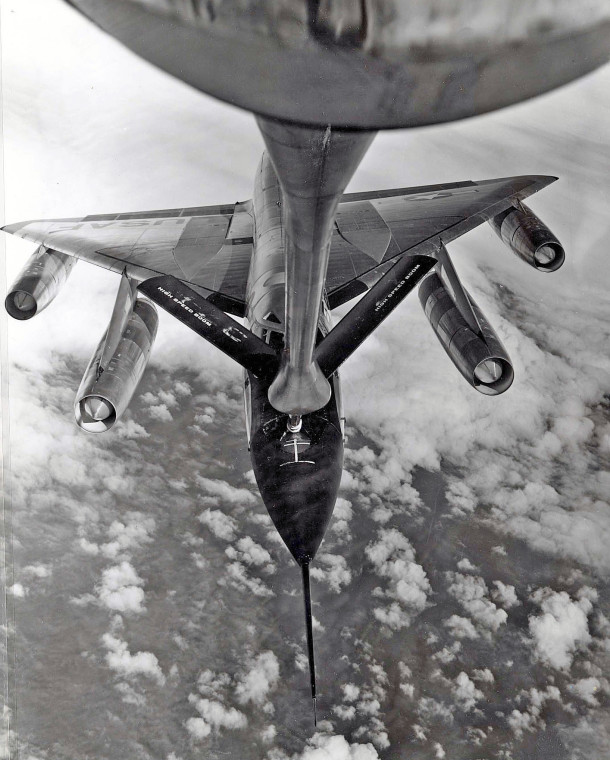
Fifty-four years ago this month, a USAF/Convair B-58A Hustler from the 43rd Bomb Wing at Carswell AFB, Texas set a trio of transcontinental speed records in a round trip from Los Angeles to New York and back. This historic feat was accomplished as part of Operation Heat Rise.
The USAF/Convair B-58A Hustler holds the distinction of being the world’s first supersonic bomber. A product of the 1950’s, the delta-winged aircraft measured 96.8 feet in length and had a wing span of 56.8 feet. GTOW stood around 163,000 lbs. Power was provided by a quartet of General Electric 79 turbojets which produced 62,000 lbs of sea level thrust in afterburner.
The Hustler’s performance was impressive then and now. With a maximum speed of 1,325 mph, the aircraft featured a service ceiling of 64,800 feet and a combat radius of 1,520 nm. The Hustler’s mission range could be markedly increased through employment of aerial refueling.
The B-58’s three man air crew sat in tandem in the order of pilot, navigator and Defensive Systems Officer (DSO). Each man occupied a separate flight station which was equipped with an ejection pod for protection during high speed egress.
The Hustler was part of Strategic Air Command (SAC). It’s primary mission was delivery of nuclear weapons. The aircraft served in the air force’s operational inventory for a period of just 10 years years (1960 to 1970). A total of 116 airframes were produced and none were used in anger.
The Hustler’s high speed capability led to the type being used to establish numerous speed records during its operational life. Operation Heat Rise was one such effort. The goal of this project was to establish segmental and overall speed records for a round trip flight between the west and east coasts of the United States.
On Monday , 05 March 1962, the crew of Major Robert G. Sowers (pilot), Captain Robert MacDonald (navigator) and Captain John T. Walton (DSO) departed Carswell AFB, Texas in B-58A S/N 59-2458 known as the Cowtown Hustler. Other than a new wax job, this aircraft was no different than the other Hustler airframes in the USAF supersonic bomber inventory.
After refueling out over the Pacific Ocean, the aircraft started its coast-to-coast speed run at Mach 2 over Los Angeles, California. Incredibly, the critical ground station monitoring the start time did not record passage of the aircraft overhead. Thus, airplane and crew were called back for a restart of the speed record attempt! This meant another trip to the tanker out over the Pacific to top off the Hustler’s fuel tanks prior to the second try.
Once officially underway, the trip from overhead Los Angeles to overhead New York took 2 hours and 58.71 seconds for an average speed of 1,214.65 mph. The aircraft was refueled over Kansas on its way east. Once out over the Atlantic Ocean, the Hustler reversed course and hit the tanker again.
The return trip from overhead New York to overhead Los Angeles was flown in 2 hours, 15 minutes and 50.08 seconds. As on the eastbound leg, the Hustler took on a load of gas over Kansas. The entire round trip required 4 hours, 41 minutes and 14.98 seconds inclusive of refueling. Each of the aforementioned trip times established new performance records.
An interesting aspect of the return leg to Los Angeles was that the Hustler flew faster than the rotational movement of the earth. Thus, the aircraft and its crew arrived in California roughly 41 minutes earlier than the sun!
After landing in Los Angeles, the crew was enthusiastically greeted by members of the air force, the aerospace industry and the media. In recognition of their accomplishments, each man received the USAF Distinguished Flying Cross at the hand of USAF General Thomas S. Power, Chief of Staff.
Finally, for their impressive performance during Operation Heat Rise, crew and aircraft were the recipients of both the 1962 MacKay and Bendix Trophies. This marked the last time that the latter was ever awarded.
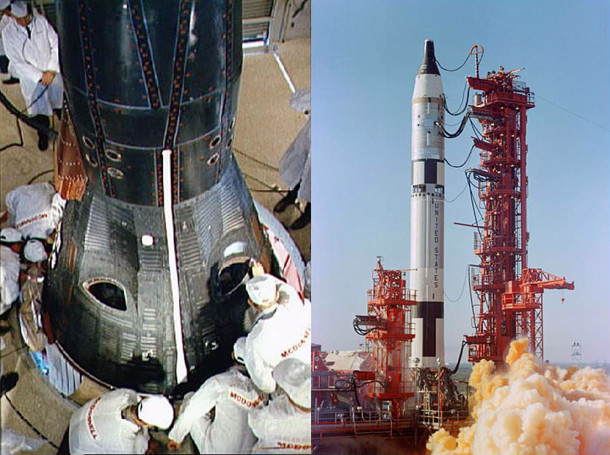
Fifty-one years ago this month, Gemini III was launched into Earth orbit with astronauts Vigil I. “Gus” Grissom and John W. Young in the cockpit. The 3-orbit mission marked the first time that the United States flew a multi-man spacecraft.
Project Mercury was America’s first manned spaceflight series. Project Apollo would ultimately land men on the Moon and return them safely to the Earth. In between these historic spaceflight efforts would be Project Gemini.
The purpose of Project Gemini was to develop and flight-prove a myriad of technologies required to get to the Moon. Those technologies included spacecraft power systems, rendezvous and docking, orbital maneuvering, long duration spaceflight and extravehicular activity.
The Gemini spacecraft weighed 8,500 pounds at lift-off and measured 18.6 feet in length. Gemini consisted of a reentry module (RM), an adapter module (AM) and an equipment module (EM).
The crew occupied the RM which also contained navigation, communication, telemetry, electrical and reentry reaction control systems. The AM contained maneuver thrusters and the deboost rocket system. The EM included the spacecraft orbit attitude control thrusters and the fuel cell system. Both the AM and EM were used in orbit only and discarded prior to entry.
Gemini-Titan III (GT-3) lifted-off at 14:24 UTC from LC-19 at Cape Canaveral, Florida on Tuesday, 23 March 1965. The two-stage Titan II launch vehicle placed Gemini 3 into a 121 nautical mile x 87 nautical mile elliptical orbit.
Gemini 3’s primary objective was to put the maneuverable Gemini spacecraft through its paces. While in orbit, Grissom and Young fired thrusters to change the shape of their orbital flight path, shift their orbital plane, and dip down to a lower altitude. Gemini 3 was also the first time that a manned spacecraft used aerodynamic lift to change its entry flight path.
As spacecraft commander, Gus Grissom named his cosmic chariot The Molly Brown in reference to a then-popular Broadway show; “The Unsinkable Molly Brown”. Grissom chose the moniker in memory of his first spaceflight experience wherein his Liberty Bell 7 Mercury spacecraft sunk in almost 17,000 feet of water during post-splashdown operations.
At almost two (2) hours into the mission, pilot John Young presented Grissom with his favorite sandwich which had been smuggled onboard. Grissom and Young took a bite of the corned beef sandwich and put it away since loose crumbs could get into spacecraft electronics with catastrophic results. Not amused, NASA management reprimanded the crew after the mission.
Gemini 3 splashed-down in the Atlantic Ocean at 19:16:31 UTC following a 3 orbit mission. The spacecraft landed 45 nautical miles short of the intended splashdown point due to a misprediction of aerodynamic lift. Although hot and sea-sick, Commander Grissom refused to open the spacecraft hatches until the recovery ship USS Intrepid came on station.
Nine (9) additional Gemini space missions would follow the flight of Gemini 3. Indeed, the historical record shows that the Gemini Program would fly an average of every two (2) months by the time Gemini XII landed in December 1966. During that period, the United States would take the lead in the race to the Moon that it would never relinquish.
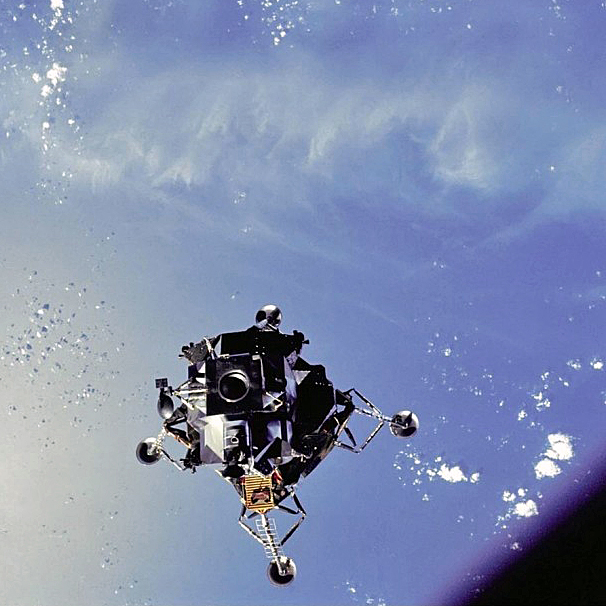
Forty-seven years ago this week, the Apollo Lunar Module (LM) flew in space with astronauts onboard for the first time during the Apollo 9 earth-orbital mission. This technological achievement was critical to the success of the first lunar landing mission which occurred a little over 4 months later.
The Apollo Lunar Module (LM) was the world’s first true spacecraft in that it was designed to operate in vacuum conditions only. It was the third and final element of the Apollo spacecraft; the first two elements being the Command Module (CM) and the Service Module (LM).
The LM had its own propulsion, life-support and GNC systems. The vehicle weighed about 32,000 lbs on Earth and was used to transport a pair of astronauts from lunar orbit to the lunar surface and back into lunar orbit.
The spacecraft was really a two-stage vehicle; a descent stage and an ascent stage weighing 22,000 lbs and 10,000 lbs on Earth, respectively. The descent stage rocket motor was throttable and produced a maximum thrust of 10,000 lbs while the ascent stage rocket motor was rated at 3,500 lbs of thrust.
On Monday, 03 March 1969, Apollo 9 was rocketed into earth-orbit by the mighty Saturn V launch vehicle. The primary purpose of this mission was to put the first manned LM through its paces preparatory to the first lunar landing attempt.
During the 10-day mission, the crew of Commander James A. McDivitt, CM Pilot David R. Scott and LM Pilot Russell L. “Rusty” Schweickart fully verified all moon landing-specific operational aspects (short of an actual landing) of the LM. Key orbital activities included multiple-firings of both LM rocket motors and several rendezvous and docking exercises in which the LM flew as far away as 113 miles from the CM/SM pair.
By the time the crew splashed-down in the Atlantic Ocean on Thursday, 13 March 1969, America had a new operational spacecraft and a fighting chance to land men on the moon and safely return them to Earth by the end of the decade.
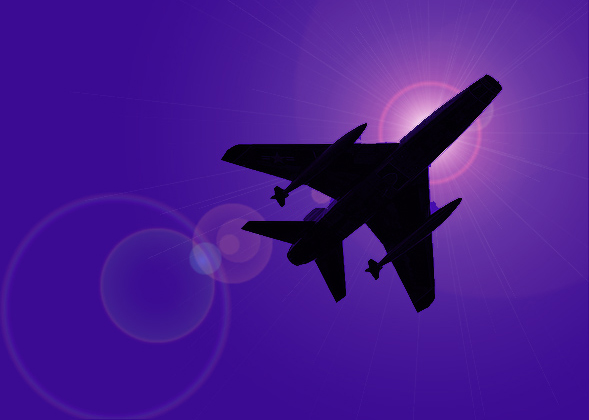
Sixty-one years ago this week, North American test pilot George F. Smith became the first man to survive ejection from an aircraft in supersonic flight at high dynamic pressure. Smith ejected from his F-100A Super Sabre at 777 MPH (Mach 1.05) as the crippled aircraft passed through 6,500 feet in a near-vertical dive.
On the morning of Saturday, 26 February 1955, North American Aviation (NAA) test pilot George F. Smith stopped by the company’s plant at Los Angeles International Airport to submit some test reports. Returning to his car, he was abruptly hailed by the company dispatcher. A brand-new F-100A Super Sabre needed to be test flown prior to its delivery to the Air Force. Would Mr. Smith mind doing the honors?
Replying in the affirmative, Smith quickly donned a company flight suit over his street clothes, got the rest of his flight gear and pre-flighted the F-100A Super Sabre (S/N 53-1659). After strapping into the big jet, Smith went through the normal sequence of aircraft pre-launch flight control and system checks. While the control column did seem a bit stiff in pitch, Smith nonetheless made the determination that his steed was ready for flight.
Smith executed a full afterburner take-off to the west. The fleet Super Sabre eagerly took to the air. Accelerating and climbing, the aircraft was almost supersonic as it passed through 35,000 feet. Peaking out around 37,000 feet, Smith sensed a heaviness in the flight control column. Something wasn’t quite right. The jet was decidely nose heavy. Smith countered by pulling aft stick.
The Super Sabre did not respond at all to Smith’s control inputs. Instead, it continued an uncommanded dive. Shallow at first, the dive steepened even as the 215-lb pilot pulled back on the stick with all of his might. But all to no avail. The jet’s hydraulic system had failed. As the stricken aircraft now accelerated toward the ground, Smith rightly concluded that this was going to be a short ride.
George Smith knew that he had only one alternative now. Eject. However, he also knew that the chances were quite small that he could survive what was quickly shaping-up to be a quasi-supersonic ejection. Suddenly, over the radio, Smith heard another Super Sabre pilot flying near his vicinity frantically yell: “Bail out, George!” So exhorted, Smith proceeded to do so.
Smith jettisoned his canopy. The roar from the airstream around him was unlike anything he had ever heard. Almost paralyzed with fear, Smith reflexively hunkered-down in the cockpit. The exact wrong thing to do. His head needed to be positioned up against the seat’s headrest and his feet placed within retraining stirrups prior to ejection. But there was no time for any of this now. Smith pulled the ejection seat trigger.
George Smith’s last recollection of his nightmare ride was that the Mach Meter read 1.05; 777 mph at the ejection altitude of 6,500 feet above the Pacific Ocean. These flight conditions corresponded to a dynamic pressure of 1,240 pounds per square foot. As he was fired out of the cockpit and into the harsh airstream, Smith’s body was subjected to a horrendous drag force of around 8,000 lbs producing on the order of 40-g’s of deceleration.
Mercifully, Smith did not recall what came next. The ferocious windblast stripped him of his helmet, oxygen mask, footwear, flight gloves, wrist watch and even his ring. Blood was forced into his head which became grotesquely swollen and his facial features unrecognizable. His eyelids fluttered and his eyes were tortuously mauled by the aerodynamic and inertial load of his ejection. Smith’s internal organs, most especially his liver, were severely damaged. His body was horribly bruised and beaten as it flailed end-over-over end uncontrollably.
Smith and his seat parted company as programmed followed by automatic deployment of his parachute. The opening forces were so high that a third of the parachute material was ripped away. Thankfully, the remaining portion held together and the unconscious Smith landed about 75 yards away from a fishing vessel positiond about a half-mile form shore. Providentially, the boat’s skipper was a former Navy rescue expert. Within a minute of hitting the water, Smith was rescued and brought onboard.
George Smith was hovering near death when he arrived at the hospital. In severe shock and with only a faint pulse, doctors quickly went to work. Smith awoke on his sixth day of hospitalization. He could hear, but he couldn’t see. His eyes had sustained multiple subconjunctival hemorrhages and the prevailing thought at the time was that he would never see again.
Happily, George Smith did recover almost fully from his supersonic ejection experience. He spent seven (7) months in the hospital and endured several operations. During that time, Smith’s weight dropped to 150 lbs. He was left with a permanently damaged liver to the extent that he could no longer drink alcohol. As for Smith’s vision, it returned to normal. However, his eyes were ever after somewhat glare-sensitive and slow to adapt to darkness.
Not only did George Smith return to good health, he also got back in the cockpit. First, he was cleared to fly low and slow prop-driven aircraft. Ultimately, he got back into jets, including the F-100A Super Sabre. Much was learned about how to markedly improve high speed ejection survivability in the aftermath of Smith’s supersonic nightmare. He in essence paid the price so that others would fare better in such circumstances as he endured.
It is possible that George Smith was not the first pilot to eject supersonically. USN LCdr Authur Ray Hawkins survived ejection from his stricken Grumman F9F-6 Cougar in 1953. Aircraft speed at ejection was never definitively determined, but was estimated to be between 688 (Mach 0.99) and 782 mph (Mach 1.16). In any event, the dynamic pressure and therefore the airloads associated with Hawkins ejection were less than half that of Smith’s punchout.
George Smith was thirty-one (31) at the time of his F-100A mishap. He lived a happy and productive thirty-nine (39) more years after its occurrence. Smith passed from this earthly scene in 1994.
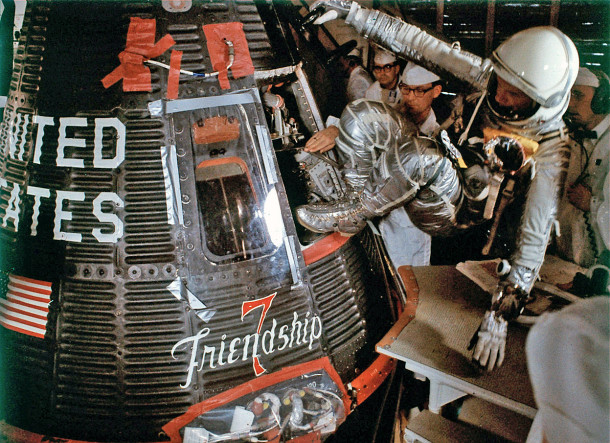
Fifty-four years ago this week, Project Mercury Astronaut John Herschel Glenn, Jr. became the first American to orbit the Earth. Glenn’s spacecraft name and mission call sign was Friendship 7.
Mercury-Atlas 6 (MA-6) lifted-off from Cape Canaveral’s Launch Complex 14 at 14:47:39 UTC on Tuesday, 20 February 1962. It was the first time that the Atlas LV-3B booster was used for a manned spaceflight.
Three-hundred and twenty seconds after lift-off, Friendship 7 achieved an elliptical orbit measuring 143 nm (apogee) by 86 nm (perigee). Orbital inclination and period were 32.5 degrees and 88.5 minutes, respectively.
The most compelling moments in the United States’ first manned orbital mission centered around a sensor indication that Glenn’s heatshield and landing bag had become loose at the beginning of his second orbit. If true, Glenn would be incinerated during entry.
Concern for Glenn’s welfare persisted for the remainder of the flight and a decision was made to retain his retro package following completion of the retro-fire sequence. It was hoped that the 3 flimsy straps holding the retro package would also hold the heatshield in place.
During Glenn’s return to the atmosphere, both the spent retro package and its restraining straps melted in the searing heat of re-entry. Glenn saw chunks of flaming debris passing by his spacecraft window. At one point he radioed, “That’s a real fireball outside”.
Happily, the spacecraft’s heatshield held during entry and the landing bag deployed nominally. There had never really been a problem. The sensor indication was found to be false.
Friendship 7 splashed-down in the Atlantic Ocean at a point 432 nm east of Cape Canaveral at 19:43:02 UTC. John Glenn had orbited the Earth 3 times during a mission which lasted 4 hours, 55 minutes and 23 seconds. In short order, spacecraft and astronaut were successfully recovered aboard the USS Noa.
John Glenn became a national hero in the aftermath of his 3-orbit mission aboard Friendship 7. It seemed that just about every newspaper page in the days following his flight carried some sort of story about his historic fete. Indeed, it is difficult for those not around back in 1962 to fully comprehend the immensity of Glenn’s flight in terms of what it meant to the United States.
John Herschel Glenn, Jr. will turn 95 on 18 July 2016. His trusty Friendship 7 spacecraft is currently on display at the Smithsonian National Air and Space Museum in Washington, DC.
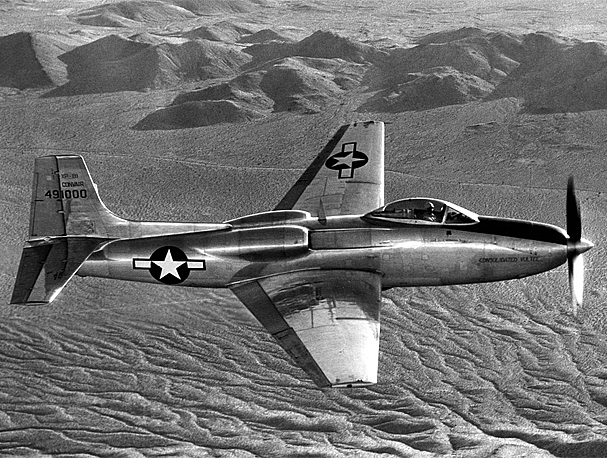
Seventy-one years ago this week, the Consolidated Vultee XP-81 made its flight test debut at Muroc Army Air Field, California with Vultee test pilot Frank Davis in the cockpit. The XP-81 was a prototype long range escort fighter powered by a combination of single turbojet and single turboprop engines.
The XP-81 was designed to serve as an escort fighter for long range bomber aircraft. Its mission was to defend bomber formations from attack by enemy fighters. To fly and fight, an escort fighter had to match the range and endurance capabilities of the much larger bombers it was assigned to protect.
The military wanted an escort fighter with an operating range of 1,250 miles and a maximum speed of 500 mph. Consolidated Vultee Aircraft (Convair) chose a bi-mode propulsion system to meet these requirements. The idea was to combine the excellent fuel economy of a turboprop with the high-speed capability of a turbojet. The turboprop was intended for cruise while use of the turbojet was reserved for takeoff and high speed flight.
The XP-51 was a big airplane by fighter standards. It measured almost 45 feet in length and had a wing span of 50.5 feet. Gross take-off and empty weights were 19,500 and 12,755 lbs, respectively. The type’s predicted range was estimated to be 2,500 miles at 275 mph and 25,000 feet. Service ceiling was rated at 35,500 feet.
Convair built a pair of XP-81 aircraft. Ship No. 1 (S/N 44-91000) and Ship No. 2 (S/N 44-91001) were completed in 1945 and sent to Muroc Army Air Field for flight testing. Ship No. 1 made the type’s first flight on Wednesday, 07 February 1945 with Vultee test pilot Frank Davis at the controls. With the exception of rather marginal directional stability, Davis found the handling characteristics to be quite good.
Testing of the XP-81 prototypes consisted of just 10 hours in the air. While the aircraft showed decent promise, the entire program was cancelled in May of 1947. With VE having occurred in May of 1945 and VJ in August of 1945, the need for a long range escort fighter simply went away.
Following program cancellation, the XP-81 aircraft served for a season as photo targets on the Bombing Range at Edwards Air Force Base. Eventually they were rescued from that inglorious state and sent to storage at the National Museum of the United States Air Force in Dayton, Ohio.