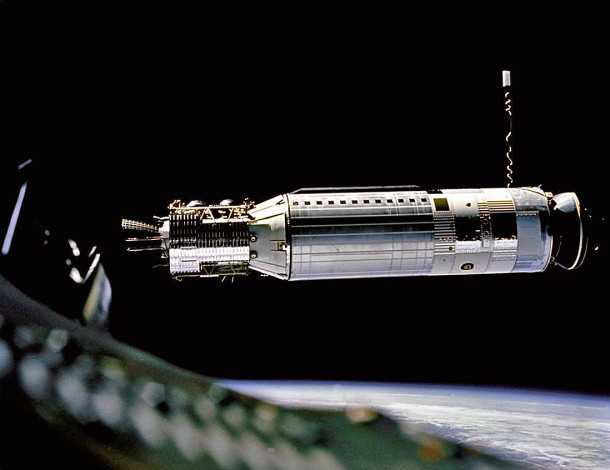
Fifty-two years ago this week, the crew of Gemini VIII successfully regained control of their tumbling spacecraft following failure of an attitude control system thruster. The incident marked the first life-threatening on-orbit emergency and resulting mission abort in the history of American manned spaceflight.
Gemini VIII was the sixth manned mission of the Gemini Program. The primary mission objective was to rendezvous and dock with an orbiting Agena Target Vehicle (ATV). Successful accomplishment of this objective was seen as a vital step in the Nation’s quest for landing men on the Moon.
The Gemini VIII crew consisted of Command Pilot Neil A. Armstrong and Pilot USAF Major David R. Scott. Both were space rookies. To them would go both the honor of achieving the first successful docking in orbit as well as the challenge of dealing with the first life and death space emergency involving an American spacecraft.
Gemini VIII lifted-off from Cape Canaveral’s LC-19 at 16:41:02 UTC on Wednesday, 16 March 1966. The crew’s job was to chase, rendezvous and then physically dock with an Agena that had been launched 101 minutes earlier. The Agena successfully achieved orbit and waited for Gemini VIII in a 161-nm circular Earth orbit.
It took just under six (6) hours for Armstrong and Scott to catch-up and rendezvous with the Agena. The crew then kept station with the target vehicle for a period of about 36 minutes. Having assured themselves that all was well with the Agena, the world’s first successful docking was achieved at a Gemini mission elapsed time of 6 hours and 33 minutes.
Once the reality of the historic docking sank in, a delayed cheer erupted from the NASA and contractor team at Mission Control in Houston, Texas. Despite the complex orbital mechanics and delicate timing involved, Armstrong and Scott had actually made it look easy. Unfortunately, things were about to change with an alarming suddenness.
As the Gemini crew maneuvered the Gemini-Agena stack, their instruments indicated that they were in an uncommanded 30-degree roll. Using the Gemini’s Orbital Attitude and Maneuvering System (OAMS), Armstrong was able to arrest the rolling motion. However, once he let off the restoring thruster action, the combined vehicle began rolling again.
The crew’s next action was to turn off the Agena’s systems. The errant motion subsided. Several minutes elapsed with the control problem seemingly solved. Suddenly, the uncommanded motion of the still-docked pair started again. The crew noticed that the Gemini’s OAMS was down to 30% fuel. Could the problem be with the Gemini spacecraft and not the Agena?
The crew jettisoned the Agena. That didn’t help matters. The Gemini was now tumbling end over end at almost one revolution per second. The violent motion made it difficult for the astronauts to focus on the instrument panel. Worse yet, they were in danger of losing consciousness.
Left with no other alternative, Armstrong shut down his OAMS and activated the Reentry Control System reaction control system (RCS) in a desperate attempt to stop the dizzying tumble. The motion began to subside. Finally, Armstrong was able to bring the spacecraft under control.
That was the good news. The bad news for the crew of Gemini VIII was that the rest of the mission would now have to be aborted. Mission rules dictated that such would be the case if the RCS was activated on-orbit. There had to be enough fuel left for reentry and Gemini VIII had just enough to get back home safely.
Gemini VIII splashed-down in the Pacific Ocean 4,320 nm east of Okinawa. Mission elapsed time was 10 hours, 41 minutes and 26 seconds. Spacecraft and crew were safely recovered by the USS Leonard F. Mason.
In the aftermath of Gemini VIII, it was discovered that OAMS Thruster No. 8 had failed in the ON position. The probable cause was an electrical short. In addition, the design of the OAMS was such that even when a thruster was switched off, power could still flow to it. That design oversight was ultimately remediated so that subsequent Gemini missions would not be threatened by a reoccurence of the Gemini VIII anomaly.
Neil Armstrong and David Scott met their Goliath in orbit and defeated the beast. Armstrong received a quality increase for his exceptional efforts on Gemini VIII while Scott was promoted to Lieutenant Colonel. Both men were also awarded the NASA Exceptional Service Medal.
More significantly, their deft handling of the Gemini VIII emergency elevated both Armstrong and Scott within the ranks of the astronaut corps. Indeed, each man would ultimately land on the Moon and serve as mission commander in doing so; Neil Armstrong on Apollo 11 and David Scott on Apollo 15.
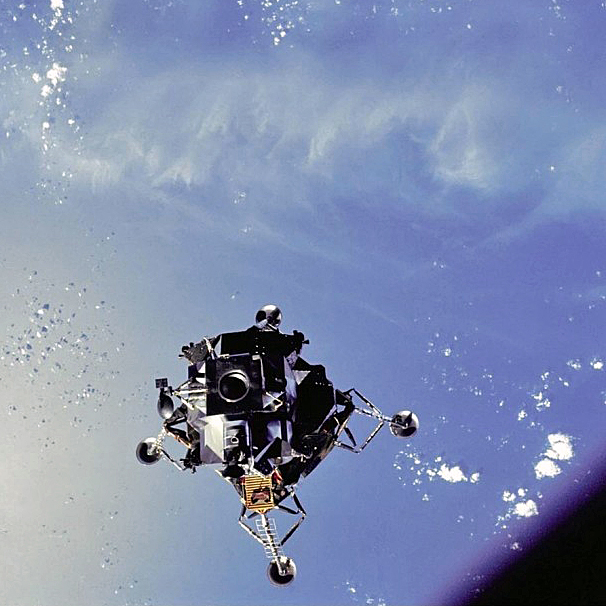
Forty-nine years ago this month, the Apollo Lunar Module (LM) was flown by an astronaut crew in space for the first time during the Apollo 9 earth-orbital mission. This technological achievement was critical to the success of the first lunar landing mission which occurred a little over 4 months later.
The Apollo Lunar Module (LM) was the world’s first true spacecraft in that it was designed to operate in vacuum conditions only. It was the third and final element of the Apollo spacecraft; the first two elements being the Command Module (CM) and the Service Module (LM).
The LM had its own propulsion, life-support and GNC systems. The vehicle weighed about 32,000 lbs on Earth and was used to transport a pair of astronauts from lunar orbit to the lunar surface and back into lunar orbit.
The spacecraft was really a two-stage vehicle; a descent stage and an ascent stage weighing 22,000 lbs and 10,000 lbs on Earth, respectively. The thrust of descent stage rocket motor could be throttled and produced a maximum thrust of 10,000 lbs while the ascent stage rocket motor was rated at 3,500 lbs of thrust.
On Monday, 03 March 1969, Apollo 9 was rocketed into earth-orbit by the mighty Saturn V launch vehicle. The primary purpose of this mission was to put the first LM through its paces by astronauts preparatory to the first lunar landing attempt.
During the 10-day mission, the crew of Commander James A. McDivitt, CM Pilot David R. Scott and LM Pilot Russell L. “Rusty” Schweickart fully verified all moon landing-specific operational aspects (short of an actual landing) of the LM. Key orbital activities included multiple-firings of both LM rocket motors and several rendezvous and docking exercises in which the LM flew as far away as 113 miles from the CM/SM pair.
By the time the crew splashed-down in the Atlantic Ocean on Thursday, 13 March 1969, America had a new operational spacecraft and a fighting chance to land men on the moon and safely return them to the Earth before the end of the decade.
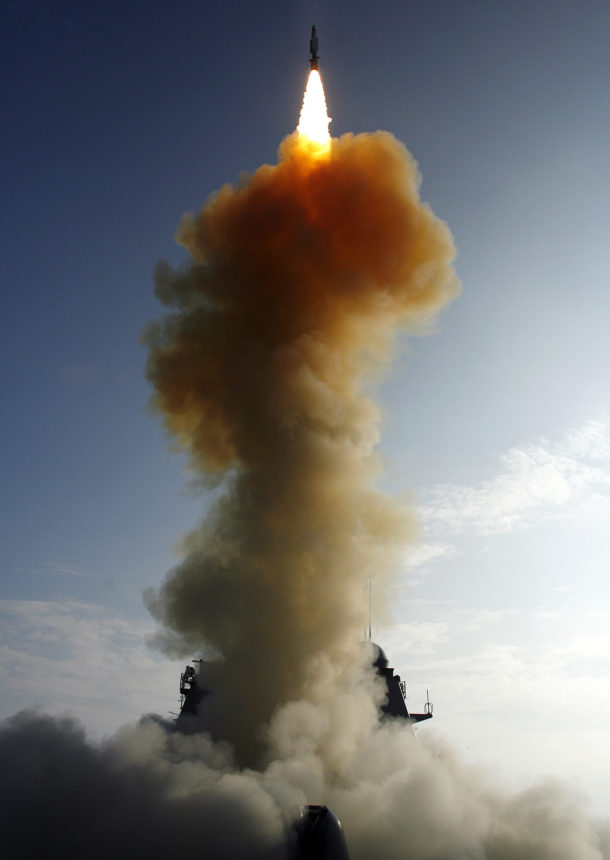
Ten years ago this month, a United States Navy STANDARD Missile SM-3 Block IA interceptor engaged and destroyed a defunct NRO satellite at an altitude of 133 nautical miles. The relative velocity at intercept was in excess of 22,000 mph.
The United States Navy/Raytheon Missile Systems SM-3 (RIM-161) is the sea-based arm of the Missile Defense Agency’s Ballistic Missile Defense System (BMDS). The 3-stage missile carries a Kinetic Warhead (KW) that provides an exoatmospheric hit-to-kill capability.
In order to ensure a lethal hit, the SM-3 KW guides to a specific aimpoint on the target’s airframe. The ability to reliably do so has been impressively demonstrated in a series of intercept flight tests that began in 2002.
SM-3 rounds are launched from the MK-41 Vertical Launcher System (VLS) aboard United States Navy cruisers and destroyers. The at-sea basing concept provides for a high degree of operational flexibility in the ballistic missile intercept mission.
The Lockheed Martin-built USA-193 was launched on a classified mission from California’s Vandenberg Air Force Base (VAFB) at 2100 UTC on Thursday, 14 December 2006. However, shortly after reaching orbit, contact with the 5,000-lb defense satellite was lost.
By January 2008, USA-193′s orbit had decayed to such an extent that its reentry back into the earth’s atmosphere appeared imminent. Such events raise concerns for the safety of those on Earth who reside within the debris impact footprint. However, there was an additional concern in the case of USA-193. The satellite still had about 1,000-lbs of hydrazine propellant onboard.
Should the USA-193 hydrazine tank survive reentry, those living in the impact area would be exposed to a highly toxic cloud of the volatile substance. Officials concluded that the safest thing to do was to destroy the satellite before it reentered the atmosphere.
On Thursday, 21 February 2008, the USS Lake Erie was on station in the Pacific Ocean somewhere west of Hawaii. The US Navy cruiser fired a single SM-3 interceptor at 0326 UTC. Minutes later, the missile’s KW took out the satellite and dispersed its hydrazine load into space. Mission accomplished!
In the aftermath of the satellite take-down, Russia and others predictably accused the United States of using the USA-193 hydrazine issue as an excuse to demonstrate SM-3′s anti-satellite capability. While such capability was indeed demonstrated, noteworthy is the fact that all systems modified to execute the satellite intercept were subsequently returned to a ballistic missile defense posture.
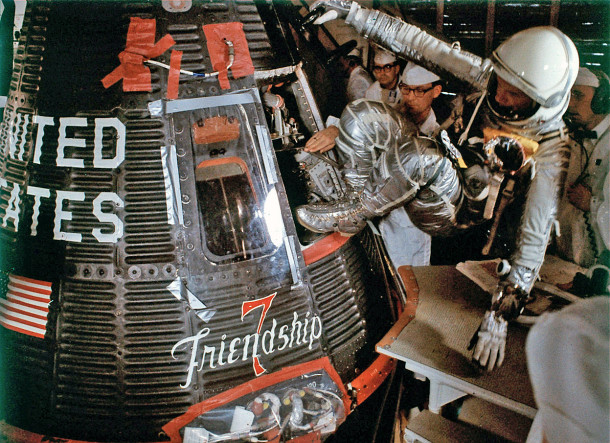
Fifty-six years ago today, Project Mercury Astronaut John Herschel Glenn, Jr. became the first American to orbit the Earth. Glenn’s spacecraft name and mission call sign was Friendship 7.
Mercury-Atlas 6 (MA-6) lifted-off from Cape Canaveral’s Launch Complex 14 at 14:47:39 UTC on Tuesday, 20 February 1962. It was the first time that the Atlas LV-3B booster was used for a manned spaceflight.
Three-hundred and twenty seconds after lift-off, Friendship 7 achieved an elliptical orbit measuring 143 nm (apogee) by 86 nm (perigee). Orbital inclination and period were 32.5 degrees and 88.5 minutes, respectively.
The most compelling moments in the United States’ first manned orbital mission centered around a sensor indication that Glenn’s heat shield and landing bag had become loose at the beginning of his second orbit. If true, Glenn would be incinerated during entry.
Concern for Glenn’s welfare persisted for the remainder of the flight and a decision was made to retain his retro package following completion of the retro-fire sequence. It was hoped that the 3 flimsy straps holding the retro package would also hold the heat shield in place.
During Glenn’s return to the atmosphere, both the spent retro package and its restraining straps melted in the searing heat of re-entry. Glenn saw chunks of flaming debris passing by his spacecraft window. At one point he radioed, “That’s a real fireball outside”.
Happily, the spacecraft’s heat shield held during entry and the landing bag deployed nominally. There had never really been a problem. The sensor indication was found to be false.
Friendship 7 splashed-down in the Atlantic Ocean at a point 432 nm east of Cape Canaveral at 19:43:02 UTC. John Glenn had orbited the Earth 3 times during a mission which lasted 4 hours, 55 minutes and 23 seconds. In short order, spacecraft and astronaut were successfully recovered aboard the USS Noa.
John Glenn became a national hero in the aftermath of his 3-orbit mission aboard Friendship 7. It seemed that just about every newspaper page in the days following his flight carried some sort of story about his historic feat. Indeed, it is difficult for those not around back in 1962 to fully comprehend the immensity of Glenn’s flight in terms of what it meant to the United States.
John Herschel Glenn, Jr. passed away on 08 December 2016 at the age of 95. His trusty Friendship 7 spacecraft is currently on display at the Smithsonian National Air and Space Museum in Washington, DC.
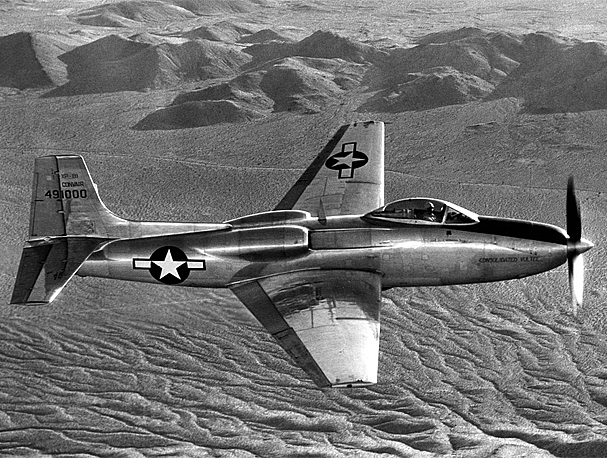
Seventy-three years ago this month, the Consolidated Vultee XP-81 made its flight test debut at Muroc Army Air Field, California with Vultee test pilot Frank Davis in the cockpit. The XP-81 was a prototype long range escort fighter powered by a combination of single turbojet and single turboprop engines.
The XP-81 was designed to serve as an escort fighter for long range bomber aircraft. Its mission was to defend bomber formations from attack by enemy fighters. To fly and fight, an escort fighter had to match the range and endurance capabilities of the much larger bombers it was assigned to protect.
The US military wanted an escort fighter with an operating range of 1,250 miles and a maximum speed of 500 mph. Consolidated Vultee Aircraft (Convair) chose a bi-mode propulsion system to meet these requirements. The idea was to combine the excellent fuel economy of a turboprop with the high-speed capability of a turbojet. The turboprop was intended for cruise while use of the turbojet was reserved for takeoff and high speed flight.
The XP-51 was a big airplane by fighter standards. It measured almost 45 feet in length and had a wing span of 50.5 feet. Gross take-off and empty weights were 19,500 and 12,755 lbs, respectively. The type’s predicted range was estimated to be 2,500 miles at 275 mph and 25,000 feet. Service ceiling was rated at 35,500 feet.
Convair constructed a pair of XP-81 aircraft. Ship No. 1 (S/N 44-91000) and Ship No. 2 (S/N 44-91001) were completed in 1945 and transported to Muroc Army Air Field for flight testing. Ship No. 1 made the type’s first flight on Wednesday, 07 February 1945 with Vultee test pilot Frank Davis at the controls. With the exception of somewhat marginal directional stability, Davis found the test aircraft’s handling characteristics to be quite good.
Testing of the XP-81 prototypes consisted of just 10 hours in the air. While the aircraft showed decent promise, the entire program was cancelled in May of 1947. With Victory in Europe (VE) having occurred in May of 1945 and Victory in Japan (VJ) in August of 1945, the need for a long range escort fighter simply went away.
Following program cancellation, the XP-81 aircraft served for a season as photo targets on the Bombing Range at Edwards Air Force Base. Eventually they were rescued from that inglorious state and sent to storage at the National Museum of the United States Air Force in Dayton, Ohio.
Sixty-three years ago this month, North American test pilot George F. Smith became the first man to survive a high dynamic pressure ejection from an aircraft in supersonic flight. Smith ejected from his F-100A Super Sabre at 777 MPH (Mach 1.05) as the crippled aircraft passed through 6,500 feet in a near-vertical dive.
On the morning of Saturday, 26 February 1955, North American Aviation (NAA) test pilot George F. Smith stopped by the company’s plant at Los Angeles International Airport to submit some test reports. Returning to his car, he was abruptly hailed by the company dispatcher. A brand-new F-100A Super Sabre needed to be test flown prior to its delivery to the Air Force. Would Mr. Smith mind doing the honors?
Replying in the affirmative, Smith quickly donned a company flight suit over his street clothes, got the rest of his flight gear and pre-flighted the F-100A Super Sabre (S/N 53-1659). After strapping into the big jet, Smith went through the normal sequence of aircraft pre-launch flight control and system checks. While the control column did seem a bit stiff in pitch, Smith nonetheless decided that his aerial steed was ready for flight.
Smith executed a full afterburner take-off to the west. The fleet Super Sabre eagerly took to the air. Accelerating and climbing, the aircraft was almost supersonic as it passed through 35,000 feet. Peaking out around 37,000 feet, Smith sensed a heaviness in the flight control column. Something wasn’t quite right. The jet was decidedly nose heavy. Smith countered by pulling aft stick.
The Super Sabre did not respond at all to Smith’s control inputs. Instead, it continued an uncommanded dive. Shallow at first, the dive steepened even as the 215-lb pilot pulled back on the stick with all of his might. But all to no avail. The jet’s hydraulic system had failed. As the stricken aircraft now accelerated toward the ground, Smith rightly concluded that this was going to be a short ride.
George Smith knew that he had only one alternative now; Eject. However, he also knew that the chances were quite small that he would survive what was quickly shaping-up to be a quasi-supersonic ejection. Suddenly, over the radio, Smith heard another Super Sabre pilot flying in his vicinity frantically yell: “Bail out, George!” So exhorted, the test pilot complied.
Smith jettisoned his canopy. The roar from the airstream around him was unlike anything he had ever heard. Almost paralyzed with fear, Smith reflexively hunkered-down in the cockpit. The exact wrong thing to do. His head needed to be positioned up against the seat’s headrest and his feet placed within retraining stirrups prior to ejection. But there was no time for any of that now. Smith pulled the ejection seat trigger.
George Smith’s last recollection of his nightmare ride was that the Mach Meter read 1.05; 777 mph at the ejection altitude of 6,500 feet above the Pacific Ocean. These flight conditions corresponded to a dynamic pressure of 1,240 pounds per square foot. As he was fired out of the cockpit and into the harsh airstream, Smith’s body was subjected to an astounding drag force of around 8,000 lbs producing on the order of 40-g’s of deceleration.
Mercifully, Smith did not recall what came next. The ferocious wind blast stripped him of his helmet, oxygen mask, footwear, flight gloves, wrist watch and even his ring. Blood was forced into his head which became grotesquely swollen and his facial features unrecognizable. His eyelids fluttered and his eyes were tortuously mauled by the aerodynamic and inertial load of his ejection. Smith’s internal organs, most especially his liver, were severely damaged. His body was horribly bruised and beaten as it flailed end-over-over end uncontrollably.
Smith and his seat parted company as programmed followed by automatic deployment of his parachute. The opening forces were so high that a third of the parachute material was ripped away. Thankfully, the remaining portion held together and the unconscious Smith landed about 75 yards away from a fishing vessel positioned about a half-mile form shore. Providentially, the boat’s skipper was a former Navy rescue expert. Within a minute of hitting the water, Smith was rescued and brought onboard.
George Smith was hovering near death when he arrived at the hospital. In severe shock and with only a faint pulse, doctors quickly went to work. Smith awoke on his sixth day of hospitalization. He could hear, but he couldn’t see. His eyes had sustained multiple subconjunctival hemorrhages and the prevailing thought at the time was that he would never see again.
Happily, George Smith did recover almost fully from his supersonic ejection experience. He spent seven (7) months in the hospital and endured several operations. During that time, Smith’s weight dropped to 150 lbs. He was left with a permanently damaged liver to the extent that he could no longer drink alcohol. As for Smith’s vision, it returned to normal. However, his eyes were ever after somewhat glare-sensitive and slow to adapt to darkness.
Not only did George Smith return to good health, he also got back in the cockpit. First, he was cleared to fly low and slow prop-driven aircraft. Ultimately, he got back into jets, including the F-100A Super Sabre. Much was learned about how to markedly improve high speed ejection survivability in the aftermath of Smith’s supersonic nightmare. He in essence paid the price so that others would fare better in such circumstances as he endured.
It is possible that George Smith was not the first pilot to eject supersonically. USN LCdr Authur Ray Hawkins survived ejection from his stricken Grumman F9F-6 Cougar in 1953. Aircraft speed at ejection was never definitively determined, but was estimated to be between 688 (Mach 0.99) and 782 mph (Mach 1.16). In any event, the dynamic pressure and therefore the airloads associated with Hawkins ejection were less than half that of Smith’s punch-out.
George Smith was thirty-one (31) at the time of his F-100A mishap. He lived a happy and productive thirty-nine (39) more years after its occurrence. Smith passed from this earthly scene in 1994.
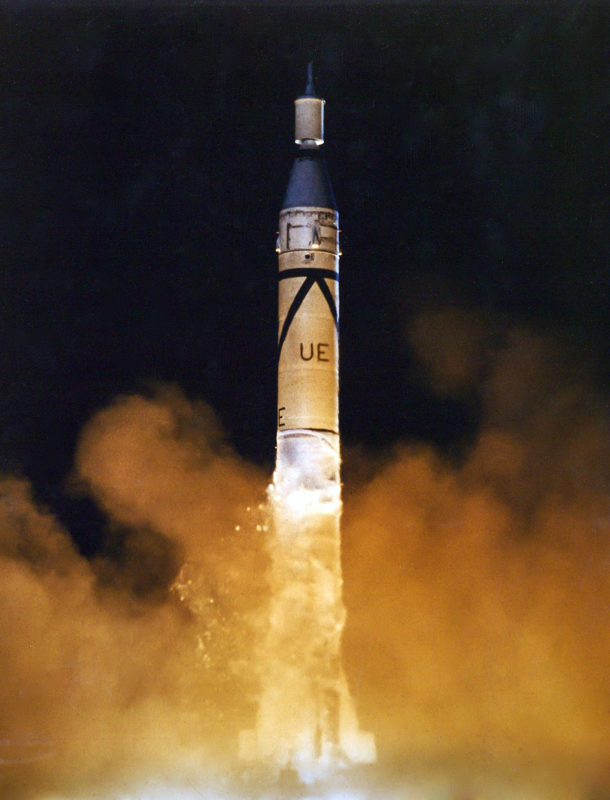
Sixty years ago today, the United States successfully orbited the country’s first space satellite. Known as Explorer I, the artificial moon went on to discover the Van Allen Radiation Belts, the extensive system of charged particles trapped in the magnetosphere that surrounds the Earth.
The Explorer I satellite was designed and fabricated by the Jet Propulsion Laboratory (JPL) under the direction of Dr. William J. Pickering. The satellite’s instrumentation unit measured 37.25 inches in length, 6.5 inches in diameter, and had a mass of only 18.3 lbs. With its burned-out fourth stage solid rocket motor attached, the total on-orbit mass of the pencil-like satellite was 30.8 lbs.
Explorer I was launched aboard a Jupiter-C (aka Juno I) launch vehicle from LC-26 at Cape Canaveral, Florida on Friday, 31 January 1958. Lift-off at occurred at 22:48 EST (0348 UTC). With all four stages performing as planned, Explorer I was inserted into a highly elliptical orbit having an apogee of 1,385 nm and a perigee of 196 nm.
Arguably the most historic achievement of the Explorer I mission was the discovery of a system of charged particles or plasma within the magnetosphere of the Earth. These belts extend from an altitude of roughly 540 to 32,400 nm above mean sea level. Most of the plasma that forms these belts originates from the solar wind and cosmic rays. The radiation levels within the Van Allen Radiation Belts (named in honor of the University of Iowa’s Dr. James A. Van Allen) are such that spacecraft electronics and astronaut crews must be shielded from the adverse effects thereof.
Explorer I operational life was limited by on-board battery life and lasted a mere 111 days. However, it soldiered-on in orbit until reentering the Earth’s atmosphere over the Pacific Ocean on Tuesday, 31 March 1970. During the 147 months it spent in space, Explorer I orbited the Earth more than 58,000 times. Data obtained and transmitted by the satellite contributed markedly to mankind’s understanding of the Earth’s space environment.
Perhaps the greatest legacy of Explorer I was that it was the first satellite orbited by the United States. Unknown to most today, this accomplishment was absolutely vital to America’s security, and indeed that of the free world, at the time. The Soviet Union had been first in space with the orbiting of the much larger Sputnik I and II satellites in late 1957. However, Explorer I showed that America also had the capability to orbit a satellite. History records that this capability would quickly grow and ultimately lead to the country’s preeminence in space.
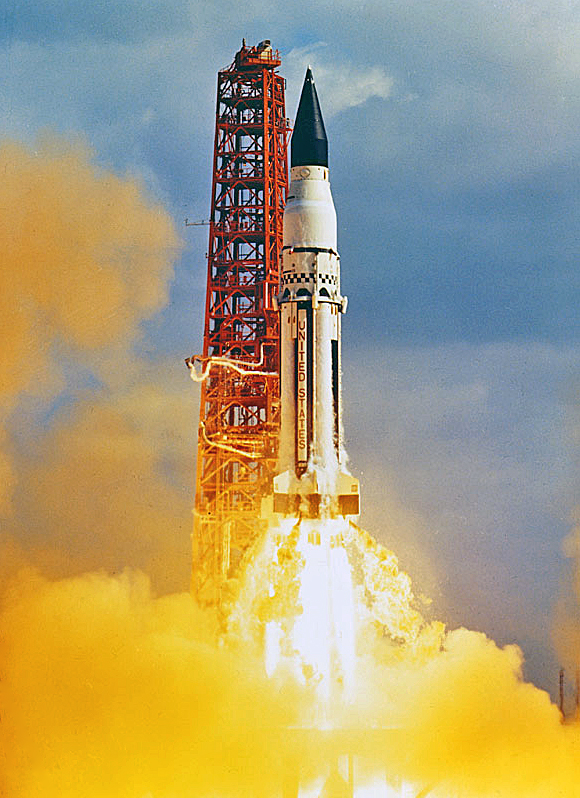
Fifty-four years ago this month, the United States successfully launched the first Saturn I Block II heavy-lift launch vehicle. Known as Saturn-Apollo No. 5 (SA-5), the space booster developmental mission featured the largest mass ever orbited up that time in the history of spaceflight.
The Saturn I vehicle was a pathfinder rocket booster that ultimately lead to the development of the mighty Saturn V launch vehicle. Ten (10) Saturn I boosters were flown between October 1961 and July 1965. The first four (4) missions involved the Block I variant wherein only the first stage was powered. The final six (6) missions employed Block II vehicles which included live first and second stages.
The powerful Saturn I measured 164 feet in length with a maximum diameter of 21.42 feet. The S-I first stage was powered by an octet of Rocketdyne H-1 engines that burned RP-1 and LOX and generated a total sea level thrust of 1,500,000 lbs. The new S-IV second-stage incorporated six (6) Pratt and Whitney RL10 engines rated at a total vacuum thrust of 900,000 lbs. The RL-10 rocket engines used liquid hydrogen and LOX as propellants.
SA-5 was launched from LC-37 at Cape Canaveral, Florida on Wednesday, 29 January 1964. Weighing 1,121,680 lbs at first stage ignition, the vehicle lifted-off at 14:25:01 UTC. As the first and second stages functioned in splendid fashion, the second stage successfully achieved an elliptical orbit measuring 142 nm x 415 nm.
The SA-5 orbited mass of 37,700 lbs was a record for the time. This payload, consisting of the S-IV stage, an instrument unit, and a modified Jupiter nose cone filled with sand ballast, remained in orbit through the end of April 1966.
The SA-5 mission was significant for a variety of reasons. It featured the first live S-IV rocket stage and was the first Saturn I vehicle to achieve orbit. It also marked that moment in spaceflight history when America finally surpassed the Soviet Union in payload mass to orbit capability. This bridging-the-gap event was an important and historic step in the race to the Moon in which America would be the ultimate victor.
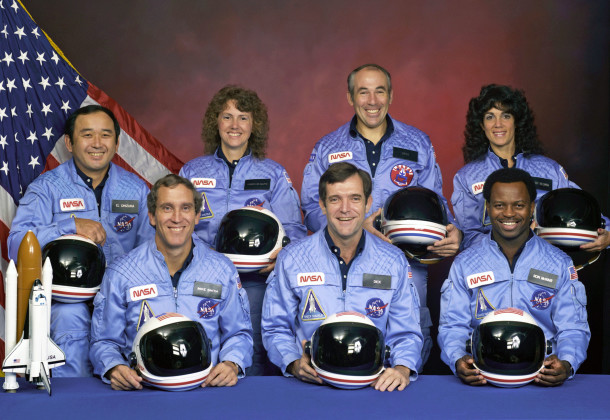
Thirty-two years ago this month, the seven member crew of STS-51L were killed when the Space Shuttle Challenger disintegrated 73 seconds after launch from LC-39B at Cape Canaveral, Florida. The tragedy was the first fatal in-flight mishap in the history of American manned spaceflight.
In remarks made at a memorial service held for the Challenger Seven in Houston, Texas on Friday, 31 January 1986, President Ronald Wilson Reagan expressed the following sentiments:
“The future is not free: the story of all human progress is one of a struggle against all odds. We learned again that this America, which Abraham Lincoln called the last, best hope of man on Earth, was built on heroism and noble sacrifice. It was built by men and women like our seven star voyagers, who answered a call beyond duty, who gave more than was expected or required and who gave it little thought of worldly reward.”
We take this opportunity to remember the noble fallen:
Francis R. (Dick) Scobee, Commander
Michael John Smith, Pilot
Ellison S. Onizuka, Mission Specialist One
Judith Arlene Resnik, Mission Specialist Two
Ronald Erwin McNair, Mission Specialist Three
S.Christa McAuliffe, Payload Specialist One
Gregory Bruce Jarvis, Payload Specialist Two
Speaking for grieving families and countrymen, President Reagan closed his eulogy with these words:
“Dick, Mike, Judy, El, Ron, Greg and Christa – your families and your country mourn your passing. We bid you goodbye. We will never forget you. For those who knew you well and loved you, the pain will be deep and enduring. A nation, too, will long feel the loss of her seven sons and daughters, her seven good friends. We can find consolation only in faith, for we know in our hearts that you who flew so high and so proud now make your home beyond the stars, safe in God’s promise of eternal life.”
Tuesday, 28 January 1986. We Remember.
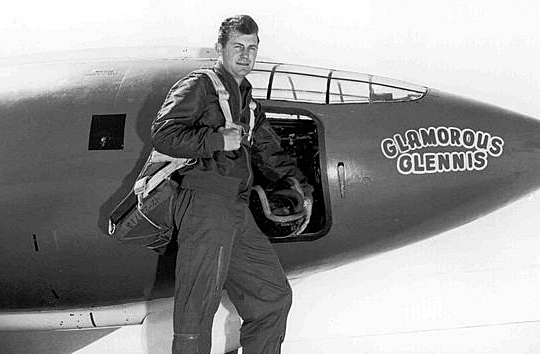
Sixty-nine years ago this month, the USAF/Bell XS-1 became the first aircraft of any type to achieve supersonic flight during a climb from a ground take-off. The daring feat took place at Muroc Air Force Base with famed USAF Captain Charles E. “Chuck” Yeager at the controls of the rocket-powered XS-1.
Rocket-powered X-aircraft such as the XS-1, X-1A, X-2 and X-15 were air-launched from a larger carrier aircraft. With the test aircraft as its payload, this “mother ship” would take-off and climb to drop altitude using its own fuel load. This capability permitted the experimental aircraft to dedicate its entire propellant load to the flight research mission proper.
The USAF/Bell XS-1 was the first X-aircraft. It was carried to altitude by a USAF/Boeing B-29 mother ship. XS-1 air-launch typically occurred at 220 mph and 22,000 feet. On Tuesday, 14 October 1947, the XS-1 first achieved supersonic flight. The XS-1 would ultimately fly as fast as Mach 1.45 and as high as 71,902 feet.
All but two (2) of the early X-aircraft were Air Force developments. The exceptions were products of the United States Navy flight research effort; the USN/Douglas D-558-I Sky Streak and USN/Douglas D-558-II Sky Rocket. The Sky Streak was a turbojet-powered, straight-winged, transonic aircraft. The Sky Rocket was supersonic-capable, swept-winged, and rocket-powered. Each aircraft was originally designed to be ground-launched.
In the best tradition of inter-service rivalry, the Navy claimed that the D-558-I at the time was the only true supersonic airplane since it took to the air under its own power. Interestingly, the Sky Streak was able fly beyond Mach 1 only in a steep dive. Nonetheless, the Air Force was indignant at the Navy’s insinuation that the XS-1 was somehow less of an X-aircraft because it was air-launched.
Motivated by the Navy’s afront to Air Force honor, the junior military service devised a scheme to ground-launch the XS-1 from Rogers Dry Lake at Muroc (now Edwards) Air Force Base. The aircraft would go supersonic in what was essentially a high performance take-off and climb. To boot, the feat was timed to occur just before the Navy was to fly its rocket-powered D-558-II Sky Rocket. Justice would indeed be righteously served!
XS-1 Ship No. 1 (S/N 46-062) was selected for the ground take-off mission. Captain Charles E. Yeager would pilot the sleek craft with Captain Jackie L. Ridley providing vital engineering support. Due to its somewhat fragile landing gear, the XS-1 propellant load was restricted to 50% of capacity. This provided approximately 100 seconds of rocket-powered flight.
On Wednesday, 05 January 1949, Yeager fired all four (4) barrels of his XLR-11 rocket motor. Behind 6,000 pounds of thrust, the XS-1 quickly accelerated along the smooth surface of the dry lake. After a take-off roll of only 1,500 feet and with the XS-1 at 200 mph, Yeager pulled back on the control yoke. The XS-1 virtually leapt into the desert air.
The aerodynamic loads were so high during gear retraction that the actuator rod broke and the wing flaps tore away. Unfazed, Yeager’s eager steed continued to climb rapidly. Eighty seconds after brake release, the XS-1 hit Mach 1.03 passing through 23,000 feet. Yeager then brought the XS-1 to a wings level flight attitude and shutdown his XLR-11 power plant.
Following a brief glide back to the dry lake, Yeager executed a smooth dead-stick landing. Total flight time from lift-off to touchdown was on the order of 150 seconds. While a little worst for wear, the plucky XS-1 had performed like a champ and successfully accomplished something that it was really not designed to do.
Yeager was so excited during the take-off roll and high performance climb that he forgot to put his oxygen mask on! Potentially, that was a problem since the XS-1 cockpit was inerted with nitrogen. Fortunately, late in the climb, Yeager got his mask in place just before he went night-night for good.
Suffice it to say that the United States Navy was not particularly fond of the display of bravado and airmanship exhibited on that long-ago January day. The Air Force had emerged victorious in a classic contest of one-upmanship. At a deeper level, Air Force honor had been upheld. And, as was often the case in the formative years of the United States Air Force, it was a test pilot named Chuck Yeager who brought victory home to the blue suiters.