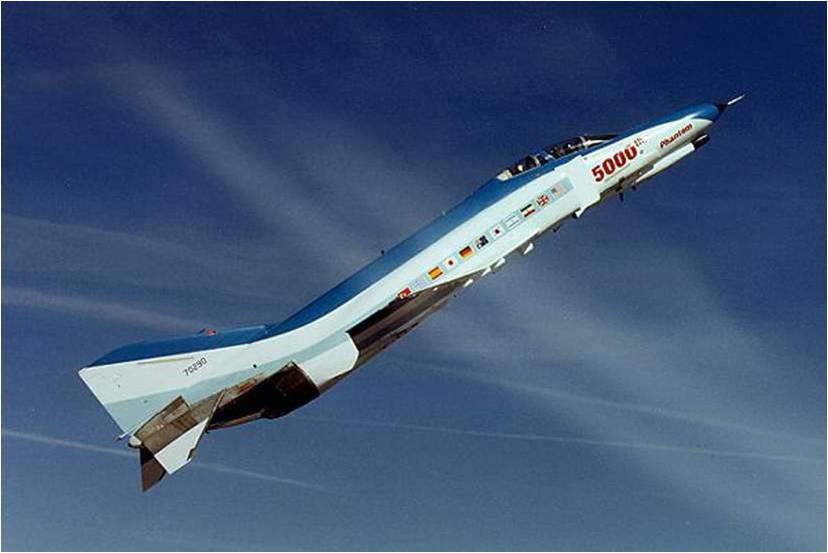
Thirty-six years ago this week, production unit No. 5,000 of the incomparable USAF/McDonnell F-4 Phantom II fighter-bomber was delivered in a public ceremony held at Lambert-St. Louis International Airport. This occasion (Wednesday, 24 May 1978) also marked the 20th anniversary of the type’s maiden flight (Saturday, 24 May 1958).
Rhino, Lead Sled, Flying Brick, Flying Anvil, Old Smokey, Double Ugly, The Hammer; such are among the many terms of endearment used by pilots, back seaters and crew chiefs to describe the fabled F-4 Phantom II. Perhaps no other military aircraft is as emblematic of the air warfare mission than this classic two-seater, twin-jet airframe.
Initially developed for the United States Navy, the Phantom was also employed by the U.S. Marine Corps, United States Air Force, and the air forces of many allied nations. As such, it served in numerous air warfare roles including fighter, bomber, attack, interceptor, defense suppression, and aerial reconnaissance. Indeed, over 50 variants of the F-4 were produced between 1958 and 1981.
The aircraft was Mach 2.2-capable with a service ceiling of 60,000 feet. At a GTOW of 41,500 lbs, the Phantom could carry an ordnance load of 18,650 lbs wherein combinations of air-to-air missiles, air-to-ground missiles and a variety of multiple-yield bombs were employed.
The Phantom was conceived in a time when reliance on missiles appeared to obviate the need for cannon in air combat engagegments. Subsequent air warfare experience in Viet Nam dictated otherwise and a centerline-mounted M61 Vulcan cannon was installed on the F-4E variant.
The Phantom was heavily used by the military services in southeast asia and proved to be extremely effective. So much so, that it gained an additional nickname as the “World’s Leading Distributor of MiG Parts”.
In its time, the Phantom also held many speed, altitude, and time-to-climb aircraft performance records. Noteworthy is the fact that the F-4 also holds the distinction of being the only aircraft flown by both the United States Air Force Thunderbirds and United States Navy Blue Angels flight demonstration teams.
Today, there are over 600 Phantoms still flying worldwide. In the United States, one is likely to see a Phantom in its natural element only at an air show. Even in an age when the F-15 Eagle, B-1B Lancer and F-22 Raptor grace the sky, it is a choice experience indeed to witness the mighty F-4 come by show center in full afterburner. Rhinos forever!
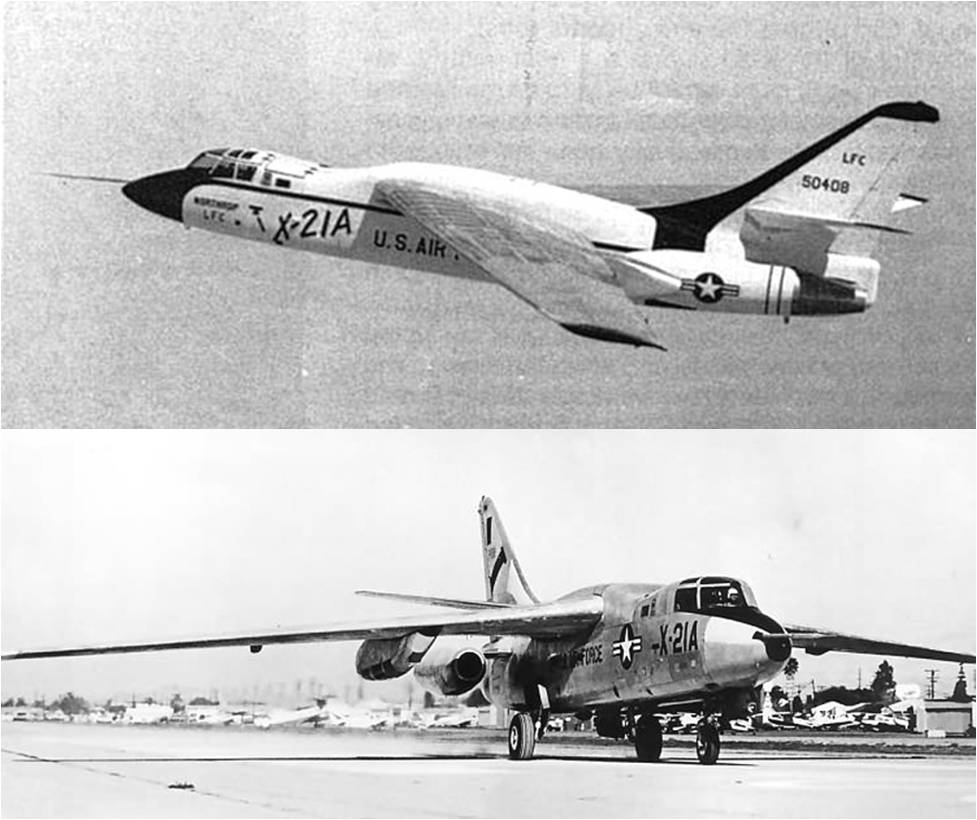
Forty-nine years ago today, the USAF/Northrop X-21A Laminar Flow Control (LFC) experimental aircraft exhibited a significant reduction in skin friction drag. This achievement marked the first time in aviation history that the LFC principle was successfully demonstrated in flight. Perhaps aviation’s greatest holy grail is the pursuit of technology that allows a laminar boundary layer to be maintianed over the entire surface of an aircraft. Doing so holds the promise of significantly reducing the overall drag and thereby markedly increasing aircraft range and endurance performance. Maintaining a laminar boundary layer is difficult since the boundary layer is naturally turbulent over most of the aircraft at flight Reynolds numbers. The X-21A LFC system was based on the principle of boundary layer removal. This was achieved by drawing surface airflow through a series of fine, porous slots machined into the upper and lower surfaces of the wing. Airflow suction was provided by laminar flow control pumps located in nacelles on the underside of the wing. A pair of existing USAF B-66D Destroyer airframes were converted to the X-21A LFC configuration. Following conversion and checkout, Ship No. 1 (S/N 55-0408) first flew on Thursday, 18 April 1963 with Northrop test pilot Jack Wells doing the honors. On this initial test hop, the X-21A flew from Northrop’s Hawthorne Airport facility to Edwards Air Force Base, California. The first successful flight demonstration of aircraft drag reduction occurred on Tuesday, 14 May 1963. Ultimately, the X-21A demonstrated laminar flow control on about 75% of the type’s wing surface. Aircraft handling was satisfactory even with asymmetric boundary layer state on opposing wings (i.e., one wing with laminar flow and the other with turbulent flow). However, the Achilles Heel of LFC is the natural flight environment itself wherein dust, dirt, particulates and even bugs clog the boundary layer suction slots. LFC system maintenance is a nightmare; laborious, time-consuming and expensive. While clearly successful, the X-21A LFC Program came to an end in 1964. Despite its promise and allure, no operational production aircraft has ever utilized an LFC system.
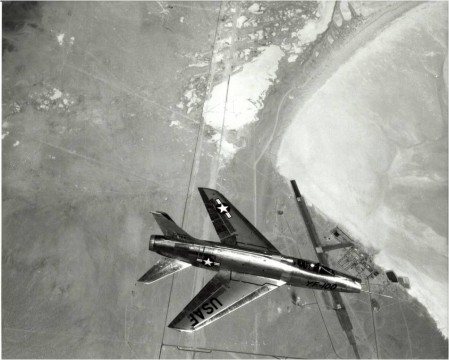
Fifty-nine years ago this month, the USAF/North American YF-100A Super Sabre air-superiority fighter made its maiden flight with North American test pilot George S. Welch at the controls. During this initial test flight, the Super Sabre exceeded the speed of sound. The North American F-100 Super Sabre was the successor to the fabled F-86 Sabre fighter. The Super Sabre holds the distinction of being the first of the 1950’s era Century Series aircraft. It was also the first USAF production aircraft capable of flying supersonically in level flight. A total of 2,294 copies of the Super Sabre in 18 variants were produced over an operational lifetime that spanned 25 years. The air forces of the United States, France, Denmark, Turkey and the Republic of China (Taiwan) flew the aircraft affectionately known as “The Hun” by its pilots. The YF-100A was the initial version of the F-100. Two copies were produced. Ship No. 1 (S/N 52-5754) first flew on Monday, 25 May 1953 at Edwards Air Force Base, California. The aircraft performed well and hit Mach 1.03 on this first flight. The Super Sabre entered the USAF active inventory in late 1954 and set a number of speed records early in its operational life. The type won the Bendix Trophy for flying 2,020 nm at an average speed of 610.726 mph in September of 1955. The F-100 was also the first USAF combat jet to enter the Vietnam War. The USAF Thunderbirds flew the Super Sabre from 1956 to 1968. In spite of these notable achievements and distinctions, the aircraft was plagued by numerous design deficiencies and shortcomings that had to be corrected before the type reached an acceptable level of maturity. Particularly vexing were roll inertial coupling issues at high speeds and pitch-up tendencies at low speeds. Indeed, the aircraft had a deserved reputation as a widow-maker starting early in its career. History records that 889 F-100 airframes were destroyed in mishaps of one kind or another. That translates to a stunningly-high loss rate of 38.75%. Soberingly, 324 pilots lost their lives flying The Hun. Progress in aviation sometimes comes at a very high price. The F-100 Super Sabre, unique in its day, now a relic of history, is a particularly profound example of this truism.

Forty-years ago this month, the United States successfully conducted the next-to-last Apollo lunar landing mission with the flight of Apollo 16. The lunar landing occurred in the densely-cratered Descartes Highlands region located near the Descartes crater.
On Sunday, 16 April 1972, Commander John W. Young, Command Module Pilot Thomas K. Mattingly II, and Lunar Module Pilot Charles M. Duke, Jr. lifted-off from Cape Canaveral’s LC-39A at 17:54:00 UTC. Apollo 16’s goal was to land in the lunar highlands whose surface material was older than that of the previously-visited lunar maria landing sites.
Apollo 16 entered lunar orbit in the 75th hour of the outbound flight. Young and Duke undocked their Lunar Module Orion from the Command Module Casper piloted by Mattingly just short of 96.5 hours into the mission. Slightly more than 8 hours later, Orion safely touched-down near Descartes crater at 2:23:35 UTC on Friday, 21 April 1972.
During their 71-hour lunar stay, Young and Duke conducted a trio of surface EVA’s to explore the Descartes region. Totaling more than 20 hours, these exploratory jaunts were facilitated by use of the motorized Lunar Rover that allowed the crew to venture as far as 2.7 miles from the Lunar Module.
Although too extensive to adequately report here, the astronauts’ exploratory discoveries were truly phenomenal and ultimately changed our understanding of the Moon’s geology. Young and Duke collected roughly 211 lbs of lunar surface samples. At 1:25:47 UTC on Monday, 24 April 1972, Orion and her crew lifted-off from the lunar surface and docked with Casper a little more than 2 hours later.
Following transfer of crew and cargo to Casper, Orion was jettisoned, and the 3-man crew remained in lunar orbit for almost a full earth day conducting experiments and surface observations before being rocketed back to Earth. The trip home and earth atmospheric entry were uneventful in the main.
Command Module splashdown took place at 19:45:05 UTC on Thursday, 27 April 1972 in the South Pacific Ocean. Crew, lunar cargo and spacecraft were safely recovered aboard the USS Ticonderoga some 37 minutes later.
Apollo 16 was a grand achievement both scientifically and technologically. Along with the other Apollo lunar landing missions, Apollo 16 reminds us what be accomplished when vision, commitment and hard work are brought to bear. Today, the lone Apollo 16 spacecraft component to return to Earth, the Command Module Casper, is on public display at the U.S. Space and Rocket Center in Huntsville, Alabama.
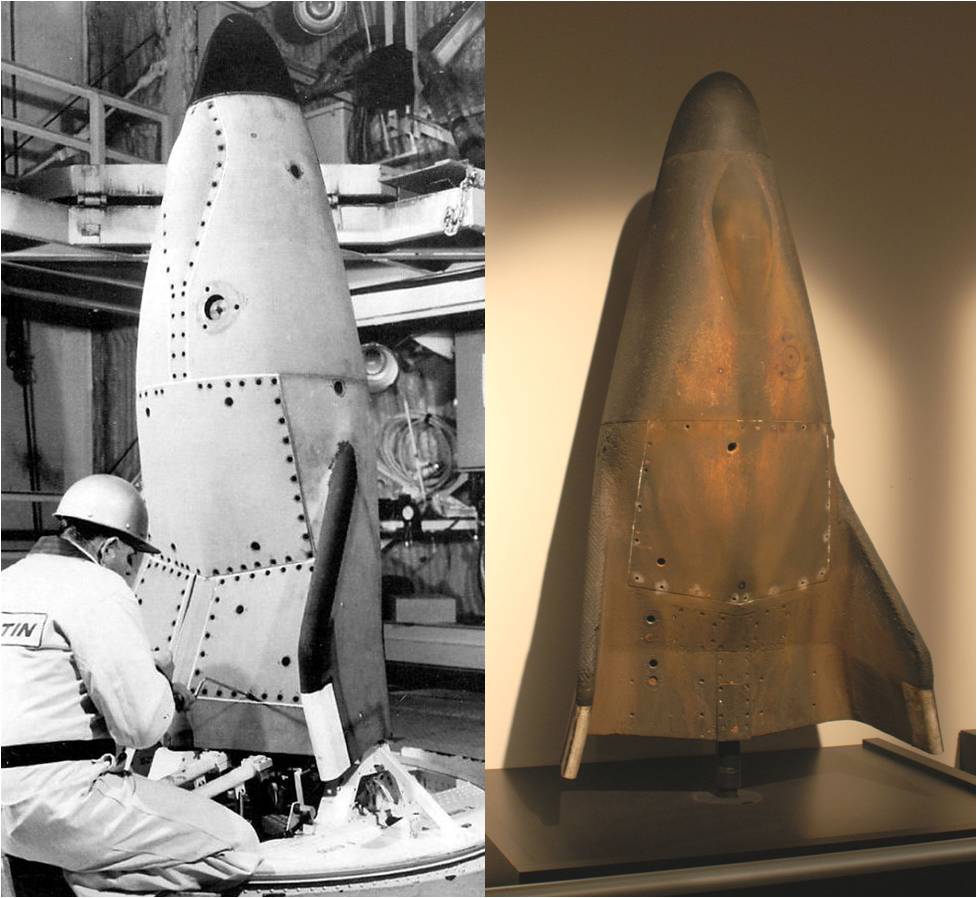
Forty-five years ago this month, the United States Air Force successfully flew and recovered the third and final Project PRIME Flight Test Vehicle (FTV-3). PRIME stood for Precision Recovery Including Maneuvering Entry. The ability to generate aerodynamic lift allows a reentry vehicle to maneuver along the endoatmospheric portion of its entry flight path. The main goal of Project PRIME was to flight test a hypersonic, maneuvering lifting body vehicle designated as the USAF/Martin SV-5D. Configured with 3-axis aerodynamic and reaction controls, the SV-5D weighed 892 lb and measured 6.7 ft, 4.0 ft and 2.8 ft in length, span and height, respectively. Thermal protection was provided by a then-novel charring ablator material. The SV-5D was an autonomous vehicle and thus had its own guidance, navigation and control system. On Wednesday, 19 April 1967, PRIME FTV-3 was launched by an Atlas booster from Vandenberg Air Force Base, California. The vehicle’s trajectory took it toward Kwajalein Missile Range (KMR) located 4,400 nm to the west in the Marshall Islands. FTV-3 performed a variety of controlled maneuvers during entry in which a maximum crossrange of 710 nm was achieved. The vehicle modulated crossrange by banking as much as 64 degrees while simultaneously pulling angles-of-attack as high as 57 degrees to achieve the required lift vector. Indeed, this very same crossrange maneuvering strategy would be used by the Space Shuttle Orbiter a decade and a half later. FTV-3 deployed a drogue parachute as it passed through Mach 2 at 100,000 feet. Main parachute deployment then occurred in the vicinity of 50,000 feet. As the vehicle-parachute combination neared an altitude of 12,000 feet, the crew of a USAF/Lockheed JC-130B Hercules then executed the only successful aerial recovery of a PRIME flight test vehicle. A planned fourth flight was cancelled due to the great success achieved in the preceding trio of PRIME flight tests. As a final note, FTV-3 was subsequently returned to the contractor for post-flight inspection and testing. Today, the recovered FTV-3 airframe is on public display at the United States Air Force Museum in Dayton, Ohio.

Fifty-years ago this week, future Apollo 11 Astronaut Neil A. Armstrong piloted the fifty-first and longest mission of the X-15 Program. The research flight was highlighted by Armstrong having to make a 180-degree turn over Los Angeles to recover the X-15 back at Edwards Air Force Base following a 45-mile overshoot of the intended landing area. X-15 Ship No. 3 (S/N 56-6672) was configured with the Honeywell MH-96 adaptive flight controller for the purpose of easing the pilot’s workload during atmospheric exit and entry. NASA test pilot Neil Armstrong was assigned responsibility to perform the early flight testing of this unit. On Friday, 20 April 1962, Armstrong made his fourth and last flight in Ship No. 3. Peak altitude and speed achieved during the flight was 207,447 feet and 3,788 mph (Mach 5.31), respectively. As Armstrong approached the Edwards area from the northeast, his trajectory ballooned anomalously. That is, rather that continuing to descend and scrub-off velocity, the X-15 climbed slightly and maintained an above-nominal speed. As he passed by Rogers Dry Lake heading south, Armstrong was still traveling at 100,000 feet and Mach 3. Armstrong banked the aircraft until it was practically inverted and invoked full elevator in an effort to get the X-15 to bite into the atmosphere and turn back towards Edwards AFB. However, it wasn’t until he was over Los Angeles, roughly 45 miles beyond the base, that he got the aircraft turned around. Now, would he have enough energy to glide back and touchdown on Rogers Dry Lake? Somehow, Armstrong managed his energy state properly and made it back to Edwards. But it was a close thing. Rather than making the standard overhead turn and landing on the north side of Rogers Dry Lake, Armstrong executed a straight-in approach and landed on the south side of the desert playa. Chase pilots are recorded to have said that he cleared the Joshua trees at the south end of Rogers Dry Lake by only about 100-150 feet. Nonetheless, pilot and aircraft were unscathed in what turned-out to be the longest flight in the history of the X-15 Program (12 minutes 28.7 seconds). In the post-flight joviality, fellow NASA test pilots reportedly referred to Armstrong’s adventure as “Neil’s cross-country flight”.

Sixty-years ago this week, the USAF/Boeing YB-52 Stratofortress (S/N 49-231) all-jet strategic bomber took to the air on its maiden flight. The crew for this historic event consisted of Boeing’s Alvin M. “Tex” Johnston (command pilot) and USAF Lt Col Guy M. Townsend (co-pilot). The B-52 was designed by the Boeing Company for the United States Air Force in the 1940’s. Its mission was to provide the Strategic Air Command (SAC) with a global nuclear strike capability. As originally designed, the B-52 featured a top speed of 513 mph at 35,000 feet and a range of 6,005 nm for a gross take-off weight of 280,000 lbs. Power was provided by an octet of Pratt and Whitney J-57 turbojets; each of which generated a maximum sea level thrust of about 10,000 lbs. With a fuselage length of 160 feet, the B-52 was configured with a huge wing having a span of 185 feet and a leading edge sweep of 35 degrees. The initial pair of prototype B-52 aircraft (S/N 49-230 and S/N 49-231)received the designation of XB-52. However, the second XB-52 (S/N 49-231) was subsequently designated as the YB-52 and was the first B-52 airframe to fly. It did so on Tuesday, 15 April 1952. This 2.35-hour maiden flight originated from Boeing Field near Seattle, Washington and recovered at Larson AFB, Washington. The big airplane performed well on its initial foray into the wild blue yonder and it was clear from the start that USAF and Boeing had a winner. Indeed, the Stratofortress would go on to a storied career whose length and breadth could not have been foreseen by its creators. The type’s speed, range and gross weight would increase over the years. New and more powerful engines would provide the improved performance. A total of 744 copies of the B-52 were built in eight (8) different production versions (B-52A through B-52H); roughly 90 of which are still flying. Amazingly, three (3) generations of Air Force pilots have flown the aircraft. With a service period that began in the Cold War and extends into the present, the B-52 Stratofortress holds the distinction of being the longest serving bomber aircraft in the history of military aviation.

Forty-seven years ago this week, the first International Telecommunications Satellite (Intelsat I) was launched into a geosynchronous orbit by a Thrust-Augmented Delta (TAD) launch vehicle. Popularly known as Early Bird, the satellite holds the distinction of being history’s first commercial communications orbital platform. It was also the first satellite to provide direct and quasi-instantaneous communication between the North American and European continents including transmission of television, telephone, and telefax signals. Fired into orbit from LC-17A at Cape Canaveral, Florida on Tuesday, 06 April 1965, Early Bird consisted of a 28-inch diameter cylinder measuring 23-inches in height. Spin-stabilized about its longitudinal axis, the satellite weighed just 85 lbs. Power was provided by an array of 6,000 solar cells covering its external surface. Early Bird was capable of handling 240 two-way telephone circuits or a single TV channel via a pair of 6-watt transmitters. Though primitive by today’s standards, Early Bird functioned well its role as a communications satellite. Among its many accomplishments, the satellite helped make possible the first live television broadcast of the splashdown of a manned spacecraft when Gemini 6 returned to earth in December of 1965. Early Bird was deactivated in January of 1969 following a 48-month service period that began on Monday, 28 June 1965. This service duration was well beyond the type’s original design life of 18 months. When the Atlantic Intelsat satellite failed at a most inopportune moment, Early Bird was returned to operational status on Sunday, 29 June 1969 to support the Apollo 11 mission. This reactivation period was brief and ended on Wednesday, 13 August 1969. With the exception of a short period of reactivation in 1990 to honor its 25th launch anniversary, Early Bird has silently orbited the Earth ever since. The Intelsat Program grew remarkably following the fledging flight of Early Bird so long ago. Indeed, more than 120 Intelsat and Intelsat-derivative satellites have been orbited by a variety of American, Russian, French and Chinese launch vehicles since 1965.

Forty-nine years ago this week, the United States successfully conducted the fourth Saturn I test flight designated as Saturn-Apollo No. 4 (SA-4). Launched from LC-34 at Cape Canaveral, Florida on Thursday, 28 March 1963, SA-4 reached an apogee of 70 nm, attained a maximum speed of 3,670 mph and flew 216 nm downrange during the brief 15 minute suborbital mission. The Saturn I measured 180 feet in length, featured a maximum diameter of 21.4 feet and weighed 1,123,600 l bs at lift-off. The first stage propulsion system consisted of an octet of H-1 engines generating a total sea level thrust of 1,600,000 lbs. Nominal burn time was 150 seconds. Part of the early Apollo Program, SA-4 was the last flight to fire just the first stage rocket engines. As with the previous three launches, the primary goal of SA-4 was to validate the structural integrity of the Saturn I vehicle. However, a significant additional objective of SA-4 was to verify the GNC system’s ability to properly handle an engine-out anomaly during first stage operation. As such, one of the H-1 engines was programmed to intentionally shutdown at approximately T+100 seconds. The GNC system did indeed respond properly to this anomaly by rerouting propellants to the remaining seven (7) engines which burned longer to compensate for the loss of thrust. SA-4 also employed a nonfunctional second stage which incorporated the external shape of the ultimate second stage design. This included the presence of vent ducts, fairings, simulated camera pods and various externally-mounted antennae. SA-4 also fired a retrorocket system that would be employed to aid separation of various rocket stages on later flights. Despite dire warnings in some quarters, the shutdown H-1 engine remained intact despite the build-up of heat caused by the lack of cooling propellant flowing around the nozzle. This survivability feature underscored the robustness of the clustered engine concept employed in the Saturn series of space boosters. Interestingly, the engine-out compensation capability demonstrated on SA-4 was in fact successfully employed during a pair of later Apollo missions; Apollo 6 and Apollo 13.
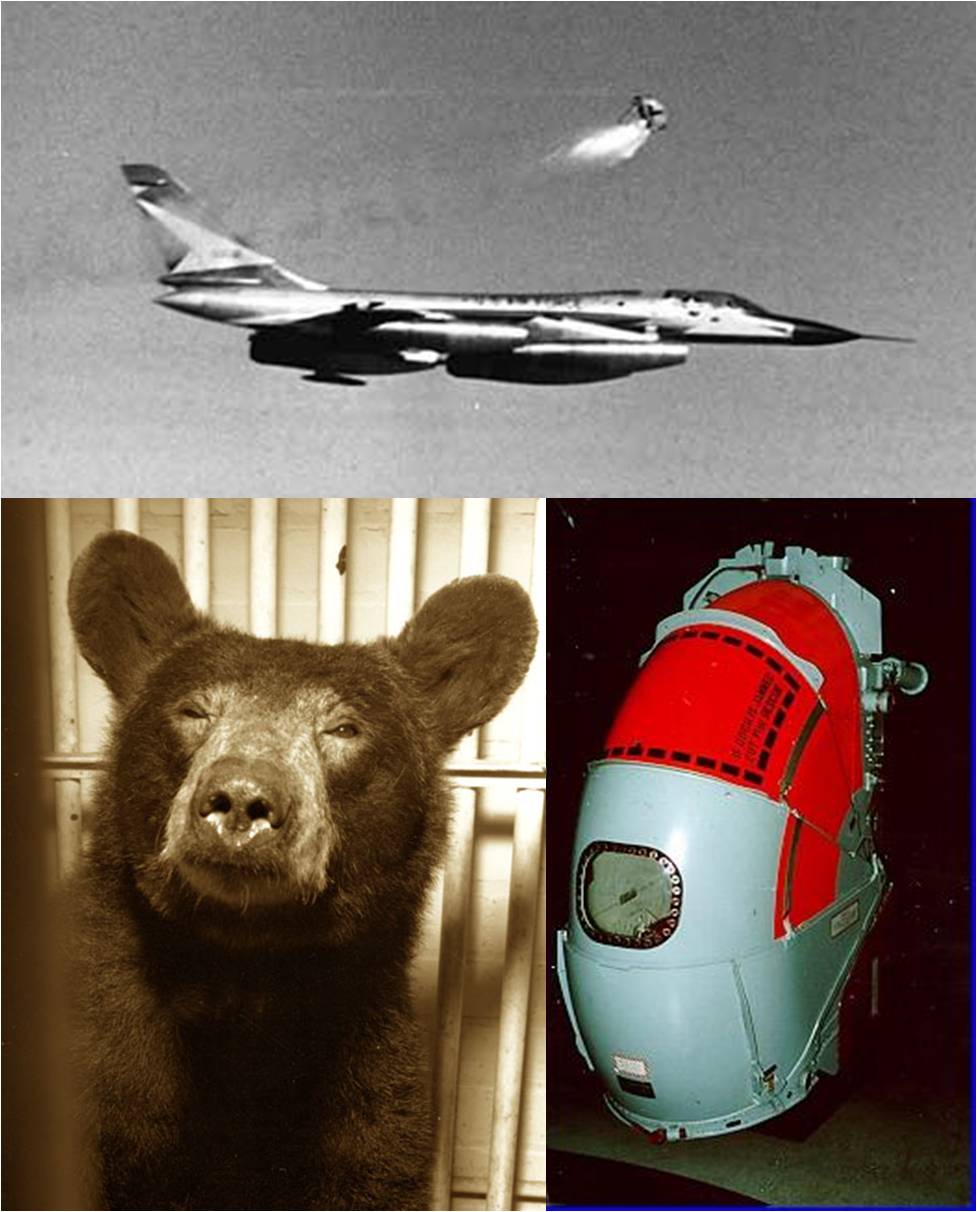
Fifty-years ago this week, a supersonic flight test of the B-58A Hustler’s crew escape system was successfully conducted with a black bear named Yogi as the test subject. Ejection took place with the test aircraft maintaining a speed of 850 mph at 35,000 feet. The USAF/Convair B-58A Hustler was the world’s first operational supersonic strategic bomber. With a GTOW of 176,000 lbs and powered by a quartet of General Electric J79-GE-5A turbojets, the aircraft featured a maximum speed of Mach 2 at 40,000 feet. The Hustler air crew consisted of a pilot, bombardier/navigator and defensive systems officer seated in separate, tandem flight stations. When the Hustler entered the operational inventory in 1960, standard ejection seats were used for air crew emergency egress. However, the chances of surviving a supersonic ejection in the B-58A or any other aircraft were quite low due to severe wind blast and exposure effects. The resolution of this issue came in the form of an encapsulation system that protected the crew member during ejection, deceleration, parachute deployment and landing. Upon activation, clamshell doors would close and seal the crew member in the escape capsule. The entire assembly was then fired out the top of the aircraft and into the air stream. Flight testing of this system was initially performed using bears due to the similarity of their internal organ arrangement with that of a man’s. On Wednesday, 21 March 1962, a 2-year old female black bear named Yogi served as the first live test subject. The tranquilized bear survived the ride upstairs, the ejection event, 7.5 minute parachute descent and landing with no apparent ill effect. Subsequent testing with other bears helped prove the escape system’s airworthiness. Although many sources claim that this was the first supersonic ejection of a live creature, such is not the case. That particular distinction (if it can be called that) goes to North American Aviation pilot George F. Smith who bailed out of his stricken F-100 Super Sabre at 777 mph on Sunday, 26 February 1955. Although battered and terribly injured in the process, Smith survived and lived to fly another day.