Forty-nine years ago today, the United States successfully launched Orbiting Solar Observatory No. 1 (OSO-1) into Earth orbit. This robotic spacecraft provided the first detailed scientific examination of the Sun from space.
The 1960’s was a time of both rapid growth and spectacular achievements in space exploration. Indeed, weather satellites, communications satellites and surveillance satellites were new inventions. Robotic space probes were sent to orbit and land on the Moon. Other autonomous spacecraft visited the inner planets of the Solar System. Men orbited the Earth. Still others landed on and returned from the Moon.
Space probes were also employed to good effect in an effort to learn more about our Sun. NASA’s Orbiting Solar Observatory (OSO) Program was America’s first attempt to acquire detailed solar physics data using orbital spacecraft. A total of eight (8) OSO space probes were launched into Earth orbit between 1962 and 1975.
The fundamental objective of the OSO Program was to monitor and measure solar electromagnetic radiation levels over an 11-year sun spot cycle. The idea was to map the direction and intensity of Ultraviolet, X-Ray and Gamma radiation throughout the celestial sphere over the long solar cycle. Onboard scientific instrumentation included a solar spectrometer, scintillation detector, proton electron analyzer and various flux monitors
OSO satellites were relatively large and complex for their time. Spacecraft attitude had to be tightly controlled since onboard instrument systems needed to be continuously trained on the solar disk. The probe’s solar physics data could be transmitted to ground receiving stations in real-time or recorded on tape for later transmittal.
OSO-1 was the first solar observatory orbited by the United States. Launch from Cape Canaveral’s LC-17A took place on Wednesday, 07 March 1962 at 16:04:00 UTC. A Thor-Delta 301/D8 launch vehicle placed the 458-lb OSO-1 satellite into a near circular Earth orbit (291-nm x 275-nm). The orbital period of 94.7 minutes meant that OSO-1 orbited the Earth 15.2 times each day.
OSO-1 performed well until its second onboard tape recorder gave up the ghost. This anomaly occurred on Tuesday, 15 May 1962. The loss of its last functional data recorder meant that all subsequent measurements had to be transmitted in real-time.
OSO-1 would continue making and transmitting solar physics measurements until May of 1964. At that time, the spacecraft power supply died when its solar cells failed. Although dormant, OSO-1 would continue to orbit the Earth for another seventeen (17) years. The spacecraft reentered the Earth’s atmosphere on Thursday, 08 October 1981.
OSO-1 and all succeeding OSO satellites contributed significantly to progress in the realm of solar physics. The OSO Program laid the foundation for more sophisticated and detailed study of our Sun through the auspices of such solar probes as SOHO, Ulysses and Skylab. Indeed, NASA’s Solar Probe Plus probe, currently scheduled to fly within the Sun’s coronal region sometime in the 2015/2016 period, will continue the legacy begun long ago by OSO-1.

Fifty-five years ago this month, the USAF/North American X-10 experimental research vehicle hit a maximum speed of Mach 2.05 during its 19th test flight. The mark established a new speed record for turbojet-powered aircraft.
The precedent set by the Nazi V-1 and V-2 Vergeltungswaffen (Vengeance Weapons) in World War II motivated the United States to launch a post-war effort to develop a strategic range-capable missile capability. The earliest example in this regard was the USAF/North American Navaho (SM-64).
Known as Project MX-770, the Navaho was developmental effort to deliver a nuclear warhead at a range of 5,500 nm. The Navaho configuration consisted of a rocket-powered first stage and a winged second stage utilizing ramjet propulsion. The second stage was designed to cruise at Mach 2.75.
The X-10 was a testbed version of the Navaho second stage. The X-10 measured 66 feet in length, sported a wingspan of 28 feet and had a GTOW of 42,000 lbs. The sleek aircraft was powered by twin Westinghouse J40-WE-1 turbojets. These powerplants burned JP-4 and were each rated at 10,900 lbs of sea level thrust in full afterburner.
The X-10 was a double sonic-capable aircraft. It had an unrefueled range of 850 miles and a maximum altitude capability of 44,800 feet.
The X-10 vehicle flight surfaces included elevons for pitch and roll control and twin rudders for yaw control. Canard surfaces were employed for pitch trim. The aircraft was designed to take-off, maneuver and land under external control provided by either airborne or ground-based assets.
A total of thirteen (13) X-10 airframes were constructed by North American. Flight testing originated at the Air Force Flight Test Center (AFFTC), Edwards Air Force Base, California and later moved to the Air Force Missile Test Center (AFMTC) at Cape Canaveral in Florida.
There was a total of twenty-seven (27) X-10 flight tests. Fifthteen (15) flight tests took place at the AFFTC between October of 1953 and March of 1955. Twelve (12) flight tests were conducted at the AFMTC between August 1955 and November 1956.
X-10 airframe GM-52-1 achieved the highest speed of the type’s flight test series. On Wednesday, 29 February 1956, the aircraft recorded a peak Mach Number of 2.05 during the 19th flight test of the X-10 Program. At the time, this was a record for turbojet-powered aircraft. The mission originated from and recovered to the AFMTC.
While the X-10 Program produced a wealth of aerodynamic, structural, flight control and flight performance data, test vehicle attrition was extremely high. The lone X-10 to survive flight testing was airframe GM-19307. It is currently on display at the Museum of the United States Air Force at Wright-Patterson Air Force Base in Dayton, Ohio.

Fifty-six years ago this week, North American test pilot George F. Smith became the first man to survive ejection from an aircraft in supersonic flight. Smith ejected from his F-100A Super Sabre at 777 MPH (Mach 1.05) as the crippled aircraft passed through 6,500 feet in a near-vertical dive.
On the morning of Saturday, 26 February 1955, North American Aviation (NAA) test pilot George F. Smith stopped by the company’s plant at Los Angeles International Airport to submit some test reports. Returning to his car, he was abruptly hailed by the company dispatcher. A brand-new F-100A Super Sabre needed to be test flown prior to its delivery to the Air Force. Would Mr. Smith mind doing the honors?
Replying in the affirmative, Smith quickly donned a company flight suit over his street clothes, got the rest of his flight gear and pre-flighted the F-100A Super Sabre (S/N 53-1659). After strapping into the big jet, Smith went through the normal sequence of aircraft flight control and system checks. While the control column did seem a bit stiff in pitch, Smith nonetheless made the determination that his steed was ready for flight.
Smith executed a full afterburner take-off to the west. The fleet Super Sabre eagerly took to the air. Accelerating and climbing, the aircraft was almost supersonic as it passed through 35,000 feet. Peaking out around 37,000 feet, Smith sensed a heaviness in the flight control column. Something wasn’t quite right. The jet was decidely nose heavy. Smith countered by pulling aft stick.
The Super Sabre did not respond at all to Smith’s control inputs. Instead, it continued an uncommanded dive. Shallow at first, the dive steepened even as the 215-lb pilot pulled back on the stick with all of his might. But all to no avail. The jet’s hydraulic system had failed. As the stricken aircraft now accelerated toward the ground, Smith rightly concluded that this was going to be a short ride.
George Smith knew that he had only one alternative now. Eject. However, he also knew that the chances were small that he could survive what was quickly shaping-up to be a quasi-supersonic ejection. Suddenly, over the radio, Smith heard another F-100A pilot flying in his vicinity yell: “Bail out, George! He proceeded to do so.
Smith jettisoned his canopy. The roar from the airstream around him was unlike anything he had ever heard. Almost paralyzed with fear, Smith reflexively hunkered-down in the cockpit. The exact wrong thing to do. His head needed to be positioned up against the seat’s headrest and his feet placed within retraining stirrups prior to ejection. But there was no time for any of this now. Smith pulled the ejection seat trigger.
George Smith’s last recollection of his nightmare ride was that the Mach Meter read 1.05; 777 mph at the ejection altitude of 6,500 feet above the Pacific Ocean. These flight conditions corresponded to a dynamic pressure of 1,240 pounds per square foot. As he was fired out of the cockpit and into the harsh airstream, Smith was subjected to a drag force of around 8,000 lbs producing on the order of 40-g’s of deceleration.
Mercifully, Smith did not recall what came next. The ferocious windblast stripped him of his helmet, oxygen mask, footwear, flight gloves, wrist watch and even his ring. Blood was forced into his head which became grotesquely swollen and his facial features unrecognizable. His eyelids fluttered and his eyes were tortuously mauled by the aerodynamic and inertial load of his ejection. Smith’s internal organs, most especially his liver, were severely damaged. His body was horribly bruised and beaten as it flailed end-over-over end uncontrollably.
Smith and his seat parted company as programmed followed by automatic deployment of his parachute. The opening forces were so high that a third of the parachute material was ripped away. Thankfully, the remaining portion held together and the unconscious Smith landed about 75 yards away from a fishing vessel positiond about a half-mile form shore. Providentially, the boat’s skipper was a former Navy rescue expert. Within a minute of hitting the water, Smith was rescued and brought onboard.
George Smith was hovering near death when he arrived at the hospital. In severe shock and with only a faint pulse, doctors quickly went to work. Smith awoke on his sixth day of hospitalization. He could hear, but he couldn’t see. His eyes had sustained multiple subconjunctival hemorrhages and the prevailing thought at the time was that he would never see again.
Happily, George Smith did recover almost fully from his supersonic ejection experience. He spent seven (7) months in the hospital and endured several operations. During that time, Smith’s weight dropped to 150 lbs. He was left with a permanently damaged liver to the extent that he could no longer drink alcohol. As for Smith’s vision, it returned to normal. However, his eyes were ever after somewhat glare-sensitive and slow to adapt to darkness.
Not only did George Smith return to good health, he also got back in the cockpit. First, he was cleared to fly low and slow prop-driven aircraft. Ultimately, he got back into jets, including the F-100A Super Sabre. Much was learned about how to markedly improve high speed ejection survivability in the aftermath of Smith’s supersonic nightmare. He in essence paid the price so that others would fare better in such circumstances as he endured.
George Smith was thirty-one (31) at the time of his F-100A mishap. He lived a happy and productive thirty-nine (39) more years after its occurrence. Smith passed from this earthly scene in 1994.

Fifty-years ago this week, the NASA SCOUT small launch vehicle successfully orbited the Explorer IX satellite. This achievement marked the first time that an all-solid propellant launch vehicle orbited an artificial satellite.
The concept for the Solid Controlled Orbital Utility Test (SCOUT) launch vehicle dates back to the late 1950’s. The National Advisory Committee For Aeronautics (NACA) saw a need to develop a simple, low-cost launch vehicle for boosting small science payloads into space. Propulsion units for each stage would be selected from the existing inventory of solid rocket motors.
In the same time period, the United States Air Force (USAF) was moving toward the development of a small launch vehicle (SLV) to support a variety of suborbital and orbital military missions. The junior service subsequently partnered with the recently established National Aeronautics and Space Administration (NASA) in March of 1959 to develop a “poor man’s rocket.”
The SCOUT SLV was a 4-stage, all-solid propellant launch vehicle that stood roughly 75-feet in height. The initial version of the vehicle was designed to put a 130-lb payload into a 115 nm circular Earth orbit. The payload capacity of later versions approached 500 lbs. A fifth stage could be added to provide greater velocity performance for missions involving reentry vehicle research, highly elliptical orbits and solar probes.
The original SCOUT propulsion stack consisted of an Algol 1st stage (105,000 lbs thrust), Castor 2nd stage (64,300 lbs thrust), Antares 3rd stage (13,500 lbs thrust) and an Altair 4th stage (3,000 lbs thrust). Many variants of the SCOUT were developed over the program’s life time as the demand increased for higher payload capability. These variants were primarily the result of rocket motor thrust-level upgrades.
A compelling aspect of the SCOUT SLV was the fact that its launch support infrastructure was less involved that the bigger liquid-fueled launch vehicles such as Atlas, Delta and Titan. SCOUT was launched from at least three (3) separate sites; Wallops Island, VA, Vandenberg AFB, CA and San Marco Island just off the coast of Kenya. The latter pair of launch locations supported polar and equatorial orbit missions, respectively.
SCOUT developmental test flights began in April of 1960. The first ten (10) test flights included four (4) orbital attempts. The only successful orbital mission was that flown on Thursday, 16 February 1961 with launch taking place from LA-3 at the Wallops Flight Facility (WFF). The Explorer IX payload was successfully placed into orbit where it was used to study the density and composition of the upper thermosphere and lower exosphere. This mission also marked the first time that a satellite had been orbited from WFF.
While NASA’s SCOUT SLV program lasted more than three (3) decades and was very successful, USAF’s experience with the vehicle was quite different. Under the code names Blue SCOUT and Blue SCOUT Junior, the service employed variants of the basic SCOUT SLV for military missions. Hardware reliability issues and inter-organizational disconnects with NASA led to the USAF SCOUT SLV program being ended in 1967.
The NASA SCOUT SLV was flown 116 times between 1960 and 1994. Of that total, the break-out between research and development (R&D) flights and operational missions was 21 and 95, respectively. Parenthetically, it must be noted that the variety of space payloads launched by SCOUT is a story in itself. (One that must be told another day.) Suffice it to say here that SCOUT was a workhorse launch vehicle for NASA and contributed mightily to the scientific exploration of both near and deep space.

Thirty-seven years ago this month, the Mariner 10 interplanetary space probe successfully conducted a flyby encounter with the planet Venus. The Venusian flyby served as a necessary prelude to a subsequent first-ever flyby of the planet Mercury.
The Mariner Program concentrated on the scientific exploration of the inner planets of the solar system. Namely, Mars, Venus and Mercury. A total of ten (10) Mariner missions were attempted; seven (7) of which were successful. These missions were flown between 1962 and 1974. As outlined below, the Mariner Program recorded a number of important spaceflight firsts.
Mariner spacecraft were the first to successfully conduct a flyby of Venus (Mariner 2), Mars (Mariner 4) and Mercury (Mariner 10). Additionally, the first close-up photos of Mars and Venus were taken by Mariner 4 and Mariner 10, respectively. Mariner 9 was the first spacecraft to orbit Mars. Finally, Mariner 10 was the first space probe to fly a gravity assist trajectory and perform a flyby of two (2) planets (Venus and Mercury) during a single mission.
Mariner spacecraft weighed between 450 and 950 lbs for flyby missions and 2,200 lbs for an orbital mission. Each carried a variety of mission-specific sensors including radiometers, spectrometers and television cameras. Atlas-Agena (Mariners 1 to 5) and Atlas-Centaur (Mariners 6 to 10) launch vehicles provided the energy required for Earth-escape.
Mariner 10 was the last mission of the Mariner Program. The primary objectives were to make measurements of the space, atmospheric and surface environments of Venus and Mercury. This dual-planet mission required the first-ever use of a gravity assist maneuver to get to Mercury. In particular, the gravity of Venus would be used to deflect the Mariner 10 trajectory such that it would be able to encounter Mercury.
Mariner 10 was launched from Cape Canaveral’s LC-36B at 05:45 UTC on Saturday, 03 November 1973. It took 94 days for Mariner 10 to arrive at Venus. As a bonus, the space probe trained its complement of sensors on the Comet Kohoutek along the way. On Tuesday, 05 February 1974, Mariner 10 passed within 3,100 nm of the Venusian surface at 17:01 UTC. The spacecraft then sailed on toward its future flyby encounters with Mercury.
Mariner 10 learned many things about Venus. Venus was found to have an atmospheric circulation pattern somewhat like that of Earth. Although its strength is very much less than that of Earth, Venus was found to have a magnetic field. The planet’s ionosphere also interacted with the solar wind to produce a huge bow shock flowfield in the exoatmospheric region surrounding the planet.
Between March of 1974 and March of 1975, Mariner 10 performed three (3) flybys of the planet Mercury. The closest approach to the planet’s surface was a mere 177 nm. Mercury’s surface was found to be very Moon-like in that it is heavily-cratered. Spacecraft measurements also confirmed that Mercury does not have an atmosphere. Further, Mercury was found to have a predominatly iron-laden core as well as a small magnetic field.
Following the last of the trio of flyby encounters with Mercury, Mariner 10 systems were put through a number of engineering tests. The mission was officially brought to an end on Monday, 24 March 1975 when the spacecraft attitude control system propellant supply went to zero. Today, the Mariner 10 hulk continues in an eternal orbit about the Sun.

Fifty-years ago today, NASA successfully conducted a critical flight test of the agency’s Mercury-Redstone vehicle which helped clear the way for the United States’ first manned suborbital spaceflight. Riding the Mercury spacecraft into space and back was a 44-month old chimpanzee by the name of HAM.
Project Mercury was America’s first manned spaceflight program. Simply put, Mercury helped us learn how to fly astronauts in space and return them safely to earth. A total of six (6) manned missions were flown between May of 1961 and May of 1963. The first two (2) flights were suborbital shots while the final four (4) flights were full orbital missions. All were successful.
The Mercury spacecraft weighed about 3,000 lbs, measured 9.5-ft in length and had a base diameter of 6.5-ft. Though diminutive, the vehicle contained all the systems required for manned spaceflight. Primary systems included guidance, navigation and control, environmental control, communications, launch abort, retro package, heatshield, and recovery.
Mercury spacecraft launch vehicles included the Redstone and Atlas missiles. Both were originally developed as weapon systems and therefore had to be man-rated for the Mercury application. Redstone, an Intermediate Range Ballistic Missile (IRBM), was the booster for Mercury suborbital flights. Atlas, an Intercontinental Ballistic Missile (ICBM), was used for orbital missions.
Early Mercury-Redstone (MR) flight tests did not go particularly well. The subject missions, MR-1 and MR-1A, were engineering test and development flight tests flown with the intent of man-rating both the coverted launch vehicle and new spacecraft.
MR-1 hardly flew at all in that its rocket motor shut down just after lift-off. After soaring to the lofty altitude of 4-inches, the vehicle miraculously settled back on the launch pad without toppling over and detonating its full load of propellants. MR-1A flew, but owing to higher-than-predicted acceleration, went much higher and farther than planned. Nonetheless, MR flight testing continued in earnest.
The objectives of MR-2 were to verify (1) that the fixes made to correct MR-1 and MR-1A deficiencies indeed worked and (2) proper operation of a bevy of untested systems as well. These systems included environmental control, attitude stabilization, retro-propulsion, voice communications, closed-loop abort sensing and landing shock attenuation. Moreover, MR-2 would carry a live biological payload (LBP).
A 44-month old male chimpanzee was selected as the LBP. He was named HAM in honor of the Holloman Aerospace Medical Center where the primate trained. HAM was taught to pull several levers in response to external stimuli. He received a banana pellet as a reward for responding properly and a mild electric shock as punishment for incorrect responses. HAM wore a light-weight flight suit and was enclosed within a special biopack during spaceflight.
On Tuesday, 31 January 1961, MR-2 lifted-off from Cape Canaveral’s LC-5 at 16:55 UTC. Within one minute of flight, it became obvious to Mission Control that the Redstone was again overaccelerating. Thus, HAM was going to see higher-than-planned loads at burnout and during reentry. Additionally, his trajectory would take him higher and farther downrange than planned. Nevertheless, HAM kept working at his lever-pulling tasks.
The Redstone burnout velocity was 5,867 mph rather than the expected 4,400 mph. This resulted in an apogee of 137 nm (100 nm planned) and a range of 367 nm (252 nm predicted). HAM endured 14.7 g’s during entry; well above the 12 g’s planned. Total flight duration was 16.5 minutes; several minutes longer than planned.
Chillingly, HAM’s Mercury spacecraft experienced a precipitous drop in cabin pressure from 5.5 psig to 1 psig just after burnout. High flight vibrations had caused the air inlet snorkel valve to open and dump cabin pressure. HAM was both unaware of and unaffected by this anomaly since he was busy pulling levers within the safety of his biopack.
HAM’s Mercury spacecraft splashed-down at 17:12 UTC about 52 nm from the nearest recovery ship. Within 30 minutes, a P2V search aircraft had spotted HAM’s spacecraft (now spaceboat) floating in an upright position. However, by the time rescue helicopters arrived, the Mercury spacecraft was found floating on its side and taking on sea water.
Apparently, a combination of impact damage to the spacecraft’s pressure bulkhead and the open air inlet snorkel valve resulted in HAM’s spacecraft taking on roughly 800 lbs of sea water. Further, heavy ocean wave action had really hammered HAM and the Mercury spacecraft. The latter having had its beryllium heatshield torn away and lost in the process.
Fortunately, one of the Navy rescue helicopters was able to retrieve the waterlogged spacecraft and deposit it safely on the deck of the USS Donner. In short order, HAM was extracted from the Mercury spacecraft. Despite the high stress of the day’s spaceflight and recovery, HAM looked pretty good. For his efforts, HAM received an apple and an orange-half.
While the MR-2 was judged to be a success, one more flight would eventually be flown to verify that the Redstone’s overacceleration problem was fixed. That flight, MR-BD (Mercury-Redstone Booster Development) took place on Friday, 24 March 1961. Forty-two (42) days later USN Commander Alan Bartlett Shepard, Jr. became America’s first astronaut.
MR-2 was HAM’s first and only spaceflight experience. He quietly lived the next 17 years as a resident of the National Zoo in Washington, DC. His last 2 years were spent living at a North Carolina zoo. On Monday, 19 January 1983, HAM passed away at the age of 26. HAM is interred at the New Mexico Museum of Space History in Alamogordo, NM.
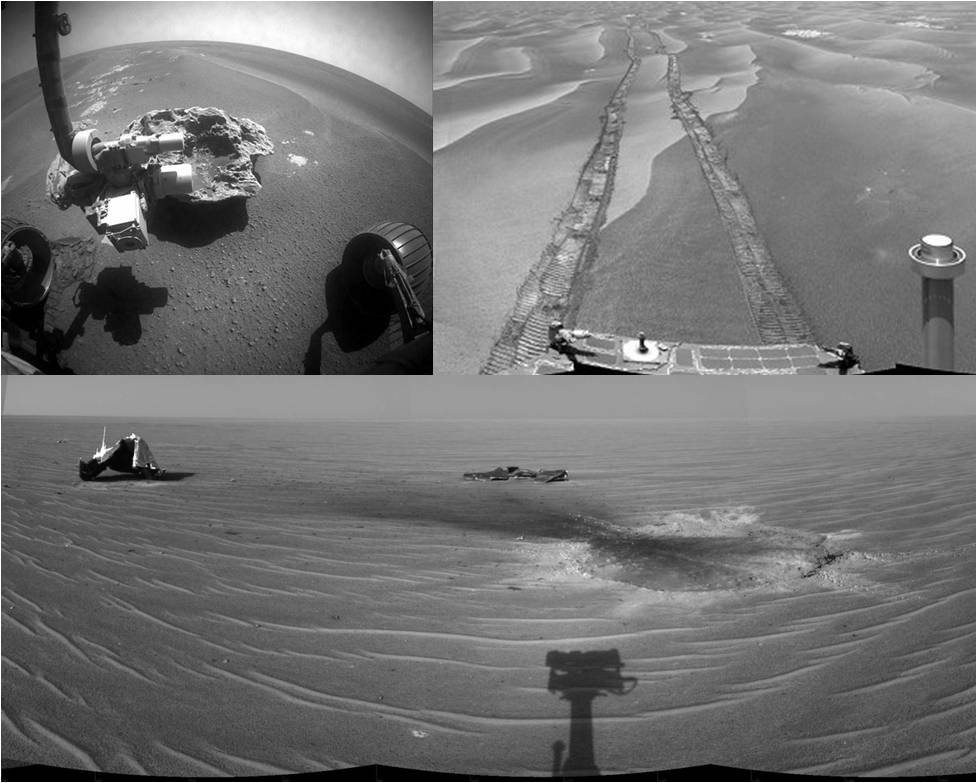
Seven years ago this week, NASA’s Mars Exploration Rover (MER) Opportunity landed at Meridiani Planum on the surface of the planet Mars. Incredibly, the robotic rover continues to gather geological, atmospheric and astronomical data well beyond its design mission duration of ninety (90) Martian days.
Mars is the 4th planet out from the Sun. It has a diameter a little more than half that of Earth. The duration of a day on Mars is a little more than that on Earth. However, a Martian year is 88% longer than a terrestrial year. While nebulous in comparison to the Earth, Mars has an atmosphere. Atmospheric temperature ranges from -190F to +98F.
Mars has always been a source of curious speculation by we Earthlings. Does or did Mars ever have water? Does or did Mars ever have life in any form? The quest to answer these and related questions has resulted in significant exploration of the Martian space, atmosphere and surface by robotic space vehicles sent from the Earth.
In 1976, Viking 1 and Viking 2 became the first American spacecraft to land on the surface of Mars. In July of 1997, the Mars Pathfinder became the first successful United States robotic rover. While a spectacular accomplishment, that first rover’s exploration capabilities and science output were modest. Something more substantial was required to provide a quantum leap in our understanding of Mars.
That something was the Mars Exploration Rover (MER) of which there would be two (2) copies. MER-A (Spirit) and MER-B (Opportunity) would be targeted to opposite hemispheres where each rover would investigate Martian geology up-close and personal. Each was configured with a sophisticated suite of scientific equipment for doing so. Together, the rovers were destined to provide the most detailed investigation of Martian geology in history.
Each MER weighs 408 lbs and measures 7.5-feet in width, 4.9-feet in height and 5.2-feet in length. Six (6) independently-driven wheels provide for rover locomotion and hill-climbing. Vehicle systems are typical with provision made for power generation, storage and distribution, vehicle guidance, navigation and control, data management, communication, and thermal control.
MER-A (Spirit) was launched on Tuesday, 10 June 2003 from SLC-17A at Cape Canaveral. Following a nominal entry and descent, the rover landed near Gusev Crater at 04:35 Ground UTC on Sunday, January 4, 2004. MER-B (Opportunity) was launched on Monday, 07 July 2003 from SLC-17B at Cape Canaveral. MER-B safely landed near Meridiani Planum at 05:05 Ground UTC on Sunday, 25 January 2004.
Both MER vehicles have produced images of and obtained scientific data on a myriad of Martian geologic features as they have roamed the region around their respective landing sites. They have operated for several thousand days beyond their 90-day design mission. That stunning success is due in great measure to the talented and dedicated mission operations and science teams back here on Earth.
In truth, any attempt to accurately synopsize here the myriad discoveries and scientific contributions of Spirit and Opportunity does both a disservice. Thus, to better grasp and appreciate the true scope and character of their incredible achievements, the reader is hereby invited to visit the following URL: http://marsrovers.jpl.nasa.gov/mission/status.html
Spirit was last heard from officially on Monday, 22 March 2010 (2,210 Mars days on the surface). The senior rover had traveled 4.8 miles during its many exploratory surface roamings. It is suspected that the vehicle is hibernating due to seasonally-low solar power levels. The hope is that Spirit will revive from its cold winter slumber when spring arrives this March at Gusev Crater.
As for Opportunity, it continues to continue! As of this writing, the junior rover is conducting a site survey at Crater Rim. It has been on the surface for 2,489 Mars days and has traveled in excess of 16.5 miles. Where this marvelous story ends is not clear at present. However, we do not have to wait for the day when MER-B finally goes silent to realize what has long been apparent; our noble exploratory marvel has afforded us a rare Opportunity indeed.

Fifty-one years ago this month, a developmental version of the USN/Lockheed Polaris A1 Fleet Ballistic Missile was test-flown from Cape Canaveral, Florida. The successful test marked a key milestone in the flight-proving of the Polaris missile’s Inertial Navigation System (INS).
The Cold War between the United States and the Soviet Union spawned the development of a Nuclear Triad by both sides. The concept involved delivery of atomic weapons via manned bombers, land-based ballistic missiles and submarine-launched ballistic missiles. This diversity of delivery systems thus provided for deterrence by maximizing the ability for either side to retaliate in the event of a first strike by the other.
The submarine-launched ballistic missile (SLBM) is arguably the most effective leg of the Nuclear Triad when its comes to deterrence. This effectiveness stems largely from the mobility and elusiveness of the nuclear-powered submarine itself. The fact that the missile is launched while the launch platform is submerged greatly enhances the weapons’s effectiveness as well.
The challenges faced by the Navy and its contractors in developing a SLBM capability were numerous and significant. Critical among these was the need to avoid igniting the first stage rocket motor within the confines of the submarine. The solution was to eject the missile from its launch canister via a high pressure gas generation system. The rocket was then air-ignited just after it broached the ocean surface.
A key aspect of the SLBM launch process is missile stability and control both in the water and in the air. During its underwater transit from canister eject to surface broach, the missile is not under active control. However, it must be statically stable in a hydrodynamic environment. Once in the air, the rocket motor must be ignited quickly since missile 3-axis control comes only via thrust vectoring.
Polaris was the first SLBM developed and deployed by the United States. Lockheed Space and Missile Systems (LSMS) began engineering development of the Navy missile in the mid-1950’s. Aerojet was the Polaris Program’s propulsion contractor. Flight testing from land-based launch pads began in 1958 with the first submarine-based launch occuring in mid-1960.
The Polaris A1 was a two-staged launch vehicle. It measured 28.5 feet in length and had a maximum diameter of 54-inches. Weight at first stage ignition was 28,800 pounds. The type’s MK 1 reentry body delivered a single MK 47 warhead having a yield of 600 kT. Maximum range was on the order of 1,200 nm.
On Thursday, 07 January 1960, Polaris A1X-7 was launched from LC-29A at Cape Canaveral, Florida. The primary purpose of the test was to prove the proper operation of the Inertial Navigation System (INS). This system was developed jointly by MIT and the General Electric Company. The missile flew 900 nm down the Eastern Test Range (ETR). The flight was entirely successful.
Thirty-four (34) more tests in the Polaris A1X series took place by early July of 1960. The majority were successful. All set the stage for the first submarine-launch of the Polaris from a submerged Navy submarine. Indeed, Polaris A1E-1 did so on Wednesday, 20 July 1960. It was followed less than three (3) hours later by Polaris A1E-2. Both missiles were launched from the USS George Washington (SSBN-598) in the waters near Cape Canaveral. Both flights were successful.
The Polaris A1 became operational in November of 1960. It was followed in 1962 and 1964 by the more capable A2 and A3 Polaris variants, respectively. In the never-ending quest for greater performance and effectiveness, the Polaris was eventually replaced by the Poseidon in the 1970’s. The latter was subsequently replaced in the 1990’s with the mighty Trident II D5 missile which serves up to the present day as the Nation’s premier SLBM.

Forty-seven years ago today, a USAF/Boeing B-52H Stratofortress landed safely following structual failure of its vertical tail during an encounter with unusually severe clear air turbulence. The harrowing incident occurred as the aircraft was undergoing structural flight testing in the skies over East Spanish Peak, Colorado.
Turbulence is the unsteady, erratic motion of an atmospheric air mass. It is attributable to factors such as weather fronts, jet streams, thunder storms and mountain waves. Turbulence influences the motion of aircraft that are subjected to it. These effects range from slight, annoying disturbances to violent, uncontrollable motions which can structurally damage an aircraft.
Clear Air Turbulence (CAT) occurs in the absence of clouds. Its presence cannot be visually observed and is detectable only through the use of special sensing equipment. Hence, an aircraft can encounter CAT without warning. Interestingly, the majority of in-flight injuries to aircraft crew and passengers are due to CAT.
On Friday, 10 January 1964, USAF B-52H (S/N 61-023) took-off from Wichita, Kansas on a structural flight test mission. The all-Boeing air crew consisted of instructor pilot Charles Fisher, pilot Richard Curry, co-pilot Leo Coors, and navigator James Pittman. The aircraft was equipped with accelerometers and other sensors to record in-flight loads and stresses.
An 8-hour flight was scheduled on a route that from Wichita southwest to the Rocky Mountains and back. The mission called for 10-minutes runs of 280, 350 and 400 KCAS at 500-feet AGL using the low-level mode of the autopilot. The initial portion of the mission was nominal with only light turbulence encountered.
However, as the aircraft turned north near Wagon Mound, Mexico and headed along a course parallel to the mountains, increasing turbulence and tail loads were encountered. The B-52H crew then elected to discontinue the low level portion of the flight. The aircraft was subsequently climbed to 14,300 feet AMSL preparatory to a run at 350 KCAS.
At approximately 345 KCAS, the Stratofortress and its crew experienced an extreme turbulence event that lasted roughly 9 seconds. In rapid sequence the aircraft pitched-up, yawed to the left, yawed back to the right and then rolled right. The flight crew desperately fought for control of their mighty behemoth. But it looked grim. The order was given to prepare to bailout.
Finally, the big bomber’s motion was arrested using 80% left wheel authority. However, rudder pedal displacement gave no response. Control inputs to the elevator produced very poor response as well. Directional stability was also greatly reduced. Nevertheless, the crew somehow kept the Stratofortress flying nose-first.
The B-52H crew informed Boeing Wichita of their plight. A team of Boeing engineering experts was quickly assembled to deal with the emergency. Meanwhile, a Boeing-bailed F-100C formed-up with the Stratofortress and announced to the crew that most of the aircraft’s vertical tail was missing! The stricken aircraft’s rear landing was then deployed to add back some directional stability.
With Boeing engineers on the ground working with the B-52H flight crew, additional measures were taken in an effort to get the Stratofortress safely back on the ground. These measures included a reduction in airspeed, controlling center-of-gravity via fuel transfer, use of differential thrust and selected application of speedbrakes.
Due to high surface winds at Wichita, the B-52H was vectored to Eaker AFB in Blytheville, Arkansas. A USAF/Boeing KC-135 was dispatched to escort the still-flying B-52H to Eaker and to serve as an airborne control center as both aircraft proceeded to the base. Amazingly, after flying 6 hours sans a vertical tail, the Stratofortress and her crew landed safely.
Safe recovery of crew and aircraft brought additional benefits. There were lots of structural flight test data! It was found that at least one gust in the severe CAT encounter registered at nearly 100 mph. Not only were B-52 structural requirements revised as a result of this incident, but those of other existing and succeeding aircraft as well.
B-52H (61-023) was repaired and returned to the USAF inventory. It served long and well for many years after its close brush with catastrophy in January 1964. The aircraft spent the latter part of its flying career as a member of the 2nd Bomb Wing at Barksdale AFB, Louisiana. The venerable bird was retired from active service in July of 2008.

Sixty-two years ago this week, the USAF/Bell XS-1 became the first aircraft of any kind to achieve supersonic flight from a ground take-off. The daring feat took place at Muroc Air Force Base with USAF Captain Charles E. Yeager at the controls of the XS-1.
Rocket-powered X-aircraft such as the XS-1, X-1A, X-2 and X-15 were air-launched from a larger carrier aircraft. With the test aircraft as its payload, this “mothership” would take-off and climb to drop altitude using its own fuel load. This permitted the experimental aircraft to dedicate its entire propellant load to the flight research mission proper.
The USAF/Bell XS-1 was the first X-aircraft. It was carried to altitude by a USAF/Boeing B-29 mothership. XS-1 air-launch typically occurred at 220 mph and 22,000 feet. On Tuesday, 14 October 1947, the XS-1 first achieved supersonic flight. The XS-1 would ultimately fly as fast as Mach 1.45 and as high as 71,902 feet.
All but two (2) of the early X-aircraft were Air Force developments. The exceptions were products of the United States Navy flight research effort; the USN/Douglas D-558-I Skystreak and USN/Douglas D-558-II Skyrocket. The Skystreak was a turbojet-powered, straight-winged, transonic aircraft. The Skyrocket was supersonic-capable, swept-winged, and rocket-powered. Each aircraft was ground-launched.
In the best tradition of inter-service rivalry, the Navy claimed that the D-558-I was the only true supersonic airplane since it took to the air under its own power. Interestingly, the Skystreak was able fly beyond Mach 1 only in a steep dive. Nonetheless, the Air Force was indignant at the Navy’s insinuation that the XS-1 was somehow less of an X-aircraft because it was air-launched.
Motivated by the Navy’s afront to Air Force honor, the junior military service devised a scheme to ground-launch the XS-1 from Rogers Dry Lake at Muroc (now Edwards) Air Force Base. The aircraft would go supersonic in what was essentially a high performance take-off and climb. To boot, the feat was timed to occur just before the Navy was to fly its rocket-powered D-558-II Skyrocket. Justice would indeed be rendered!
XS-1 Ship No. 1 (S/N 46-062) was selected for the ground take-off mission. Captain Charles E. Yeager would pilot the sleek craft with Captain Jackie L. Ridley providing vital engineering support. Due to its delicate landing gear, the XS-1 propellant load was restricted to 50% of capacity which provided about 100 seconds of powered flight.
On Wednesday, 05 January 1949, Yeager fired all four (4) barrels of his XLR-11 rocket motor. Behind 6,000 pounds of thrust, the XS-1 quickly accelerated along the smooth surface of the dry lake. After a take-off roll of 1,500 feet and with the XS-1 at 200 mph, Yeager pulled back on the control yoke. The XS-1 virtually leapt into the air.
The aerodynamic loads were so high during gear retraction that the actuator rod broke and the wing flaps tore away. Unfazed, Yeager’s eager steed climbed rapidly. Eighty seconds after brake release, the XS-1 hit Mach 1.03 passing through 23,000 feet. Yeager then brought the XS-1 to a wings level flight attitude and shutdown his XLR-11 powerplant.
Following a brief glide back to the dry lake, Yeager executed a smooth dead-stick landing. Total flight time from lift-off to touchdown was on the order of 150 seconds. While a little worst for wear, the plucky XS-1 had performed like a champ and successfully accomplished something that it was really not designed to do.
Yeager was so excited during the take-off roll and high performance climb that he forgot to put his oxygen mask on! Potentially, that was a problem since the XS-1 cockpit was inerted with nitrogen. Fortunately, late in the climb, Yeager got his mask in place just before he went night-night for good.
Suffice it to say that the United States Navy was not particularly fond of the display of bravado and airmanship exhibited on that long-ago January day. The Air Force had emerged victorious in a classic contest of one-upmanship. Indeed, Air Force honor had been upheld. And, as was often the case in the formative years of the United States Air Force, it was Chuck Yeager who brought victory home to the blue suiters.