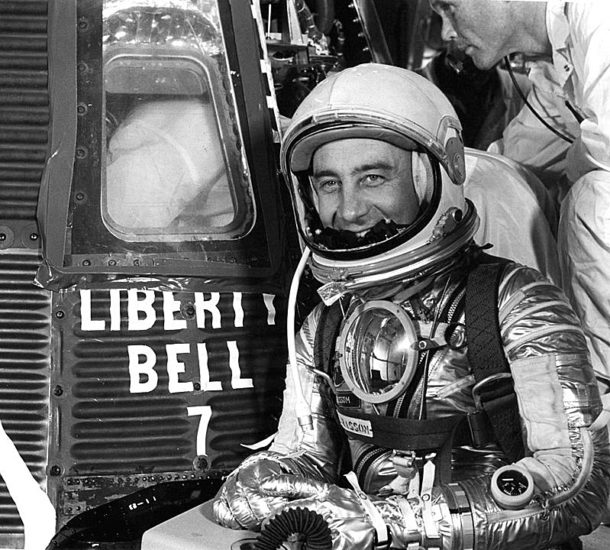
Fifty-five years ago this month, Mercury Seven Astronaut Vigil I. “Gus” Grissom, Jr. became the second American to go into space. Grissom’s suborbital mission was flown aboard a Mercury space capsule that he named Liberty Bell 7.
The United States first manned space mission was flown on Friday, 05 May 1961. On that day, NASA Astronaut Alan B. Shepard, Jr. flew a 15-minute suborbital mission down the Eastern Test Range in his Freedom 7 Mercury spacecraft. Known as Mercury-Redstone 3, Shepard’s mission was entirely successful and served to ignite the American public’s interest in manned spaceflight.
Shepard was boosted into space via a single stage Redstone rocket. This vehicle was originally designed as an Intermediate-Range ballistic Missile (IRBM) by the United States Army. It was man-rated (that is, made safer and more reliable) by NASA for the Mercury suborbital mission. A descendant of the German V-2 missile, the Redstone produced 78,000 lbs of sea level thrust.
Shepard’s suborbital trajectory resulted in an apogee of 101 nautical miles (nm). With a burnout velocity of 7,541 ft/sec, Freedom 7 splashed-down in the Atlantic Ocean 263 nm downrange of its LC-5 launch site at Cape Canaveral, Florida. Shepard endured a maximum deceleration of 11 g’s during the reentry phase of the flight.
Mercury-Redstone 4 was intended as a second and confirming test of the Mercury spacecraft’s space-worthiness. If successful, this mission would clear the way for pursuit and achievement of the Mercury Program’s true goal which was Earth-orbital flight. All of this rested on the shoulders of Gus Grissom as he prepared to be blasted into space.
Grissom’s Liberty Bell 7 spacecraft was a better ship than Shepard’s steed from several standpoints. Liberty Bell 7 was configured with a large centerline window rather than the two small viewing ports featured on Freedom 7. The vehicle’s manual flight controls included a new rate stabilization system. Grissom’s spacecraft also incorporated a new explosive hatch that made for easier release of this key piece of hardware.
Mercury-Redstone 4 (MR-4) was launched from LC-5 at Cape Canaveral on Friday, 21 July 1961. Lift-off time was 12:20:36 UTC. From a trajectory standpoint, Grissom’s flight was virtually the same as Shepard’s. He found the manual 3-axis flight controls to be rather sluggish. Spacecraft control was much improved when the new rate stabilization system was switched-on. The time for retro-fire came quickly. Grissom invoked the retro-fire sequence and Liberty Bell 7 headed back to Earth.
Liberty Bell 7’s reentry into the Earth’s atmosphere was conducted in a successful manner. The drogue came out at 21,000 feet to stabilize the spacecraft. Main parachute deployed occurred at 12,300 feet. With a touchdown velocity of 28 ft/sec, Grissom’s spacecraft splashed-down in the Atlantic Ocean 15 minutes and 32 seconds after lift-off. America now had both a second spaceman and a second successful space mission under its belt.
Following splashdown, Grissom logged final switch settings in the spacecraft, stowed equipment and prepared for recovery as several Marine helicopters hovered nearby. As he did so, the craft’s new explosive hatch suddenly blew for no apparent reason. Water started to fill the cockpit and the surprised astronaut exited the spacecraft as quickly as possible.
Grissom found himself outside his psacecraft and in the water. He was horrfied to see that Liberty Bell 7 was in imminent peril of sinking. The primary helicopter made a valiant effort to hoist the spacecraft out of the water, but the load was too much for it. Faced with losing his vehicle and crew, the pilot elected to release Liberty Bell 7 and abandon it to a watery grave.
Meanwhile, Grissom struggled just to stay afloat in the churning ocean. The prop blast from the recovery helicopters made the going even tougher. Finally, Grissom was able to retrieve and get himself into a recovery sling provided by one of the helicopters. He was hoisted aboard and subsequently delivered safely to the USS Randolph.
In the aftermath of Mercury-Redstone 4, accusations swirled around Grissom that he had either intentionally or accidently hit the detonation plunger that activated the explosive hatch. Always the experts on everything, especially those things which they have little comprehension of, the denizens of the press insinuated that Grissom must have panicked. Grissom steadfastly asserted to the day that he passed from this earthly scene that he did no such thing.
Liberty Bell 7 rested at a depth of 15,000 feet below the surface of the Atlantic Ocean until it was recovered by a private enterprise on Tuesday, 20 July 1999; a day short of the 38th anniversary of Gus Grissom’s MR-4 flight. The beneficiary of a major restoration effort, Liberty Bell 7 is now on display at the Kansas Cosmosphere and Space Center. The spacecraft’s explosive hatch was never found.
As for Gus Grissom, ultimate vindication of his character and competence came in the form of his being named by NASA as Commander for the first flights of Gemini and Apollo. Indeed, Grissom and rookie astronaut John W. Young successfully made the first manned Gemini flight in March of 1965 during Gemini-Titan 3. Later, Grissom, Edward H. White II and Roger B. Chaffee trained as the crew of Apollo 1 which was slated to fly in early 1967. History records that their lives were cut short in the tragic and infamous Apollo 1 Spacecraft Fire of Friday, 27 January 1967.
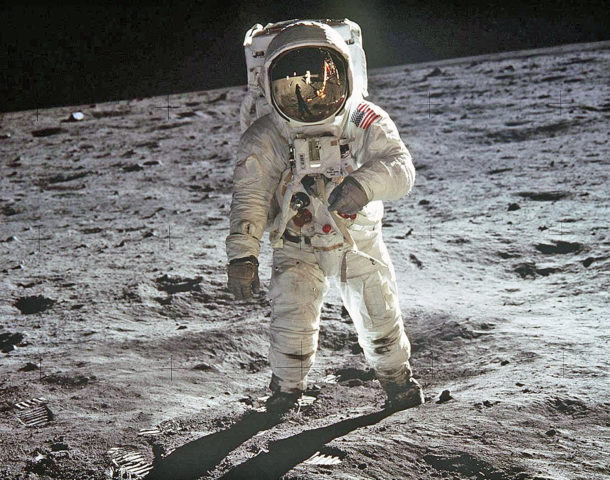
Forty-seven years ago today, the United States of America landed two men on the surface of the Moon. This feat marked the first time in history that men from the planet Earth set foot on another celestial body in the solar system.
The Apollo 11 Lunar Module Eagle landed in the Sea of Tranquility region of the Moon on Sunday, 20 July 1969 at 20:17:40 UTC. Less than seven hours later, Astronauts Neil A. Armstrong and Edwin E. Aldrin, Jr. became the first human beings to walk upon Earth’s closest neighbor. Fellow crew member Michael Collins orbited high overhead in the Command Module Columbia.
As Apollo 11 commander, Neil A. Armstrong was accorded the privilege of being the first man to step foot upon the Moon. As he did so, Armstrong spoke these words: “That’s one small step for Man; one giant leap for Mankind”. He had intended to say: “That’s one small step for ‘a’ man; one giant leap for Mankind”.
Armstrong and Aldrin explored their Sea of Tranquility landing site for about two and a half hours. Total lunar surface stay time was 22 hours and 37 minutes. The Apollo 11 crew left a plaque affixed to one of the legs of the Lunar Module’s descent stage which read: “Here Men From the Planet Earth First Set Foot Upon the Moon; July 1969, A.D. We Came in Peace for All Mankind”.
Following a successful lunar lift-off aboard the Eagle, Armstrong and Aldrin rejoined Collins in lunar orbit. Approximately seven hours later, the Apollo 11 crew rocketed out of lunar orbit to begin the quarter million mile journey back to Earth. Columbia splashed-down in the Pacific Ocean at 16:50:35 UTC on Thursday, 24 July 1969. Total mission time was 195 hours, 18 minutes, and 35 seconds.
With completion of the flight of Apollo 11, the United States of America fulfilled President John F. Kennedy’s 25 May 1961 call to land a man on the Moon and return him safely to the Earth before the decade of the 1960’s was out. It had taken 2,982 demanding days and a great deal of national treasure to do so.
Mission Accomplished, Mr. President.
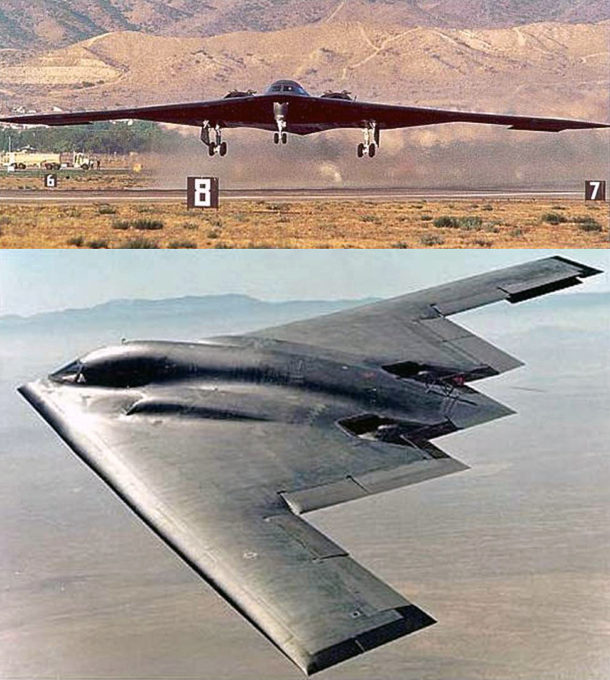
Twenty-seven years ago this month, the USAF/Northrop B-2 Stealth Strategic Bomber flew for the first time. The aircrew for the B-2’s maiden trip upstairs included Northrop B-2 Division Chief Test Pilot Bruce J. Hinds (command pilot) and B-2 Combined Test Force Commander USAF Col. Richard S. Couch (co-pilot).
The B-2 traces it lineage to a variety of Northrop flying wing aircraft including the piston-powered YB-35 and jet-propelled YB-49. These 1940’s-era experimental aircraft served as important stepping stones in the evolution of large flying wing technology.
An all-wing aircraft represents an aerodynamically-optimal configuration from the standpoint of high lift, low drag and therefore high lift-to-drag ratio. These favorable aerodynamic attributes translate to high levels of range performance and load-carrying capability. In addition, the type’s high aspect ratio and slim profile provide for more favorable low observable characteristics than traditional fuselage-wing-empennage aircraft geometries.
Arguably the most challenging aspects of creating an all-wing aircraft have to do with flight control and handling qualities. The crash of the second YB-49 flying wing in June of 1948 underscored the insufficiency of aerospace technology at that time to handle these design challenges. It was not until the advent of modern flight control avionics during the 1980’s that the full potential of a flying wing aircraft would be realized.
The B-2 is only 69 feet in length, but has a wing span of 172 feet and a wing area of 5,140 square feet. Gross take-off and empty weights are 336,500 lbs and 158,000 lbs, respectively. Embedded within the wings are a quartet of fuel-efficient F118-GE-100 turbofan engines, each generating 17,300 lbs of thrust. The aircraft has a top speed of about Mach 0.85, an unrefueled range of 6,000 nm and a service ceiling of 50,000 feet. Maximum ordnance load is 50,000 lbs.
B-2 AV-1 (Spirit of America; S/N 82-1066) took-off for the first time from Air Force Plant 42 in Palmdale, California on Monday, 17 July 1989. Supported by F-16 chase aircraft, the majestic flying wing flew a 2 hour 12 minute test mission which concluded with a landing at nearby Edwards Air Force Base. As a first flight precaution, the entire mission was flown with the landing gear down.
The first B-2 airframe to enter the operational inventory was AV-8, the Spirit of Missouri (S/N 88-0329). It did so on 31 March 1994. While initial plans called for a production run of 132 aircraft, only 21 B-2 airframes were actually built. With the 2008 loss of the Spirit of Kansas shortly after take-off from Andersen Air Force Bas in Guam, 20 of these aircraft remain in active service today.
Whiteman Air Force Base in Missouri serves as Air Force’s home for the B-2. From there, the majestic flying wing has flown a multitude of global strike missions to deliver a variety of ordnance with pinpoint accuracy. To date, the B-2 has successfully engaged targets in Kosovo, Afganistan, Iraq and Libya. The B-2 is truly a technological marvel and a national defense asset. As such, it may be expected to be a vital part of the Air Force’s active inventory for decades to come.
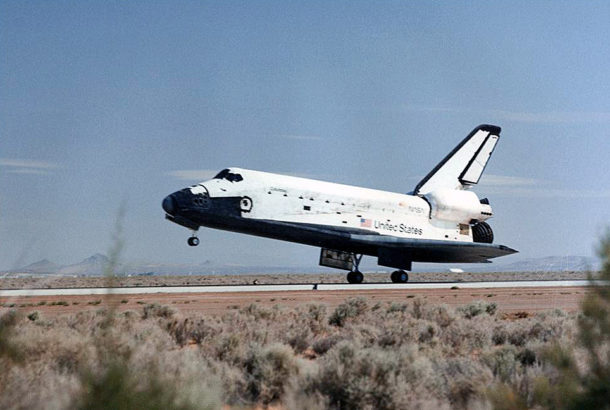
Thirty-four years ago this week, the Space Shuttle Columbia landed at Edwards Air Force Base to successfully conclude the fourth orbital mission of the Space Transportation System. Columbia’s return to earth added a special touch to the celebration of America’s 206th birthday.
STS-4 was NASA’s fourth Space Shuttle mission in the first fourteen months of Shuttle orbital flight operations. The two-man crew consisted of Commander Thomas K. Mattingly, Jr. and Pilot Henry W. Hartsfield who were both making their first Shuttle orbital mission. STS-4 marked the last time that a Shuttle would fly with a crew of just two.
STS-4 was launched from Cape Canaveral’s LC-39A on Sunday, 27 June 1982. Lift-off was exactly on-time at 15:00:00 UTC. Interestingly, this would be the only occasion in which a Space Shuttle would launch precisely on-time. The Columbia weighed a hefty 241,664 lbs at launch.
Mattingly and Hartsfield spent a little over seven (7) days orbiting the Earth in Columbia. The orbiter’s cargo consisted of the first Getaway Special payloads and a classified US Air Force payload of two missile launch-detection systems. In addition, a Continuous Flow Electrophoresis System (CFES) and the Mono-Disperse Latex Reactor (MLR) were flown for a second time.
The Columbia crew conducted a lightning survey using manual cameras and several medical experiments. Mattingly and Hartsfield also maneuvered the Induced Environment Contamination Monitor (IECM) using the Orbiter’s Remote Manipulator System (RMS). The IECM was used to obtain information on gases and particles released by Columbia in flight.
On Sunday, 04 July 1982, retro-fire started Columbia on its way back to Earth. Touchdown occurred on Edwards Runway 22 at 16:09:31 UTC. This landing marked the first time that an Orbiter landed on a concrete runway. (All three previous missions had landed on Rogers Dry Lake at Edwards.) Columbia made 112 complete orbits and traveled 2,537,196 nautical miles during STS-4.
The Space Shuttle was declared “operational” with the successful conduct of the first four (4) shuttle missions. President Ronald Reagan and First Lady Nancy Reagan even greeted the returning STS-4 flight crew on the tarmac. However, as history has since taught us, manned spaceflight still comes with a level of risk and danger that exceeds that of military and commercial aircraft operations. It will be some time before a manned space vehicle is declared operational in the desired sense.
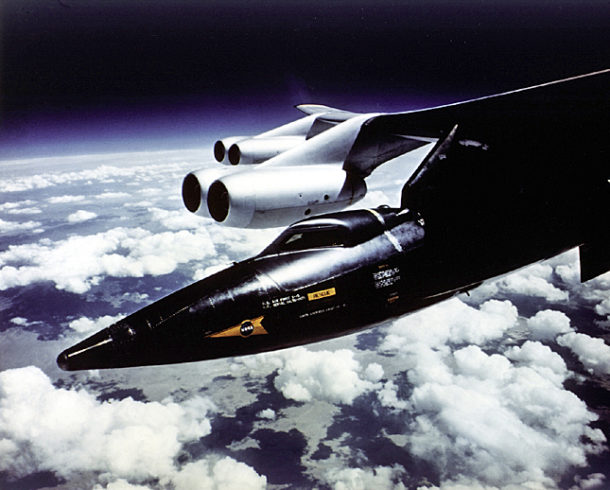
Forty-nine years ago today, USAF Major William F. “Pete” Knight made an emergency landing in X-15 No. 1 at Mud Lake, Nevada. Knight somehow managed to save the hypersonic aircraft following a complete loss of electrical power as the vehicle passed through 107,000 feet during the climb.
The famed X-15 Program conducted 199 flights between June 1959 and October 1968. North American Aviation (NAA) built three (3) X-15 aircraft. Twelve (12) men from NAA, USAF and NASA flew the X-15. Eight (8) pilots received astronaut wings for flying the X-15 beyond 250,000 feet. One (1) aircraft and one (1) pilot were lost during flight test.
The X-15 flew as fast as 4,520 mph (Mach 6.7) and as high as 354,200 feet. The basic airframe measured 50 feet in length, featured a wing span of 22 feet and had a gross weight of 33,000 pounds. The type’s Reaction Motors XLR-99 rocket engine burned anhydrous ammonia and liquid oxygen to produce a sea level thrust of 57,000 pounds. The X-15 used both 3-axis aerodynamic and ballistic flight controls.
An X-15 mission was fast-paced. Flight time from B-52 drop to unpowered landing was typically 10 to 12 minutes in duration. The pilot wore a full pressure suit and experienced 6 to 7 G’s during pull-out from max altitude. There really was no such thing as a routine X-15 mission. However, all X-15 missions had one factor in common; high danger.
On Thursday, 29 June 1967, X-15 No. 1 (S/N 56-6670) made its 73rd and the X-15 Program’s 184th free flight. Launch took place at 1828 UTC as the NASA B-52B launch aircraft (S/N 52-0008) flew at Mach 0.82 and 40,000 feet near Smith Ranch, Nevada. Knight, making his 10th X-15 flight, quickly ignited the XLR-99 and started the climb upstairs.
The X-15 was performing well and Knight was enjoying the flight until 67.6 seconds into a planned 87 second XLR-99 burn. That’s when the engine suddenly quit. A couple of heartbeats later, the Stability Augmentation System (SAS) failed, the Auxiliary Power Units (APU’s) ceased operating, the X-15’s generators stopped functioning and the cockpit lights went out. This was the total hit; a complete power failure.
Pete Knight was now just along for the ride. No thrust to power the aircraft. No electrical power to run onboard systems. No hydraulics to move flight controls. Even the reaction controls appeared inoperative. The X-15 continued upward, but it wallowed aimlessly in the low dynamic pressure of high altitude flight. At this point, Knight considered taking his chances and punching-out.
The X-15 went over the top at 173,000 feet. On the way downhill, Knight was able to get some electrical power from the emergency battery. This meant that he now had some hydraulic power and could utilize the X-15’s flight control surfaces. Knight next tried to fire-up the APU’s. The right APU would not respond. The left APU fired, but the its generator would not engage.
As the X-15 descended and the dynamic pressure built-up, Knight was able to maneuver his stricken X-15. He headed for Mud Lake in a sustained 6-G turn. As he leveled off at 45,000 feet, Knight instinctively knew he could now make the east shore of the Nevada dry lake. But it was tough work to fly the X-15. Knight ended-up using both hands to fly the airplane; one hand on the side stick and one hand on the center stick.
While Knight was trying to get his airplane down on the ground in one piece, only he and his Maker knew his whereabouts. The X-15 flight test team certainly didn’t, since Knight’s radio, telemetry and radar transponder were now inop. Further, the X-15 was not being skinned tracked at the time of the electrical anomaly. Just before he touched-down at Mud Lake, Knight’s X-15 was spotted by NASA’s Bill Dana who was flying a F-104N chase aircraft.
Pete Knight made a good landing at Mud Lake. The X-15 slid to a stop. After a struggle with the release mechanism, he managed to get the canopy open. Hot and soaked with perspiration, Knight somehow removed his own helmet. A ground crewman usually did that for him. But there were no flight support people at his X-15 landing site on this day.
As he attempted to get out of the X-15 cockpit, Knight pulled an emergency release. To his surprise, the headrest blew off, bounced off the canopy and smacked him square in the head. Undeterred, Knight got out of the cockpit and onto terra firma. In the meantime, a Lockheed C-130 Hercules had landed at Mud Lake. Wearily, Pete Knight got onboard and returned to Edwards Air Force Base.
Post-flight investigation revealed that the most probable source of the X-15’s electrical failure was arcing in a flight experiment system. This system had been connected to the X-15’s primary electrical bus. The solution was to connect flight experiments to the secondary electrical bus.
Reflecting on Knight’s amazing recovery from almost certain disaster, long-time NASA flight test manager Paul Bickle claimed the fete was among the most impressive of the X-15 Program. Indeed, it was Pete Knight’s clearly uncommon piloting skill and calmness under pressure that gave him the edge.
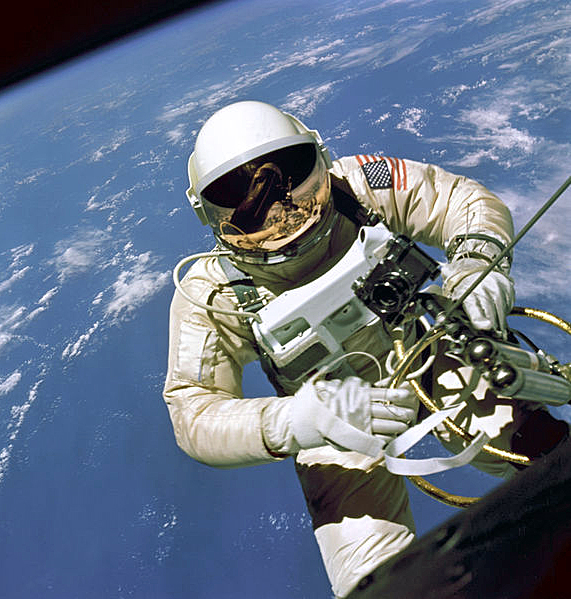
Fifty-one years ago this month, Astronaut Edward H. White II became the first American to perform what in NASA parlance is referred to as an Extra Vehicular Activity (EVA). In everyday terms; a space walk.
White, Mission Commander James A. McDivitt and their Gemini IV spacecraft were launched into low Earth orbit by a two-stage Titan II launch vehicle from LC-19 at Cape Canaveral Air Force Station, Florida. The mission clock started at 15:15:59 UTC on Thursday, 03 June 1965.
On the third orbit, less than five hours after launch, White opened the Gemini IV starboard hatch. He stood in his seat and mounted a camera to capture his historic space stroll. He then cast-off from Gemini IV and became a human satellite.
White was tethered to Gemini IV via a 15-foot umbilical that provided oxygen and communications to his EVA suit. A gold-plated visor on his helmet protected his eyes from the searing glare of the sun. The space-walking astronaut was also outfitted with a hand-held maneuvering unit that used compressed oxygen to power its small thrusters. And, like any good tourist, he also took along a camera.
Ed White had the time of his all-too-brief life in the 22 minutes that he walked in space. The sight of the earth, the spacecraft, the sun, the vastness of space, the freedom of movement all combined to make him exclaim at one point, “I feel like a million dollars!”.
Presently, it was time to get back into the spacecraft. But, couldn’t he just stay outside a little longer? NASA Mission Control and Commander McDivitt were firm. It was time to get back in; now! He grudgingly complied with the request/order, plaintively saying: “It’s the saddest moment of my life!”
As Ed White got back into his seat, he and McDivitt struggled to lock the starboard hatch. Both men were exhausted, but ebullient as they mused about the successful completion of America’s first space walk.
Gemini IV would eventually orbit the Earth 62 times before splashing-down in the Atlantic Ocean at 17:12:11 GMT on Sunday, 07 June 1965. The 4-day mission was another milestone in America’s quest for the moon.
The mission was over and yet Ed White was still a little tired. But then, that was really quite easy to understand. In the time that he was working outside the spacecraft, Gemini IV had traveled almost a third of the way around the Earth.
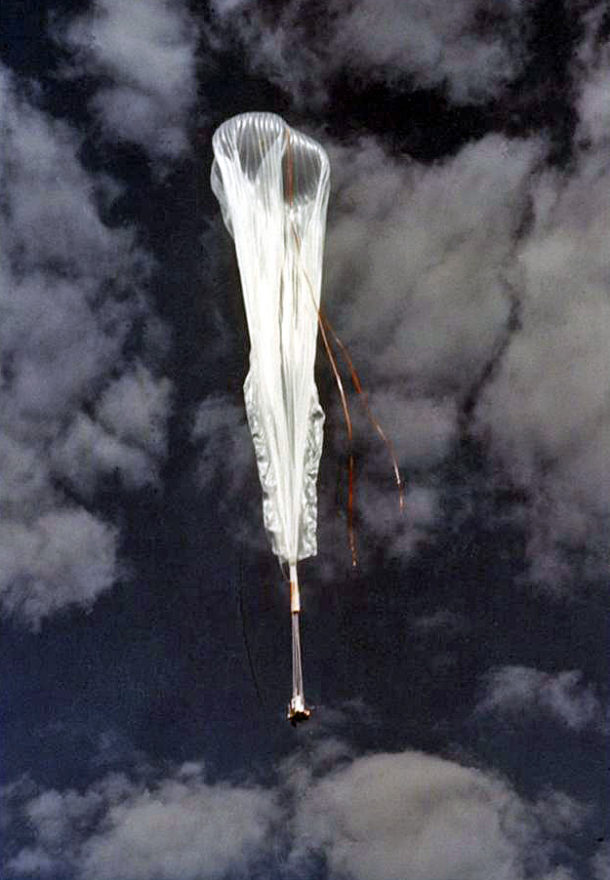
Fifty-nine years ago this month, USAF Captain Joseph W. Kittinger successfully completed the first Manhigh aero medical research balloon mission. During his 6.5-hour flight, Kittinger reached an altitude of 95,200 feet above mean sea level.
Project Manhigh was a United States Air Force biomedical research program that investigated the human factors of spaceflight by taking men into a near-space environment. Preparations for the trio of Manhigh flights began in 1955. The experience and data gleaned from Manhigh were instrumental to the success of the nation’s early manned spaceflight effort.
The Manhigh target altitude was approximately 100,000 feet above sea level. A helium-filled polyethylene balloon, just 0.0015-inches thick and inflatable to a maximum volume of over 3-million cubic feet, carried the Manhigh gondola into the earth’s stratosphere. At float altitude, this balloon expanded to a diameter of roughly 200 feet.
The Manhigh gondola was a hemispherically-capped cylinder that measured 3-feet in diameter and 8-feet in length. It was attached to the transporting balloon via a 40-foot diameter recovery parachute. Although compact, the gondola was amply provisioned with the necessities of flight including life support, power and communication systems. It also included expendable ballast for use in controlling the altitude of the Manhigh balloon.
The Manhigh test pilot wore a T-1 partial pressure suit during the Manhigh mission. This would protect him in the event that the gondola cabin lost pressure at extreme altitude. The pilot was hooked-up to a variety of sensors which transmitted his biomedical information to the ground throughout the flight. This allowed medicos on the ground to keep a constant tab on the pilot’s physical status.
The flight of Manhigh I took place on Sunday, 02 June 1957 with USAF Captain Joseph W. Kittinger as pilot. The massive balloon carrying Kittinger and his gondola was released at 11:23 UTC from Fleming Field Airport, South Saint Paul, Minnesota. In less than 2 hours, Kittinger’s huge balloon reached its design float altitude of 95,200 feet above sea level.
Radio communication problems complicated the Manhigh I mission. While Kittinger could hear the ground, the ground could not hear him. However, the resourceful pilot managed to work around this issue by communicating with the ground via Morse code.
Though balloon, gondola and pilot were functioning quite well, the Manhigh I mission had to be cut short due to rapid depletion of the gondala’s oxygen supply. Post-flight investigation revealed that this anomaly was caused by accidental crossing of the oxygen supply and vent lines prior to the flight.
Kittinger made a safe and uneventful landing near Indian Creek, Minnesota; located roughly 60 nm southeast of the launch site. The recovery crew was quick to the scene and extracted the plucky pilot from the sealed balloon gondola which had fallen over on its side. The official mission elapsed time (MET) was recorded as 6 hours and 32 minutes.
The flight of Manhigh I was a significant technical accomplishment that materially contributed to the advancement of manned spaceflight. Indeed, a TIME Magazine article, entitled “Prelude to Space” and dated 17 June 1957, captured the essence of the achievement. A man had been subjected to space-equivalent physiological conditions for a protracted period, had functioned well in that environment, and then returned safely to earth without ill effect.
For his significant efforts during the Manhigh I mission, Captain Joseph W. Kittinger received the USAF Distinguished Flying Cross.
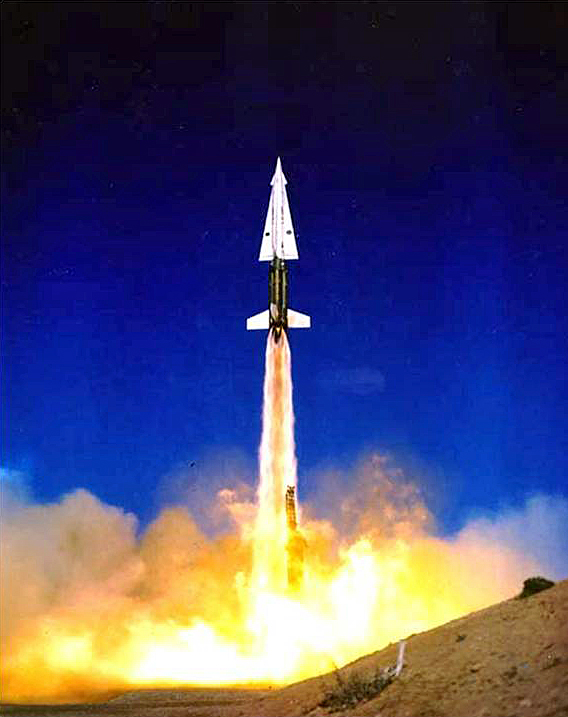
Fifty-eight years ago this month, the United States Army Nike Hercules air defense missile system was first deployed in the continental United States. The second-generation surface-to-air missile was designed to intercept and destroy hostile ballistic missiles.
The Nike Program was a United States Army project to develop a missile capable of defending high priority military assets and population centers from attack by Soviet strategic bombers. Named for the Greek goddess of victory, the Nike Program began in 1945. The industrial consortium of Bell Laboratories, Western Electric, Hercules and Douglas Aircraft developed, tested and fielded Nike for the Army.
Nike Ajax (MIM-3) was the first defensive missile system to attain operational status under the Nike Program. The two-stage, surface-launched interceptor initially entered service at Fort Meade, Maryland in December of 1953. A total of 240 Nike Ajax launch sites were eventually established throughout CONUS. The primary assets protected were metropolitan areas, long-range bomber bases, nuclear plants and ICBM sites.
Nike Ajax consisted of a solid-fueled first stage (59,000 lbs thrust) and a liquid-fueled second stage (2,600 lbs thrust). The launch vehicle measured nearly 34 feet in length and had a ignition weight of 2,460 lbs. The second stage was 21 feet long, had a maximum diameter of 12 inches and weighed 1,150 lbs fully loaded. The type’s maximum speed, altitude and range were 1,679 mph, 70,000 feet and 21.6 nautical miles, respectively.
The Nike Hercules (MIM-14) was the successor to the Nike Ajax. It featured all-solid propulsion and much higher thrust levels. The first stage was rated at 220,000 lbs of thrust while that of the second stage was 10,000 lbs. The Nike Hercules airframe was significantly larger than its predecessor. The launch vehicle measured 41 feet in length and weighed 10,700 lbs at ignition. Second stage length and ignition weight were 26.8 feet and 5,520 lbs, respectively.
Nike Hercules kinematic performance was quite impressive. The respective top speed, altitude and range were 3,000 mph, 150,000 feet and 76 nautical miles. This level of performance allowed the vehicle to be used for the ballistic missile intercept mission. Most Nike Hercules missiles carried a nuclear warhead with a yield of 20 kilotons.
The first operational Nike Hercules systems were deployed to the Chicago, Philadelphia and New York localities on Monday, 30 June 1958. By 1963, fully 134 Nike Hercules batteries were deployed throughout CONUS. These systems remained in the United States missile arsenal until 1974. The exceptions were batteries located in Alaska and Florida which remained in active service until the 1978-79 time period.
Like Nike Ajax before it, Nike Hercules had a successor. It was originally known as Nike Zeus and then Nike-X. This Nike variant was designed for intercepting enemy ICBM’s that were targeted for American soil. The vehicle went through a number of iterations before a final solution was achieved. Known as Spartan, this missile was what we would refer to today as a mid-course interceptor.
In companionship with a SPRINT terminal phase interceptor, Spartan formed the Safeguard Anti-Ballistic Missile System. The American missile defense system was impressive enough to the Soviet Union that the communist country signed the Anti-Ballistic Missile (ABM) Treaty 3 years before Safeguard’s deployment. Though operational for a mere 3 months, Safeguard was depostured in 1975. This action brought to a close a 30-year period in which the Nike Program was a major player in American missile defense.
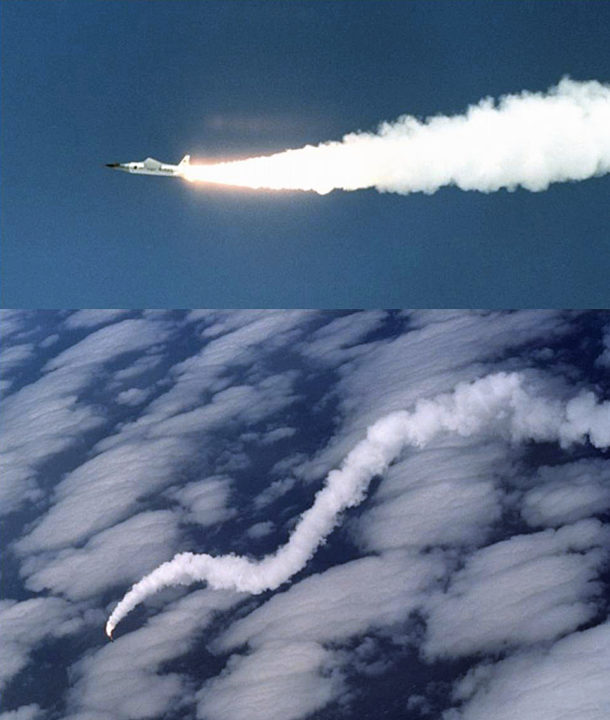
Fifteen years ago today, the first NASA X-43A airframe-integrated scramjet flight research vehicle was launched from a B-52 carrier aircraft high over the Pacific Ocean. The inaugural mission of the HYPER-X Flight Project came to an abrupt end when the launch vehicle departed controlled flight while passing through Mach 1.
In 1996, NASA initiated a technology demonstration program known as HYPER-X (HX). The central goal of the HYPER-X Program was to successfully demonstrate sustained supersonic combustion and thrust production of a flight-scale scramjet propulsion system at speeds up to Mach 10.
Also known as the HYPER-X Research Vehicle (HXRV), the X-43A aircraft was a scramjet test bed. The aircraft measured 12 feet in length, 5 feet in width, and weighed close to 3,000 pounds. The X-43A was boosted to scramjet take-over speeds with a modified Orbital Sciences Pegasus rocket booster.
The combined HXRV-Pegasus stack was referred to as the HYPER-X Launch Vehicle (HXLV). Measuring approximately 50 feet in length, the HXLV weighed slightly more than 41,000 pounds. The HXLV was air-launched from a B-52 mothership. Together, the entire assemblage constituted a 3-stage vehicle.
The first flight of the HYPER-X program took place on Saturday, 02 June 2001. The flight originated from Edwards Air Force Base, California. Using Runway 04, NASA’s venerable B-52B (S/N 52-0008) started its take-off roll at approximately 19:28 UTC. The aircraft then headed for the Pacific Ocean launch point located just west of San Nicholas Island.
At 20:43 UTC, the HXLV fell away from the B-52B mothership at 24,000 feet. Following a 5.2 second free fall, the rocket motor lit and the HXLV started to head upstairs. Disaster struck just as the vehicle accelerated through Mach 1. That’s when the rudder locked-up. The launch vehicle then pitched, yawed and rolled wildly as it departed controlled flight. Control surfaces were shed and the wing was ripped away. The HXRV was torn from the booster and tumbled away in a lifeless state. All airframe debris fell into the cold Pacific Ocean far below.
The mishap investigation board concluded that no single factor caused the loss of HX Flight No. 1. Failure occurred because the vehicle’s flight control system design was deficient in a number of simulation modeling areas. The result was that system operating margins were overestimated. Modeling inaccuracies were identified primarily in the areas of fin system actuation, vehicle aerodynamics, mass properties and parameter uncertainties. The flight mishap could only be reproduced when all of the modeling inaccuracies with uncertainty variations were incorporated in the analysis.
The X-43A Return-to-Flight effort took almost 3 years. Happily, the HYPER-X Program hit paydirt twice in 2004. On Saturday, 27 March 2004, HX Flight No. 2 achieved scramjet operation at Mach 6.83 (almost 5,000 mph). This historic accomplishment was eclipsed by even greater success on Tuesday, 16 November 2004. Indeed, HX Flight No. 3 achieved sustained scramjet operation at Mach 9.68 (nearly 7,000 mph).
The historic achievements of the HYPER-X Program went largely unnoticed by the aerospace industry and the general public. For its part, NASA did not do a very good job of helping people understand the immensity of what was accomplished. Even the NASA Administrator appeared indifferent to the scramjet program. While he attended an X-Prize flight by Scaled-Composites’ SpaceShipOne right up the street at the Mojave Spaceport, he did not see fit to attend either of that year’s historic scramjet flights that originated right down the road at Edwards Air Force base.
However, it was the loss of the Space Shuttle Columbia on STS-107 in February of 2003 that doomed HX even before the program’s first successful flight. Everything changed for NASA when Columbia and its crew was lost. The space agency’s overriding focus and meager financial resources went into the Shuttle Return-to-Flight and Phase-Out efforts. NASA’s aeronautical and access-to-space arms were especially hard hit.
If timing is everything as some insist, then the HYPER-X Program was really the victim of bad timing. It is both intriguing and distressing to ponder what would have been the case if HX Flight No. 1 had been successful. The likely answer is that at least one of the anticipated follow-on scramjet flight research programs (i.e., X-43B, X-43C, and X-43D) would have been developed and flown. Thanks to Murphy’s ubiquitous influence, we’ll never know.
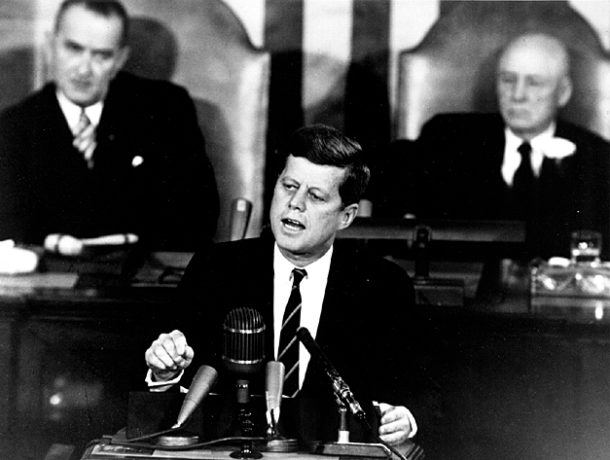
Fifty-five years ago today, President John F. Kennedy called a special session of the United States Congress to bring before that august body a variety of issues which he referred to as “urgent national needs”.
The transcript of President Kennedy’s speech indicates that the ninth and last issue addressed by the President was simply entitled SPACE. The most stirring words of that portion of his speech may well be these:
“I believe that this nation should commit itself to achieving the goal, before this decade is out, of landing a man on the moon and returning him safely to the earth. No single space project in this period will be more impressive to mankind, or more important for the long-range exploration of space; and none will be so difficult or expensive to accomplish.”
Although he did not live to see the fulfillment of that goal, the record shows that 8 years, 1 month, and 26 days later, the United States of America did indeed land a man (men) on the moon and returned him (them) safely to earth before the decade was out.
Thus, as a country, we can say now, even as we said then to our departed leader: Mission Accomplished, Mr. President.