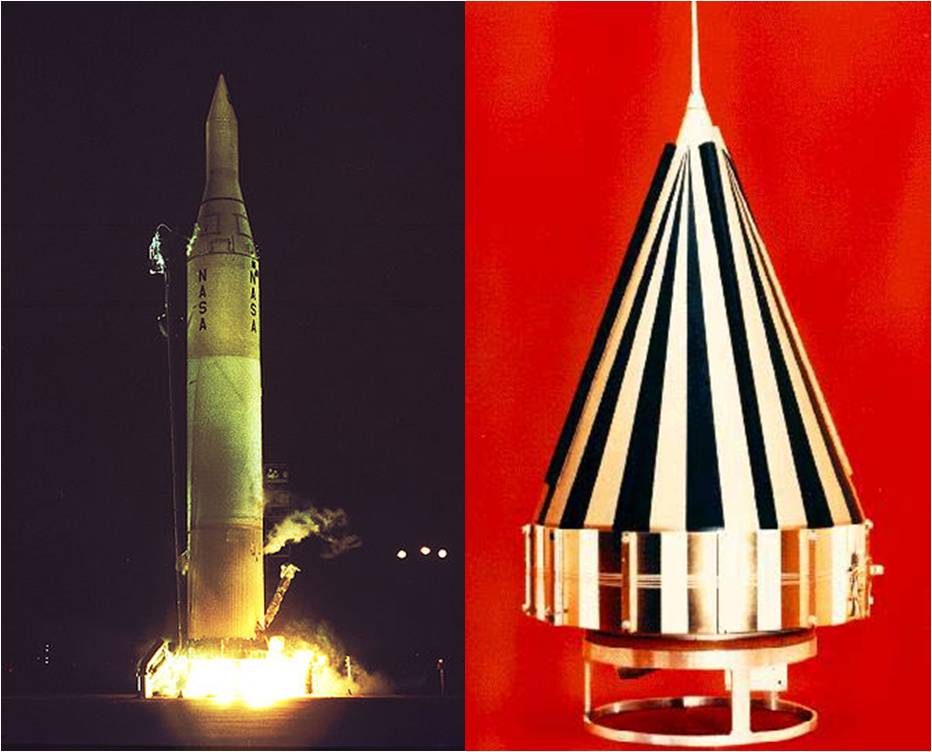
Fifty-one years ago this week, NASA’s Pioneer 4 probe flew within 37,000 miles of the lunar surface. In doing so, the spacecraft flew the first successful American lunar flyby mission.
The Pioneer Program was a series of planetary space missions conducted by NASA between 1958 and 1978. The target of the early missions (1958-1960) was the Moon. The one exception was Pioneer 5 which investigated the interplanetary medium between Earth and Venus. Later Pioneer mission (1965-1978) were devoted to investigation of Jupiter and Saturn.
It was tough sledding in the early days of the Pioneer Program where the primary goal was to orbit the Moon. However, launch vehicle reliability was simply too poor and space trajectory control too crude to meet the lunar orbit goal in the lat 1950’s.
Indeed, none of the ten (10) Pioneer missions flown in the 1958-1960 period managed to achieve a lunar orbit of any kind. Interestingly, the United States would not orbit a spacecraft around the Moon until the Lunar Orbiter 1 mission in August of 1966.
While the lunar orbit goal proved too daunting for the early Pioneer Program, a lunar flyby mission was feasible using extant technology. The flyby mission simply required the spacecraft to sweep by the Moon (without impacting the surface) as the probe moved along an interplanetary trajectory towards the Sun. Ultimately, the spacecraft would find itself in solar orbit.
The Pioneer 4 spacecraft was a cone 20-inches in length and 9-inches in diameter. It weighed a mere 13.5 pounds. Spin-stabilization was effected by spinning the vehicle at 400 rpm about its longitudinal axis. Instrumentation was sparse; just a photoelectric sensor and a pair of radiation sensors.
On Tuesday, 03 March 1959, a Juno II launch vehicle carrying the Pioneer 4 spacecraft lifted-off from Cape Canaveral, Florida at 1711 UTC. The 4-stage Juno II was a modification of the Juno I launch vehicle that orbited America’s first satellite (Explorer 1) on Friday, 31 January 1958.
Pioneer 4 was successfully placed into an interplanetary trajectory that saw the probe pass within 37,000 miles of the lunar surface at 22:25 UTC on Wednesday, 04 March 1959. Considering that the Moon is about 238,000 miles from Earth, the flyby wasn’t all that close. However, at the dawn of the space age, it was indeed a significant accomplishment.
Pioneer 4 was powered by mercury batteries; that is, the spacecraft did not use solar cells. Sensor measurements were telemetered back to Earth at 960.05 MHz via a 0.1-Watt transmitter. Earth-based stations tracked the space probe out to a distance of roughly 407,000 miles from Earth.
At 01:00 UTC on Wednesday, 18 March 1959, Pioneer 4 reached the closest point in its eternal orbit about the Sun. Having done so, Pioneer 4 would forever hold the distinction of being the first American spacecraft to transit interplanetary space and reach heliocentric orbit.
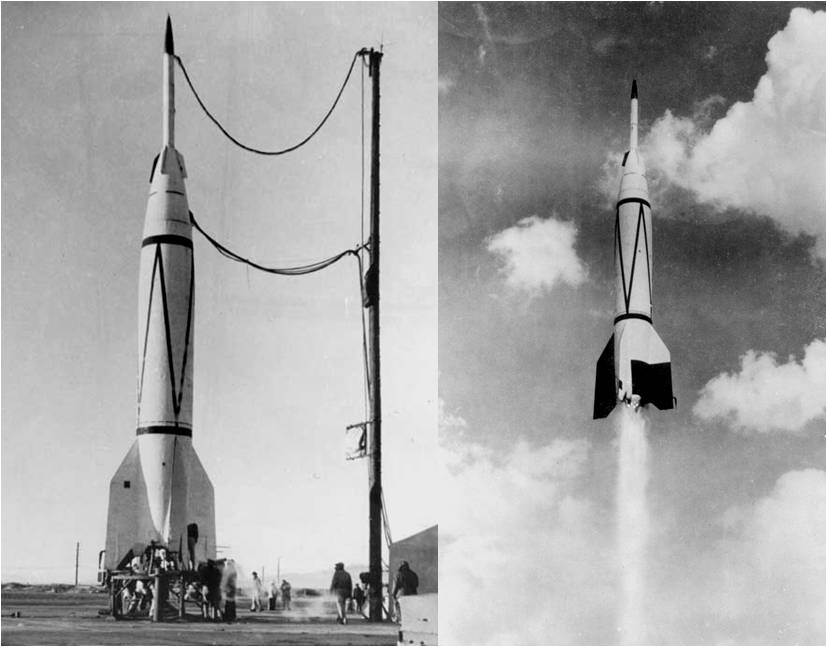
Sixty-one years ago this week, a United States two-stage liquid-fueled rocket reached a then-record altitude of 250 miles. Launch took place from Pad 33 at White Sands Proving Ground (WSPG), New Mexico.
The Bumper Program was a United States Army effort to reach flight altitudes and velocities never before achieved by a rocket vehicle. The name “Bumper” was derived from the fact that the lower stage would act to “bump” the upper stage to higher altitude and velocity than it (i.e., the upper stage) was able to achieve on its own.
The Bumper Program, which was actually part of the Army’s Project Hermes, officially began on Friday, 20 June 1947. The project team consisted of the General Electric Company, Douglas Aircraft Company and Cal Tech’s Jet Propulsion Laboratory. A total of eight (8) test flights took place between May 1948 and July 1950.
The Bumper two-stage configuration consisted of a V-2 booster and a WAC Corporal upper stage. The V-2’s had been captured from Germany following World War II while the WAC Corporal was a single stage American sounding rocket. The launch stack measured 62 feet in length and weighed around 28,000 pounds.
Propulsion-wise, the V-2 booster generated 60,000 pounds of thrust with a burn time of 70 seconds. The WAC Corporal rocket motor produced 1,500 pounds of thrust and had a burn time of 47 seconds.
The flight of Bumper-WAC No. 1 occurred on Thursday, 13 May 1948. This was an engineering test flight in which the WAC Corporal achieved a peak altitude of 79 miles. Unfortunately, the next three (3) flights were plagued by development problems of one kind or another and failed to achieve an altitude of even 10 miles.
Bumper-WAC No. 5 was fired from WSPG on Thursday, 24 February 1949. The V-2 burned-out at an altitude of 63 miles and a velocity of 3,850 feet per second. The WAC Corporal accelerated to a maximum velocity of 7,550 feet per second and then coasted to an apogee of 250 miles.
With generation of a very thin bow shock layer and high aerodynamic surface heating levels, the flight of Bumper-WAC No. 5 can be considered as the first time a man-made flight vehicle entered the realm of hypersonic flight. Notwithstanding that achievement, its maximum Mach number of 7.6 would be eclipsed in July of 1950 when Bumper-WAC No. 7 reached Mach 9.
Three (3) more Bumper-WAC missions would follow Bumper-WAC No.5. While Bumper-WAC No. 6 would fly from WSPG, the final two (2) missions were conducted from an isolated Florida launch site in July of 1950.
The hot, bug-infested Floridian launch location, springing-up amongst sand dunes and scrub palmetto, would one day become the seat of American spaceflight. It was known then as the Joint Long-Range Proving Ground. Today, we know it as Cape Canaveral.
The Bumper Program successfully demonstrated the efficacy of the multi-staging concept. Bumper also provided valuable flight experience in stage separation and high altitude rocket motor ignition systems. In short, Bumper played a vital role in helping America successfully develop its ICBM, satellite and manned spaceflight capabilities.
While its historical significance, and even its existence, has been lost to many here in the 21st Century, the Bumper Program played a major role in our quest for the Moon. As such, it will forever hold a hollowed place in the annals of United States aerospace history.
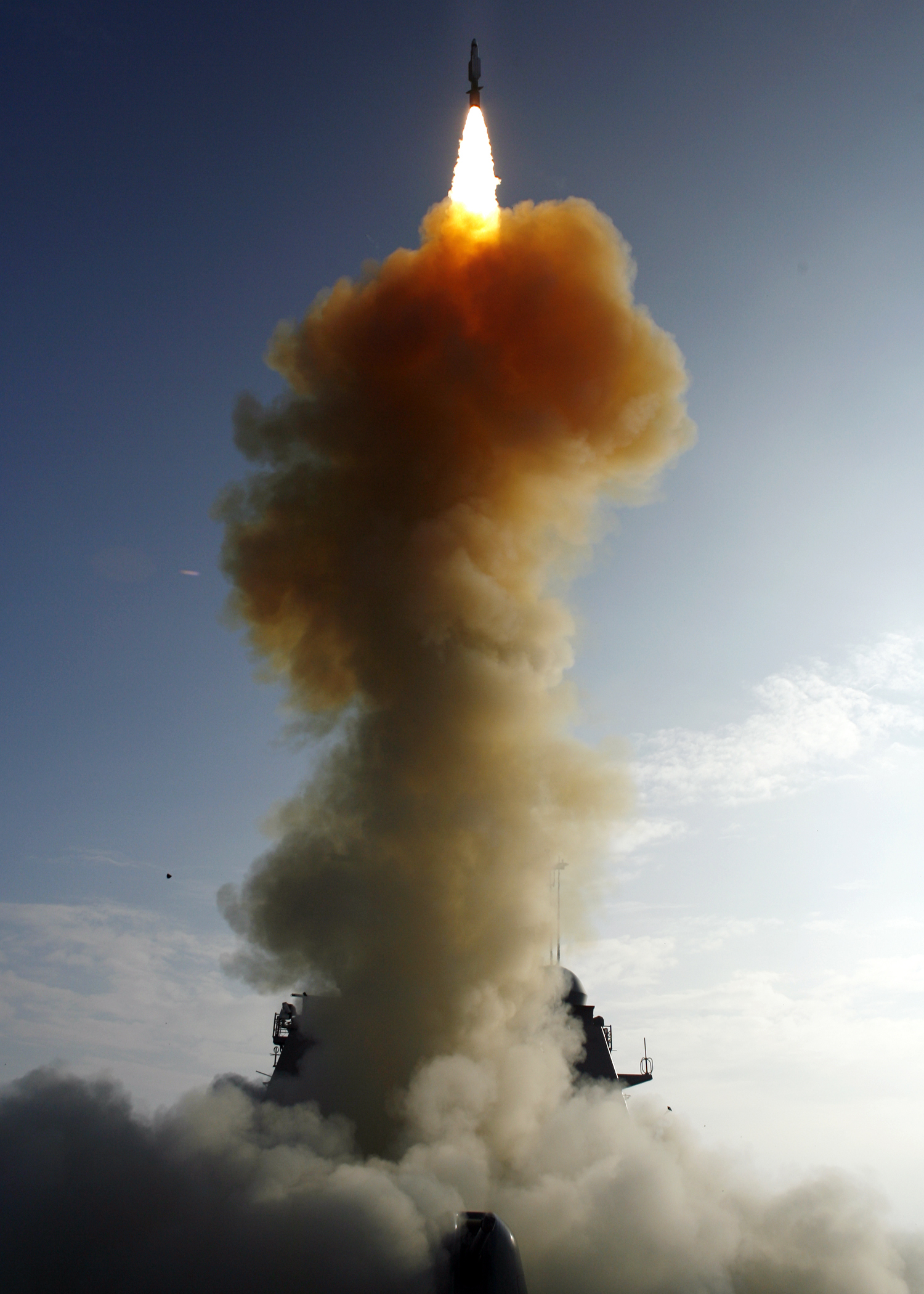
Two years ago this month, a United States Navy STANDARD Missile SM-3 Block IA intercepted and destroyed a failed NRO satellite at an altitude of 133 nautical miles. The relative velocity at intercept was in excess of 22,000 mph.
The United States Navy/Raytheon Missile Systems SM-3 (RIM-161) is the sea-based arm of the Missile Defense Agency’s Ballistic Missile Defense System (BMDS). The 3-stage missile carries a Kinetic Warhead (KW) that provides an exoatmospheric hit-to-kill capability.
In order to ensure a lethal hit, the SM-3 KW guides to a specific aimpoint on the target’s airframe. The ability to reliably do so has been impressively demonstrated in a series of intercept flight tests that began in 2002.
SM-3 rounds are launched from the MK-41 Vertical Launcher System (VLS) aboard United States Navy cruisers and destroyers. The at-sea basing concept provides for a high degree of operational flexibility in the ballistic missile intercept mission.
The Lockheed Martin-built USA-193 was launched on a classified mission from California’s Vandenberg Air Force Base (VAFB) at 2100 UTC on Thursday, 14 December 2006. Shortly after reaching orbit, contact with the 5,000-lb satellite was lost.
By January 2008, USA-193’s orbit had decayed to such an extent that its reentry appeared imminent. Such events raise concerns for the safety of those on Earth who reside within the debris impact footprint. However, there was an additional concern in the case of USA-193. The satellite still had about 1,000-lbs of hydrazine onboard.
Should the USA-193 hydrazine tank survive reentry, those living in the impact area would be exposed to a highly toxic cloud of the volatile substance. Officials concluded that the safest thing to do was to destroy the satellite before it reentered the atmosphere.
On Thursday, 21 February 2008, the USS Lake Erie was on station in the Pacific Ocean west of Hawaii. The US Navy cruiser fired a single SM-3 interceptor at 0326 UTC. Minutes later, the missile’s KW took out the satellite and dispersed its hydrazine load into space. Mission accomplished!
In the aftermath of the satellite take-down, Russia and others predictably accused the United States of using the USA-193 hydrazine issue as an excuse to demonstrate SM-3’s anti-satellite capability. While such capability was indeed demonstrated, noteworthy is the fact that all systems modified to execute the satellite intercept have subsequently been returned to a ballistic missile defense posture.
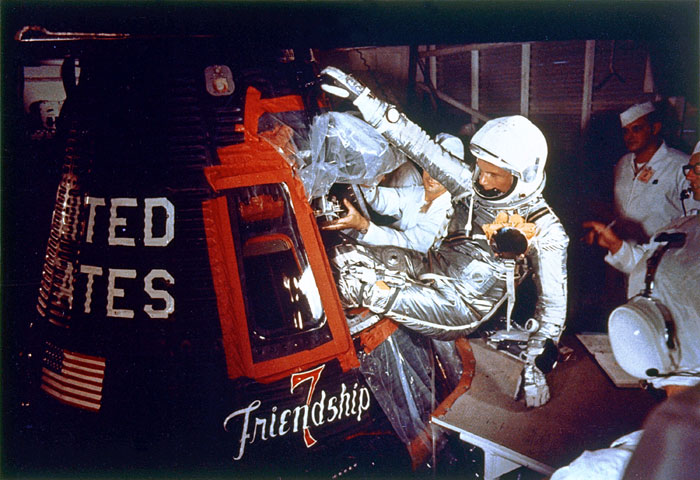
Forty-eight years ago this month, Project Mercury Astronaut John H. Glenn, Jr. became the first American to orbit the Earth. Glenn’s spacecraft name and mission call sign was Friendship 7.
Mercury-Atlas 6 (MA-6) lifted-off from Cape Canaveral’s Launch Complex 14 at 14:47:39 UTC on Tuesday, 20 February 1962. It was the first time that the Atlas LV-3B booster was used for a manned spaceflight.
Three-hundred and twenty seconds after lift-off, Friendship 7 achieved an elliptical orbit measuring 143 nm (apogee) by 86 nm (perigee). Orbital inclination and period were 32.5 degrees and 88.5 minutes, respectively.
The most compelling moments in the United States’ first manned orbital mission centered around a sensor indication that Glenn’s heatshield and landing bag had become loose at the beginning of his second orbit. If true, Glenn would be incinerated during entry.
Concern for Glenn’s welfare persisted for the remainder of the flight and a decision was made to retain his retro package following completion of the retro-fire sequence. It was hoped that the 3 straps holding the retro package would also hold the heatshield in place.
During Glenn’s return to the atmosphere, both the spent retro package and its restraining straps melted in the searing heat of re-entry. Glenn saw chunks of flaming debris passing by his spacecraft window. At one point he radioed, “That’s a real fireball outside”.
Happily, the spacecraft’s heatshield held during entry and the landing bag deployed nominally. There had never really been a problem. The sensor indication was found to be false.
Friendship 7 splashed-down in the Atlantic Ocean at a point 432 nm east of Cape Canaveral at 19:43:02 UTC. John Glenn had orbited the Earth 3 times during a mission which lasted 4 hours, 55 minutes and 23 seconds. Within short order, spacecraft and astronaut were successfully recovered aboard the USS Noa.
John Glenn became a national hero in the aftermath of his 3-orbit mission aboard Friendship 7. It seemed that just about every newspaper page in the days following his flight carried some sort of story about his historic fete. Indeed, it is difficult for those not around back in 1962 to fully comprehend the immensity of Glenn’s flight in terms of what it meant to the United States.
John Herschel Glenn, Jr. will turn 89 on 18 July 2010. His trusty Friendship 7 spacecraft is currently on display at the Smithsonian National Air and Space Museum in Washington, DC.
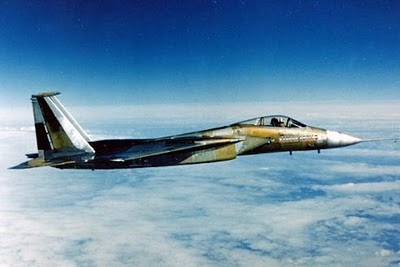
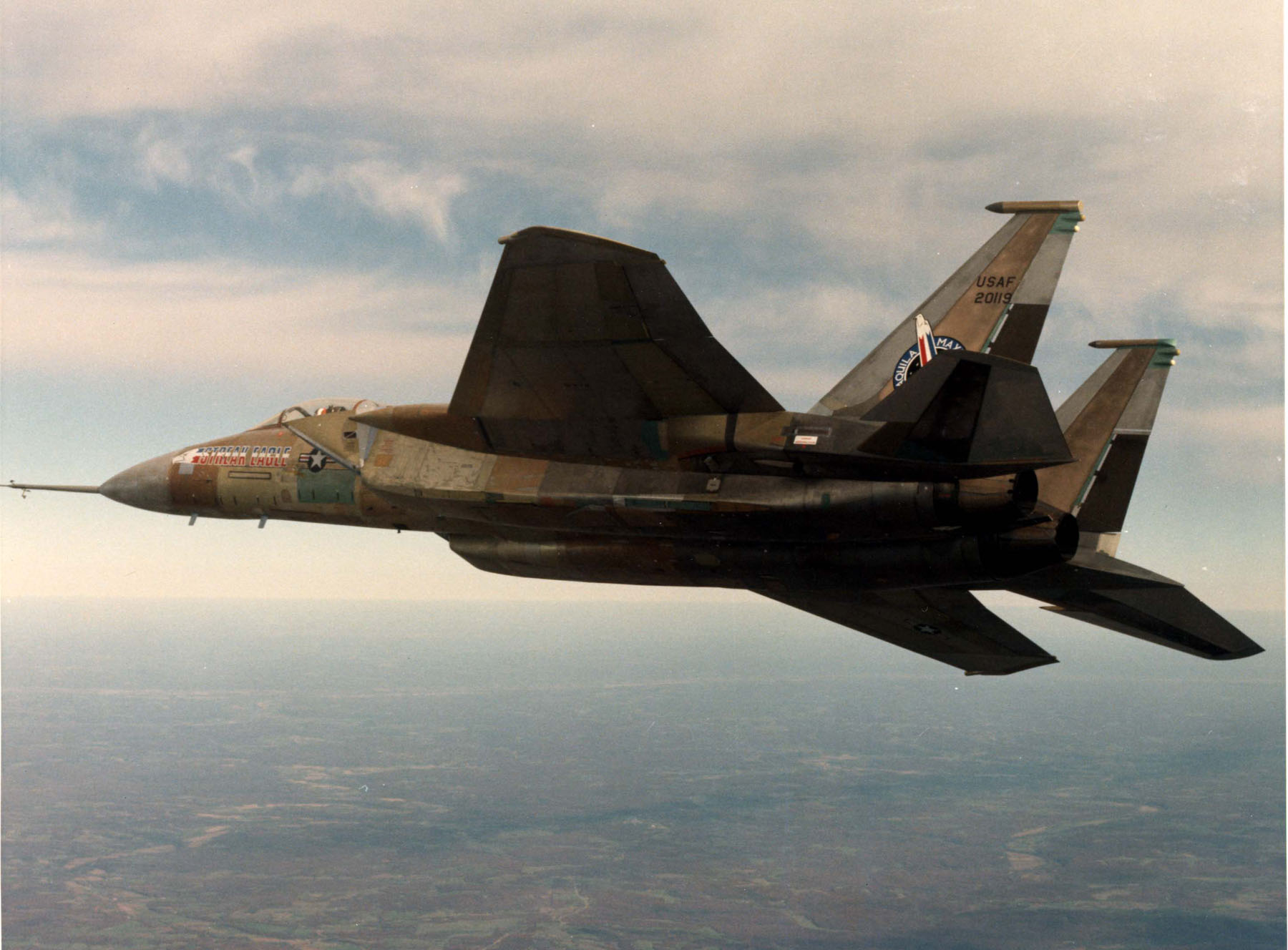
Thirty-five years ago today, an USAF F-15A Eagle reached an altitude of 30 km (98,425 feet) 207.8 seconds from brake release. The pilot for the record-breaking mission was USAF Major Roger Smith.
Operation Streak Eagle was a mid-1970’s effort by the United States Air Force to set eight (8) separate time-to-climb records using the McDonnell-Douglas F-15 Air Superiority Fighter. These record-setting flights originated from Grand Forks Air Force Base in North Dakota.
Starting on Thursday, 16 January 1975, the 19th pre-production F-15 Eagle aircraft (S/N 72-0119) was used to establish the following time-to-climb records during Operation Streak Eagle:
3 km, 16 January 1975, 27.57 seconds, Major Roger Smith
6 km, 16 January 1975, 39.33 seconds, Major Willard Macfarlane
9 km, 16 January 1975, 48.86 seconds, Major Willard Macfarlane
12 km, 16 January 1975, 59.38 seconds, Major Willard Macfarlane
15 km, 16 January 1975, 77.02 seconds, Major David Peterson
20 km, 19 January 1975, 122.94 seconds, Major Roger Smith
25 km, 26 January 1975, 161.02 seconds, Major David Peterson
The eighth and final time-to-climb record attempt of Operation Streak Eagle took place on Saturday, 01 February 1975. The goal was to set a new time-to-climb record to 30 km. The pilot was required to wear a full pressure suit for this mission.
At a gross take-off weight of 31,908 pounds, the Streak Eagle aircraft had a thrust-to-weight ratio in excess of 1.4. The aircraft was restrained via a hold-down device as the two Pratt and Whitney F100 turbofan engines were spooled-up to full afterburner.
Following hold-down and brake release, the Streak Eagle quickly accelerated during a low level transition following take-off. At Mach 0.65, Smith pulled the aircraft into a 2.5-g Immelman. The Streak Eagle completed this maneuver 56 seconds from brake release at Mach 1.1 and 9.75 km. Rolling the aircraft upright, Smith continued to accelerate the Streak Eagle in a shallow climb.
At an elapsed time of 151 seconds and with the aircraft at Mach 2.2 and 11.3 km, Smith executed a 4-g pull to a 60-degree zoom climb. The Steak Eagle passed through 30 km at Mach 0.7 in an elapsed time of 207.8 seconds. The apex of the zoom trajectory was about 31.4 km. With a new record in hand, Smith uneventfully recovered the aircraft to Grand Forks AFB.
Operation Streak Eagle ended with the capturing of the 30 km time-to-climb record. In December 1980, the aircraft was retired to the USAF Museum at Wright-Patterson Air Force Base in Dayton, Ohio. It is currently held in storage at the Museum and no longer on public display.
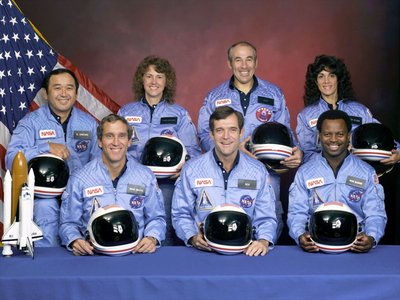
Twenty-four years ago this week, the seven member crew of STS-51L were killed when the Space Shuttle Challenger disintegrated 73 seconds after launch from LC-39B at Cape Canaveral, Florida. It was the first fatal in-flight accident in American spaceflight history.
In remarks made at a memorial service held for the Challenger Seven in Houston, Texas on Friday, 31 January 1986, President Ronald Wilson Reagan expressed the following sentiments:
“The future is not free: the story of all human progress is one of a struggle against all odds. We learned again that this America, which Abraham Lincoln called the last, best hope of man on Earth, was built on heroism and noble sacrifice. It was built by men and women like our seven star voyagers, who answered a call beyond duty, who gave more than was expected or required and who gave it little thought of worldly reward.”
We take this opportunity now to remember the heroic fallen:
Francis R. (Dick) Scobee, Commander
Michael John Smith, Pilot
Ellison S. Onizuka, Mission Specialist One
Judith Arlene Resnik, Mission Specialist Two
Ronald Erwin McNair, Mission Specialist Three
S.Christa McAuliffe, Payload Specialist One
Gregory Bruce Jarvis, Payload Specialist Two
Speaking for his grieving countrymen, President Reagan closed his eulogy with these words:
“Dick, Mike, Judy, El, Ron, Greg and Christa – your families and your country mourn your passing. We bid you goodbye. We will never forget you. For those who knew you well and loved you, the pain will be deep and enduring. A nation, too, will long feel the loss of her seven sons and daughters, her seven good friends. We can find consolation only in faith, for we know in our hearts that you who flew so high and so proud now make your home beyond the stars, safe in God’s promise of eternal life.”
Tuesday, 28 January 1986. We Remember.

One year ago this month, US Airways Flight 1549 successfully ditched in the Hudson River following loss of thrust in both turbofan engines. Incredibly, all 155 passengers and crew members survived.
US Airways Flight 1549 lifted-off from Runway 4 of New York’s LaGuardia Airport at 18:25:56 UTC on Thursday, 15 January 2009. The Airbus 320-214 (N106US) was making its 16,299th flight. Call sign for the day’s flight was Cactus 1549.
Captain Chesley B. Sullenberger III and First Officer Jeffrey B. Skiles were in the cockpit of Cactus 1549. Donna Dent, Doreen Welsh and Sheila Dail served as flight attendants. Together, these crew members were responsible for the lives of 150 airline passengers.
Following a normal take-off, Cactus 1549 collided with a massive flock of Canadian Geese climbing through 3,000 feet. Numerous bird strikes were experienced. Most critically, both CFM56-5B4/P turbofan engines suffered bird ingestion. As Captain Sullenberger suscinctly described it later, the result was “sudden, complete, symmetrical” loss of thrust.
Quickly assessing their predicament, Captain Sullenberger instinctively knew that he could not get his aircraft back to a land-based runway. He was flying too low and slow to make such an attempt. He would have to ditch his 150,000-pound aircraft in the nearest waterway; the Hudson River.
The story of what ensued following loss of thrust is best told by Captain Sullenberger himself. The reader is therefore directed to chapters 13 and 14 of his post-mishap book entitled “Highest Duty”. The bottom line is that the aircraft was successfully ditched in the Hudson River roughly three and half minutes after loss of thrust.
Once the aircraft was on the water, the crew members evacuated all 150 passengers in less than 4 minutes. People either got into life rafts or stood on the aircraft’s wings. It was very cold. Air temperature was 21F with a windchill factor of 11F. The water temperature registered at 36F.
First responders from the New York Waterway quickly came to the aid of Cactus 1549. A total of fourteen vessels responded to the emergency with the first boat arriving within four minutes of the aircraft coming to a stop.
Many selfless acts of compassion and exemplary displays of valor were observed during Cactus 1549 rescue operations. This was true for those amongst the ranks of the rescuers and rescued alike.
Happily and to the great relief of the US Airways flight crew, there was no loss of life resulting from the emergency ditching of Cactus 1549. Now known as “The Miracle on the Hudson”, the events of that harrowing experience on a winter day in NYC will be forever remembered in the annals of aviation.
For their professional efforts in handling the Cactus 1549 in-flight emergency, Chesley Sullenberger, Jeff Skiles, Donna Dent, Doreen Welsh and Sheila Dail received the rarely-awarded Guild of Air Pilots and Air Navigators Master’s Medal on Thursday, 22 January 2009.
In part, the Master’s Medal citation read: “The reactions of all members of the crew, the split second decision making and the handling of this emergency and evacuation was ‘text book’ and an example to us all. To have safely executed this emergency ditching and evacuation, with the loss of no lives, is a heroic and unique aviation achievement.”
To which we say: Amen!
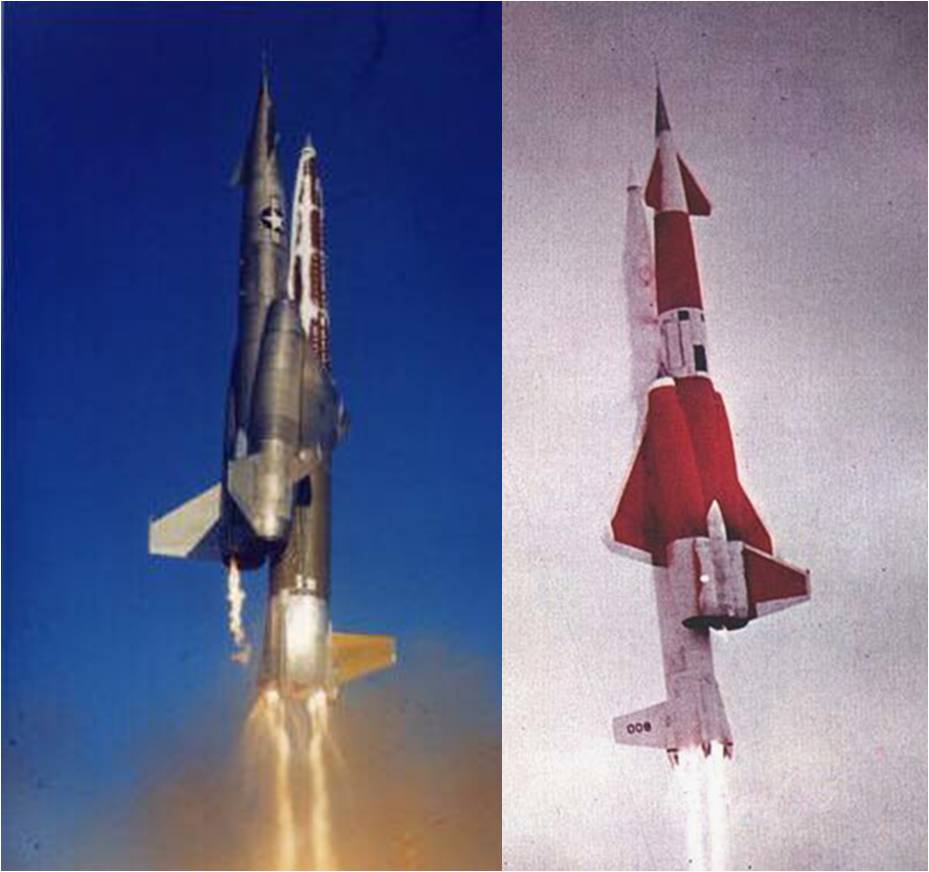
Fifty-two years ago this month, a XSM-64 Navaho G-26 flight test vehicle flew 1,075 miles in 40 minutes at a sustained speed of Mach 2.8. It was the 8th flight test of the ill-fated Navaho Program.
The post-World War II era saw the development of a myriad of missile weapons systems. Perhaps the most influential and enigmatic of these systems was the Navaho missile.
Navaho was intended as a supersonic, nuclear-capable, strategic weapon system. It consisted of two (2) stages. The first stage was rocket-powered while the second stage utilized ramjet propulsion. The aircraft-like second stage was configured with a high lift-to-drag airframe in order to achieve strategic reach.
While there were a number of antecedants dating back to 1946, the Navaho Program really began in 1950 as Weapon System 104A. The requirements included a range of 5,500 miles, a minimum cruise speed of Mach 3 and a minimum cruise altitude of 60,000 feet. The payload included an ordnance load of 7,000 pounds delivered within a CEP of 1,500 feet.
North American Aviation (NAA) proposed a 3-phase development plan for WS-104A. Phase 1 involved testing of the missile alone (the X-10) up to Mach 2. Phase 2 covered the testing of the two-stage launch vehicle (the G-26) up to Mach 2.75 and a range of 1,500 miles. Phase 3 would be the ultimate near-production vehicle (the G-38). Only Phase 1 and Phase 2 testing took place.
The Navaho missile-booster vehicle measured 84 feet in length and weighed about 135,000 pounds at lift-off. The launch weight for the booster was 75,000 pounds; most of which was due to the alcohol and LOX propellants. The missile empty weight was 24,000 pounds.
On Friday, 10 January 1958, Navaho G-26 No. 9 (54-3098) lifted-off from LC-9 at Cape Canaveral, Florida. Climbing out under 240,000 pounds of thrust from its dual Rocketdyne XLR71-NA-1 rocket motors, missile-booster separation occurred at Mach 3.15 and 73,000 feet. Following air-start and take-over of twin Wright XRJ47-W-5 ramjets, generating a combined thrust of 16,000 pounds, the Navaho missile initiated a near triple-sonic cruise toward the Puerto Rico target area.
As the Navaho missile approached the environs of Puerto Rico, the vehicle was commanded to initiate a sweeping right-hand turn back towards the Cape. Unfortunately, the right intake experienced an unstart and a concommitant, asymmetric loss of thrust. Underpowered and without a restart capability, the vehicle was subsequently commanded to execute a dive into the Atlantic.
Flight No. 8, although only partially successful, flew longer and farther than any Navaho flight test vehicle. Only G-26 Flight No. 6 flew faster (Mach 3.5).
Although three (3) flights would follow G-26 Flight No. 8, all would suffer failure of one kind or another. In point of fact, the Navaho Program had been canceled on Saturday, 13 July 1957. The final six (6) Navaho flights were simply an attempt to extract the most from the remaining missile-booster rounds. Over 15,000 NAA employees lost their jobs the day Navaho died.
Navaho was cancelled primarily due to the ascendancy of the Intercontinental Ballistic Missile (ICBM). Very simply, an ICBM could deliver nuclear ordnance farther, faster and more accurately than a winged, unstealthy strategic missile. Navaho’s relatively numerous technical issues and programmatic delays simply served to drive the final nail into a long-prepared coffin.
While few today remember or even know of the Navaho Program, its technology has had a profound influence on all manner of aerospace vehicles up to the present day. Interestingly, the Space Shuttle launch vehicle concept bears a strong resemblance to the Navaho missile-booster combination. That is, a winged flight vehicle mounted asymmetrically on a longer boost vehicle.
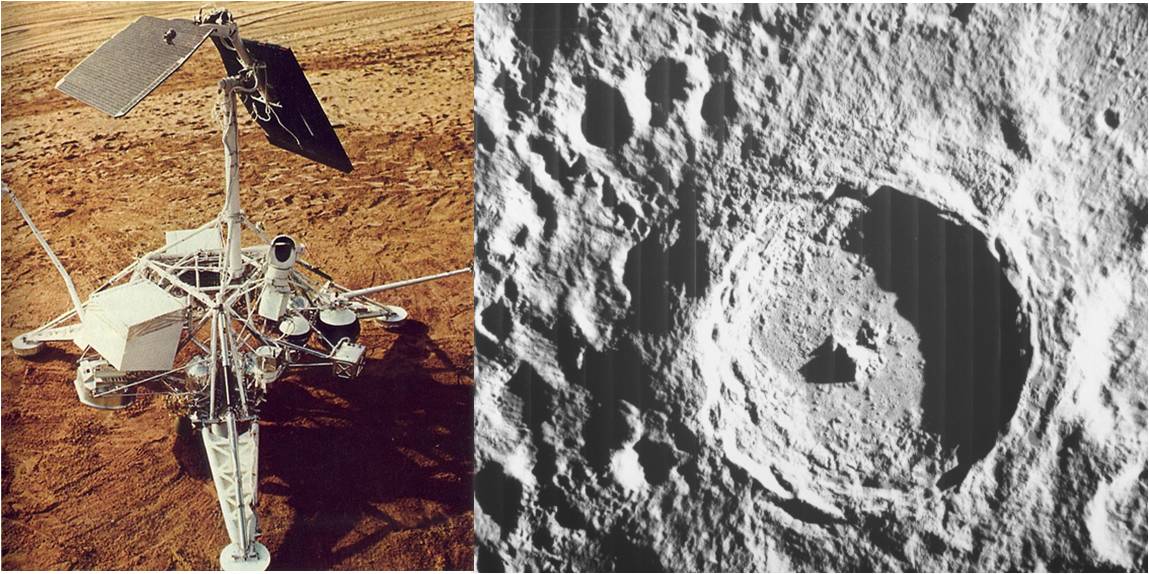
Forty-two years ago this month, the Surveyor 7 spacecraft soft-landed in the lunar highlands near the Crater Tycho. It was the fifth and last Surveyor vehicle to successfully perform an autonomous landing on the Moon.
In preparation for the first manned lunar landing, the United States conducted an extensive investigation of the Moon using Ranger, Lunar Orbiter and Surveyor robotic spacecraft.
Ranger provided close-up photographs of the Moon starting at a distance of roughly 1,100 nautical miles above the lunar surface all the way to impact. Nine (9) Ranger missions were flown between 1961 and 1965. Only the last three (3) missions were successful.
Lunar Orbiter spacecraft mapped 99% of the lunar surface with a resolution of 200 feet or better. Five (5) Lunar Orbiter missions were flown between 1967 and 1968. All were successful.
Surveyor spacecraft were tasked with landing on the Moon and providing detailed photographic, geologic and environmental information about the lunar surface. Seven (7) Surveyor missions were flown between 1966 and 1968. Five (5) spacecraft successfully landed.
The Surveyor spacecraft weighed 2,300 lbs at lift-off and 674 lbs at landing. The 3-legged vehicle stood within a diameter of 15 feet and measured almost 11 feet in height. Surveyor was configured with a television camera, a surface sampler and an alpha-scattering instrument to determine the chemical composition of the lunar soil.
Surveyor 7 was launched from Kennedy Space Center’s Launch Complex 36A at 06:30:00.545 UTC on Sunday, 07 January 1968. The ride to the Moon was provided by a General Dynamics Atlas-Centaur launch vehicle. It took almost 68 hours to reach the Moon.
On Wednesday, 10 January 1968, Surveyor 7 successfully landed at 01:05:36 UTC on the lunar surface near the North Rim of Tycho Crater. A total of 20,993 photographs were taken during Surveyor 7’s first lunar day. By Friday, 26 January 1968, Surveyor 7 was powered-down for its first lunar night.
On Monday, 12 February 1968, Surveyor 7 was powered-up for its second lunar day of surface operations. The spacecraft took an additional 45 photographs and operated erratically for 9 earth-days. At 00:24 UTC on Wednesday, 21 February 1968, contact with Surveyor 7 was lost for the final time. By 06:48 UTC, the Surveyor 7 mission was officially terminated.
Although seldom remembered today, the Surveyor Program provided America with a wealth of lunar surface information critical to the Apollo Program. Surveyor’s success provided an added measure of confidence in the attainability of a manned lunar landing. Indeed, seventeen (17) months after Surveyor 7 fell silent, Astronauts Armstrong and Aldrin imprinted the lunar surface with their bootprints at Mare Tranquilitatis.
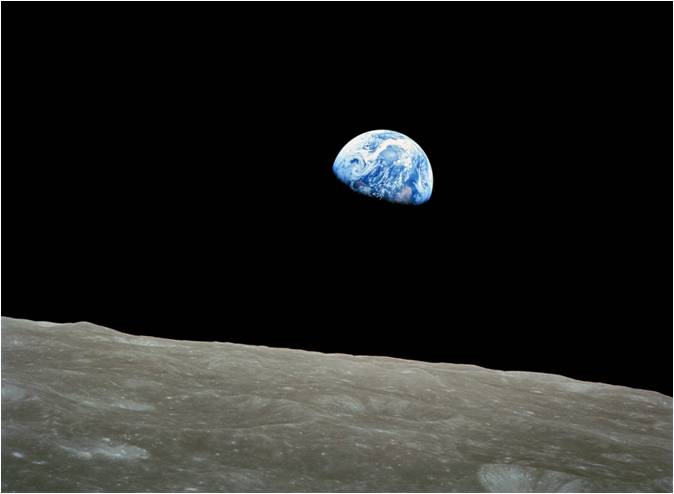
Forty-one years ago this month, three American astronauts became the first men to orbit the Earth’s Moon during the flight of Apollo 8. The flight also featured the first manned flight of the mighty Saturn V rocket booster as well as history’s first superorbital entry of a manned spacecraft.
Following the Apollo 1 tragedy in January of 1967, the United States would not fly another manned space mission until October 1968. That flight, Apollo 7, was a highly successful earth-orbital mission in which the new Block II Apollo Command Module was thoroughly flight-proven.
Notwithstanding Apollo 7 ‘s accomplishments, only 14 months remained for the United States to meet the national goal of achieving a manned lunar landing before the end of the 20th century’s 7th decade. The view held by many in late 1968 was that an already daunting task was now unachievable in the narrow window of time that remained to accomplish it.
The pessimism about reaching the Moon before the end of the decade was easy to understand. The Saturn V moon rocket had not been man-rated. The Lunar Module had not flown. Lunar Orbit Rendezvous (LOR) was untried. Men had not even so much as orbited the Moon. Yet, history would record that the United States would find a way to accomplish that which had never before been achieved.
George Low, manager of NASA’s Apollo Spacecraft Program Office, came up with the idea. Low proposed that the first manned flight of the Saturn V be a trip all the way to the Moon. It was something that Low referred to as the “All-Up Testing” concept. The newly-conceived mission would be flown in December 1968 near Christmas time.
While initially seen as too soon and too risky by many in NASA’s management hierarchy, Low’s bold proposal was ultimately accepted as the only way to meet the national lunar landing goal. Yes, there was additional risk. However, the key technologies were ready, the astronauts were willing, and the risk was tolerable.
Apollo 8 lifted-off from LC-39A at the Kennedy Space Center in Florida on Saturday, 21 December 1968 at 12:51 hours UTC. The crew consisted of NASA astronauts Frank Borman, James A. Lovell, Jr. and William A. Anders. Their target – the Moon – was 220,000 miles away.
After a 69-hour outbound journey, Apollo 8 entered lunar orbit on Tuesday, 24 December 1968 – Christmas Eve. The Apollo 8 crew photographed the lunar surface, studied the geologic features of its terrain, and made other observations from a 60-nautical mile circular orbit. The spacecraft circled the Moon 10 times in slightly over 20 hours.
The most poignant and memorable event in Apollo 8’s historic journey occurred on Christmas Eve night when each of the flight crew took turns reading from the Book of Genesis in the Holy Bible. The solemnity of the moment was evident in the voices of the astronauts. They had seen both the Moon and the Earth from a perspective that none before them had. Fittingly, they expressed humble reverence for the Creator of the Universe on the anniversary of the birth of mankind’s Redeemer.
Apollo 8 departed lunar orbit a little over 89 hours into the mission. Following a nearly 58-hour inbound trip, Apollo 8 reentered the earth’s atmosphere at 36, 221 feet per second on Friday, 27 December 1968. The first manned superorbital reentry was performed in total darkness. It was entirely successful as Apollo 8 landed less than 1 nautical mile from its target in the Pacific Ocean. The USS YORKTOWN effected recovery of the weary astronauts and their trustworthy spacecraft. Mission total elapsed time was 147 hours and 42 seconds.
The year 1968 was a tumultuous one for the United States of America. Martin Luther King and Robert Kennedy had been assassinated. American military blood flowed on the battlefields of Vietnam and civilian blood was let in countless demonstrations taking place in the nation’s cities. The ill-posed sexual revolution continued to eat away at the country’s moral moorings.
But, as is so often the case, an event from the realm of flight, now newly extended to lunar space, reminded us of our higher nature and potential. For a too brief moment, Apollo 8 put our collective purpose for being here into sharp focus. Perhaps a short phrase in a telegram sent to Frank Borman from someone he had never met said it best: “You saved 1968!”
However, looking through the lens of history, we now know that Apollo 8 did much more than end the penultimate year of the 1960’s on a positive note. Indeed, Apollo 8 saved the entire Apollo Program.