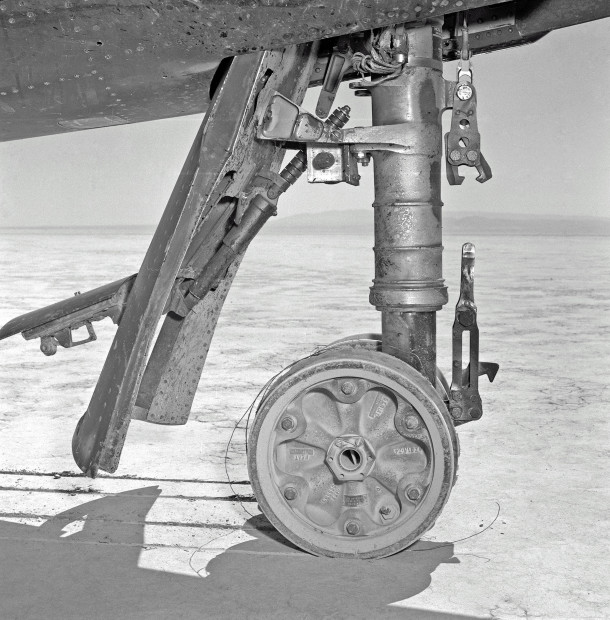
Fifty-three years ago yesterday, the fabled North American X-15 hit a speed of 3,590 mph (Mach 5.23) in a flight that reached an altitude of 103,300 feet. While decelerating through Mach 4.2, the nose gear of the aircraft unexpectedly deployed in flight.
The 114th powered flight of the legendary X-15 Program took place on Friday, 14 August 1964. USAF Major Robert A. Rushworth was at the controls of X-15 Ship No. 2 (S/N 56-6671). The mission would be Rushworth’s 22nd flight in the famed hypersonic aircraft.
X-15 drop from the NB-52A (S/N 52-0003) launch aircraft took place over Delamar Dry Lake, Nevada. Seconds later, Rushworth called for 100% power from the X-15’s XLR-99 liquid-fueled rocket engine as he pulled into a steep climb. He subsequently pushed-over and then leveled-off at 103,300 feet.
XLR-99 burnout occurred 80.3 seconds after ignition. At this juncture, the X-15 was traveling at 3,590 mph; better than 5 times the speed of sound. Following rocket motor burnout, the aircraft slowed and began to lose altitude under the influence of weight and aerodynamic drag.
As the Mach meter needle passed through Mach 4.2, Rushworth heard a loud bang from the airframe. The aircraft became hard to control as it gyrated in pitch, yaw and roll. Rushworth was equal to the moment and brought his troubled steed under control. However, the aircraft had an uncommanded sideslip and Rushworth had to use left aileron to hold the wings level.
Gathering his wits, Rushworth realized that the loud bang he heard was very similar to that which occurred when the nose gear was deployed in the landing pattern. Unaccountably, the X-15 nose gear had deployed in supersonic flight. An unsettling confirmation of Rushworth’s hypothesis came when the pilot spotted smoke, quite a bit of it, in the X-15 cockpit.
As Rushworth neared Edwards Air Force Base, chase aircraft caught up with him and confirmed that the nose gear was indeed down and locked. Further, the tires were so scorched from aerodynamic heating that they probably would disintegrate during touchdown on Rogers Dry Lake. They verily did.
Despite his tireless nose gear, Rushworth was able to control the rollout of his aircraft fairly well on the playa silt. He brought the X-15 to a stop and deplaned. Man and machine had survived to fly another day.
Post-flight analysis revealed that expansion of the X-15 fuselage due to aerodynamic heating was greater than expected. The nose gear door bowed or deformed outward more than anticipated as well. Together, these two anomalies caused the gear uplock hook to bend and release the nose gear. Fixes were subsequently made to Ship No. 2 to prevent a recurrence of the nose gear door deployment anomaly.
Rushworth next flew X-15 Ship No. 2 on Tuesday, 29 September 1964. He reached a maximum speed of 3,542 mph (Mach 5.2) at 97,800 feet. The nose gear door remained locked. However, while decelerating through Mach 4.5, Rushworth heard a bang that was less intense than the previous flight. This time, thermal stresses caused the nose gear door air scoop to deploy in flight. While the aircraft handled poorly, Rushworth managed to get it and himself back on the ground in one piece.
Following another redesign effort, Rushworth took to the air in X-15 Ship No. 2 on Thursday, 17 February 1965. He hit 3,539 mph (Mach 5.27) at 95,100 feet. On this occasion, both the nose gear door and nose gear door scoop remained in place. Unfortunately, the right main landing skid deployed at Mach 4.3 and 85,000 feet.
Thermal stresses were once again the culprit. Despite degraded handling qualities with the landing skid deployed, the valiant Rushworth safely landed the X-15. Upon deplaning, he is reported to have kicked the aircraft in a show of disgust and frustration. Unprofessional maybe, but certainly understandable.
Yet another redesign effort followed in the aftermath of the unexpected main landing skid deployment. This was the third consecutive mission for X-15 Ship No. 2 and Rushworth to experience a thermally-induced landing gear or landing skid deployment anomaly. Happily, subsequent flights of the subject aircraft were free of such vexing issues.
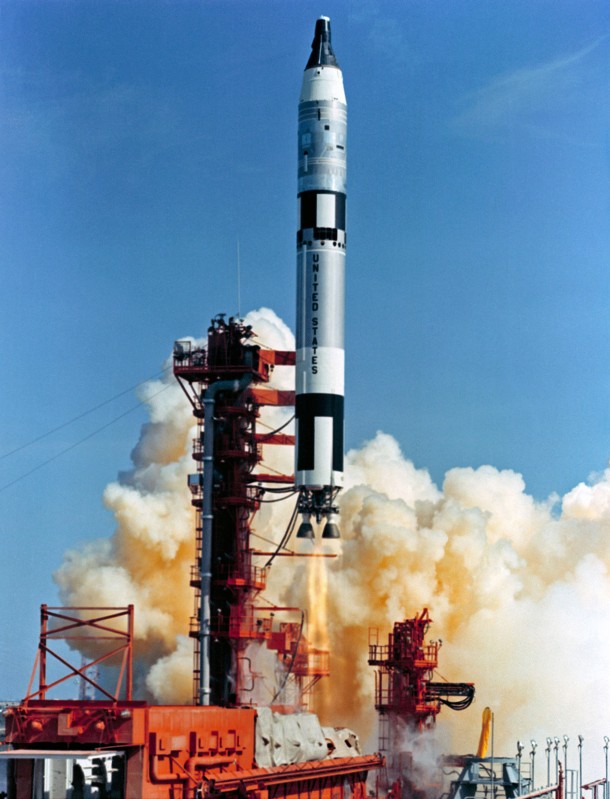
Fifty-two years ago this month, NASA astronauts Leroy Gordon “Gordo” Cooper and Charles M. “Pete” Conrad set a new spaceflight endurance record during the flight of Gemini 5. It was the third of ten (10) missions in the historic Gemini spaceflight series. The motto for the mission was “Eight Days or Bust”.
The purpose of Project Gemini was to develop and flight-prove a myriad of technologies required to get to the Moon. Those technologies included spacecraft power systems, rendezvous and docking, orbital maneuvering, long duration spaceflight and extravehicular activity.
The Gemini spacecraft weighed 8,500 pounds at lift-off and measured 18.6 feet in length. Gemini consisted of a reentry module (RM), an adapter module (AM) and an equipment module (EM).
The crew occupied the RM which also contained navigation, communication, telemetry, electrical and reentry reaction control systems. The AM contained maneuver thrusters and the deboost rocket system. The EM included the spacecraft orbit attitude control thrusters and the fuel cell system. Both the AM and EM were used in orbit only and discarded prior to entry.
Gemini-Titan V (GT-5) lifted-off at 13:59:59 UTC from LC-19 at Cape Canaveral, Florida on Saturday, 21 August 1965. The two-stage Titan II launch vehicle placed Gemini 5 into a 189 nautical mile x 87 nautical mile elliptical orbit.
A primary purpose of the Gemini 5 mission was to stay in orbit at least eight (8) days. This was the minimum time it would take to fly to the Moon, land and return to the Earth. Other goals of the Gemini 5 mission were to test the first fuel cells, deploy and rendezvous with a special rendezvous pod and conduct a variety of medical experiments.
Despite fuel cell problems, electrical system anomalies, reaction control system issues and the cancellation of various experiments, Gemini 5 was able to meet the goal of an 8-day flight. But it wasn’t easy. The last days of the mission were especially demanding since the crew didn’t have much to do. Pete Conrad called his Gemini 5 experience “8 days in a garbage can.”
On Sunday, 29 August 1965, Gemini 5 splashed-down in the Atlantic Ocean at 12:55:13 UTC. Mission elapsed time was 7 days, 22 hours, 55 minutes and 13 seconds. A new spaceflight endurance record.
Gemini 5 was Gordon Cooper’s last spaceflight. Cooper left NASA due to a deteriorating relationship with management. Pete Conrad flew three (3) more times in space. In particular, he commanded the Gemini 11, Apollo 12 and Skylab I missions. Indeed, Conrad’s Apollo 12 experience made him the third man to walk on surface of the Moon.
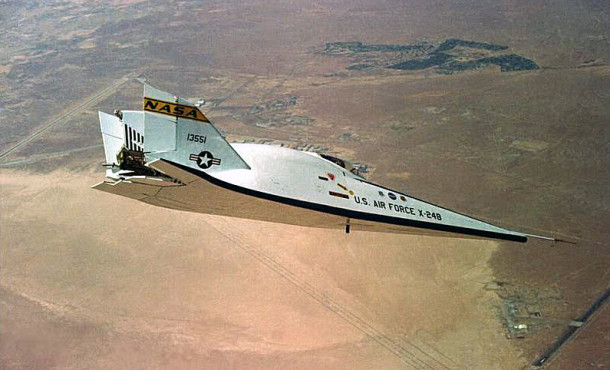
Forty-two years ago this week, the USAF/NASA/Martin X-24B became the first lifting body to make an unpowered precision landing on a concrete runway. The feat was pivotal to convincing NASA officials that landing the Space Shuttle Orbiter in an unpowered state was operationally feasible.
Early Space Shuttle Orbiter operational concepts featured the use of a pair of turbojets to provide a powered landing capability. These airbreathing engeines were to be internally stowed just below the Orbital Maneuvering System (OMS) pods. The turbojets would be deployed and started once the Orbiter had decelerated to high subsonic flight speeds.
While airbreathing propulsion would give the Orbiter a loiter and go-around capability, the drawbacks were significant. Jet fuel would have to be carried into and out of earth orbit. The weight of this fuel and the turbojets would severely penalize Orbiter payload capability. Further, the system would increase both the complexity of and cost to Shuttle operations.
As the Shuttle Program grappled with the development of a powered landing capability for the Orbiter, the NASA DFRC flight test community made what appeared to be a rather bold claim. The Orbiter could simply glide all the way to touchdown and land deadstick. After all, X-planes had been doing so safely and without incident since the late 1940’s.
A leading proponent of unpowered Shuttle landings was NASA DFRC test pilot John Manke. He was convinced that the Orbiter could routinely and safely conduct unpowered precision landings on a concrete runway. If true, the Orbiter could land anywhere a 15,000-foot concrete runway was located.
Manke proposed that the X-24B (S/N 66-13551) lifting body be employed to conduct unpowered precision landings on Runway 04/22 at Edwards Air Force Base. He and fellow test pilot USAF Lt. Col. Michael V. Love practiced low lift-to-drag precision landings using F-104 and T-38 aircraft in preparation for the demonstrations.
On Tuesday, 05 August 1975, John Manke successfully made the first-ever unpowered precision landing of an aircraft on a concrete runway. The X-24B main gear touched-down exactly at the aimpoint situated 5,000 feet down Runway 04/22. On Wednesday, 20 August 1975, Mike Love duplicated the feat.
Following the successful unpowered precision landings with the X-24B lifting body, John Manke was quoted as saying: “We now know that concrete runway landings are operationally feasible and that touchdown accuracies of ±500 feet can be expected.” NASA Space Shuttle Program management concurred and officially adopted the unpowered precision landing concept.
History records that thirty-one years of Orbiter flight operations confirmed the wisdom of that long-ago decision.
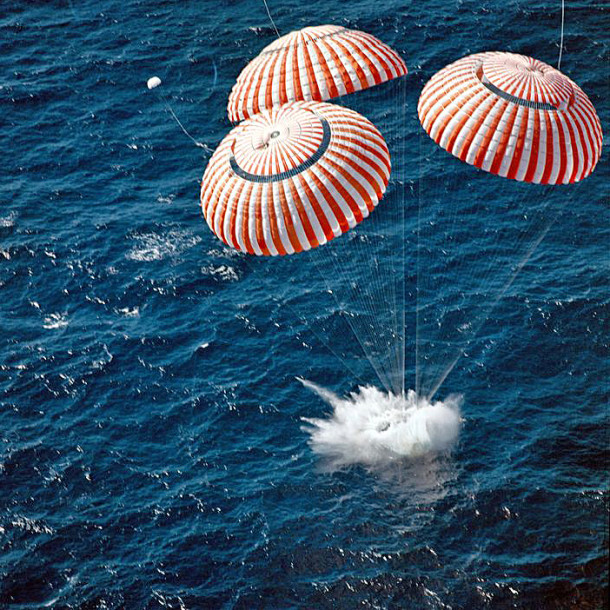
Forty-eight years ago today, Apollo 11 astronauts Neil A. Armstrong, Edwin E. Aldrin, Jr., and Michael Collins returned safely to Earth when they splashed-down in the Pacific Ocean at a point 812 nautical southwest of Hawaii. The epic journey to the Moon and back covered 952,700 nautical miles. Mission total elapsed time was 195 hours, 18 minutes, and 35 seconds.
Following splashdown, the Apollo 11 astronauts and their Command Module Columbia were brought aboard the USS Hornet (CV-12). Concerned that they would infect Earthlings with lunar pathogens, NASA quarantined the astronauts in the Mobile Quarantine Facility (MQF), which was a converted vacation trailer.
The Hornet steamed for Hawaii and transferred the MQF for airlift to Ellington Air Force Base, Texas. Following landing, the MQF and its heroic occupants were transported to the Johnson Spacecraft Center (MSC) in Houston, Texas. Once there, the astronauts and several medical staff were transferred from the MQF to more substantial accommodations known as the Lunar Receiving Laboratory (LRL).
Combined stay time in the MQF and LRL was 21 days. During their forced confinement, Armstrong, Aldrin, and Collins debriefed the Apollo 11 mission, rested, and mused about their unforgettable experiences at the Moon.
The Apollo 11 astronauts were released from the LRL on Thursday, 13 August 1969, having never contracted nor transmitted a lunar disease.
Parenthetically, Apollo 11 brought the first geologic samples from the Moon back to Earth. Roughly 48 pounds of lunar rock samples were collected. Two primary types of rocks, basalts and breccias, were found at the Sea of Tranquility landing site. Subsequent analyses indicated that these samples neither contained water nor provided evidence for living organisms at any time in the history of the Moon.
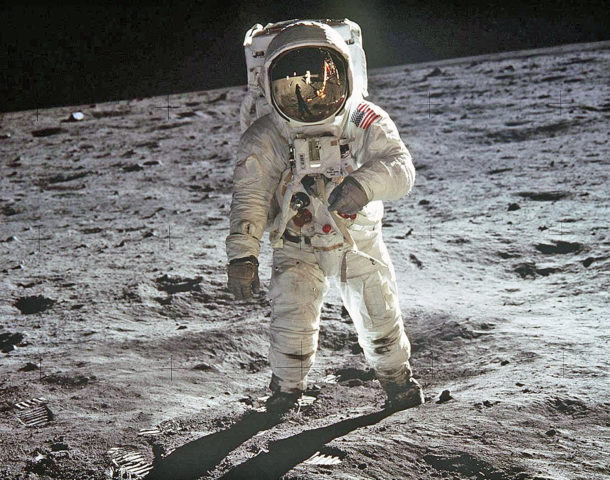
Forty-eight years ago today, the United States of America landed two men on the surface of the Moon. This feat marked the first time in history that men from the planet Earth set foot on another celestial body in the solar system.
The Apollo 11 Lunar Module Eagle landed in the Sea of Tranquility region of the Moon on Sunday, 20 July 1969 at 20:17:40 UTC. Less than seven hours later, Astronauts Neil A. Armstrong and Edwin E. Aldrin, Jr. became the first human beings to walk upon Earth’s closest neighbor. Fellow crew member Michael Collins orbited high overhead in the Command Module Columbia.
As Apollo 11 commander, Neil A. Armstrong was accorded the privilege of being the first man to step foot upon the Moon. As he did so, Armstrong spoke these words: “That’s one small step for Man; one giant leap for Mankind”. He had intended to say: “That’s one small step for ‘a’ man; one giant leap for Mankind”.
Armstrong and Aldrin explored their Sea of Tranquility landing site for about two and a half hours. Total lunar surface stay time was 22 hours and 37 minutes. The Apollo 11 crew left a plaque affixed to one of the legs of the Lunar Module’s descent stage which read: “Here Men From the Planet Earth First Set Foot Upon the Moon; July 1969, A.D. We Came in Peace for All Mankind”.
Following a successful lunar lift-off aboard the Eagle, Armstrong and Aldrin rejoined Collins in lunar orbit. Approximately seven hours later, the Apollo 11 crew rocketed out of lunar orbit to begin the quarter million mile journey back to Earth. Columbia splashed-down in the Pacific Ocean at 16:50:35 UTC on Thursday, 24 July 1969. Total mission time was 195 hours, 18 minutes, and 35 seconds.
With completion of the flight of Apollo 11, the United States of America fulfilled President John F. Kennedy’s 25 May 1961 call to land a man on the Moon and return him safely to the Earth before the decade of the 1960’s was out. It had taken 2,982 demanding days, a number of lives, and a great deal of national treasure to do so. “Mission Accomplished, Mr. President”.
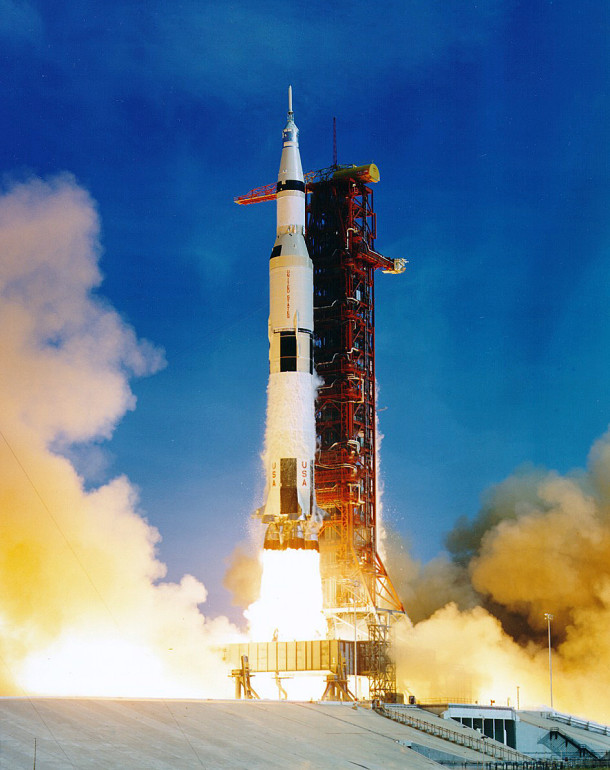
Forty-eight years ago this month, the epic flight of Apollo 11, the first mission to land men on the Moon, began with launch from the Kennedy Space Center (KSC) at Merritt Island, Florida. Nearly 1-million people gathered around America’s famous space complex to witness the historic event. An estimated 1-billion viewers worldwide watched the proceedings on television.
The names of the Apollo 11 crew are now legend: Mission Commander Neil A. Armstrong, Lunar Module Pilot Edwin E. Aldrin, Jr., and Command Module Pilot Michael Collins. Each astronaut was making his second spaceflight.
The overall Apollo 11 spacecraft weighed over 100,000 pounds and consisted of 3 major components: Command Module, Service Module, and Lunar Excursion Module (LEM). Out of American history came the names used to distinguish two of these components from one another. The Command Module was named Columbia, the feminine personification of America, while the Lunar Excursion Module received the appellation Eagle in honor of America’s national bird.
The Apollo-Saturn V launch stack measured 363-feet in length, had a maximum diameter of 33-feet, and weighed 6.7-milllion pounds at ignition of its five F-1 engines. The vehicle rose from the Earth on 7.7-million pounds of lift-off thrust.
The acoustic energy produced by the Saturn’s first stage propulsion system was unlike anything in common experience. The sound produced was like intense, continuous thunder even miles away from the launch point. Ground and structure shook disturbingly and a person’s lungs vibrated within their chest cavity.
Lift-off of Apollo 11 (AS-506) from KSC’s LC-39A occurred at 13:32 UTC on Wednesday, 16 July 1969. The target for the day’s launch, the Moon, was 218,096 miles distant from Earth. It took 12 seconds just for the massive Apollo 11 launch vehicle to clear the launch tower. However, a scant 12 minutes later, the Apollo 11 spacecraft was safely in low earth orbit (LEO) traveling at 17,500 miles per hour.
Following checkout in earth orbit, trans-lunar injection, and earth-to-moon coast, Apollo 11 entered lunar orbit nearly 76 hours after lift-off. Now, the big question: Would they make it? Even Apollo 11’s Command Module Pilot, Michael Collins, estimated that the chance of a successful lunar landing on the first attempt was only 50/50. The answer would soon come. History’s first lunar landing attempt was now only 24 hours away.
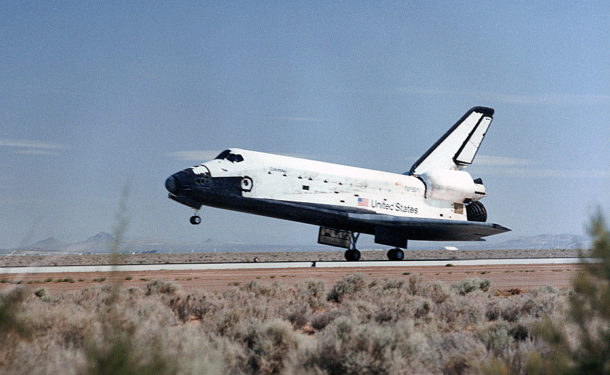
Thirty-five years ago today, the Space Shuttle Columbia landed at Edwards Air Force Base to successfully conclude the fourth orbital mission of the Space Transportation System. Columbia’s return to earth added a special and patriotic touch to the celebration of our nation’s 206th birthday.
STS-4 was NASA’s fourth Space Shuttle mission in the first fourteen months of Shuttle orbital flight operations. The two-man crew consisted of Commander Thomas K. Mattingly, Jr. and Pilot Henry W. Hartsfield who were both making their first Shuttle orbital mission. STS-4 marked the last time that a Shuttle would fly with a crew of just two.
STS-4 was launched from Cape Canaveral’s LC-39A on Sunday, 27 June 1982. Lift-off was exactly on-time at 15:00:00 UTC. This mission stands as the first occasion in which a Space Shuttle launch would occur precisely on-time. The Columbia orbiter weighed a hefty 241,664 lbs at launch.
Mattingly and Hartsfield spent a little over seven (7) days orbiting the Earth in Columbia. The orbiter’s cargo consisted of the first Getaway Special payloads and a classified US Air Force payload of two missile launch-detection systems. In addition, a Continuous Flow Electrophoresis System (CFES) and the Mono-Disperse Latex Reactor (MLR) were flown for a second time.
The Columbia crew conducted a lightning survey using manual cameras and several medical experiments. Mattingly and Hartsfield also maneuvered the Induced Environment Contamination Monitor (IECM) using the Orbiter’s Remote Manipulator System (RMS). The IECM was used to obtain information on gases and particles released by Columbia in flight.
On Sunday, 04 July 1982, retro-fire of the Orbital Maneuvering System (OMS) engines started Columbia on its way back to Earth. Touchdown occurred on Edwards Runway 22 at 16:09:31 UTC. This landing marked the first time that an Orbiter landed on a concrete runway. (All three previous missions had landed on Rogers Dry Lake at Edwards.) Columbia made 112 complete orbits and traveled 2,537,196 nautical miles during STS-4.
The Space Shuttle was optimistically declared “operational” with the successful conduct of the first four (4) shuttle missions. President Ronald Reagan and First Lady Nancy Reagan even greeted the returning STS-4 flight crew on the tarmac.
However, as space history has taught us, manned spaceflight still comes with a level of risk and danger that exceeds that of military and commercial aircraft operations. Despite its unparalled accomplishments and enduring legacy, the Space Shuttle was never operational in the true and desired sense.
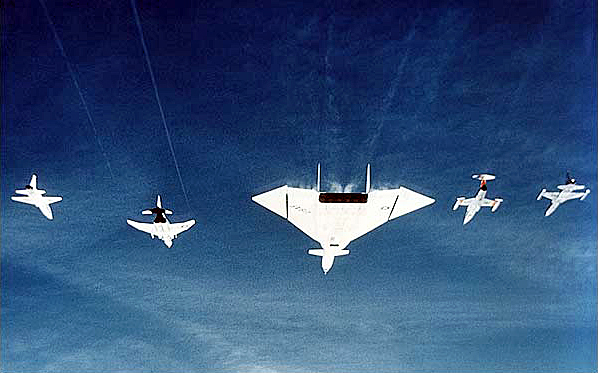
Fifty-one years ago this month, XB-70A Valkyrie Air Vehicle No. 2 (62-0207) and a NASA F-104N Starfighter (N813NA) were destroyed following a midair collision near Bartsow, CA. USAF Major Carl S. Cross and NASA Chief Test Pilot Joseph A. Walker perished in the tragedy.
On Wednesday, 08 June 1966, XB-70A Valkyrie Air Vehicle No. 2 took-off from Edwards Air Force Base, California for the final time. The crew for this flight included aircraft commander and North American test pilot Alvin S. White and right-seater USAF Major Carl S. Cross. White would be making flight No. 67 in the XB-70A while Cross was making his first. For both men, this would be their final flight in the majestic Valkyrie.
In the past several months, Air Vehicle No. 2 had set speed (Mach 3.08) and altitude (74,000 feet) records for the type. But on this fateful day, the mission was a simple one; some minor flight research test points and a photo shoot.
The General Electric Company, manufacturer of the massive XB-70A’s YJ93-GE-3 turbojets, had received permission from Edwards USAF officials to photograph the XB-70A in close formation with a quartet of other aircraft powered by GE engines. The resulting photos were intended to be used for publicity.
The formation, consisting of the XB-70A, a T-38A Talon (59-1601), an F-4B Phantom II (BuNo 150993), an F-104N Starfighter (N813NA), and an F-5A Freedom Fighter (59-4898), was in position at 25,000 feet by 0845. The photographers for this event, flying in a GE-powered Gates Learjet Citation (N175FS) stationed about 600 feet to the left and slightly aft of the formation, began taking photos.
The photo session was planned to last 30 minutes, but went 10 minutes longer to 0925. Then at 0926, just as the formation aircraft were starting to leave the scene, the frantic cry of Midair! Midair Midair! came over the communications network.
Somehow, the NASA F-104N, piloted by NASA Chief Test Pilot Joe Walker, had collided with the right wing-tip of the XB-70A. Walker’s out-of-control Starfighter then rolled inverted to the left and sheared-off the XB-70A’s twin vertical tails. The F-104N fuselage was severed just behind the cockpit and Walker died instantly in the terrifying process.
Curiously, the XB-70A continued on in steady, level flight for about 16 seconds despite the loss of its primary directional stability lifting surfaces. Then, as White attempted to control a roll transient, the XB-70A rapidly departed controlled flight.
As the doomed Valkyrie torturously pitched, yawed and rolled, its left wing structurally failed and fuel spewed furiously from its fuel tanks. White was somehow able to eject and survive. Cross never left the stricken aircraft and rode it down to impact just north of Barstow, California.
A mishap investigation followed and (as always) responsibility (blame) for the mishap was assigned and new procedures implemented. However, none of that changed the facts that on this, the Blackest Day at Edwards Air Force Base, American aviation lost two of its best men and aircraft in a flight mishap that was, in the final analysis, preventable.
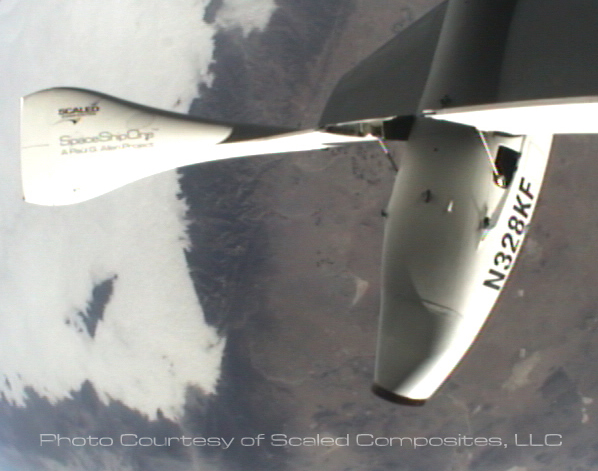
Thirteen years ago today, Scaled Composite’s SpaceShipOne flew to an altitude of 62.214 statute miles. The flight marked the first time that a privately-developed flight vehicle had flown above the 62-statute mile boundary that entitles the flight crew to FAI-certified astronaut wings. As a result, SpaceShipOne pilot Mike Melvill became history’s first private citizen astronaut.
SpaceShipOne Mission 15P began with departure from California’s Mojave Spaceport at 0647 PDT. Carrying SpaceShipOne at the centerline station, Scaled’s White Knight launch aircraft climbed to the drop altitude of 47,000 feet.
At 0750 PDT on Monday, 21 June 2004, the 7,900-pound SpaceShipOne fell away from the White Knight and Melvill immediately ignited the 16,650-pound thrust hybrid rocket motor. Melvill then quickly pulled SpaceShipOne into a steep vertical climb.
Passing through 60,000 feet, SpaceShipOne experienced a series of uncommanded rolls as it encountered a wind shear. Melvill struggled with the controls in an attempt to arrest the roll transient. Then, late in the boost, the vehicle lost primary pitch trim control. In response, Melvill switched to the back-up system as he continued the ascent.
Rocket motor burnout occurred at 180,000 feet with SpaceShipOne traveling at 2,150 mph. It now weighed only 2,600 pounds. The vehicle then coasted to an apogee of 62.214 statute miles (328,490 feet). The target maximum altitude was 68.182 statute miles (360,000 feet). However, the control problems encountered going upstairs caused the trajectory to veer somewhat from the vertical.
Melvill experienced approximately 3.5 minutes of zero-g flight going over the top. He had some fun during this period as he released a bunch of M&M’s and watched the chocolate candy pieces float in the SpaceShipOne cabin.
Back to business now, Melvill transitioned SpaceShipOne to the high-drag feathered configuration in preparation for the critical entry phase of the mission. The vehicle initially accelerated to over 2,100 mph in the airless void before encountering the sensible atmosphere. At one point during atmospheric entry, Melvill experienced in excess of 5 g’s deceleration.
At 57,000 feet, Melvill reconfigured SpaceShipOne to the standard aircraft configuration for powerless flight back to the Mojave Spaceport. Fortunately, the aircraft was a very good glider. The control problems encountered during the vehicle’s ascent resulted in atmospheric entry taking place some 22 statute miles south of the targeted reentry point.
SpaceShipOne touched-down on Mojave Runway 12/30 at 0814 PDT; thus ending an historic, if not harrowing mission.
After the flight, Mike Melvill had much to say. But perhaps the following quote says it best for the rest of us who can only imagine what it was like: “And it was really an awesome sight, I mean it was like nothing I’ve ever seen before. And it blew me away, it really did. … You really do feel like you can reach out and touch the face of God, believe me.”
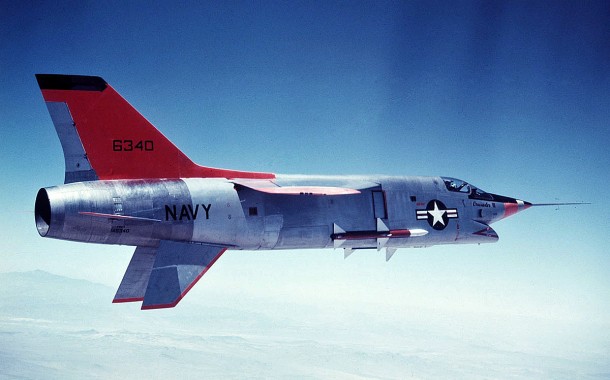
Fifty-nine years ago this month, the USN/Vought XF8U-3 Crusader III interceptor prototype took off on its maiden test flight at Edwards Air Force Base, California. Vought chief test pilot John W. Konrad was at the controls of the advanced high performance aircraft.
The Vought XF8U-3 was designed to intercept and defeat adversary aircraft. Although it bore a close external resemblance to its F8U-1 and F8U-2 forbears, the XF8U-3 was much more than just a block improvement in the Crusader line. It was considerably bigger, faster, and more capable than previous Crusaders and was in reality a new airplane.
The XF8U-3 measured 58.67 feet in length and had a wing span of an inch less than 40 feet. Gross Take-Off and empty weights tipped the scales at 38,770 lbs and 21,860 lbs, respectively. Power was provided by a single Pratt and Whitney J75-P-5A generating 29,500 lbs of sea level thrust in afterburner.
A distinctive feature of the XF8U-3 was a pair of ventrally-mounted vertical tails. These surfaces were installed to improve aircraft directional stability at high Mach number. Retracted for take-off and landing, the surfaces were deployed once the aircraft was in flight.
The No. 1 XF8U-3 (S/N 146340) first flew on Monday, 02 June 1958 at Edwards Air Force, California. Vought chief test pilot John W. Konrad did the first flight piloting honors. The aircraft flew well with no major discrepancies reported. Approach and landing back at Edwards were uneventful.
Subsequent flight testing verified that the XF8U-3 was indeed a hot airplane. The type reached a top speed of Mach 2.39 and could have flown faster had its canopy had been designed for higher temperatures. The flight test-determined absolute altitude of 65 KFT was exceeded by 25 KFT in a zoom climb.
Those who flew the XF8U-3 said that the aircraft was a real thrill to fly. The Crusader III displayed outstanding acceleration, maneuverability and high-speed flight stability. Control harmony in pitch, yaw, and roll was extremely good as well.
Despite its great promise, the XF8U-3 never proceeded to production. This was primarily the result of coming up short in a head-to-head competition with the McDonnell F4H-1 Phantom II during the second half of 1958. While the Crusader was faster and more maneuverable than the Phantom, the latter’s mission capability and payload capacity were better.
Most historical records indicate that a total of five (5) Crusader III airframes were built. The serial numbers assigned by the Navy were 146340, 146341, 147085, 147086, and 147087. None of these aircraft exist today.