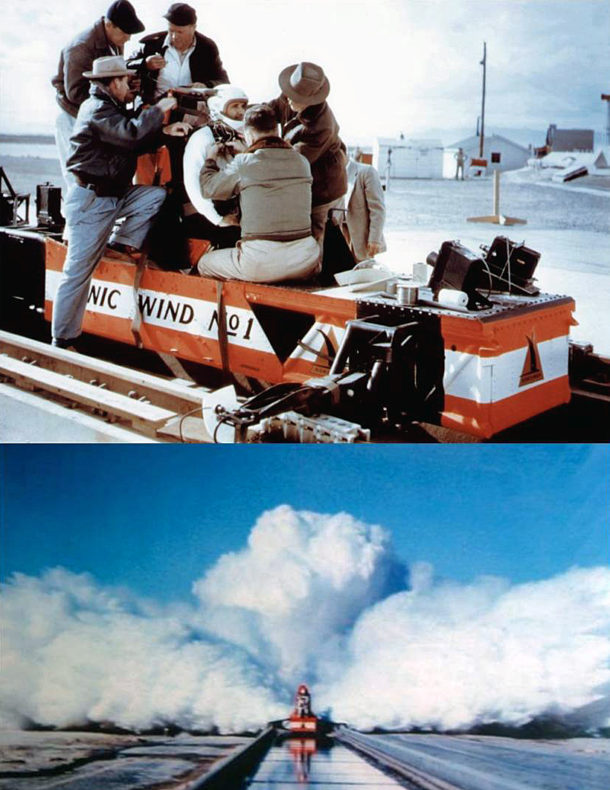
Sixty-two years ago this month, USAF Lieutenant Colonel John Paul Stapp set a record for human G-tolerance when his Sonic Wind #1 rocket-powered test sled decelerated from 632 mph to a full stop in roughly 1.4 seconds. In so doing, Stapp endured a deceleration load equal to 46.2 times the weight of his body.
The period immediately following World War II marked the beginning of a steady rise in the speed and altitude capabilities of military aircraft. These performance increases subjected aircrew to wider ranges of flight loads and physical stresses. Manifold aeromedical issues and crew safety concerns arose; particularly in the area of emergency escape from a stricken aircraft.
Abandoning an aircraft in flight under emergency conditions and surviving the experience has always been a sporty proposition. Ejection forces, wind blast, body limb flailing, parachute opening shock levels, and the like make it so. Add to this list the effects of atmospheric temperature, pressure and oxygen concentration, and one starts to get an appreciation for the severity of the situation.
John Paul Stapp was a USAF physician who had an abiding interest in the aeromedical aspects of emergency escape. He knew that too many pilots were dying in situations that could have been survivable if proper equipment and procedures were available. Stapp dedicated himself to improving the chances of aircrew survival.
Stapp was a pioneer in scientifically investigating the effects of acceleration and deceleration on the human body. In March of 1947, he began a series of deceleration tests using a 2,000-foot sled track at Edwards Air Force Base. A rocket-powered test sled named the Gee Whiz carried test subjects down the track and brought them to a sudden halt to produce specific deceleration levels.
Initially, Stapp’s test subjects were anthropomorphic dummies and primates. However, he had always held to the belief that the best test subject would be a human. Better yet, a human who possessed extensive medical knowledge. Stapp selected himself for the assignment.
Stapp took his first ride down the Edwards sled test track on Wednesday, 10 December 1947. By May of 1948, he had riden the Gee Whiz a total of 16 times. One run resulted in a deceleration of 35-G’s. This meant that Stapp briefly experienced a force equal to 35 times his normal body weight during deceleration. In so doing, he pointedly dispelled the prevailing notion that a human being could not survive a deceleration level beyond 18-G’s.
Riding the sled was a form of physical abuse. Among numerous injuries, Stapp received several concussions, broke the same wrist twice, cracked ribs, and sustained retinal hemorrhages for his time on the track. All in an effort to find ways to preserve the lives of aircrew. Stapp, other human volunteers and chimpanzees continued sled testing on the Edwards track until 1953.
Stapp transferred to the Aeromedical Field Lab at Holloman Air Force Base, New Mexico in early 1953. He now had a longer track (3,550 feet) and a faster sled (Sonic Wind #1) with which to expand his deceleration research. The system was checked-out using a new crash test dummy and then a live primate. Stapp made the first human run on the Holloman track.
John Paul Stapp completed his 29th and final experimental sled test run on Friday, 10 December 1954. Propelled by a set of 9 rocket motors producing 70,000 pounds of thrust, the Sonic Wind #1 hit a peak velocity of 632 mph (Mach 0.9 at the test site altitude). Stapp endured a maximum acceleration of 20 G’s and then an incredible peak deceleration of 46.2-G’s during 1.4 seconds of slow-down. At that moment, he weighed 6,800 pounds.
Stapp took a severe pounding during his record ride. There were the “usual” body bruises, lacerations and harness burns. However, the worse effects involved his eyes. Both hemorrhaged and were completely filled with blood. Stapp indicated that all he could see was a watery salmon-colored fluid. Happily, his vision would return to quasi-normal by the next day. Stapp sported a pair of world-class shiners as peculiar momentos of his extreme deceleration experience.
Characteristically, Stapp had plans to go faster and endure more G’s. Indeed, the proposed Sonic Wind #2 test sled would be capable of driving him in excess of 1,000 mph and decelerating at more than 80 G’s. Such was not to occur as USAF would not allow Stapp to risk all again as a sled test subject.
John Paul Stapp’s legendary work produced enormous dividends in helping develop equipment, techniques and procedures that have saved the lives of countless aircrew. But the benefits of his research have gone well beyond that. Today, automobile safety standards are based in large measure on Stapp’s pioneering deceleration work. His legacy continues in other ways as well. Indeed, the 54th Stapp Car Crash Conference was held in November of this year.
John Paul Stapp, USAF officer, physician, sled test subject, was a man of uncommon valor and a bonifide hero in the truest sense of that over-used word. He willingly risked his life numerous times so that others might live. A man can do no more than that for his friends. On Wednesday, 13 November 1999, this man among men passed away peacefully in his sleep at age 89.
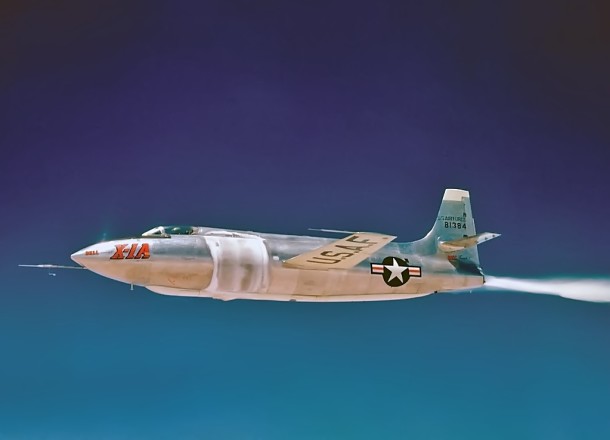
Sixty-three years ago today, USAF Major Charles E. Yeager set an unofficial world speed record of 1,650 mph (Mach 2.44) in the Bell X-1A flight research aircraft. In the process, the legendary test pilot very nearly lost his life when the aircraft departed controlled flight shortly after rocket motor burnout.
The USAF/Bell X-1A was a second generation X-aircraft intended to explore flight beyond Mach 2. It measured 35.5 feet in length and had a wing span of 28 feet. Gross take-off weight was 16,500 pounds.
Like its XS-1 forebear, the X-1A was powered by an XLR-11 rocket motor which produced a maximum sea level thrust of 6,000 lbs. The XLR-11 burned 9,200 pounds of propellants (alcohol and liquid oxygen) in roughly 270 seconds of operation.
Departing Edwards Air Force Base, California on Saturday, 12 December 1953, Yeager and the X-1A (S/N 48-1384) were carried to altitude by a USAF B-29 mothership (S/N 45-21800 ). X-1A drop occurred at 240 knots and 30,500 feet. Within ten seconds, Yeager lit off three of the XLR-11’s four rocket chambers and started to climb upstairs.
Yeager fired the 4th chamber of the XLR-11 passing through 43,000 feet and initiated a pushover at 62,000 feet. The maneuver was completed at 76,000 feet; higher than planned. In level flight now and traveling at Mach 1.9, the X-1A continued to accelerate in the thin air of the stratosphere.
Yeager quickly exceeded Scott Crossfield’s briefly-held Mach 2.005 record set on Friday, 20 November 1953. However, he now had to be very careful. Wind tunnel testing had revealed that the X-1A would be neutrally stable in the directional channel as it approached Mach 2.3.
As Yeager cut the throttle around Mach 2.44, the X-1A started an uncommanded roll to the left. Yeager quickly countered with aileron and rudder. The X-1A then rapidly rolled right. Full aileron and opposite rudder failed to control the roll. After 8 to 10 complete revolutions, the aircraft ceased rolling, but was now inverted.
In an instant, the X-1A started rolling left and then went divergent in all three axes. The aircraft tumbled and gyrated through the sky. Control inputs had no effect. Yeager was in serious trouble. He could not control his aircraft and punching-out was not an option. The X-1A had no ejection seat.
Chuck Yeager took a tremendous physical and emotional beating for more than 70 seconds as the X-1A wildly tumbled. Normal acceleration varied between plus-8 and negative 1.3 G’s. His helmet hit the canopy and cracked it. He struck the control column so hard that it was physically bent. His frantic air-to-ground communications were distinctly those of a man who was convinced that he was about to die.
As the X-1A tumbled, it decelerated and lost altitude. At 33,000 feet, a battered and groggy Yeager found himself in an inverted spin. The aircraft suddenly fell into a normal spin from which Yeager recovered at 25,000 feet over the Tehachapi Mountains situated northwest of Edwards. Somehow, Yeager managed to get himself and the X-1A back home intact.
The culprit in Yeager’s wide ride was the then little-known phenomenon identified as roll inertial coupling. That is, inertial moments produced by gyroscopic and centripetal accelerations overwhelmed aerodynamic control moments and thus caused the aircraft to depart controlled flight. Roll rate was the critical mechanism since it coupled pitch and yaw motion.
The X-1A held the distiction of being the fastest-flying of the early X-aircraft until the Bell X-2 reached 1,900 mph (Mach 2.87) in July of 1956. Yeager’s harrowing experience in December 1953 would be his last flight at the controls of a rocket-powered X-aircraft. For his record-setting X-1A mission, Chuck Yeager was awarded the 1953 Harmon Trophy.
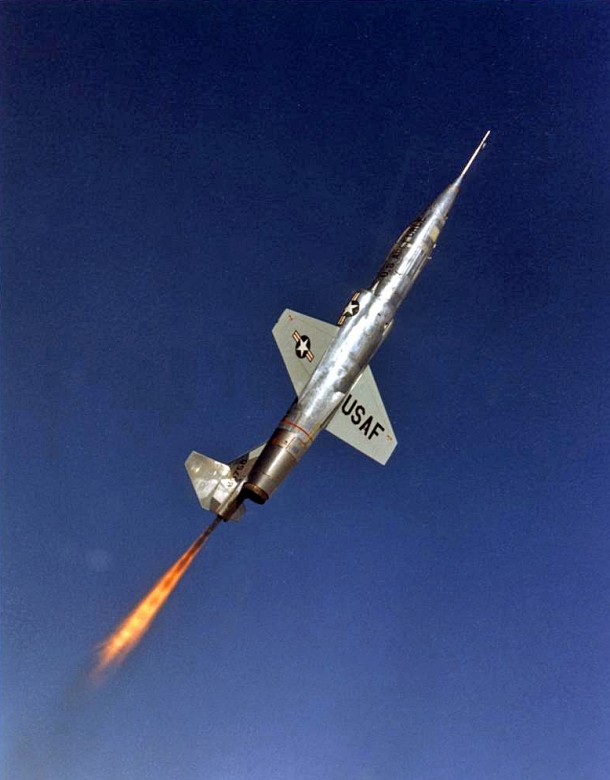
Fifty-three years ago today, USAF Major Robert W. Smith zoomed the rocket-powered Lockheed NF-104A to an unofficial world record altitude of 120,800 feet. This mark still stands as the highest altitude ever achieved by a United States aircraft from a runway take-off.
A zoom maneuver is one in which aircraft kinetic energy (speed) is traded for potential energy (altitude). In doing so, an aircraft can soar well beyond its maximum steady, level altitude (service ceiling). The zoom maneuver has both military and civilian flight operations value.
The USAF/Lockheed NF-104A was designed to provide spaceflight-like training experience for test pilots attending the Aerospace Research Pilot School (ARPS) at Edwards Air Force Base, California. The type was a modification of the basic F-104A Starfighter aircraft. Three copies of the NF-104A were produced (S/N’s 56-0756, 56-0760 and 56-0762). It was the ultimate zoom flight platform.
In addition to a stock General Electric J79-GE-3 turbojet, the NF-104A was powered by a Rocketdyne LR121-NA-1 rocket motor. The J79 generated 15,000 pounds of thrust in afterburner and burned JP-4. The LR-121 produced 6,000 pounds of thrust and burned a combination of JP-4 and 90% hydrogen peroxide. Rocket motor burn time was on the order of 90 seconds.
The NF-104A was kinematically capable of zooming to altitudes approaching 125,000 feet. As such, it was a combined aircraft and spacecraft. The pilot had to blend aerodynamic and reaction controls in the low dynamic pressure environment near the zoom apex. He was also required to fly in a full pressure suit for survival at altitudes beyond the Armstrong Line.
On Friday, 06 December 1963, Bob Smith took-off from Edwards and headed west for the Pacific Ocean. Out over the sea, he changed heading by 180 degrees in preparation for the zoom run-in. At a point roughly 100 miles out, Smith then accelerated the NF-104A (S/N 56-0760) along a line that would take him just north of the base. Arriving at Mach 2.4 and 37,000 feet, Smith then initiated a 3.75-g pull to a 70-degree aircraft pitch angle. Turbojet and rocket were at full throttle.
Things happened very quickly now. Smith brought the turbojet out of afterburner at 65,000 feet and then moved the throttle to the idle detent at 80,000 feet. The rocket motor burned-out around 90,000 feet. Smith controlled the aircraft (now spacecraft) over the top of the zoom using 3-axis reaction controls. The NF-104A’s arcing parabolic trajectory subjected him to 73 seconds of weightlessness. Peak altitude achieved was 120,800 feet above mean sea level.
On the back side of the zoom profile, Bob Smith restarted the windmilling J79 turbojet and set-up for landing at Edwards. He touched down on the main runway and rolled out uneventfully. Total mission time from brake-release to wheels-stop was approximately 25 minutes.
Much more could be said about the NF-104A and its unique mission. Suffice it to say here that two of the aircraft ultimately went on to serve in the ARPS from 1968 to 1971. The only remaining aircraft today is 56-0760 which sits on a pole in front of the USAF Test Pilot School (TPS) at Edwards.
Bob Smith went on to make many other noteworthy contributions to aviation and his nation. Having flown the F-86 Sabre in Korea, he volunteered to fly combat in Viet Nam in his 40th year. Stationed at Korat AFB in Thailand, he commanded the 34th Fighter Squadron of the 388th Tactical Fighter Wing. Smith flew 100 combat missions in the fabled F-105D Thunderchief; many of which involved the infamous Pack VI route in North Viet Nam.
Bob Smith was a true American hero. Like so many of the airmen of his day, Smith was a man whose dedication, service, and courage went largely unnoticed and unappreciated by his fellow countrymen. Bob Smith’s final flight came just 3 months shy of his 82nd birthday on Thursday, 19 August 2010.
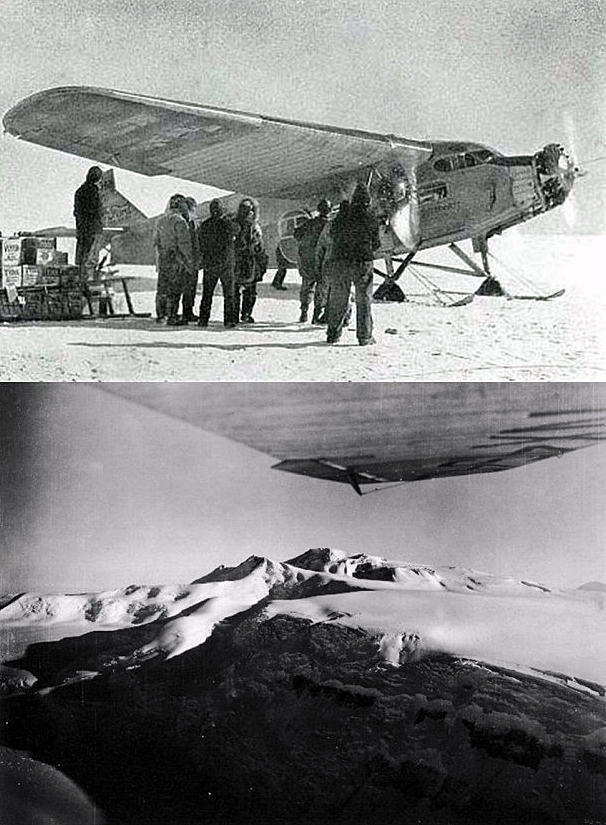
Eighty-seven years ago this week, a four-man crew became the first Antarctic explorers to fly over the Earth’s South Pole. The aircraft used to make the historic flight was a Ford Trimotor.
While substantial exploration of the Artic and Antarctic by land and sea had occurred far earlier, exploration of these regions by air was in its infancy during the decade of the 1920′s. Of particular focus was the goal to fly over both the North and South Poles.
The historic first flight to the South Pole originated from Little America, an exploration base camp situated on Antartica’s Ross Ice Shelf. Distance to the South Pole was about 800 miles as the crow flies.
A Ford Trimotor aircraft, the Floyd Bennett (S/N NX4542), was selected for the epic polar air journey. The crew consisted of pilot Bernt Balchen, co-pilot Harold June, navigator Richard E. Byrd, and radio operator Ashley McKinley.
The fabled Trimotor was well-suited for the rigors of polar flight. The all-metal aircraft measured 50-feet in length and had a wing span of 76-feet. Empty weight was roughly 6,500 pounds. Power was provided by a single 520-HP Wright Cylone and a pair of 200-HP Wright Whirlwind radial engines.
Following departure from Little America at 02:39 UTC, the Floyd Bennett headed for the South Pole. Navigation was via sun compass due to the proximity of the South Magnetic Pole.
Myriad glaciers, massifs, plateaus, and crevasses marked the stark, rugged landscape unfolding under the Floyd Bennett’s flight path. The most imposing of these geological features were the Queen Maud Mountains that towered more than 11,000 feet above sea level.
Pilot Balchen struggled to get his aircraft over the high mountain pass that runs between Mounts Fridtjof and Fisher. The crew jettisoned empty fuel cans and hundreds of pounds of precious food to lighten the load. The Floyd Bennett cleared the terrain by about 600 feet.
Just after 1200 UTC (local midnight) on Friday, 29 November 1929, the Floyd Bennett and her crew flew over the Earth’s South Pole. After briefly loitering around the Pole, the aircraft headed back to Little America at 1225 UTC.
According to plan, Balchen landed the airplane to take on 200 gallons of fuel that had been pre-positioned at the base of the Liv Glacier. The Floyd Bennett took-off again and landed back at Little America around 21:10 UTC. Total mission time was nearly 19 hours.
United States Navy Commander Richard E. Byrd now had flown over both poles. He would go on to successfully explore the Antarctic for many more years. For his part in the South Pole overflight, Byrd was promoted to the rank of Rear Admiral.
Today, the aircraft that made the first flight over the South Pole in November 1929 is displayed in the Heroes of the Sky exhibit at the Henry Ford Museum in Dearborn, Michigan.
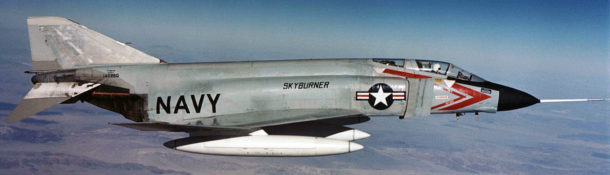
Fifty-five years ago this week, a United States Navy YF4H-1 Phantom II set a world absolute speed record of 1,606.342 mph. Piloting the aircraft for this record flight was United States Marine Corps Lieutenant Colonel Robert B. Robinson.
The McDonnell Douglas YF4H-1 Phantom II was first flown in May 1958. The aircraft measured 58 feet length with a wing span of 38 feet. Gross take-off weight was 44,000 pounds. A pair of General Electric J79-GE-8 turbojets produced a total of 34,000 pounds of thrust in afterburner.
The YF4H-1 was the first in a long line of Phantom II variants that would eventually see a production run of 5,195 aircraft. Second only to the nearly 10,000 production units of the multi-variant North American F-86 Sabre.
Since 1961 marked the 50th anniversary of Naval Aviation, the US Navy planned to celebrate by establishing a series of speed records. The aircraft of choice was their super-powered Phantom II. Operation SAGEBURNER was the low altitude speed program (i.e., 125 feet off the deck) while Operation SKYBURNER was the high altitude speed component.
On Wednesday, 22 November 1961, the second YF4H-1 (S/N 142260) took-off from Edwards Air Force Base, California in an attempt to surpass the existing world absolute speed record. A United States Air Force F-106 Delta Dart, piloted by Major Joseph W. Rogers, held the existing record of 1,525.96 mph which was set on Tuesday, 15 December 1959.
Robinson had to fly a precisely-timed and positioned flight profile to extract maximum performance from his YF4H-1. FAI rules required the aircraft to enter the Edwards speed course in level flight and to make two runs. The final speed mark would be the average of the two runs.
The Phantom II was a big airplane and had to carry a lot of fuel. In addition to a full internal fuel load, the aircraft carried a 600-gallon centerline tank and a pair of 370-gallon wing tanks. Following take-off to the east, climb-out was made to the south toward El Centro, California. Arriving in the area, Robinson made a sweeping left-hand turn over the Salton Sea and accelerated the aircraft north back towards Edwards.
As the aircraft gained speed, Robinson dropped the empty centerline fuel tank over the Chocolate Mountains gunnery range. Then, arriving over the Bristol Dry Lake range, he punched-off the empty wing tanks. The aircraft was now lighter and aerodynamically cleaner.
Robinson approached the Edwards speed course from the east in full afterburner. The Phantom II exited the 20-mile course quickly. Following his first pass, Robinson came out of afterburner, made a Mach 0.9 turn to the south, cruised 105 miles out and then made the turn back to Edwards for the second speed pass.
His aircraft lighter now and not having to concern himself with the logistics of dropping empty fuel tanks, Robinson was clocked at over 1,700 mph on his second time through the Edwards speed course. The two-run average was 1,606.342 mph; a new world absolute speed record.
The F-4 Phantom II would go on to a legendary combat career in both the United States Navy and United States Air Force. Among many distinctions, the McDonnel Douglas F-4 Phantom II is the only aircraft to have seen service with both the USAF Thunderbirds (1969-1973) and the US Navy Blue Angels (1969-1974) flight demonstration squadrons.
For setting the world absolute speed record in 1961, Operation SKYBURNER pilot Bob Robinson was presented with the Distinguished Flying Cross by the then-Secretary of the Navy, John B. Connally.
Twelve years ago today, the NASA X-43A scramjet-powered flight research vehicle reached a record speed of over 6,600 mph (Mach 9.68). In doing so, the X-43A eclipsed its own record speed of Mach 6.83 (4,600 mph) and became the fastest airbreathing aircraft of all time.
In 1996, NASA initiated a technology demonstration program known as HYPER-X. The central goal of the HYPER-X Program was to successfully demonstrate sustained supersonic combustion and thrust production of a flight-scale scramjet propulsion system at speeds up to Mach 10.
Also known as the HYPER-X Research Vehicle (HXRV), the X-43A aircraft was a scramjet test bed. The aircraft measured 12 feet in length, 5 feet in width, and weighed close to 3,000 pounds. The X-43A was boosted to scramjet take-over speeds with a modified Orbital Sciences Pegasus rocket booster.
The combined HXRV-Pegasus stack was referred to as the HYPER-X Launch Vehicle (HXLV). Measuring approximately 50 feet in length, the HXLV weighed slightly more than 41,000 pounds. The HXLV was air-launched from a B-52 mothership. Together, the entire assemblage constituted a 3-stage vehicle.
The third and final flight of the HYPER-X program took place on Tuesday, 16 November 2004. The flight originated from Edwards Air Force Base, California. Using Runway 04, NASA’s venerable B-52B (S/N 52-0008) started its take-off roll at approximately 21:08 UTC. The aircraft then headed for the Pacific Ocean launch point located just west of San Nicholas Island.
At 22:34:43 UTC, the HXLV fell away from the B-52B mothership. Following a 5 second free fall, rocket motor ignition occurred and the HXLV initiated a pull-up to start its climb and acceleration to the test window. It took the HXLV 75 seconds to reach a speed of slightly over Mach 10.
Following rocket motor burnout and a brief coast period, the HXRV (X-43A) successfully separated from the Pegasus booster at 109,440 feet and Mach 9.74. The HXRV scramjet was operative by Mach 9.68. Supersonic combustion and thrust production were successfully achieved. Total engine-on duration was approximately 11 seconds.
As the X-43A decelerated along its post-burn descent flight path, the aircraft performed a series of data gathering flight maneuvers. A vast quantity of high-quality aerodynamic and flight control system data were acquired for Mach numbers ranging from hypersonic to transonic. Finally, the X-43A impacted the Pacific Ocean at a point about 850 nautical miles due west of its launch location. Total flight time was approximately 15 minutes.
The HYPER-X Program was now history. Supersonic combustion and thrust production of an airframe-integrated scramjet had indeed been achieved for the first time in flight; a goal that dated back to before the X-15 Program. Along the way, the X-43A established a speed record for airbreathing aircraft and earned several Guinness World Records for its efforts.
As a footnote to the X-43A story, the HYPER-X Flight 3 mission would also be the last for NASA’s fabled B-52B mothership. The aircraft that launched many of the historic X-15, M2-F2, M2-F3, X- 24A, X-24B and HL-10 flight research missions, and all three HYPER-X flights, would take to the air no more. In tribute, B-52B (S/N 52-0008) now occupies a place of honor at a point near the North Gate of Edwards Air Force Base.
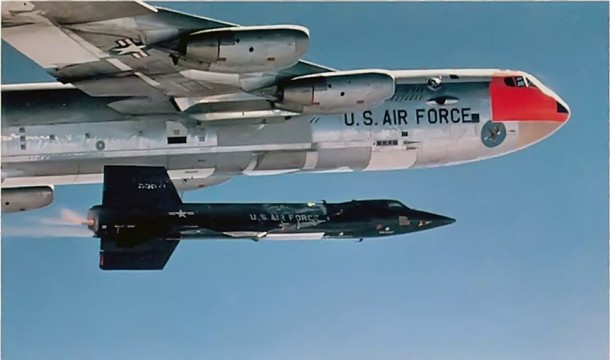
Fifty-five years ago today, the USAF/NASA/North American X-15 became the first manned aircraft to exceed Mach 6. United States Air Force test pilot Major Robert M. White was at the controls of the legendary hypersonic flight research aircraft.
The North American X-15 was the first manned hypersonic aircraft. It was designed, engineered, constructed and first flown in the 1950’s. As originally conceived, the X-15 was designed to reach 4,000 mph (Mach 6) and 250,000 feet. Before its flight test career was over, the type would meet and exceed both performance goals.
North American built a trio of X-15 airframes; Ship No. 1 (S/N 56-6670), Ship No. 2 (56-6671) and Ship No. 3 (56-6672). The X-15 measured 50 feet in length, had a wing span of 22 feet and a GTOW of 33,000 lbs. Ship No. 2 would later be modified to the X-15A-2 enhanced performance configuration. The X-15A-2 had a length of 52.5 feet and a GTOW of around 56,000 lbs.
The Reaction Motors XLR-99 rocket engine powered the X-15. The small, but mighty XLR-99 generated 57,000 pounds of sea level thrust at full-throttle. It weighed only 910 pounds. The XLR-99 used anhydrous ammonia and LOX as propellants. Burn time varied between 83 seconds for the stock X-15 and about 150 seconds for the X-15A-2.
The X-15 was carried to drop conditions (typically Mach 0.8 at 42,000 feet) by a B-52 mothership. A pair of aircraft were used for this purpose; a B-52A (S/N 52-003) and a B-52B (S/N 52-008). Once dropped from the mothership, the X-15 pilot lit the XLR-99 to accelerate the aircraft. The X-15A-2 also carried a pair of drop tanks which provided propellants for a longer burn time than was possible with the stock X-15 flight.
The X-15 employed both aerodynamic and reaction flight controls. The latter were required to maintain vehicle attitude in space-equivalent flight. The X-15 pilot wore a full-pressure suit in consequence of the aircraft’s extreme altitude capability. The typical X-15 drop-to-landing flight duration was on the order of 10 minutes. All X-15 landings were performed deadstick.
On Thursday, 09 November 1961, USAF Major Robert M. White would fly his 11th X-15 mission. The X-15 and White had already become respectively the first aircraft and pilot to hit Mach 4 and Mach 5. On this particular day, White would be at the controls of X-15 Ship No. 2. The planned maximum Mach number for the mission was Mach 6.
At 17:57:17 UTC of the aforementioned day, X-15 Ship No. 2 was launched from the B-52B mothership commanded by USAF Captain Jack Allavie. Bob White lit the XLR-99 and pulled into a steep climb. Mid-way through the climb, White pushed-over and ultimately leveled-off at 101,600 feet. XLR-99 burnout occurred 83 seconds after ignition. At this point, White was traveling at 4,093 mph or Mach 6.04.
On this record flight, the X-15 was exposed to the most severe aerodynamic heating environment it had experienced to date. Decelerating through Mach 2.7, the right window pane on the X-15’s canopy shattered due to thermal stress. The glass pane remained intact, but White could not see out of it. Fortunately, he could see out of the left pane and made a successful deadstick landing on Rogers Dry Lake at Edwards AFB.
For his Mach 6+ flight, Bob White was a recipient of both the 1961 Collier Trophy and the Iven C. Kincheloe Award. The year before, White had received the Harmon Trophy for his X-15 flight test work. He would go on to fly the X-15 to a still-standing FAI altitude record of 314,750 feet in July of 1962. For this accomplishment, White was awarded USAF Astronaut Wings.
Bob White flew the X-15 a total of sixteen (16) times. He was one (1) of only twelve (12) men to fly the aircraft. White left X-15 Program and Edwards AFB in 1963. He went on to serve his country in numerous capacities as a member of the Air Force including flying 70 combat missions in Viet Nam. He returned to Edwards AFB as AFFTC Commander in August of 1970.
Major General Robert M. White retired from the United States Air Force in 1981. During his period of military service, he received numerous decorations and awards including the Air Force Cross, Distinguished Service Medal, Silver Star with three oak leaf clusters, Legion of Merit, Distinguished Flying Cross with four oak leaf clusters, Bronze Star Medal, and Air Medal with 16 oak leaf clusters.
Bob White was a true American hero. He was one of those heroes who neither sought nor received much notoreity for his accomplishments. He served his country and the aviation profession well. Bob White’s final flight occurred on Wednesday, 17 March 2010. He was 85 years of age.
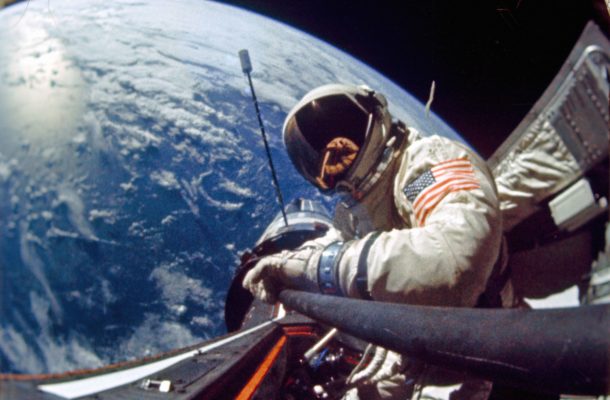
Fifty years ago this month, NASA’s pioneering spaceflight program, Project Gemini, was brought to a successful conclusion with the 4-day flight of Gemini XII. Remarkably, the mission was the tenth Gemini flight in 20 months.
Boosted to Earth orbit by a two-stage Titan II launch vehicle, Gemini XII Command Pilot James A. Lovell, Jr. and Pilot Edwin E. “Buzz” Aldrin, Jr. lifted-off from Cape Canaveral’s LC-19 at 20:46:33 UTC on Friday, 11 November 1966. The flight was Lovell’s second trip into space and Aldrin’s first.
Like almost every Gemini mission before it, Gemini XII was not a glitch-free spaceflight. For instance, when the spacecraft’s rendezvous radar began acting oddly, the crew had to resort to sextant and chart to complete the last 65 nautical miles of the rendezvous with their Agena Target Vehicle. But, overcoming this and other obstacles served to provide the experience and instill the confidence needed to meet the truly daunting challenge that lay ahead; landing on the Moon.
Unquestionably, Gemini XII’s single most important contribution to the United States manned space effort was validating the notion that a well-trained astronaut could indeed do useful work in an Extra-Vehicular Activity (EVA) environment. The exhausting and even dangerous EVA experiences of Gene Cernan on Gemini IX and Dick Gordon on Gemini XI brought into sharp focus the challenge of performing even seemingly simple work assignments outside the Gemini spacecraft.
Buzz Aldrin performed a trio of EVA’s on Gemini XII. Two of these involved standing in his seat with the hatch open. The third involved a tethered EVA or space walk. On the latter, Aldrin successfully moved about the exterior of the Gemini-Agena combination without exhausting himself. He also used a special-purpose torque wrench to perform a number of important work tasks. Central to Aldrin’s success was the use of foot restraints and auxiliary tethers to anchor his body while floating in a weightless state.
Where others had struggled and not been able to accomplish mission EVA goals, Buzz Aldrin came off conqueror. One of the chief reasons for his success was effective pre-flight training. A pivotal aspect of this training was to practice EVA tasks underwater as a unique means of simulating the effects of weightlessness. This approach was found to be so useful that it has been used ever since to train American EVA astronauts.
Lovell and Aldrin did many more things during their highly-compressed 4-day spaceflight in November of 1966. Multiple dockings with the Agena, Gemini spacecraft maneuvering, tethered stationkeeping exercises, fourteen scientific experiments, and photographing a total eclipse occupied their time aloft.
On Tuesday, 15 November 1966, on their 59th orbit, a tired, but triumphant Gemini XII crew returned to Earth. The associated reentry flight profile was automated; that is, totally controlled by computer. Yet another first and vital accomplishment for Project Gemini. Splashdown was in the West Atlantic at 19:21:04 UTC.
While Gemini would fly no more, both Lovell and Aldrin certainly would. In fact, both men would play prominent roles in several historic flights to the Moon. Jim Lovell flew on Apollo 8 in December 1968 and Apollo 13 in April 1970. And of course, Buzz Aldrin would walk on the Moon at Mare Tranquilitatis in July 1969 as the Lunar Module Pilot for Apollo 11.
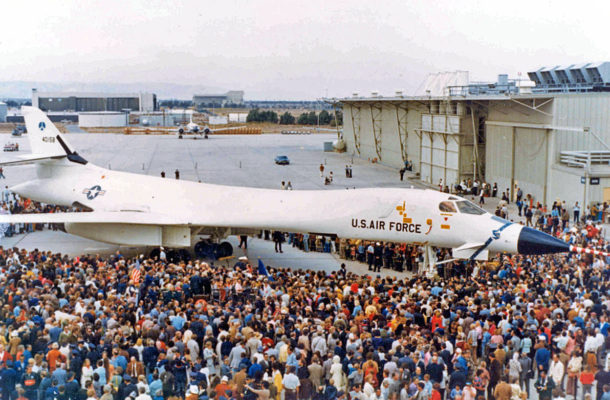
Forty-two years ago today, the official rollout of the first USAF/Rockwell B-1A multi-role strategic bomber took place at the contractor’s USAF Plant 42 facility in Palmdale, California. The swing-wing, supersonic aircraft was intended to replace the venerable USAF/Boeing B-52 Stratofortress.
The USAF/Rockwell B-1A Lancer was the product of 1960’s-era Air Force studies calling for a supersonic-capable, low-level penetration bomber. North American Rockwell was awarded a contract to manufacture and test four (4) prototype airframes (S/N’s 74-0158, 74-0159, 74-0160 and 76-0174) in 1970. General Electric was selected as the powerplant provider.
The B-1A was designed for both Mach 2.3 flight at 50,000 feet and Mach 0.85 flight at sea level. The aircraft was able to satisfy these requirements by virtue of several design features. Formost among these was the aircraft’s ability to adjust its wing sweep in flight. Coupled with its sleek, aerodynamically-efficient fuselage, this gave the aircraft very low wave drag. Another key element were the type’s quartet of General Electric F-101 turbofan engines which generated a total of 120,000 lbs of afterburner thrust at sea level. Thrust performance was optimized through the use of variable-geometry air intakes.
The B-1A measured 150.2 feet in length and featured a wing span that could be varied in flight from 136.7 feet (15-deg sweep) to 78.2 feet (67.5-deg sweep). Gross take-off and empty weights were 395,000 lbs and 115,000 lbs, respectively. Unrefueld range was 5,300 nm. The aircraft was designed to carry 75,000 lbs of nuclear and/or conventional ordnance internally and up to 40,000 lbs externally. Operationally, the B-1A’s four-man crew would consist of aircraft commander, pilot, offensive systems officer and defensive systems officer.
The No. 1 B-1A (S/N 74-0158) was rolled out for the public on Saturday, 26 October 1974. About 10,000 people attended this event which took place at Rockwell’s facility on USAF Plant 42 property in Palmdale, California. The big, white, sleek aircraft was visually stunning and bore a majestic presence. The media covered the event in some detail.
The No. 1 B-1A took-off for the first time from USAF Plant 42 on Monday, 23 December 1974. The flight test aircrew included Charles Bock, Jr. (aircraft commander), Col. Emil (Ted) Sturmthal (pilot) and Richard Abrams (flight test engineer). The aircraft’s landing gear was not retracted and wing sweep was not varied during this initial flight test. These systems were operated on the type’s second flight test which occurred on Thursday, 23 January 1975.
Each of the B-1A prototypes served a distinct role in the aircraft’s flight test program. The No. 1 aircraft (74-0158) was the flying qualities evaluation testbed. It flew 79 times (405.3 hours) and was the first B-1A to hit Mach 1.5 (Oct 1975) as well as Mach 2 (Apr 1976). Aircraft No. 2 (S/N 74-0159) evaluated structural loading parameters, flew 60 times (282.5 hours), and achieved the highest Mach number of any B-1A aircraft (Mach 2.22 on Oct 1978). Aircraft No. 3 (S/N 74-0160) amassed 138 flights (829.4 hours) as an offensive and defensive systems testbed. Aircraft No. 4 (76-0174) had a similar role in that it tested essentially operational versions of the offensive and defensive systems. It flew 70 times (378 hours).
The B-1A program was cancelled by the Carter Administration in June of 1977. While it never attained operational status, the aircraft broke new ground in mutiple areas including aircraft design, aerodynamics, flight performance, and electronic warfare. Indeed, the multiple technological capabilities that it pioneered were ultimately exploited in the type’s direct heir; today’s USAF B-1B Lancer.
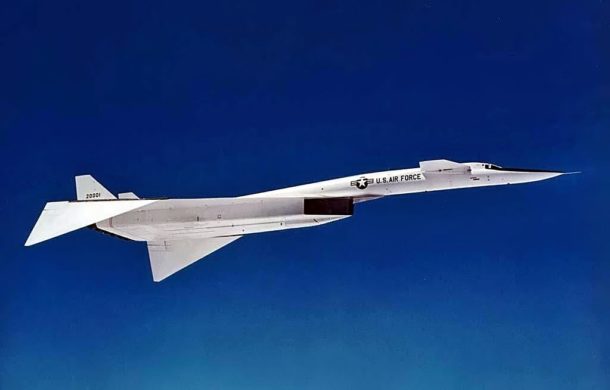
Fifty-one years ago this month, the USAF/North American XB-70A Valkyrie reached three times the speed of sound for the first time. The historic aviation achievement took place on the 18th anniversary of the breaking of the sound barrier by the USAF/Bell XS-1.
When it comes to legendary aircraft, aviation enthusiasts speak in almost reverent terms about the XB-70A Valkyrie. Indeed, few aircraft have evoked such utter awe or symbolized better the profound majesty of flight than the “The Great White Bird”. Though its flight history was brief, the XB-70A’s influence on aviation has proven to be of enduring worth.
The Valkyrie measured 185 feet in length, had a wingspan of 105 feet and an empty weight of 210,000 pounds. With a GTOW of 550,000 pounds, it was the heaviest supersonic-capable aircraft of all-time. The aircraft was powered by a six-pack of General Electric YJ93-GE-3 turbojets generating more than 172,000 pounds of thrust in afterburner.
To enhance lift-to-drag ratio and directional stability at high Mach number, the Valkyrie was configured with wing tips that could be deflected downward as much as 65 degrees. Each wing tip was the size of an USAF/Convair B-58A Hustler wing panel. To this day, the XB-70A deflectable wing tip is the largest control surface ever used on an aircraft.
The XB-70A was originally intended to be a supersonic strategic bomber. The aircraft’s mission was to penetrate Soviet airspace at Mach 3 and deliver nuclear ordnance from an altitude of 72,000 feet. However, the rapid ascendancy of Soviet surface-to-air missile capability would compromise the type’s military mission before it even flew.
As a consequence of the above, the Valkyrie ultimately became a high-speed flight research aircraft. Only two (2) copies were constructed and flown. Ship No. 1 (S/N 62-0001) made its maiden flight on Monday, 21 September 1964 while Ship No. 2 (62-0207) first took to the air on Saturday, 17 July 1965.
XB-70A Ship No. 1 became the first Valkyrie to hit Mach 3. It did so while flying at an altitude of 70,000 feet on Thursday, 14 October 1965. The flight crew consisted of North American Aviation test pilot Alvin S. White (aircraft commander) and USAF Colonel Joseph Cotton (co-pilot).
The XB-70A aircraft flew all of their flight research missions out of Edwards Air Force Base in California. Between September of 1964 and February of 1969, a total of 129 XB-70A research flights took places; 83 by Ship No. 1 and 46 by Ship No. 2. A total of nearly 253 flight hours was amassed by the aircraft.
The XB-70A Program made significant contributions to high-speed aircraft technology including aerodynamics, aerodynamic heating, flight controls, structures, materials, and air-breathing propulsion. Lessons-learned from its flight research have been applied to numerous aircraft developments including the B-1A, American SST, Concorde and the TU-144.
XB-70A Ship No. 1 survived the flight test program while Ship No. 2 did not. The latter was destroyed in a mid-air collision with a NASA F-104N on Wednesday, 08 June 1966. Today, XB-70A Ship No. 1 can be seen at the National Museum of the United States Air Force at Wright-Patterson Air Force Base in Dayton, Ohio.