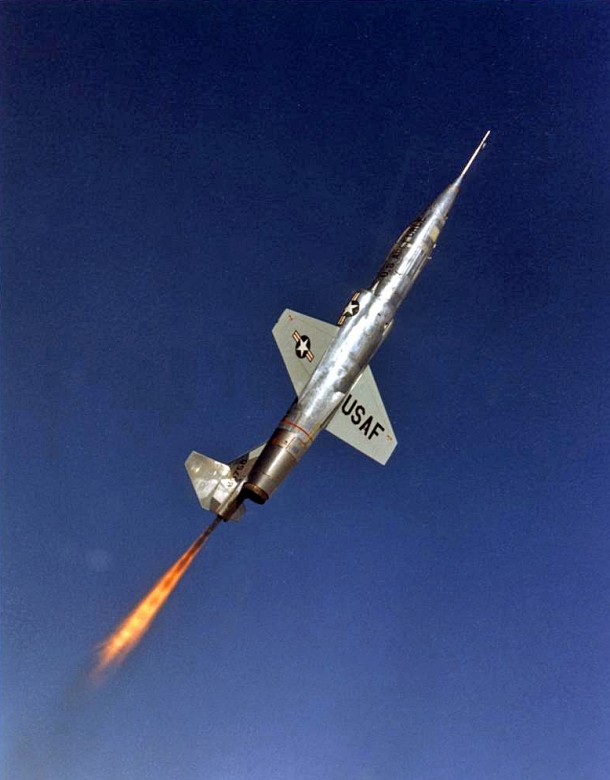
Fifty-eight years ago today, USAF Major Robert W. Smith zoomed the rocket-powered USAF/Lockheed NF-104A to an unofficial world record altitude of 120,800 feet. This mark still stands as the highest altitude ever achieved by a United States aircraft from a runway take-off.
A zoom maneuver is one in which aircraft kinetic energy (speed) is traded for potential energy (altitude). In doing so, an aircraft can soar well beyond its maximum steady, level altitude (service ceiling). The zoom maneuver has both military and civilian flight operations value.
The USAF/Lockheed NF-104A was designed to provide spaceflight-like training experience for test pilots attending the Aerospace Research Pilot School (ARPS) at Edwards Air Force Base, California. The type was a modification of the basic F-104A Starfighter aircraft. Three copies of the NF-104A were produced (S/N’s 56-0756, 56-0760 and 56-0762). It was the ultimate zoom flight platform.
In addition to a stock General Electric J79-GE-3 turbojet, the NF-104A was powered by a Rocketdyne LR121-NA-1 rocket motor. The J79 generated 15,000 pounds of thrust in afterburner and burned JP-4. The LR-121 produced 6,000 pounds of thrust and burned a combination of JP-4 and 90% hydrogen peroxide. Rocket motor burn time was on the order of 90 seconds.
The NF-104A was kinematically capable of zooming to altitudes approaching 125,000 feet. As such, it was a combined aircraft, rocket, and spacecraft. The pilot had to blend aerodynamic and reaction controls in the low dynamic pressure environment near the zoom apex. He was also required to fly in a full pressure suit for survival at altitudes beyond the Armstrong Line.
On Friday, 06 December 1963, Bob Smith took-off from Edwards and headed west for the Pacific Ocean. Out over the sea, he changed heading by 180 degrees in preparation for the zoom run-in. At a point roughly 100 miles out, Smith then accelerated the NF-104A (S/N 56-0760) along a line that would take him just north of the base. Arriving at Mach 2.4 and 37,000 feet, Smith then initiated a 3.75-g pull to a 70-degree aircraft pitch angle. Turbojet and rocket were at full throttle.
Things happened very quickly at this point. Smith brought the J79 turbojet out of afterburner at 65,000 feet and then moved the throttle to the idle detent at 80,000 feet. The rocket motor burned-out around 90,000 feet. Smith controlled the aircraft (now spacecraft) over the top of the zoom using 3-axis reaction controls. The NF-104A’s arcing parabolic trajectory subjected him to 73 seconds of weightlessness. Peak altitude achieved was 120,800 feet above mean sea level.
On the back side of the zoom profile, Bob Smith restarted the windmilling J79 turbojet and set-up for landing at Edwards. He touched down on the main runway and rolled out uneventfully. Total mission time from brake-release to wheels-stop was approximately 25 minutes.
Much more could be said about the NF-104A and its unique mission. Suffice it to say here that two of the aircraft ultimately went on to serve in the ARPS from 1968 to 1971. The only remaining aircraft today is 56-0760 which sits on a pole in front of the USAF Test Pilot School (TPS) at Edwards.
Bob Smith went on to make many other noteworthy contributions to aviation and his nation. Having flown the F-86 Sabre in Korea, he volunteered to fly combat in Viet Nam in his 40th year. Stationed at Korat AFB in Thailand, he commanded the 34th Fighter Squadron of the 388th Tactical Fighter Wing. Smith flew 100 combat missions in the fabled F-105D Thunderchief; many of which involved the infamous Pack VI route in North Viet Nam.
Bob Smith was a true American hero. Like so many of the airmen of his day, Smith was a man whose dedication, service, and courage went largely unnoticed and underappreciated by his fellow countrymen. Bob Smith’s final flight came just 3 months shy of his 82nd birthday on Thursday, 19 August 2010.
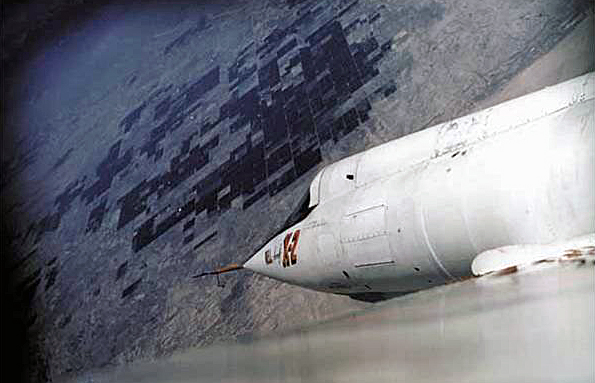
Sixty-five years ago today, the rocket-powered USAF/Bell X-2 aircraft established a new altitude record when the vehicle soared to 126,200 feet above sea level. This historic accomplishment took place on the penultimate mission of the type’s troubled 20-flight aeronautical research program.
The X-2 was the successor to Bell’s X-1A rocket-powered aircraft which had recorded maximum speed and altitude marks of 1,650 mph (Mach 2.44) and 90,440 feet, respectively. The X-2 was designed to fly beyond Mach 3 and above 100,000 feet. The X-2’s primary mission was to investigate aircraft flight control and aerodynamic heating in the triple-sonic flight regime.
The X-2 had a gross take-off weight of 24,910 lbs and was powered by a Curtis-Wright XLR-25 rocket motor which generated 15,000-lbs of thrust. Aircraft empty weight was 12,375 lbs. Like the majority of X-aircraft, the X-2 was air-launched from a mothership. In the X-2’s case, an USAF EB-50D served as the drop aircraft. The X-2 was released from the launch aircraft at 225 mph and 30,000 feet.
The day was Friday, 07 September 1956. The pilot for the X-2 maximum altitude mission was USAF Captain Iven Carl Kincheloe, Jr. Kincheloe was a Korean War veteran and highly accomplished test pilot. He wore a partial pressure suit for survival at extreme altitude.
While the dynamic pressure at the apex of his trajectory was only 19 psf, Kincheloe successfully piloted the X-2 with aerodynamic controls only. The X-2 was not configured with reaction controls. Mach number over the top of the trajectory was supersonic (approximately Mach 1.7).
Kincheloe’s maximum altitude flight in the X-2 (S/N 46-674) would remain the highest altitude achieved by a manned aircraft until August of 1960 when the fabled X-15 would fly just beyond 136,000 feet. However, for his achievement on that late summer day in 1956, the popular press would refer to Iven Kincheloe as the “First of the Space Men”.
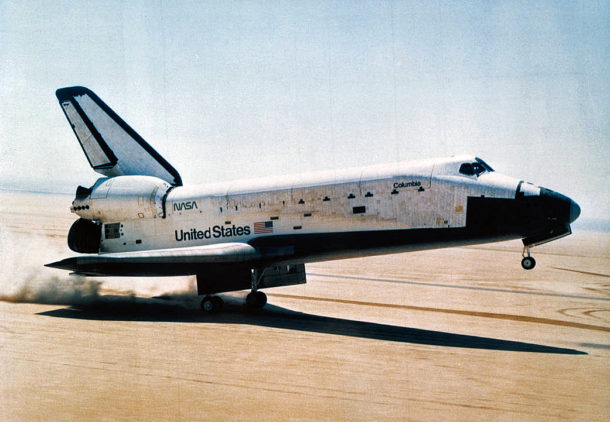
Forty years ago today, the Space Shuttle Columbia successfully returned from its first earth-orbital mission. An estimated 225,000 people witnessed the historic landing on Rogers Dry Lake at Edwards Air Force Base, California.
Known officially as the Space Transportation System (STS), the Space Shuttle was unlike any manned space vehicle ever flown. A giant aircraft known as the Orbiter was side-mounted on a huge liquid-propellant stage called the External Tank (ET). Flanking opposing sides of the ET was a pair of Solid Rocket Boosters (SRB). The Orbiter, SRB’s and ET measured 122 feet, 149 feet and 154 feet in length, respectively.
The Space Shuttle system was conceived with an emphasis on reusability. Each Orbiter (Columbia, Challenger, Atlantis, Discovery, and Endeavor) was designed to fly 100 missions. Each SRB was intended for multiple mission use as well. The only single-use element was the ET since it was more cost effective to use a new one for each flight than to recover and refurbish a reusable version.
NASA called STS-1 the boldest test flight in history. Indeed, the STS-1 mission marked the first time that astronauts would fly a space vehicle on its inaugural flight! STS-1 was also the first time that a manned booster system incorporated solid rocket propulsion. Unlike liquid propellant rocket systems, once ignited, the Shuttle’s solid rockets burned until fuel exhaustion.
And then there was the Orbiter element which had its own new and flight-unproven propulsion systems. Namely, the Space Shuttle Main Engines (SSME) and Orbital Maneuvering System (OMS). Each of the three (3) SSME’s generated 375,000 pounds of thrust at sea level. Thrust would increase to 475,000 pounds in vacuum. Each OMS rocket engine produced 6,000 pounds of thrust in vacuum.
The Orbiter was also configured with a reusable thermal protection system (TPS) which consisted of silica tiles and reinforced carbon-carbon material. The TPS for all previous manned space vehicles utilized single-use ablators. Would the new TPS work? How robust would it be in flight? What post-flight care would be needed? Answers would come only through flight.
To add to the stress of first flight, the Orbiter was a winged vehicle and would therefore perform a hypersonic lifting entry. The vehicle energy state would have to be managed perfectly over the 5,000 mile reentry flight path from entry interface to runway touchdown. Since the Orbiter flew an unpowered entry, it would land dead-stick. There would only be one chance to land.
On Sunday,12 April 1981, the Space Shuttle Columbia lifted-off from Pad 39A at Cape Canaveral, Florida. Official launch time was 12:00:03 UTC. The flight crew consisted of Commander John W. Young and Pilot Robert L. Crippen. Their Columbia launch stack tipped the scales at 4.5 million pounds and thundered away from the pad on over 7 million pounds of thrust.
Columbia went through maximum dynamic pressure (606 psf) at Mach 1.06 and 26.5 KFT. SRB separation occurred 120 seconds into flight at Mach 3.88 and 174,000 feet; 10,000 feet higher than predicted. This lofting of the ascent trajectory was later attributed to unmodeled plume-induced aerodynamic effects in the Orbiter and ET base region.
Following separation, Columbia rode the ET to burnout at Mach 21 and 389.7 KFT. Following ET separation, Columbia’s OMS engines were fired minutes later to achieve a velocity of 17,500 mph and a 166-nautical mile orbit.
Young and Crippen orbited the Earth 37 times before coming home on Tuesday, 14 April 1981. In doing so, they successfully flew the first hypersonic lifting reentry from earth orbit. Though unaware of it at the time, the crew came very close to catastrophe as the Orbiter’s body flap had to be deflected 8 degrees more than predicted to maintain hypersonic pitch control.
The reason for this “hypersonic anomaly” was that ground test and aero modeling had failed to capture the effects of high temperature gas dynamics on Orbiter pitch aerodynamics. Specifically, the vehicle was more stable in hypersonic flight than had been predicted. This necessitated greater nose-down body flap deflections to trim the vehicle in pitch. It was a close-call. But Columbia and her crew lived to fly another day.
Columbia and her crew touched-down at 220 mph on Runway 23 at Edwards Air Force Base, California at 18:20:57 UTC. Young and Crippen were euphoric with the against-the-odds success of the Space Shuttle’s first mission.
NASA too reveled in the Shuttle’s marvelous accomplishment. And so did America. This was the country’s first manned space mission since 1975. At the time, this was the longest period of manned spaceflight inactivity ever in our nation’s history.
Fittingly, a well-known national news magazine celebrated Columbia’s success with a headline which read: “America is Back!”
And while Columbia flies no more, we remember with fondness that first Orbiter, her first flight, and her many subsequent accomplishments. To which we say: Hail Columbia!
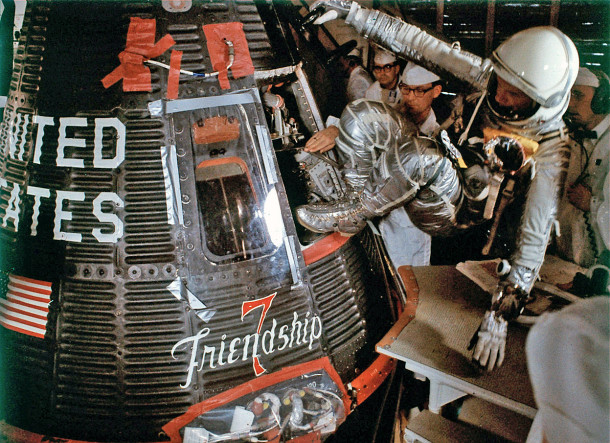
Fifty-nine years ago today, Project Mercury Astronaut John Herschel Glenn, Jr. became the first American to orbit the Earth. Glenn’s spacecraft name and mission call sign was Friendship 7.
Mercury-Atlas 6 (MA-6) lifted-off from Cape Canaveral’s Launch Complex 14 at 14:47:39 UTC on Tuesday, 20 February 1962. It was the first time that the Atlas LV-3B booster was used for a manned spaceflight.
Three-hundred and twenty seconds after lift-off, Friendship 7 achieved an elliptical orbit measuring 143 nautical miles (apogee) by 86 nautical miles (perigee). Orbital inclination and period were 32.5 degrees and 88.5 minutes, respectively.
The most compelling moments in the United States’ first manned orbital mission centered around a sensor indication that Glenn’s heat shield and landing bag had become loose at the beginning of his second orbit. If true, Glenn would be incinerated during entry.
Concern for Glenn’s welfare persisted for the remainder of the flight and a decision was made to retain his retro package following completion of the retro-fire sequence. It was hoped that the 3 flimsy straps holding the retro package would also hold the heat shield in place.
During Glenn’s return to the atmosphere, both the spent retro package and its restraining straps melted in the searing heat of re-entry. Glenn saw chunks of flaming debris passing by his spacecraft window. At one point he radioed, “That’s a real fireball outside”.
Happily, the spacecraft’s heat shield held during entry and the landing bag deployed nominally. There had never really been a problem. The sensor indication was found to be false.
Friendship 7 splashed-down in the Atlantic Ocean at a point 432 nautical miles east of Cape Canaveral at 19:43:02 UTC. John Glenn had orbited the Earth 3 times during a mission which lasted 4 hours, 55 minutes and 23 seconds. In short order, spacecraft and astronaut were successfully recovered aboard the USS Noa.
John Glenn became a national hero in the aftermath of his 3-orbit mission aboard Friendship 7. It seemed that just about every newspaper page in the days following his flight carried some sort of story about his historic feat. Indeed, it is difficult for those not around back in 1962 to fully comprehend the immensity of Glenn’s flight in terms of what it meant to the United States.
John Herschel Glenn, Jr. passed away on 08 December 2016 at the age of 95. His trusty Friendship 7 spacecraft is currently on display at the Smithsonian National Air and Space Museum in Washington, DC.
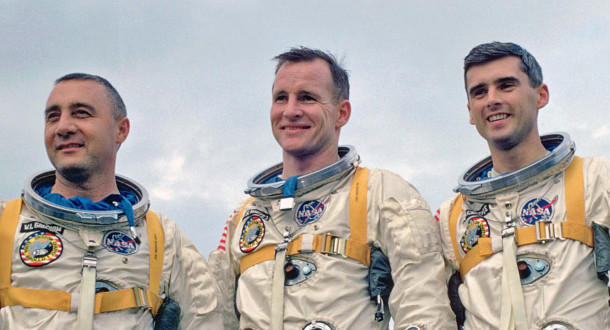
Fifty-four years ago this month the Apollo 204 prime crew perished as fire swept through their Apollo Block I Command Module (CM). The Apollo 204 crew of Command Pilot Vigil I. “Gus” Grissom, Senior Pilot Edward H. White II and Pilot Roger B. Chaffee had been scheduled to make the first manned flight of the Apollo Program some three weeks hence.
On Friday, 27 January 1967, during a plugs-out ground test on LC-34 at Cape Canaveral, Florida, a fire broke out in the Apollo 204 spacecraft at 23:31:04 UTC (6:31:04 pm EST). Shortly after, a chilling cry was heard across the communications network from Astronaut Chaffee: “We’ve got a fire in the cockpit”.
Believed to have started just below Grissom’s seat, the fire quickly erupted into an inferno that claimed the men’s lives in less than 30 seconds. While each received extensive 3rd degree burns, death was attributed to toxic smoke inhalation.
The Apollo 204 fire was most likely brought about by some minor malfunction or failure in equipment or wire insulation. This failure, which was never positively identified, initiated a sequence of events that culminated in the conflagration.
The post-mishap investigation uncovered numerous defects in CM Block I design, manufacturing, and workmanship. The use of a (1) pure oxygen atmosphere pressurized to 16.7 psia and (2) complex 3-component hatch design (that took a minimum of 90 seconds to open) sealed the astronauts’ fate.
A haunting irony of the tragedy is that America lost her first astronaut crew, not in the sideral heavens, but in a spacecraft that was firmly rooted to the ground.