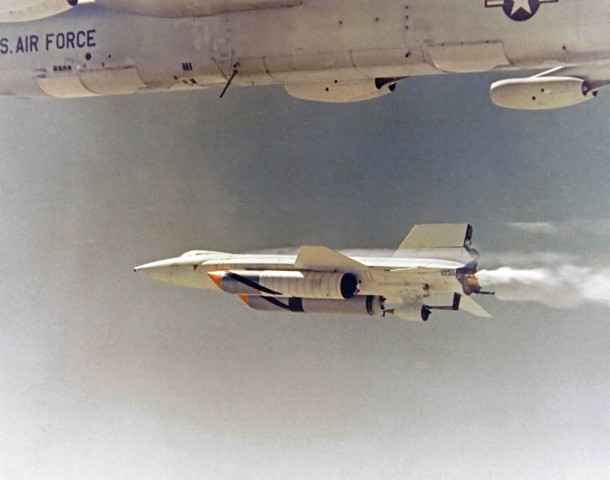
Forty-eight years ago this month, USAF Major William J. “Pete” Knight piloted the fabled USAF/North American X-15A-2 hypersonic research aircraft to a record speed of 4,520 mph – about a mile and a quarter per second.
North American’s original X-15 production run consisted of three (3) aircraft. The X-15A-2 was a rebuild of the 2nd airframe (S/N 56-6671) which had been severely damaged during an emergency landing at Mud Lake, Nevada in November of 1962.
The rebuilt aircraft was configured with a pair of droppable propellant tanks that allowed the type’s XLR-99 rocket engine to operate 60 seconds beyond the stock X-15’s 80-second burn time. Among other modifications, the aircraft also carried a pylon-mounted dummy ramjet in the ventral region of the aft fuselage.
With the addition of the external propellant tanks, the X-15A-2 was really a three-stage vehicle. The first stage was the NASA NB-52B mothership which launched the X-15 at Mach 0.82 and 45,000 feet. The second stage consisted of the propellant-laden external tanks which were jettisoned at Mach 2.0 and 70,000 feet. The third stage was the X-15A-2 with its entire internal propellant load.
Due to the increased speed of the X-15A-2, the aircraft was covered with Martin MA-25S ablator to protect it from the higher aerodynamic heating loads. The baseline ablator was pink in color and gave the X-15A-2 a rather odd appearance. Fortunately, application of a white wear/sealer over the ablator gave the aircraft a more dignified look.
On Tuesday, 03 October 1967, Pete Knight and the X-15A-2 dropped away from the NB-52B (S/N 52-008) at the start of the X-15 Program’s 188th mission. Knight ignited the XLR-99 rocket engine and excuted a pull-up followed by a pushover to level flight at a little over 102,000 feet. Aircraft speed at XLR-99 burnout was 4,520 mph (Mach 6.7).
As the aircraft decelerated following burnout, Knight executed a series of pre-planned flight maneuvers to acquire vital aerodynamics data. However, passing through Mach 5.5, he received an indication in the cockpit that a high temperature condition existed in the XLR-99 engine bay.
Knight attempted to jettison the aircraft’s remaining propellants, but to no avail. The jettison tubes were welded shut by whatever was happening in the engine bay. This meant he would land heavier and faster than usual. Fortunately, Knight’s piloting skills allowed him to get the X-15A-2 on to Rogers Dry Lake in one piece.
As flight support personnel inspected the X-15A-2 airframe following Knight’s emergency landing, they were alarmed at what they found. The aft ventral region of the aircraft had incurred significant thermal damage. Further, the dummy ramjet was gone.
As reported in the classic NASA document, TM-X-1669, higher-than-expected aerodynamic heating levels were responsible for the damage to the X-15A-2.
First, shock wave/boundary layer interaction heating on the lower fuselage just ahead of the pylon (1) completely destroyed the ablator in that region and (2) penetrated the Inconel-X airframe structure. This introduced very high temperature air into the X-15 engine bay.
Second, impingement of the dummy ramjet nose shock on the detached bow shock coming off of the pylon produced a shear layer that focused on the pylon leading edge. The resulting heating rates were of sufficient magnitude and duration to both burn away the pylon ablator and burn through the pylon structure. The weakened pylon structural attachment eventually failed and the dummy ramjet departed the main airframe.
Pete Knight will forever hold the record for the fastest X-15 flight. However, the X-15A-2 never flew again. Only 11 more flights remained in the X-15 Program at the time. A lack of time and funding meant that little was to be gained by repairing the thermally-damaged aircraft.
As for the final disposition of the X-15A-2 (S/N 56-6671), the aircraft’s remaining ablator was removed with its external surface cleaned-up and original markings restored. The aircraft now resides in a place of honor at the National Museum of the United States Air Force located at Wright-Patterson AFB in Dayton, Ohio.
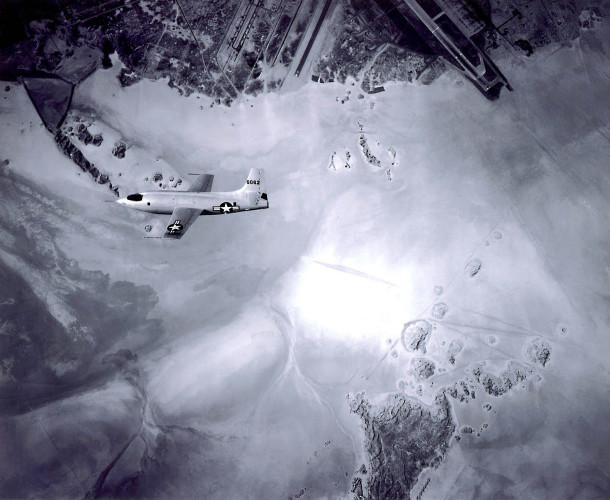
Sixty-eight years ago this week, the legendary USAF/Bell XS-1 experimental aircraft exceeded the speed of sound when it reached a maximum speed of 700 mph (Mach 1.06) at 45,000 feet.
Bell Aircraft Corporation of Buffalo, New York built three copies of the XS-1 under contract to the United States Army Air Forces (USAAF). The aircraft were designed to approach and then fly beyond the speed of sound.
The Bell XS-1 was 31-feet in length and had a wing span of 28 feet. Gross take-off weight was around 12,500 lbs. The aircraft had an empty weight of about 7,000 lbs. Propulsion was provided by a Reaction Motors XLR-11 rocket motor capable of generating a maximum thrust of 6,000 lbs.
On the morning of Tuesday, 14 October 1947, the XS-1 (S/N 46-062) dropped away from its B-29 mothership (S/N 45-21800 ) as the pair flew at 220 mph and 20,000 feet. In the XS-1 cockpit was USAAF Captain and World War II ace Charles E. Yeager. The young test pilot had named the aircraft Glamorous Glennis in honor of his wife.
Following drop, Yeager sequentially-lit all four XLR-11 rocket chambers during a climb and push-over that ultimately brought him to level flight around 45,000 feet. The resulting acceleration profile propelled the XS-1 slightly beyond Mach 1 for about 20 seconds. Yeager then shutdown the rocket, decelerated to subsonic speeds, and landed the XS-1 on Muroc Dry Lake at Muroc Army Airfield, California.
The world would not find out about the daring exploits of 14 October 1947 until December of the same year. As it was, the announcement came from a trade magazine that even today is sometimes referred to as “Aviation Leak”.
Today, Glamorous Glennis is prominently displayed in the Milestones of Flight hall of the National Air and Space Museum located in Washington, DC. For his intrepid piloting efforts in breaking the sound barrier, Chuck Yeager was a co-recipient of the 1948 Collier Trophy.
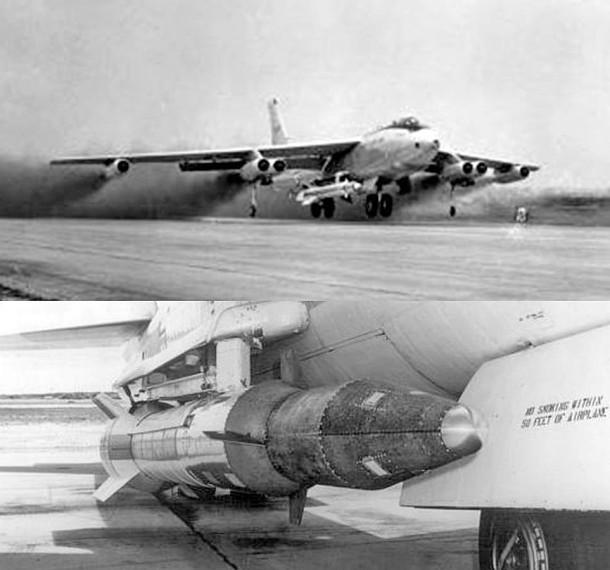
Fifty-six years ago this month, the USAF Bold Orion air-launched ballistic missile performed a successful intercept of the Explorer VI satellite. This event marked the first time in history that a endoatmospherically-launched missile intercepted a target vehicle in space.
Bold Orion was a 1950’s-era air-launched ballistic missile (ALBM) prototype developed by Martin Aircraft for the United States Air Force (USAF). It was part of USAF’s Weapons System 199 (WS-199) research and development program. The goal of WS-199 was to develop technology to be used in emerging strategic weapons systems by the Strategic Air Command (SAC).
The Bold Orion was developed using components obtained from existing missile systems as a cost savings measure. The missile was initially configured as a single stage vehicle. Power was provided by a Thiokol TX-20 Sergeant solid rocket motor. However, preliminary flight tests showed that the vehicle lacked sufficient kinematic performance. The addition of an ABL X-248 Altair solid rocket motor made Bold Orion a two-stage vehicle.
The two-stage Bold Orion configuration was 37 feet in length and had a maximum diameter of 31 inches. The vehicle was air-launched from a USAF/Boeing B-47 Stratojet aircraft. Missile launch occurred while the carrier aircraft executed a zoom climb maneuver. The option was available to fly either a maximum range endoatmospheric mission (about 1,000 nm) or achieve exoatmospheric altitudes as high as 150 nm.
The Bold Orion flight test program consisted of a dozen missions. The first six of these were single-stage vehicles which were flown between May and November of 1958. The remaining rounds were two-stage configurations which were tested between December of 1958 and October of 1959. All missions were air-launched off the coast of Florida and flown down the Eastern Test Range.
Bold Orion’s grandest moment came on the occasion of its final flight. The goal was to test the vehicle’s ability to perform in the anti-satellite (ASAT) role. The Explorer VI satellite served as the mission target. A direct hit was not required since a tactical interceptor would be configured with a nuclear warhead. Detonation of the nuclear device within several miles of the target would be sufficient to destroy it.
Bold Orion’s ASAT mission occurred on Tuesday, 13 October 1959. Launch took place within the Atlantic Missile Range Drop Zone (AMR DZ). The altitude, latitude and longitude of the drop point were 35,000 feet, 29 deg North and 79 deg West, respectively. Bold Orion successfully intercepted the Explorer VI satellite, passing its target at a range of less than 3.5 nm and an altitude of 136 nm.
The Bold Orion ASAT test marked the first interception of a satellite in space and verified the feasibility of an ASAT system. However, negative political ramifications came along with technical success. Specifically, the Eisenhower Administration intended to keep space neutral. Bold Orion’s overtones of hostile intent did not play well with that mandate. As a result, ASAT development within the United States was halted not long after Bold Orion’s final mission.
Bold Orion’s success gave USAF the flight experience and technology to develop the Skybolt ALBM. Known as GAM-87, this two-stage missile sported a W59 thermonuclear warhead with a yield of 1.2 megatons. A quartet of pylon-mounted Skybolt missiles would be carried by and air-launched from a USAF/Boeing B-52H Stratofortress. While Skybolt’s kinematic performance was impressive, test problems and the development of the Submarine-Launched Ballistic Missile (SLBM) ultimately led to its cancellation.
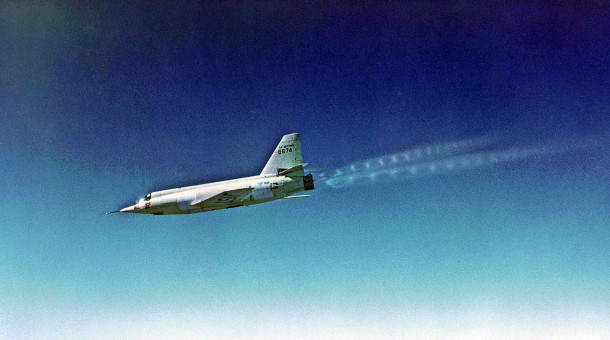
Fifty-nine years ago yesterday, the No. 1 USAF/Bell X-2 rocket-powered flight research aircraft reached a record speed of 2,094 mph with USAF Captain Milburn G. “Mel” Apt at the controls. However, victory quickly turned to tragedy when the aircraft departed controlled flight, crashed to destruction, and Apt perished.
Mel Apt’s historic achievement came about because of the Air Force’s desire to have the X-2 reach Mach 3 before turning it over to the National Advisory Committee For Aeronautics (NACA) for further flight research testing. Just 20 days prior to Apt’s flight in the X-2, USAF Captain Iven C. Kincheloe, Jr. had flown the aircraft to a record altitude of 126,200 feet.
On Thursday, 27 September 1956, Apt and the X-2 (Ship No. 1, S/N 46-674) dropped away from the USAF B-50 motherhip at 30,000 feet and 225 mph. Despite the fact that Mel Apt had never flown an X-aircraft, he executed the flight profile exactly as briefed. In addition, the X-2′s twin-chamber XLR-25 rocket motor burned propellant 12.5 seconds longer than planned. Both of these factors contributed to the aircraft attaining a speed in excess of 2,000 mph.
Apt and his aerial steed hit a peak Mach number of 3.2 at an altitude of 65,000 feet. Based on previous flight tests as well as flight simulator sessions, Apt knew that the X-2 had to slow to roughly Mach 2.4 before turning the aircraft back to Edwards. This was due to degraded directional stability, control reversal, and aerodynamic coupling issues that adversely affected the X-2 at higher Mach numbers.
However, Mel Apt was now faced with a difficult decision. If he waited for the X-2 to slow to Mach 2.4 before initiating a turn back to Edwards Air Force Base, he quite likely would not have enough energy and therefore range to reach Rogers Dry Lake. On the other hand, if he decided to initiate the turn back to Edwards at high Mach number, he risked having the X-2 depart controlled flight. Flying in a coffin corner of the X-2’s flight envelope, Apt opted for the latter.
As Apt increased the aircraft’s angle-of-attack, the X-2 departed controlled flight and subjected him to a brutal pounding. Aircraft lateral acceleration varied between +6 and -6 g’s. The battered pilot ultimately found himself in a subsonic, inverted spin at 40,000 feet. At this point, Apt effected pyrotechnic separation of the X-2′s forebody which contained the cockpit and a drogue parachute.
X-2 forebody separation was clean and the drogue parachute deployed properly. However, Apt still needed to bail out of the X-2′s forebody and deploy his personal parachute to complete the emergency egress process. However, it was not to be. Mel Apt ran out of time, altitude, and luck. The young pilot lost his life when the X-2 forebody from which he was trying to escape impacted the ground at a speed of one hundred and twenty miles an hour.
Mel Apt’s flight to Mach 3.2 established a record that stood until the X-15 exceeded it in August 1960. However, the price for doing so was very high. The USAF lost a brave test pilot and the lone remaining X-2 on that fateful day in September 1956. The mishap also ended the USAF X-2 Program. NACA never did conduct flight research with the X-2.
However, for a few terrifying moments, Mel Apt was the fastest man alive.
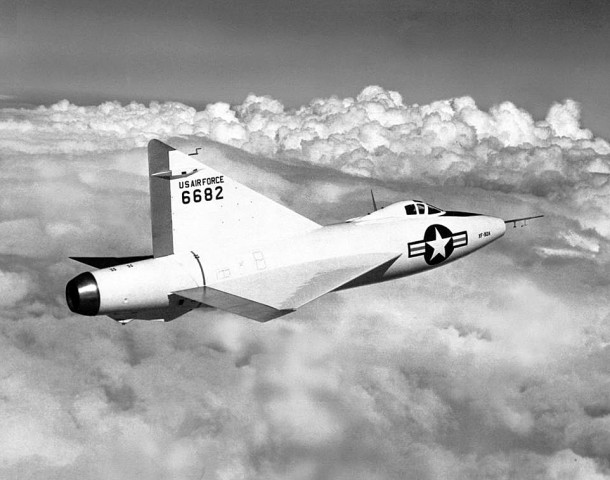
Sixty-seven years ago this month, the USAF/Convair XF-92A Dart made its first official flight from Muroc Army Airfield in California. Convair test pilot Ellis D. “Sam” Shannon was at the controls of the experimental delta-winged aircraft.
The XF-92A Dart holds the distinction of being the first delta-winged, turbojet-powered aircraft in the United States. It was designed and produced by the Consolidated Vultee Aircraft (Convair) Company for the United States Army Air Force. Only one copy of the type (S/N 46-682) was ever built and tested.
At the time, the delta wing planform was something of a novelty. Convair designers chose this shape principally due to its aerodynamics benefits. For example, transonic wave drag is significantly lower than that of a swept wing of equal area. The delta wing also exhibits favorable lift-curve slope, center-of-pressure travel and ground effect characteristics.
The large chord of a delta-winged aircraft allows for static pitch stability to be realized without the use of a classic horizontal tail. Pitch control is provided via wing trailing edge-mounted elevons. These surfaces, when differentially-deflected, also provide roll control.
The XF-92A measured 42.5 feet in length and had a wing span of 31.33 feet. Empty and gross weight were 9,978 lbs and 14,608 lbs, respectively. Early in its development, the XF-92A was powered by an Allison J33-A-21 turbojet which generated a maximum thrust of only 4,250 lbs. The final version of the aircraft was configured with an Allison J33-A-16 turbojet which produced a maximum sea level thrust of 8,400 lbs.
The XF-92A made its maiden flight on Saturday, 18 September 1948 from Muroc Army Airfield, California. Convair test pilot Ellis D. “Sam” Shannon did the piloting honors. Although the aircraft handled well, it was a bit over-responsive to control inputs. In addition, the XF-92A was underpowered.
Convair completed the last of 47 Phase I test flights on Friday, 26 August 1949. The Air Force conducted the first Phase II flight test on Thursday, 13 October 1949 with none other than Major Charles E. “Chuck” Yeager at the controls. Phase II testing of the aircraft was completed on Wednesday, 28 December 1949 by USAF Major Frank K. “Pete” Everest.
Following Phase II testing, the aircraft was re-engined with an Allison J33-A-29 turbojet capable of generating 7,500 lbs of sea level thrust. The Air Force continued to fly the XF-92A on various and infrequent test missions into February of 1953. Pilots of historical note who flew the aircraft include Al Boyd, Kit Murray, Jack Ridley, Joe Wolfe and Fred Ascani. It appears that the Air Force flew a total of 47 flight tests using the XF-92A.
The lone XF-92A was turned over to the National Advisory Committe For Aeronautics (NACA) once the Air Force was done testing it. The aircraft was promptly configured with an Allison J33-A-16 turbojet that generated 8,400 lbs of sea level thrust. NACA test pilot A. Scott Crossfield flew the XF-92A a total of 25 times. The type’s last flight occurred on Wednesday, 14 October 1953.
The XF-92A was not all that great from a piloting standpoint. Among other things, the aircraft had a severe pitch-up problem which produced normal accelerations between 6 and 8 g’s. The XF-92A was also plagued with landing gear failure problems. As noted previously, the aircraft was underpowered; a situation that was not uncommon for jet-powered aircraft of the era.
Inspite of its flaws, the design and flight experience gained from the XF-92A’s development led to an extensive series of delta-winged highly-successful aircraft produced by Convair in the 1950’s. These historically-significant aircraft include the F-102 Delta Dagger, F-106 Delta Dart, B-58 Hustler, XF2Y Sea Dart and XFY Pogo.
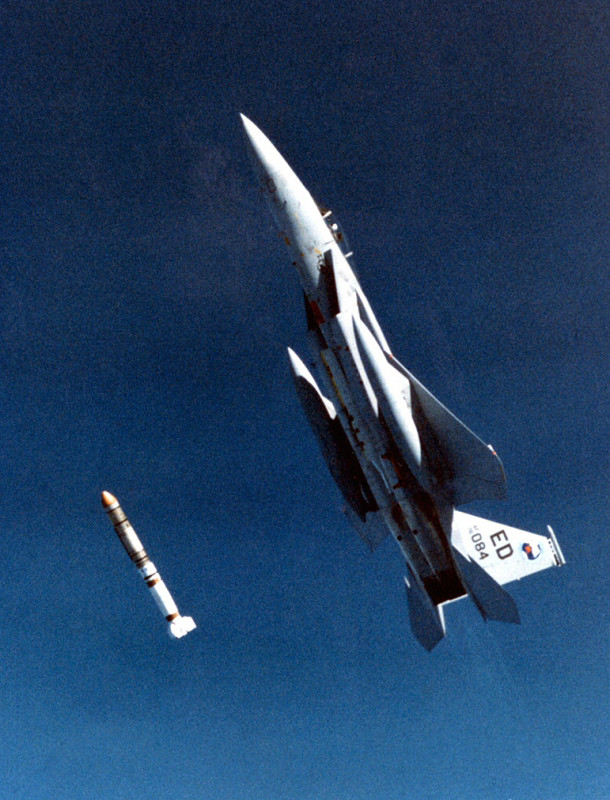
Thirty years ago yesterday, the USAF/LTV ASM-135 anti-satellite missile successfully intercepted a target satellite orbiting 300 nautical miles above surface of the Earth. The historic test was the first and only time that an aircraft-launched missile successfully engaged and destroyed an orbiting spacecraft.
The United States began testing anti-satellite missiles in the late 1950′s. These and subsequent vehicles used nuclear warheads to destroy orbiting satellites. A serious disadvantage of this approach was that a nuclear detonation intended to destroy an adversary satellite will likely damage nearby friendly satellites as well.
By the mid 1970′s, the favored anti-satellite (ASAT) approach had changed from nuclear detonation to kinetic kill. This latter approach required the interceptor to directly hit the target. The 15,000-mph closing velocity provided enough kinetic energy to totally destroy the target. Thus, no warhead was required.
The decision to proceed with development and deployment of an American kinetic kill weapon was made by President Jimmy Carter in 1978. Carter’s decision came in the aftermath of the Soviet Union’s successful demonstration of an orbital anti-satellite system.
LTV Aerospace was awarded a contract in 1979 to develop the Air-Launched Miniature Vehicle (ALMV) for the USAF. The resulting anti-satellite missile (ASM) system was designated the ASM-135. The two-stage missile was to be air-launched by a USAF F-15A Eagle executing a zoom climb. In essence, the aircraft acted as the first stage of what was effectively a 3-stage vehicle.
The ASM-135 was 18-feet in length and 20-inches diameter. The 2,600-lb vehicle was launched from the centerline station of the host aircraft. The ASM consisted of a Boeing SRAM first stage and an LTV Altair 3 second stage. The vehicle’s payload was a 30-lb kinetic kill weapon known as the Miniature Homing Vehicle (MHV).
The ASM-135 was first tested in flight on Saturday, 21 January 1984. While successful, the missile did not carry a MHV. On Tuesday, 13 November 1984, a second ASM-135 test took place. Unfortunately, the missile failed when the MHV that it was carrying was aimed at a star that served as a virtual target. Engineers went to work to make the needed fixes.
In August of 1985, a decision was made by President Ronald Reagan to launch the next ASM-135 missile against an orbiting US satellite. The Solwind P78-1 satellite would serve as the target. Congress was subsequently notified by the Executive Branch regarding the intended mission.
The historic satellite takedown mission occurred on Friday, 13 September 1985. USAF F-15A (S/N 77-0084), stationed at Edwards Air Force Base, California and code-named Celestial Eagle, departed nearby Vandenberg Air Force Base carrying the ASM-135 test package. Major Wilbert D. Pearson was at the controls of the Celestial Eagle.
Flying over the Pacific Ocean at Mach 1.22, Pearson executed a 3.8-g pull to achieve a 65-degree inertial pitch angle in a zoom climb. As the aircraft passed through 38,000-feet at Mach 0.93, the ASM-135 was launched at a point 200 miles west of Vandenberg. Both stages fired properly and the MHV intercepted the Solwind P78-1 satellite within 6-inches of the aim point. The 2,000-lb satellite was completely obliterated.
In the aftermath of the stunningly successful takedown of the Solwind P78-1 satellite, USAF was primed to continue testing the ASM-135 and then introduce it into the inventory. Plans called for upwards of 112 ASM-135 rounds to be flown on F-15A aircraft stationed at McChord AFB in Washington state and Langley AFB in Virginia. However, such was not to be.
Even before the vehicle flew, the United States Congress acted to increasingly restrict the ASM-135 effort. A ban on using the ASM-135 against a space target was put into effect in December 1985. Although USAF actually conducted successful additional ASM-135 flight tests against celestial virtual targets in 1986, the death knell for the program had been sounded.
In the final analysis, a combination of US-Soviet treaty concerns, tepid USAF support and escalating costs killed the ASM-135 anti-satellite effort. The Reagan Administration formally cancelled the program in 1988.
While the ASM-135 effort was relatively short-lived, the technology that it spawned has propagated to similar applications. Indeed, today’s premier exoatmospheric hit-to-kill interceptor, the United States Navy SM-3 Block IA anti-ballistic missile, is a beneficiary of ASM-135 homing guidance, intercept trajectory and kinetic kill weapon technologies.
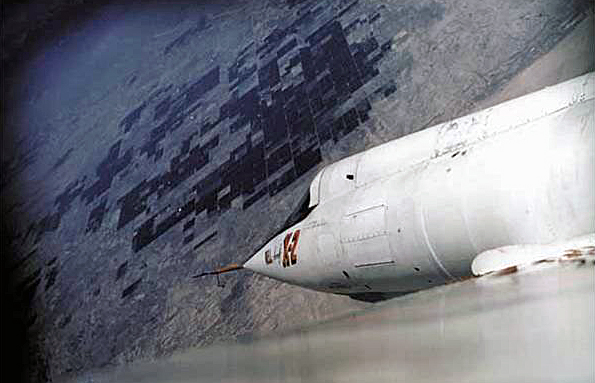
Fifty-nine years ago today, the rocket-powered USAF/Bell X-2 aircraft established a new altitude record when it soared to 126,200 feet above sea level. This historic accomplishment took place on the penultimate mission of the type’s 20-flight aeronautical research program. The day was Friday, 07 September 1956.
The X-2 was the successor to Bell’s X-1A rocket-powered aircraft which had recorded maximum speed and altitude marks of 1,650 mph (Mach 2.44) and 90,440 feet, respectively. The X-2 was designed to fly beyond Mach 3 and above 100,000 feet. The X-2’s primary mission was to investigate aircraft flight control and aerodynamic heating in the triple-sonic flight regime.
The X-2 had a gross take-off weight of 24,910 lbs and was powered by a Curtis-Wright XLR-25 rocket motor which generated 15,000-lbs of thrust. Aircraft empty weight was 12,375 lbs. Like the majority of X-aircraft, the X-2 was air-launched from a mothership. In the X-2’s case, an USAF EB-50D served as the drop aircraft. The X-2 was released from the launch aircraft at 225 mph and 30,000 feet.
The pilot for the X-2 maximum altitude mission was USAF Captain Iven Carl Kincheloe, Jr. Kicheloe was a Korean War veteran and highly accomplished test pilot. He wore a partial pressure suit for survival at extreme altitude.
While the dynamic pressure at the apex of his trajectory was only 19 psf, Kincheloe successfully piloted the X-2 with aerodynamic controls only. The X-2 was not configured with reaction controls. Mach number over the top of the trajectory was supersonic (approximately Mach 1.7).
Kicheloe’s maximum altitude flight in the X-2 (S/N 46-674) would remain the highest altitude achieved by a manned aircraft until August of 1960 when the fabled X-15 would fly just beyond 136,000 feet. However, for his achievement on this late summer day in 1956, the popular press would refer to Iven Kicheloe as the “First of the Space Men”.
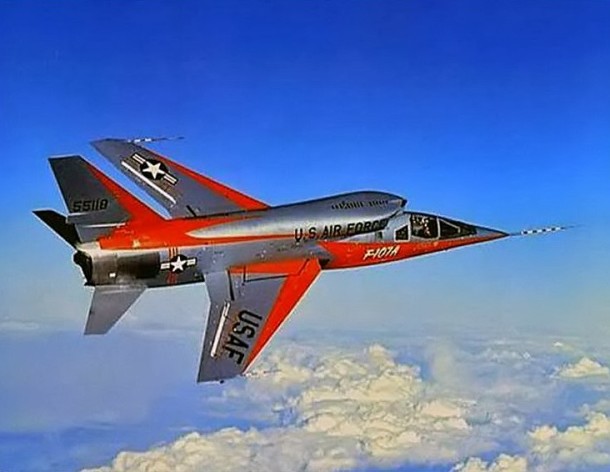
Fifty-nine years ago this month, the USAF/North American F-107A aircraft flew for the first time. The Mach 2-capable fighter-bomber went supersonic on the type’s maiden flight.
The F-107A was designed, developed and tested by North American Aviation (NAA) in the mid-1950’s. With it, the contractor hoped to satisfy Tactical Air Command’s (TAC) need for a front line fighter-bomber. However, Republic Aircraft also had a candidate for the same role; the F-105 Thunder Chief.
The competition between Republic and North American for the TAC fighter-bomber production contract has a story of its own. Suffice it to say here that the competitive effort was (1) extremely close and (2) tinged with political intrigue. In the end, Republic Aircraft reaped the spoils of victory.
Although the F-107A came out on the short end of the stick in the TAC fighter-bomber competition, such did not imply an inferiority in fulfilling the intended role. Indeed, like the Northtrop YF-23’s loss to the General Dynamics YF-22 in the ATF competition of the early 1990’s, North American’s failure to get the nod with the F-107A is still a subject of passionate debate.
The F-107A measured 60.8 feet in length and had a wing span of 36.6 feet. Gross take-off weight was around 41,000 pounds. The aircraft was powered by a single Pratt and Whitney YJ75-P-11 turbojet that produced 15,500 pounds of thrust in military power and 23,500 pounds of thrust in full afterburner.
F-107A longitudinal control was provided by an all-flying horizontal tail. Similarly, an all-flying vertical tail was employed for directional control. Lateral control was provided by a unique 3-segment spoiler-deflector system mounted on each wing. The aircraft was also configured with inboard flaps and leading edge slats for lift augmentation at low speeds.
A unique and prominent feature of the F-107A was its dorsal-mounted air induction system known as the Variable-Area Inlet Duct (VAID). Internally, this unit incorporated a system of adjustable ramps to efficiently decelerate and compress freestream prior to entering the engine compressor face. Ramp deflection scheduling with Mach number was controlled automatically. Ramp boundary layer bleed air was vented from the top of the VAID.
The F-107A carried weapons externally. In addition to wing pylon-mounted stores, the aircraft was designed to carry a single “special weapon” from a semi-submerged recess located on the aircraft ventral centerline. The term “special weapon” means that it was a tactical nuclear bomb. The Sandia-developed store could also be used in combination with a special saddle fuel tank to extend the aircraft’s combat range.
A total of three (3) F-107A aircraft were built and flown. USAF-assigned tail numbers include 55-5118, 55-5119 and 55-5120. On Monday, 10 September 1956, the No. 1 ship (55-5118) took-off from Edwards Air Force Base on its first flight. NAA Chief Test Pilot Robert Baker, Jr. was at the controls. The aircraft attained a maximum Mach number of 1.03 in a 43 minute flight test.
The F-107A could really scream. The type had a maximum climb rate of around 40,000 feet per minute in full afterburner. The maximum demonstrated Mach number attained by the F-107A was Mach 2.18. Program engineers estimated that by increasing the engine inlet area slightly, the F-107A was capable of reaching approximately Mach 2.4.
The trio of F-107A aircraft flew 272 flight tests totalling 176.5 hours. Included in this testing was successful separation of a special store prototype at Mach 2. Test pilots of note who flew the F-107A included XB-70A pilot Al White and X-15 pilots Scott Crossfield, Bob White, Jack McKay and Forrest Peterson.
Though it never became a production aircraft, the F-107A contributed in significant ways to aviation progress. Indeed, many future aircraft would greatly benefit from F-107A flight control and air induction technology including the A-5 Vigilante, XB-70A, A-12, SR-71, YF-12A and F-15.
The F-107A was the last of NAA’s fighter aircraft which includes such notables as the P-51 Mustang, the F-86 Sabre and the F-100 Super Sabre. While the F-107A has often been referred to in print as the Ultra Sabre, Ultimate Sabre, Super Super Sabre or such, it was never officially assigned a nickname. Alas, there was never an XF-107A or YF-107A designation either. North American Aviation’s TAC fighter-bomber candidate was simply known as the F-107A.
Today, the No. 1 F-107A (55-5118) is displayed at the Pima Air and Space Museum (PASM) in Tucson, Arizona. The No. 2 ship (55-5119) resides at the USAF Museum at Wright-Patterson Air Force Base in Dayton, Ohio. The No. 3 airplane (55-5120) no longer exists as it was relegated to the status of a fire fighting prop and ultimately destroyed in that role sometime in 1961 or 1962.
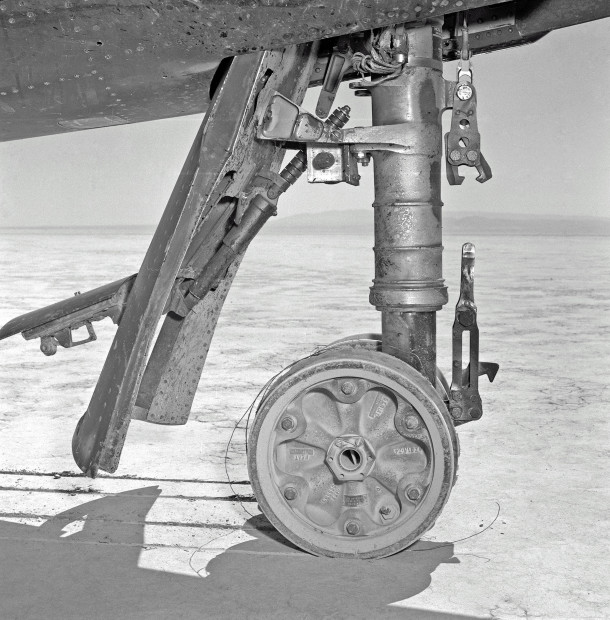
Fifty-one years ago this month, the North American X-15 hit a speed of 3,590 mph (Mach 5.23) in a flight that reached an altitude of 103,300 feet. While decelerating through Mach 4.2, the nose gear of the aircraft unexpectedly deployed in flight.
The 114th powered flight of the legendary X-15 Program took place on Friday, 14 August 1964. USAF Major Robert A. Rushworth was at the controls of X-15 Ship No. 2 (S/N 56-6671). The mission would be Rushworth’s 22nd flight in the famed hypersonic aircraft.
X-15 drop from the NB-52A (S/N 52-0003) launch aircraft took place over Delamar Dry Lake, Nevada. Seconds later, Rushworth called for 100% power from the X-15’s XLR-99 liquid-fueled rocket engine as he pulled into a steep climb. He subsequently pushed-over and then leveled-off at 103,300 feet.
XLR-99 burnout occurred 80.3 seconds after ignition. At this juncture, the X-15 was traveling at 3,590 mph; better than 5 times the speed of sound. Following rocket motor burnout, the aircraft slowed and began to lose altitude under the influence of weight and aerodynamic drag.
As the Mach meter needle passed through Mach 4.2, Rushworth heard a loud bang from the airframe. The aircraft became hard to control as it gyrated in pitch, yaw and roll. Rushworth was equal to the moment and brought his troubled steed under control. However, the aircraft had an uncommanded sideslip and Rushworth had to use left aileron to hold the wings level.
Gathering his wits, Rushworth realized that the loud bang he heard was very similar to that which occurred when the nose gear was deployed in the landing pattern. Unaccountably, the X-15 nose gear had deployed in supersonic flight. An unsettling confirmation of Rushworth’s hypothesis came when the pilot spotted smoke, quite a bit of it, in the X-15 cockpit.
As Rushworth neared Edwards Air Force Base, chase aircraft caught up with him and confirmed that the nose gear was indeed down and locked. Further, the tires were so scorched from aerodynamic heating that they probably would disintegrate during touchdown on Rogers Dry Lake. They verily did.
Despite his tireless nose gear, Rushworth was able to control the rollout of his aircraft fairly well on the playa silt. He brought the X-15 to a stop and deplaned. Man and machine had survived to fly another day.
Post-flight analysis revealed that expansion of the X-15 fuselage due to aerodynamic heating was greater than expected. The nose gear door bowed or deformed outward more than anticipated as well. Together, these two anomalies caused the gear uplock hook to bend and release the nose gear. Fixes were subsequently made to Ship No. 2 to prevent a recurrence of the nose gear door deployment anomaly.
Rushworth next flew X-15 Ship No. 2 on Tuesday, 29 September 1964. He reached a maximum speed of 3,542 mph (Mach 5.2) at 97,800 feet. The nose gear door remained locked. However, while decelerating through Mach 4.5, Rushworth heard a bang that was less intense than the previous flight. This time, thermal stresses caused the nose gear door air scoop to deploy in flight. While the aircraft handled poorly, Rushworth managed to get it and himself back on the ground in one piece.
Following another redesign effort, Rushworth took to the air in X-15 Ship No. 2 on Thursday, 17 February 1965. He hit 3,539 mph (Mach 5.27) at 95,100 feet. On this occasion, both the nose gear door and nose gear door scoop remained in place. Unfortunately, the right main landing skid deployed at Mach 4.3 and 85,000 feet.
Thermal stresses were once again the culprit. Despite degraded handling qualities with the landing skid deployed, the valiant Rushworth safely landed the X-15. Upon deplaning, he is reported to have kicked the aircraft in a show of disgust and frustration. Unprofessional maybe, but certainly understandable.
Yet another redesign effort followed in the aftermath of the unexpected main landing skid deployment. This was the third consecutive mission for X-15 Ship No. 2 and Rushworth to experience a thermally-induced landing gear or landing skid deployment anomaly. Happily, subsequent flights of the subject aircraft were free of such vexing issues.
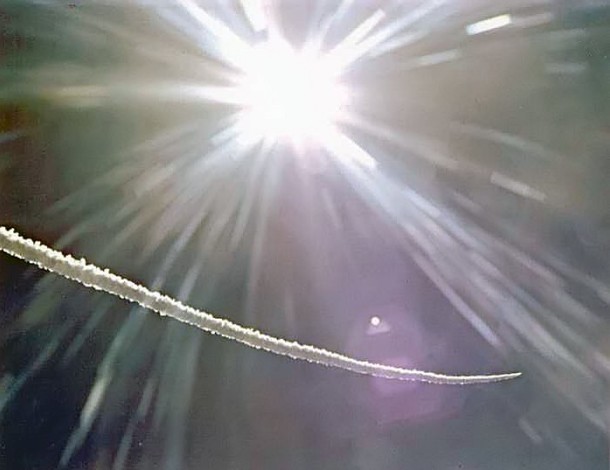
Fifty-two years ago this week, NASA chief research pilot Joseph A. Walker flew X-15 Ship No. 3 (S/N 56-6672) to an altitude of 354,200 feet. This flight would mark the highest altitude ever achieved by the famed hypersonic research vehicle. The date was Thursday, 22 August 1963.
Carried aloft by NASA’s NB-52A (S/N 52-0003) mothership, Walker’s X-15 was launched over Smith Ranch Dry Lake, Nevada at 17:05:42 UTC. Following drop at around 45,000 feet and Mach 0.82, Walker ignited the X-15’s small, but mighty XLR-99 rocket engine and pulled into a steep vertical climb.
The XLR-99 was run at 100 percent power for 85.8 seconds with burnout occurring around 176,000 feet on the way uphill. Maximum velocity achieved was 3,794 miles per hour which tranlates to Mach 5.58 at the burnout altitude. Following burnout, Walker’s X-15 gained an additional 178,200 feet in altitude as it coasted to apogee.
Joe Walker went over the top at 354,200 feet (67 miles). Although he didn’t have much time for sight-seeing, the Earth’s curvature was strikingly obvious to the pilot as he started downhill from his lofty perch. Walker subsequently endured a hefty 5-g’s of eyeballs-in normal acceleration during the backside dive pull-out. The aircraft was brought to a wings-level attitude at 70,000 feet. Shortly after, Walker greased the landing on Rogers Dry Lake at Edwards Air Force Base, California.
The X-15 maximum altitude flight lasted 11 minutes and 8 seconds from drop to nose wheel stop. In that time, Walker and X-15 Ship 3 covered 305 miles in ground range. The mission was Ship No. 3’s 22nd flight and the 91st of the X-15 Program.
For Joseph Albert Walker, the 22nd of August 1963 marked his 25th and last flight in an X-15 cockpit. The mission qualified him for Astronaut Wings since he had exceeded the 328,000 foot (100 km) FAI/NASA standard set for such a distinction. Ironically, the historic record indicates that Joe Walker never officially received Astronaut Wings for this flight in which the X-15 design altitude was exceeded by over 100,000 feet.